Leading Ladies

Meryl Streep shares her thoughts on Inez McCormack and Margaret Thatcher, two figures she has portrayed:

After the death this April of Inez’s nemesis, Mrs Thatcher, I was sunk in thought about what it all meant. I had portrayed both of these women and tried to understand them emotionally, from the inside out. What the sources of their passionately held (and diametrically opposed) convictions were; the strength both women applied in diligent pursuit of what they regarded as the right, and righteous, path; the way their admirers and adversaries both commented on their formidable stamina and seemingly limitless energy towards correcting what they perceived as the flaws of society: all of this interested me. We can, and should, look to these trailblazers for clues as to how to lead, and lead effectively.

Inez said always “Look around the table, and see who is not there”: her leadership style was inclusion. In order to change the world for the better, she felt that all people, including and especially those deemed least valuable, the most disenfranchised, must have their voices heard and credited.

I can’t say if Mrs Thatcher would have agreed. But no one ever accused her of running from an argument, or being afraid to hear and rebut conflicting views, to mix it up in the scrum. She lived for it.

Franzen vs The Internet: Round 37, Ctd

A reader writes (with several updates below):

As a medievalist, I should point out that, when Jonathan Franzen writes, “If I had been born in 1159, when the world was steadier,” he has no idea what he is talking about.

Being born in 1159 would have put Franzen in the center of the so-called Renaissance of the twelfth century. The cathedral schools had by then replaced the old-fashioned monastic schools, introducing a far more secular and rationalistic way of thinking than Europe had seen since the fall of the Roman Empire. Translations from Greek and Arabic texts were making scientific and philosophical texts accessible, which were in turn fostering the development of scholasticism and the rationalization of Christian theology. The University of Paris had just been founded, introducing an institutionalization of higher learning that we continue to live with today. With Gothic cathedrals replacing Romanesque cathedrals; polyphonic music replacing monophonic music; romances replacing epic literature; and guilds, fairs, and new trade routes transforming economic life, virtually every aspect of culture was different than it had been a generation, let alone two or three generations, earlier.

We are the first people to feel that “Any connection to the key values of the past has been lost”? What about all of the twelfth-century intellectuals who referred to themselves as “moderni,” in contrast to the “antiqui” who came before them? Franzen may be right to claim that, “As long as modernity lasts, all days will feel to someone like the last days of humanity,” but he would do well to recognize that the “moderni” of the twelfth century – who knew the Book of Revelations really well – would have shared this view.

I’m not sure whether Franzen is ignorant of medieval history or just using the Middle Ages as a heuristic device – an allegedly dull, monolithic, unchanging time period against which to contrast our allegedly fascinating, diverse, and dynamic era. But how would it change his argument if he recognized that culture has always been in a process of change and that it has gone through many periods of very rapid and disorienting change?

Update from a reader:

I’d like to point out to the condescending mediaevalist “has no idea what he’s talking about.” Franzen’s a Scandinavian name. Being born in today’s Sweden in 1159 means there’s a very decent chance Franzen wouldn’t even have been Christian, let alone affected by cathedral vs. monastic schooling or the rationalization of Christian theology. And of course, if he were born in the Slavic half of Europe, it would definitely have meant being part of what was effectively a “dull, monolithic, unchanging time period.” I know it’s hard for many to admit, but Europe does in fact mean more than England, France, Italy, and Germany.

Another keeps the academic debate going:

Having just finished my early Russian history class for the morning, I can assure your reader that 1159 was no more “dull, monolithic, and unchanging” for eastern Slavs than it was for other Europeans. The central town Kiev was losing economic and political power and in fact would be sacked – by a Russian prince – in ten years. New Russian powers were rising to the west in Volhynia and north in forested Vladimir. To the east Turkic, mostly pagan nomads were both raiding villages and marrying into the local elites, creating a highly mixed population of people who were both Slavic and Christian yet closely related to Turks. The monks who wrote the chronicles hated all of this.

And another:

It may be that the person writing in about medieval Scandinavia is just trying to make a point about the vibrant, diverse communities in medieval Europe and that a single narrative doesn’t fit every nationality. If so, I agree with the spirit of it. However, this correction seems to be misapplied to what Franzen is saying and also is just not very historically informed. Franzen’s own presentation of the medieval as something static and unchanging clearly assumes a single experience of medieval life. But the comment is also blissfully unaware of the actual history of the region in question. By 1159 Iceland, Denmark, and Norway had been pretty thoroughly Christianized for well over a century, and Sweden did the same during the 12th century. There were certainly pagans around in Scandinavia at the time, but the upper classes would all have been thoroughly Christian for political, if not religious reasons. Scandinavia of the twelfth century was also rocked by a large number of civil wars, and a significant number of monasteries and convents were founded in the period. It was a time of change, and just because the changes occurring were not the same as those in France and other places doesn’t mean that it fits Franzen’s narrative. Even if Franzen were imagining himself in medieval Scandinavia, which hardly seems a certain proposition, he would not find it the refuge of stability he imagines.

By the way, I love this discussion, and I would love to see medievalists with knowledge of other places write in. You’d be hard-pressed to find a time and place in medieval Europe that is as stable as modern people imagine it to be.

Rain Painting

Artist Nathan Sharratt uses a water-repellant spray to create work that’s only visible in the rain:

Jennie Xie hopes this marks a new trend:

Looking ahead, Sharratt has plans to make a huge rain drawing on the side of a 14-story marble building, as well as smaller works on road intersections in Atlanta. And he’s not the only one playing with this new material. … Will these new stealthy works of art begin invading our streets? We’ll just have to wait for the rainy days to find out.

Heavy Issues In Children’s Books

Linda Holmes defends the “ugliness” of Rainbow Rowell’s young adult novel Eleanor & Park:

Kids in school read books about sad and difficult things all the time. They read Animal Farm and Lord Of The Flies. Heaven knows they’ve read about some very painful deaths if they read the Harry Potter or Hunger Games books. Sometimes they even read about the complicated and sexy lives of adults — I believe I was 11 when I read Rebecca and 12 when I read Gone With The Wind. They will not miss the difference, in Eleanor & Park, between the behavior of the people they relate to and the bullies who make those people miserable. Hearing bullies swear will not make them want to swear. Hearing bullies torment Eleanor by talking about her breasts won’t make them think that’s what they should do. They will not want to emulate Eleanor’s bullies any more than they want to emulate the worst tendencies they see in Lord Of The Flies.

Ugliness — honesty about ugliness — is important, because it gives shape and meaning to some important stories about not allowing it to swamp you. For kids who already experience difficult things and painful things, it seems like straightforwardly acknowledging that these things exist and hurt, sometimes a lot, is not going to tell them anything they don’t know.

Previous Dish on YA fiction here and here.

The Best Of The Dish Today

But first, Trita Parsi updates us on the state of the Green Movement:

Today was UN Day – and the tantalizing possibility of a thaw with Iran. Iraq hawk Kenneth Pollack came out against military intervention; I argued for Obama to think big; Parsi feared the consequences of failure; I parsed Rouhani’s speech, while giving AIPAC my now-sadly-familiar kick.

Hillary fatigue was setting in already; this 3-D flat screen sculpture was almost as cool as this dog was hilarious. And Edie Windsor loved fucking.

The most popular post was “Meep Meep Watch“. The runner-up was “What Austerity Has Wrought.”

See you in the morning.

Face Of The Day

UN-GENERAL ASSEMBLY-US-OBAMA

US President Barack Obama makes a toast during a luncheon hosted by UN Secretary General Ban Ki-Moon on the sideline of the 68th United Nations General Assembly at the UN in New York on September 24, 2013. Obama demanded that the world take action on Syria, saying that the regime must face consequences after the use of chemical weapons. Speaking before the UN General Assembly, Obama defended his threat of force against Syrian President Bashar al-Assad’s regime and denounced critics who accuse the United States of inconsistency. By Jewel Samad/AFP/Getty Images.

A Country Ruled By Complexity

Steven M. Teles coins a new term for the incoherence of American government:

Understanding, describing, and addressing this problem of complexity and incoherence is the next great American political challenge. But you cannot come to terms with such a problem until you can properly name it. While we can name the major questions that divide our politics — liberalism or conservatism, big government or small — we have no name for the dispute between complexity and simplicity in government, which cuts across those more familiar ideological divisions. For lack of a better alternative, the problem of complexity might best be termed the challenge of “kludgeocracy.”

A “kludge” is defined by the Oxford English Dictionary as “an ill-assorted collection of parts assembled to fulfill a particular purpose…a clumsy but temporarily effective solution to a particular fault or problem.” The term comes out of the world of computer programming, where a kludge is an inelegant patch put in place to solve an unexpected problem and designed to be backward-compatible with the rest of an existing system. When you add up enough kludges, you get a very complicated program that has no clear organizing principle, is exceedingly difficult to understand, and is subject to crashes. Any user of Microsoft Windows will immediately grasp the concept.

A Moment In The Neon

http://youtu.be/XIZej7SMlPM

In a review of John Florio and Ouisie Shapiro’s One Punch from the Promised Land, Paul Beston captures the energy of Leon Spinks:

In just his eighth pro fight [on February 15, 1978, “Neon” Leon] was matched with an out-of-shape, unmotivated [Muhammad] Ali, who by then barely did any fighting in the ring at all. He lay against the ropes, absorbing arm, shoulder, and kidney punches, looking to steal rounds, wear out opponents, and charm judges and fans with his clowning. The act had grown wearisome. Leon pounded Ali with abandon and held off a late-round charge to win the decision. The Greatest had been beaten by a novice pro. Moreover, he had been displaced as champion by a man as different from him as could be imagined.

Florio and Shapiro are insightful in describing how Spinks represented a new kind of heavyweight champion. Most of Leon’s predecessors came from poor or modest backgrounds, but none from such a deep-seated ghetto culture. He was “a kid from the projects who had little guidance, an eye for the ladies, and a sweet tooth for cocaine,” Florio and Shapiro write. “He had only two speeds—turbo and sleep.” Leon’s constant run-ins with the law for minor traffic infractions or drug possession—he was once busted for a quantity of cocaine valued at $1.50—made him a figure of ridicule within weeks of beating Ali. …

The authors describe how, shortly before it was time for him to enter the ring in New Orleans for his rematch with Ali, Leon disappeared, and neither his camp nor his bodyguard—Mr. T., the future Clubber Lang—could find him. He was finally located in a hotel room, drunk. Somehow Leon managed to fight on relatively even terms with Ali for five rounds before Ali took command. It wasn’t much of a fight. Ali danced for the first time in years, but he landed mostly one- and two-punch combinations while holding Leon ceaselessly over 15 rounds and winning a lopsided decision. Leon went back out partying and kept the party going for years, though his career quickly became a sideshow.

The rematch with Ali:

Listening To Rouhani

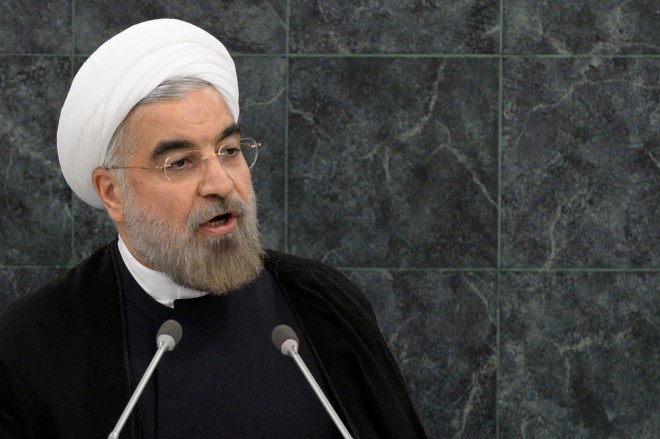
68th Session Of The United Nations General Assembly Begins

There are several points (pdf) at which I spluttered. To wit:

The human tragedy in Syria represents a painful example of catastrophic spread of violence and extremism in our region. From the very outset of the crisis and when some regional and international actors helped to militarize the situation through infusion of arms and intelligence into the country and active support of extremist groups, we emphasized that there was no military solution to the Syrian crisis.

One of those regional actors was clearly Iran, protecting its Shiite ally, the murderous Bashir al-Assad. Was Rouhani criticizing some factions in his own country – or bullshitting? I’d say bullshitting. On Syria, he said:

I should underline that illegitimate and ineffective threat to use or the actual use of force will only lead to further exacerbation of violence and crisis in the region.

But of course it was only the threat of US force that prompted the world to get serious about Assad’s chemical weapons.

There were other weirdnesses – “Shia-phobia”? But nonetheless, it seems to me, Rouhani’s critique of the US as a hegemonic power is onto something – not because it is the worst such hegemon in world history. Au contraire. But all hegemonies lead to abuse, and in the case of the US since the end of the Cold War, American unipolar hegemony has led us close to a self-defeat and bankruptcy. Increasingly isolated, engaged in pre-emptive war, America’s wars of invasion and occupation have been morally corrosive failures – and incredibly costly ones at that. The neoconservative vision simply foundered in a world that simply resents the nosy bully – as you could see in the Brazilian president’s speech earlier today. That doesn’t help the US. It doesn’t help our interests. You don’t have to adopt Rouhani’s worldview to see that. We have to live in a more multi-polar world.

And in foreign relations, Rouhani has a point about Iran’s relative moderation. Yes, it exports terror via Hezbollah and Hamas. But it has not launched wars; it has cooperated even with the Bush administration with respect to the Taliban. Gone are the despicable Holocaust denials of Ahmadinejad. And he’s right about double standards. The US is exerting force to insist on Syria’s destruction of its chemical weapons arsenal, even as we send military aid to Israel, which has not ratified the Chemical Weapons Convention. We have threatened force to prevent Iran getting a nuclear bomb, but we give military aid to Israel, which currently has a break-out capacity of up to 300 nuclear warheads. Is it not reasonable for humankind to look at this double standard and say collectively: WTF?

And is he not within his rights to complain about Israel’s assassinations of scientists?

For what crimes have they been assassinated? The United Nations and the Security Council should answer the question: have the perpetrators been condemned?

The key point of the speech, though, was roughly Ken Pollack’s point. Iran is an advanced society, despite crippling sanctions, and has every right to pursue nuclear power. There is no way to stop this. Indeed, telling a country it cannot develop its scientific and energy expertise this way is abhorrent. The question is whether this is about nuclear weapons. And Rouhani says no – emphatically:

Iran’s nuclear program – and for that matter, that of all other countries – must pursue exclusively peaceful purposes. I declare here, openly and unambiguously, that, notwithstanding the positions of others, this has been, and will always be, the objective of the Islamic Republic of Iran. Nuclear weapon and other weapons of mass destruction have no place in Iran’s security and defense doctrine, and contradict our fundamental religious and ethical convictions. Our national interests make it imperative that we remove any and all reasonable concerns about Iran’s peaceful nuclear program.
_
The second objective, that is, acceptance of and respect for the implementation of the right to enrichment inside Iran and enjoyment of other related nuclear rights, provides the only path towards achieving the first objective. Nuclear knowledge in Iran has been domesticated now and the nuclear technology, inclusive of enrichment, has already reached industrial scale. It is, therefore, an illusion, and extremely unrealistic, to presume that the peaceful nature of the nuclear program of Iran could be ensured through impeding the program via illegitimate pressures.

It’s interesting he puts the end of any ambiguity about Iran’s nuclear program as a matter of national interest. Presumably he doesn’t just mean his rather corny call to join a “WAVE” against violence and extremism. He means the sanctions. And surely there must be an overlap of interests here. Iran is not denying its nuclear capacity, like Syria did or Saddam once did; it’s broadcasting it. And it is simultaneously insisting it is not for military purposes.

That latter point can surely be tested, verified, examined. And given the awful consequences of military conflict over this, we have a moral obligation to try.

(Photo: Iranian President Hassan Rouhani addresses the U.N. General Assembly on September 24, 2013 in New York City. By Brendan McDermid-Pool/Getty Images.)