What A Deal With Iran Would Look Like

68th Session Of The United Nations General Assembly Begins

Kenneth Pollack outlines it in a must-read. How far the US should be willing to go:

Rouhani may ultimately need more than the removal of the multilateral sanctions. He may need the U.S. to pledge, as we did to Cuba after the 1962 Missile Crisis, that we will not invade or otherwise try to overthrow the Iranian regime. He may need a commitment from the international community to help Iran develop its nuclear energy sector, which can be done by providing lightwater reactors that would not significantly bolster Iran’s ability to build nuclear weapons. He may also need economic support from international financial institutions like the World Bank and the IMF. He might even want to try to bring Iran into the World Trade Organization, although that seems unlikely given Khamenei’s insistence that the WTO is a subversive organization whose requirements would undermine the Islamic regime. The United States and our allies ought to be ready and willing to agree to any or all.

Amen. But the resistance from the Greater Israel lobby will be intense, as will opposition from Christianists and the 20th Century faction in the GOP, like McCain and Butters. Hence the president’s remark in his UN speech right now about how “the roadblocks may prove to be too great.” But Obama needs to drop some of his caution and defensiveness on this – and embrace the “Yes We Can” of his 2008 campaign. Those of us who supported him back then in the wake of neoconservative catastrophe dreamed of a moment like this one. He must not let it pass.

How Juan Cole understands Iran’s nuclear program:

Ali Akbar Salehi, the head of the Atomic Energy Organization of Iran, has confirmed that Iran has turned 40% of its stock of high-grade LEU into fuel rods for the medical reactor. Once made into fuel rods, the material cannot be weaponized. So Iran only has 140 kilograms left of the 19.75% enriched uranium left. That isn’t enough for a bomb even if Iran knew how to make one and had the facilities to do so, which it doesn’t. Salehi says that Tehran intends to turn the rest of the stock into fuel rods, as well. Iran has in fact been feeding these fuel rods into the medical reactor and not stockpiling the high grade LEU, which is how you would expect them to act if they were in fact only interested in fuel, not bombs. Long time readers know that I have held since the middle of the last decade that Iran does not want an actual bomb, but rather only wants a breakout capacity like that of Japan– the ability to construct a bomb in short order if they faced an imminent existential threat. Such a breakout capacity would be almost impossible to forestall, since it mainly depends on know-how, which is widespread. But if Iran and give solid evidence that it has no active weapons program, that might be enough for a deal.

(Photo: U.S. President Barack Obama addresses the U.N. General Assembly on September 24, 2013 in New York City. By John Moore/Getty.)

Quote For The Day

“Personal data of citizens was intercepted indiscriminately. Corporate information – often of high economic and even strategic value – was at the center of espionage activity. Also, Brazilian diplomatic missions, among them the permanent mission to the UN and the office of the president of the republic itself, had their communications intercepted… Tampering in such a manner in the affairs of other countries is a breach of international law and is an affront of the principles that must guide the relations among them, especially among friendly nations. A sovereign nation can never establish itself to the detriment of another sovereign nation. The right to safety of citizens of one country can never be guaranteed by violating fundamental human rights of citizens of another country,” – Brazilian president, Dilma Rousseff, unloading on the US government’s NSA program, just before president Obama’s speech to the UN today.

The Un-Thatcher, Ctd

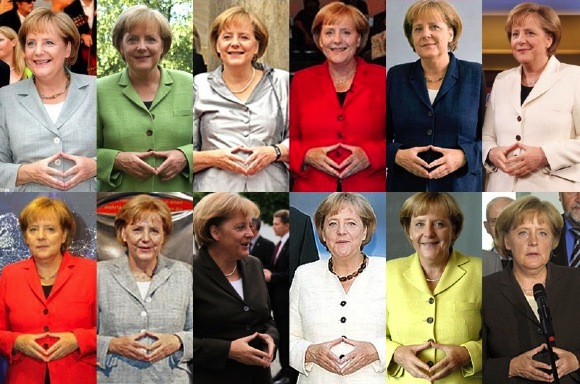
angela-merkel-shapes (1)

Anne Applebaum delivers some backhanded praise for the reelected Merkel:

Her very dullness, her middle-aged frumpiness, and her lack of emotion must actually represent something that Germans want: leadership without drama. It’s not just that she’s a “safe pair of hands”: Merkel provokes no jealousy, no anxiety, and no fear, either in Germany or in Germany’s immediate neighborhood.

Nobody writes about Merkel as the leader of the “Fourth Reich,” after all, and nobody compares her to Hitler or Bismarck. The eastern neighbors treat Germany as a benign partner. The southern neighbors are resentful but can’t really complain. Everyone else imports German products and feels relieved that at least one large European country still has decent economic growth and good prospects for the immediate future. Merkel makes it possible for Germany to be the dominant power in Europe without anybody really noticing, in other words. That suits her countrymen. And for the moment, it seems to suit other Europeans as well.

Maybe not the Greeks:

Greece is stuck in its sixth year of recession, but this has not stopped Prime Minister Antonis Samaras from declaring this month that “Greece is turning the page,” when the national statistics agency reported that the Greek economy shrank by “only” 3.8 percent in the second quarter, less than the expected 4.6 percent.

By the term “Un-Thatcher”, I meant the lack of polarizing drama – not a relentless pursuit of fiscal retrenchment. After all, what Merkel has done to Europe in the last few years is largely what Thatcher did to her own country in the early 1980s. But Thatcher was able to use the British parliamentary system to dominate politics in a way that Germany’s coalition-style polity cannot. Catherine Mayer wonders if Merkel will be able to form a stable government on her current course:

Merkel’s options for coalition partners are limited.

The Free Democrats, who served with her during her last term, crashed spectacularly at the election, failing even to achieve the 5% of votes necessary to enter parliament. Merkel governed in her first term in a grand coalition with her largest rivals, the Social Democrats (SPD). They too suffered at the ballot box after their association with Merkel and fear that a return to coalition with her will damage their party in the long term. They may be right. Proximity to Merkel has proved politically fatal to rivals within her own party, including her mentor, former Chancellor Helmut Kohl, whom she was key to ousting when scandal damaged the CDU’s ratings. Her popularity is also such that her supporter base—which extends far beyond the ranks of traditional CDU voters—tends to attribute every success to her and blame every failing on the government of the day.

(Image thanks to the Internet)

What Does White Smell Like?

Anthropologist David Howes explores cultural synesthesia:

In China, the color white is often identified with a harsh, foul odor. In the West, white is usually identified with soft, sweet smells. Such cultural associations can change over time. Mint was perceived as heating and drying in Western cultures prior to the modern era; now it’s more likely to be perceived as cooling and refreshing. And some associations may be universal. To take a well-documented example, most people would say that the word “maluma” sounds like a curvy shape, while “takete” sounds like a sharp-edged one.

Sci-Fi As An Early Warning System

MIT’s Dan Novy thinks speculative fiction can help tech innovators make better products:

Frederick Pohl once said that it wasn’t the job of science fiction authors to create the automobile 330-1but to describe the traffic jam. It follows that it is our job as technologists not to avoid creating the automobile, but to look at the traffic jam and design so that doesn’t happen. Thinking about these things at the beginning and iteratively throughout the process allows us to create better technology. Just as storytelling gives you more lives to live, speculative design or science fiction prototyping gives you more iterations to consider before your creation goes out into the wild and becomes hard to control. Once a genie is out of the bottle, it isn’t inclined to allow itself to be stuffed back in.

Previous Dish on the growing field of space law here.

Francis And Liberation Theology

Ezra Fieser finds that the current Pope, who was ordained as a priest “in 1969, during the height of the Latin American-born church movement,” has had a complex relationship with the school of thought:

While liberation theology influenced generations of Catholic clergy, especially Jesuit priests, Pope Francis never adopted the most left-leaning strands of the movement, according to Argentine Jesuit priest Juan Carlos Scannone, one of Pope Francis’s teachers. In [the] recently published book, Pope Francis: Our Brother, Our Friend, Mr. Scannone wrote, “social Marxists analysis is not used” in Argentine liberation theology. Father [Father José María Cantó, who holds Francis’ former position as rector of the Faculty of Philosophy and Theology at Colegio Máximo in Buenos Aires], says Pope Francis was more influenced by a current within liberation theology based on popular concerns, culture, and historical context. “It is more in line with what the Southern Cone of South America preferred,” he says.

However, Pope Francis has shown an openness to liberation theology, despite years of criticism from the Vatican toward the movement. Earlier this month, he held an audience with [founder of liberation theology Gustavo] Gutiérrez himself, who [historian of religion Jennifer] Hughes calls “one of the most important theological figures of the 20th century.” It remains unclear as to how much the pope is willing to open the Vatican to reconciliation with liberation theologians.

A Flat-Screen Sculpture

How artist Benjamin Muzzin describes his work:

With this project I wanted to explore the notion of the third dimension, with the desire to try to get out of the usual frame of a flat screen. For this, my work mainly consisted in exploring and experimenting a different device for displaying images, trying to give animations volume in space. The resulting machine works with the rotation of two screens placed back to back, creating a three-dimensional animated sequence that can be seen at 360 degrees. Due to the persistence of vision, the shapes that appear on the screen turn into kinetic light sculptures.

(Hat tip: The Verge)

What Is The Function Of Fiction?

Literary critic Charles Baxter dismisses any attempt to answer the question definitively:

I’d never want to say that there’s only one purpose to literature. I’m not even sure that literature has a purpose, other than to give pleasure and, possibly, enlightenment. Ours is a pragmatic culture, and we’re always trying to justify something by saying what its purpose is. But sometimes art has no clear purpose, apart from the pleasure it gives. What’s the purpose of Debussy’s Preludes? And do novels really make us care deeply about others? If they did, English departments would be full of generous, humane, and sweet-tempered people. Joseph Goebbels wrote a novel, and Hitler loved Wagner’s operas. Art does not always make us better people. We have to remember that.