The People Behind The Pen

Meet Madeleine Morel, a literary agent who specializes in ghostwriters:

[W]hat I have now is a talent agency. I have hundreds of different writers to whom I have access, but I would say that at any given time I have 100 to 150 writers who I’m in touch with on a semi-regular basis. So when anybody’s looking for a writer, I always give them four to six different writers to choose from, all of whom have been published multiple times by the major houses and many of whom have put books on the bestseller list. They all specialize in particular areas: sport, politics, popular culture, health and fitness and diet. Whatever you see on the bestseller list is what I do.

How she describes a “typical” ghostwriter:

[Ghostwriters] fall into three rubrics: former magazine writers; former book editors who couldn’t stand the corporate life any longer, or who were laid off; and what we used to call in the old days mid-list writers—that is, writers who wrote perfectly nice books and got advances of $5,000 to $15,000. But those books can’t be sold any longer, because they don’t have a platform. So they started writing for other people.

Mapping A Montage

Dan McQuade investigates his favorite training montage from the Rocky films – the run through Philadelphia in the second movie:

What’s always amused me about this scene is how absolutely little sense Rocky’s route makes: South Philly becomes North Philly becomes the Italian Market becomes North Philly again, and so on. Obviously, the montage isn’t mean to be taken seriously as an actual workout; it’s just a few scenes strung together so “Gonna Fly Now” can play and Rocky can finish at the top of the Art Museum steps.

But, I wondered, what if this roadwork were treated as one actual run? How far would Rocky go? Well, I decided to find out.

After breaking down the scene neighborhood by neighborhood, he calculates an answer:

Over thirty and a half miles. Rocky almost did a 50K. No wonder he won the rematch against Apollo!

The Diction That Defines A Writer

Brad Leithauser ruminates on writers’ favorite words:

I sometimes wonder what could be responsibly deduced about a poet whose work you’d never actually read—if you were supplied only with a bare-bones concordance providing tables of vocabulary frequency. A fair amount, probably. You might reasonably postulate that Housman was homosexual upon learning that “lad,” “lads,” and “man” together surface roughly two hundred times in his poetry, as opposed to something like twenty appearances of “woman,” “women,” “girl,” and “girls.” Or you might—a deeper challenge—presuppose the existence of an essential temperamental and creative schism between two giants upon learning that “tranquil” and its variants (“tranquility,” “tranquilizing,” etc.) materialize more than fifty times in Wordsworth’s poetry and about a dozen in Byron’s. Doesn’t this statistic present, in stark relief, the posed polarities of the poet as contemplative and the poet as a man of action?

At the end of the day, when darkness falls, a concordance turns out to be a sort of sky chart to the assembling night. It shows how the poet’s mind constellates. Even if we’d never read Milton, we might surmise something of his vast, magisterial temperament on being told that “law” emerges some fifty times in his complete poems. We might surmise something further on discovering that “Hell” surfaces nearly as often as “love.”

Chart Of The Day

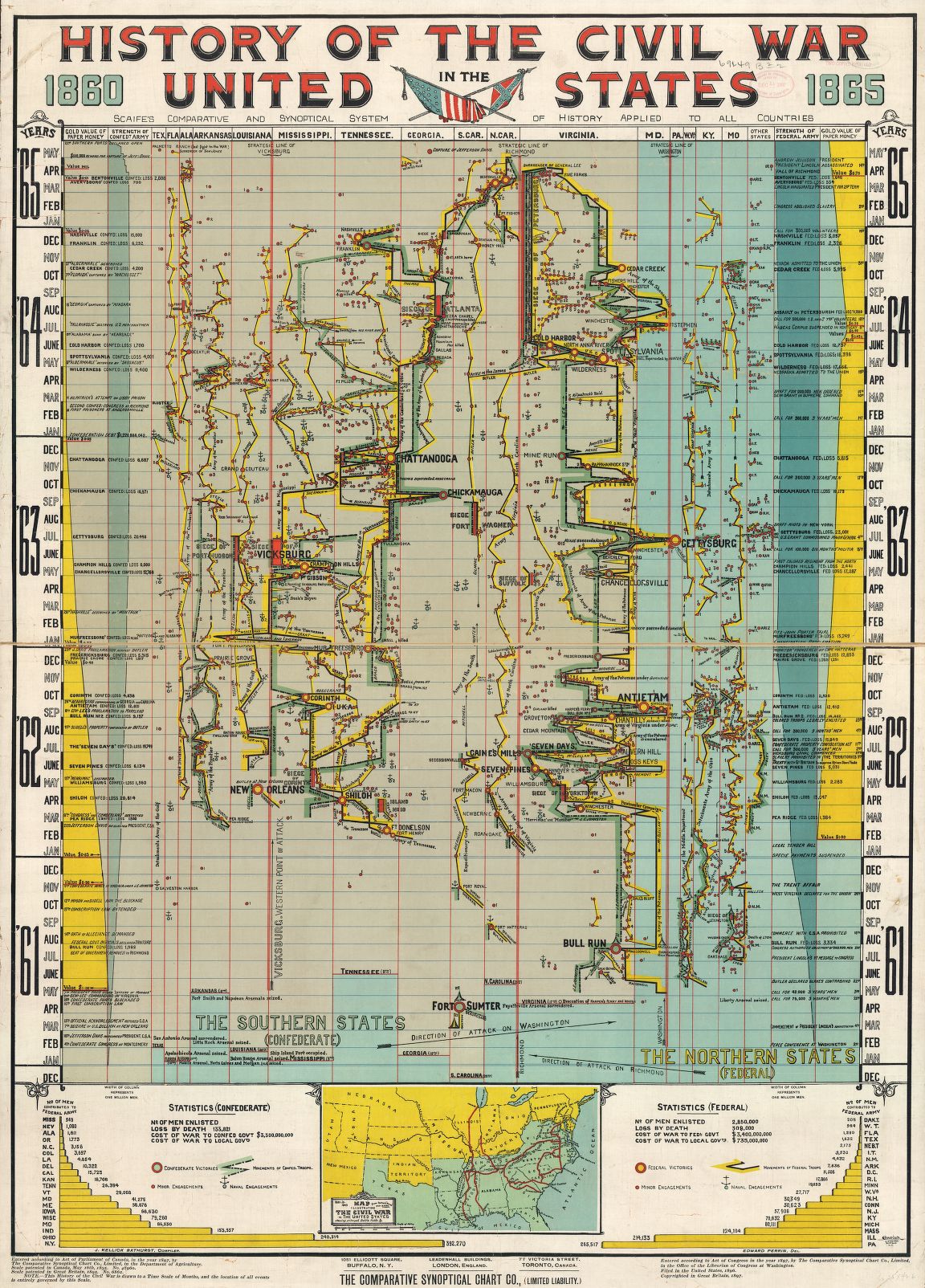
civilwarchart

Rebecca Onion passes along the above chart, which “depicts major battles, troop losses, skirmishes, and other events in the American Civil War.” She focuses on a few parts:

A war is a complicated thing, and the chart has tried to track so many factors—geographical, political, and financial—that it’s easiest to concentrate on one or two of these at a time.

I noticed, for example, that the far left-hand column charts the decline in value of Confederate dollars, from one U.S. dollar in May 1861 to “nil” in April 1865, while the far right-hand column shows the decline in value of Union currency in relationship to gold, from $1 in February 1862 to $0.75 in April 1865. Perhaps the best way to approach such a chart is  to give up on complete “synoptical” understanding, and delight in those details.

A zoomable version of the graphic is here.

Mankind’s Triumph Over Instinct

Christopher Booker criticizes Edward O. Wilson’s The Social Conquest of Earth for failing to acknowledge it:

What marks out humankind as unique is the degree to which we have broken free from the dictates of instinct. We may in terms of our individual ‘ego-instincts’, such as our urges to eat, sleep, live in social groups and reproduce our species, be just as much governed by instinct as other creatures. But in all the ways in which we give expression to those urges, how we build our shelters, obtain our food, organise our societies, we are no longer guided entirely by instinct. Unlike any other species, we have become free to imagine how all these things can be done differently. Whereas one ant colony is structured exactly like another, the forms of human organisation may vary as widely as a North Korean dictatorship and a village cricket club.

It is our ability to escape from the rigid frame of instinct which explains almost everything that distinguishes human beings from any other form of life. But one looks in vain to Wilson to recognise this, let alone to explain how it could have come about in terms of Darwinian evolutionary theory. No attribute of Darwinians is more marked than their inability to grasp just how much their theory cannot account for, from all those evolutionary leaps which require a host of interdependent things to develop more or less simultaneously to be workable, that peculiarity of human consciousness which has allowed us to step outside the instinctive frame and to ‘conquer the Earth’ far more comprehensively than ants.

Getting Parents To Change Their Tune

Mark Oppenheimer laments the persistence of parents forcing their children to learn a musical instrument, finding it to be the remnant of an earlier age:

Before the twentieth century, there was a good reason for anyone to study music: If you couldn’t make the music yourself, then you would rarely hear it. Before the radio and the phonograph, any music in the house was produced by the family itself. So it made sense to play fiddle, piano, jug, whatever. And before urbanization and the automobile, most people did not have easy, regular access to concerts. Of course, small-town people could come together for occasional concerts, to play together or to hear local troupes or traveling bands. Growing up in the sticks, you still might see Shakespeare performed, and a touring opera company could bring you Mozart. But very infrequently. If music was to be a part of your daily life, it had to be homemade.

How he thinks we should approach the issue today:

We can probably all agree that it’s worthwhile for children (as well as their parents) to try new activities, and that there is virtue in mastering difficult disciplines. So what challenges should we be tackling, if not ballet and classical music? How about auto repair? At least one Oppenheimer should be able to change the oil, and it isn’t me. It may as well be one of my daughters. Sewing would be good. And if it has to be an instrument, I’d say bass or guitar. The adults I know who can play guitar can actually be seen playing their guitars. And as any rock guitarist will tell you, there is a shortage of bassists.

But I do not believe that all artistic pursuits, or all disciplines that one studies, should be judged for their usefulness. The sublimity of art is tied, after all, to its uselessness (cf. Dazed and Confused). More than anything, I want children to find pursuits, whether useful or not, that they can take with them into adulthood.

Paul Berman is unpersuaded:

Those childhood violin studies of mine have shaped my adult ear and brain, and, when I listen to Mendelssohn or to any of the greats, I naturally respond in ways that are encouraged by the grand tradition. I do not know what it is to be a person without access to that tradition, and I can only picture a lack of access as a kind of poverty.

Oppenheimer replies:

Many music teachers, and parents, believe that there is something special, better, about the classical and art-music tradition. Several wrote to tell me how offended they were by the comparison of violin to ukulele: The former is so much more difficult, and its repertoire, so much richer. They may be right, but they have touched on a debate worth having, one we do not have enough. Given how relatively easy it is to get a little bit competent on, say, guitar, enough to lead a camp sing-along, why do we start so many children on harder instruments, and ones bound to seem less relevant to their lives? I was trying to make the case for pointless pastimes, things we do just for the fun of it, whatever instrument or hobby pleases us—and Berman replies with reasons we might favor the classical instruments. That’s great. It’s all great, so long as it’s not parents buying music lessons as part of some upper-middle-class acculturation plan.
“I Am A Sinner”

DSC_0780

A photographer we have featured in the past writes:

I have spent the last three years photographing addicts in the South Bronx. Before that I worked on Wall Street. The first addict I met in Hunts Point was Takeesha. She was standing near the long and high wall of the Corpus Christi Monastery. We talked for close to an hour before I took her picture. When we finished I asked her how she wanted to be described.

She said without any pause, “As who I am. A prostitute, a mother of six, and a child of God.” After spending close to twenty years on Wall Street it was jarring to hear someone so self-aware.

Talking in front of the monastery evoked memories. I grew up Catholic and for much of my early life nuns taught me. In my teens I walked away from the church and into science. Until my work in Hunts Point I thought little about the church or the bible or God. If I did, it was with a degree of cynicism. I heard little of what the nuns taught me coming from church leaders.

In the last three years, I have been reminded daily of what the nuns taught me: That we are all sinners who fall short. Most addicts understand that viscerally. Many successful people don’t, their sense of entitlement having numbed their compassion.

Yesterday, I read the interview with Pope Francis. It got headlines for his discussion about homosexuality, abortion, and contraception. I was more struck by his answer to the first question, “Who is Pope Francis?” “I am a sinner.”

Takeesha, me – every human is fallible. In that we are all the same, and as such, we should pause before judging another.

I immediately think of Mary Magdalen, a Takeesha of her time, who was there at the very end as Jesus writhed in agony on the cross. And of this passage from Luke:

Then he turned toward the [prostitute] and said to Simon, “Do you see this woman? I came into your house. You did not give me any water for my feet, but she wet my feet with her tears and wiped them with her hair. You did not give me a kiss, but this woman, from the time I entered, has not stopped kissing my feet. You did not put oil on my head, but she has poured perfume on my feet. Therefore, I tell you, her many sins have been forgiven — as her great love has shown.

But whoever has been forgiven little loves little.”

Face Of The Day

Theyyam Dancer Performs At Onam Festival Celebrations

A Theyyam dancer getting ready for Onam Celebrations at Kerala Bhawan in New Delhi, India. Theyyam or Theyyattam is popular folk dance performed in North Malabar region of Kerala. People of these districts consider Theyyam itself a God and they seek blessings from this Theyyam. By Raj K Raj/Hindustan Times via Getty Images.

Taking Liberties With Language

Ralph Keyes explores the American talent for neologisms – itself a word first used by Thomas Jefferson:

What literate person hasn’t dreamed of staking a claim to verbal posterity by coining a word? Some, such as Gelett Burgess, become virtual mints of coined words. Though little remembered today, the early-20th-century San Francisco humorist and folk lexicographer was a prolific generator of neologisms. In a 1906 article, Burgess repurposed the chemical term bromide to refer to clichés. The cover of his 1907 book  Are You a Bromide ?  featured an effusive woman named Miss Belinda Blurb, whose surname Burgess suggested we use for book endorsements, ones “abounding in agile adjectives and adverbs, attesting that this book is the ‘sensation of the year.’ ” Blurb caught on and stuck around, partly because it named a new phenomenon heretofore unnamed, partly because it felt good in the mouth. So did another Burgessism: goop. These neology hits were the exception, however. Most of Burgess’s verbal inventions were misses. Like all determined word coiners, Burgess had far more splooches than successes. (Splooch was his word for “a failure.”) Among the humorist’s many creations that died with him were huzzlecoo (“an intimate talk”), igmoil (“a sordid quarrel over money matters”), and wox (“a state of placid, satisfied contentment”).