What Makes Writers Interesting?

Phyllis Rose considers the relationship between a writer’s life experiences and his or her work:

In his 2001 Nobel acceptance speech, V. S. Naipaul elaborated on this theme, that a writer has no life but what he writes. “Everything of value about me,” he said, “is in my books. Whatever extra there is in me at any given moment isn’t fully formed. I am hardly aware of it; it awaits the next book. It will—with luck—come to me during the actual writing, and it will take me by surprise.” Reading about Naipaul’s family, Indian immigrants in the Caribbean, we are likely to think, “What great material he had! How lucky he was!”

But Naipaul anticipated the thought. “Perhaps you might feel that the material was so rich it would have been no trouble … to get started and to go on. What I have said about [my] background, however, comes from the knowledge I acquired with my writing.” The writer, that is, begins in confusion and nothingness and writes his way into form and clarity. At the start of Naipaul’s career, all around him were “areas of darkness.” His own novels wrote these areas of darkness into form, so now we think of the Caribbean and other third-world places as Naipaul’s “natural” material and naturally interesting.

The material does not make the work. The life does not make the art. Exactly the opposite.

The work creates the material. The art creates the life. Did Trinidad exist before Naipaul? Did cargo ships exist before Joseph Conrad? Did Newark and the New Jersey suburbs exist before Philip Roth? Did women in playgrounds in New York City exist before Grace Paley? See how the writer invents the material? These places did not exist as literary subjects. They were invisible to literature. The magic of a great book is that it makes its own subject seem inevitable. The danger is, it makes the subject seem like the source of power in the work. It makes people think that all they have to do is position themselves in the right place at the right time, and they can produce a great book. In the past, it was conceivable for a young man who wanted to write to go to sea, like Conrad or Melville, in pursuit of his literary ambitions.

Writers’ lives seem interesting after the fact because writers have irradiated and transformed their own experience. But there is nothing intrinsically interesting about them. Writers spend more time inside at a desk than anyone except office clerks. Prison has proved a remarkably supportive spot for writers from Cervantes onward.

Taking The Back Door Into The Ivy League

Theodore Johnson asks if enrolling in Harvard’s distance-learning program counts as attending Harvard:

I often felt [as if] I’d snuck into one of the world’s premier institutions for higher learning. There is little chance that my slightly-above-average undergraduate GPA and an extra-curricular résumé that only consisted of a part-time job at a music store would’ve secured a spot for me in one of Harvard’s ultra-competitive graduate schools. Yet, with no admission letter in hand and exactly zero hours spent preparing for graduate admissions tests, I became a Harvard student. And I was not alone. The Extension School  Harvard’s degree-granting continuing education school  has a student population of more than 13,000.

Johnson, who was one of the .2 percent of Harvard Extension School students to graduate with a degree, asks, “Did I really go to Harvard?” Daniel Luzer says no  but it doesn’t matter anyway:

The truth is that Harvard, like other colleges, runs a lot of programs that aren’t really Harvard.

Harvard Business School runs the Executive Education Program, in which “those enrolled attend one three-week session, which … cost $33,000 a pop, per year for three years.” Enrollees don’t earn an MBA but they “still receive alumnus status.” High school students can attend Harvard Summer School and spend $7,000 to live in Harvard dorms and take a class on the Harvard campus. In the unlikely event that one is subsequently admitted to Harvard College, however, such classes cannot be applied to a Harvard degree.

Harvard Extension is not quite the same thing, of course. While it’s arguably not really Harvard, it’s not “fake Harvard,” either. It’s not a scam. It’s not an attempt to earn extra cash by selling the Harvard brand. Indeed, at $1,020 to $2,000 per four-credit course, it’s actually donating the Harvard brand.

Unequal Justice Under International Law

ICC

Eric Posner considers the growing irrelevance of the International Criminal Court (ICC), especially in light of how it hasn’t gone after Assad:

The countries that signed on were mostly peaceful democracies and poor countries embroiled in endless conflicts that could not be addressed with regular law enforcement. Because the ICC treaty specifically limits ICC involvement to cases where national legal institutions fall short, the ICC focused its attention on the latter group, which unfortunately were mostly African.

In some cases, the African countries invited ICC participation, but in others it was thrust upon them. For example, the Security Council authorized the ICC to investigate Sudan, whose president Omar al-Bashir was indicted for his role in ethnic killings in Darfur. (He has refused to appear for trial.) Even a country like Uganda, which invited ICC participation, later found that as a result it could not offer an amnesty to insurgents in order to establish peace. As the ICC increasingly interfered in their affairs, African countries took the view that the court, in the words of Ugandan President Yoweri Museveni, is now being used by Western powers “to install leaders of their choice in Africa and eliminate the ones they do not like.” Meanwhile, the ICC—with an annual budget of more than $140 million and staff of about 700—has been able to convict only one person (the Congolese warlord Thomas Lubanga) in more than a decade.

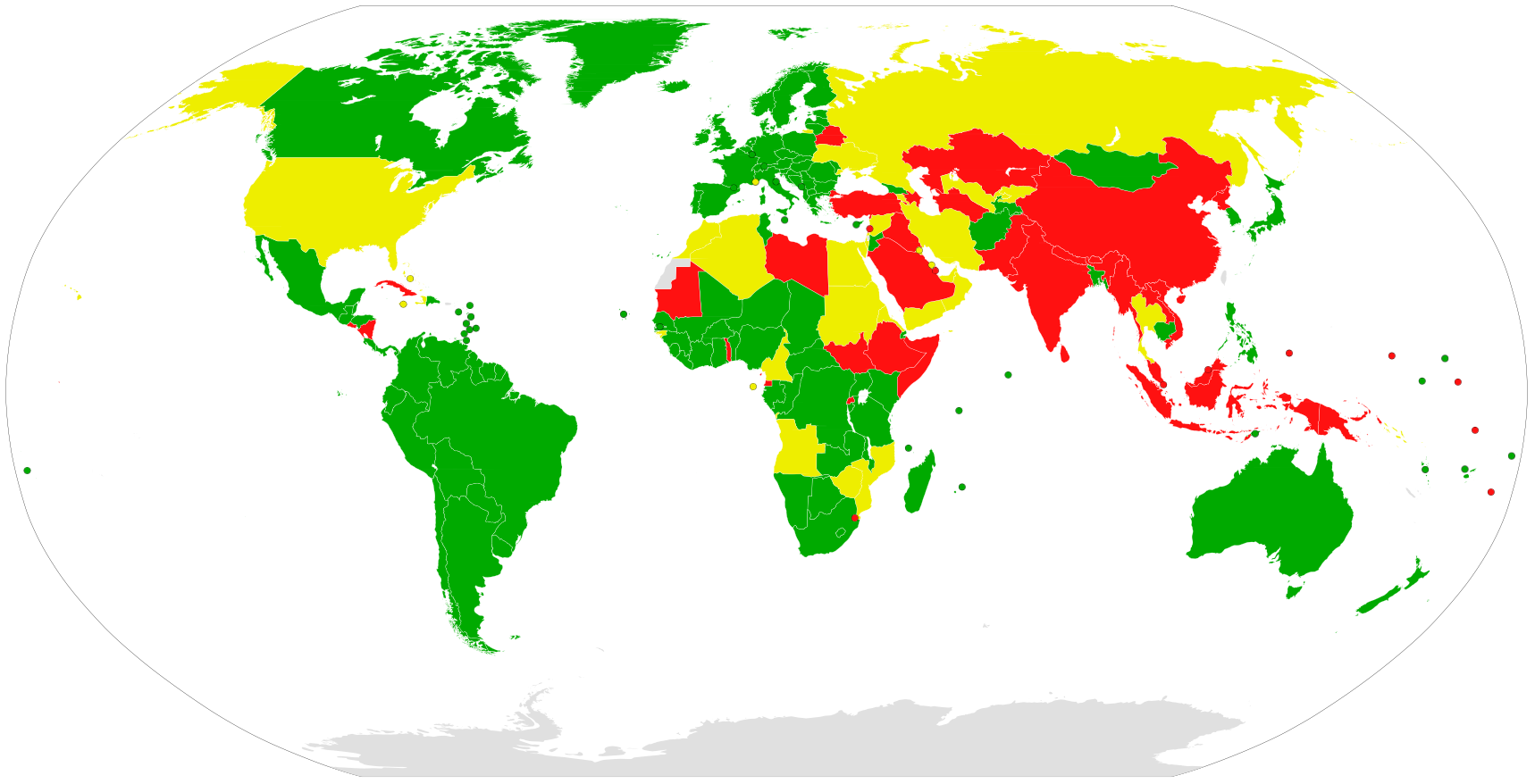
The map seen above, from Wikipedia, shows countries belonging to the ICC (green), countries that have signed but not ratified (yellow), and countries that have not signed (red).

Is English Undermining The EU?

Robert Lane Greene suggests so. He feels all schoolchildren in the European Union should learn two foreign languages:

Why not let the [English] spread to every corner of Europe – and, indeed, the rest of the world? This would certainly seem more practical than teaching every European child two more languages. But mandating English might also serve to undermine loyalty to the EU. There are too many Europeans who would rather not have English dominate political affairs. The continent has more native German-speakers, including four countries where German is an official language. French has as many native-speakers in Europe, too, and is official in three countries (not to mention Europe’s de facto capital, Brussels). Native English-speakers make up less than a fifth of the EU’s population. And, awkwardly, English is the official language of the one country that will soon hold a referendum on whether to quit the EU entirely.

But the real reason not to adopt a “mainly English” language policy involves the EU’s promise to its members, under the official motto “united in diversity.” No country joined the union in order to be crushed under a homogenizing wheel.

Robot Linguistics

Jessica Love wonders how changing technology will affect language, especially between humans and machines:

[C]onsider an interaction between Kevin and a thermostat. In this event—a temperature-adjusting event—Kevin is very much a Proto-agent, and the thermostat a Proto-patient. We would probably describe this scenario using a sentence like Kevin adjusted the thermostat.

But what if the thermostat in question is a very smart thermostat—a thermostat that anticipates Kevin’s needs based on past heating and air conditioning usage, one that perhaps even detects that he is preparing for bed early, or that company has arrived, and switches temperatures accordingly? Now it is the thermostat that, when it comes to adjusting the temperature, seems to play a more agentive role. We might describe this scenario as The thermostat adjusted or even The thermostat accommodated Kevin.

With intelligence distributed more widely among the objects that surround us, in other words, our own role as an agent—speaking linguistically and, I suppose, non-linguistically—might shift as well.

A Popularity Contest For The Dead

Esther Zuckerman calls for a moratorium on award-show tributes to the recently departed:

Debating whether or not a dead person deserves to be honored by an institution is a losing battle. Sure, you can make the argument that by including [Glee’s Cory] Monteith the Emmys leave out [Dallas’] Larry Hagman, who arguably had a more lasting impact on the history of TV. You can also make the perfectly respectable argument, like [Today producer Ken] Ehrlich did, that it’s unfair to younger TV watchers to understate the sorrow of Monteith’s passing. (You might also rebut the bringing young eyes to awards shows is what networks and advertisers really want, no matter how they get there.) Ultimately, though, both these arguments hinge on the notion that it’s up to producers to determine the value of someone’s life, and that’s pretty gross.

Scrap The UN?

Jim Arkedis calls the veto-ridden United Nations “officially broken” and suggests that the US help create a entirely new, more exclusive body:

A United Democratic Nations would be composed of only the world’s most free countries: those who have had decades-long traditions of open, fair elections and institutions, peaceful transfers of power, well-established protections for all. The list is not hard to imagine.

The United Democratic Nations’ mandate would be to safeguard freedom and openness and to protect the voices who cannot express themselves in undemocratic countries: too often, it’s women and girls, ethnic minorities, and civilians trapped by combat. It would deliberate resolutions that support democratic institutions and protect innocents. In extreme cases, it could sanction the use of military force to protect civilians in combat. (Though, of course, all nations would reserve the right to use force in self-defense.)

Or think of it this way: a body of the world’s democracies would have so much legitimacy that it would make cases of worthy intervention–like Syria and Libya–easier, while making dubious interventions–like Iraq–more difficult.

Larison pans the idea:

Whenever the idea of a “league of democracies” or something similar comes up, it is almost always because the U.N. failed to function as a rubber stamp for Western military action.

This latest case for a “United Democratic Nations” is no different. The Security Council is “flawed” in this analysis because it is too representative of the world’s major powers, and at least some of those powers predictably have no interest in endorsing every war of choice the U.S. opts to fight. Let’s remember that if the Security Council were reformed to include more permanent members, there would be more states regularly voting against the U.S. on the Security Council.

The “solution” offered here is to create a new international institution that would include many fewer states and would exclude at least two of the world’s most powerful governments for the sake of having an illusory “democratic” consensus on controversial questions of interfering in other states’ internal affairs and authorizing military intervention.

Previous Dish on the decline of the UN here.

The Heartless Blogger

Leon Wieseltier – news alert – thinks I’m a callous bastard:

In the name of “nation-building at home,” we are learning to be unmoved by evil. I will give an example. On Anderson Cooper’s show last week, there appeared a man named Zaidoun Al Zoabi, an academic in Damascus and a prominent anti-Assad activist, who was kidnapped by the Syrian secret police and held in one of Assad’s most notorious prisons. He was pleading for American action to stop Assad’s savagery. “Is the diplomatic path now only about chemical weapons?” Al Zoabi asked, with a look on his face composed in equal measure of dignity and desperation. “What about [Assad’s] massacring us for the past two years?”

At which point Andrew Sullivan, who was a panelist on the show, folded his arms, turned away, and sneered: “Chemical weapons is all you’re going to get right now!” Go back to your disgusting little country and die. The blogger giveth and the blogger taketh away. Is this “war-weariness”? It is certainly a disrespect for suffering.

A couple of points. Zoabi has opposed military intervention by the West for the last two years. Anne-Marie Slaughter noted this on the show:

SLAUGHTER: Last week when we talked you did not support military strikes. You did not think…

ZOABI: I do not support until now.

So how heartless was Zoabi for the last two years? More to the point, a clear majority of Syrians still oppose military intervention by the US. From a recent YouGov poll:

More opponents of the regime strongly disapprove of a U.S. military strike than favor it. 81 percent of government supporters, as well as 56 percent of those who prefer not to say. There’s little evidence that ordinary Syrians favor an attack.

In fact, distrust of America is nearly unanimous among Syrian poll-takers. Only 7 percent of those interviewed thought that the U.S. government was “a friend of the Syrian people.” There wasn’t much disagreement on this point among supporters and opponents of Assad. 79 percent of supporters, 61 percent of opponents and 57 percent of non-aligned said the U.S. was “an enemy of the Syrian people.”

If the Syrian people themselves remain at best ambivalent, is it really solely a mark of “heartlessness” to be skeptical that military intervention would do any good either for the future of Syria or for the current cessation of chemical attacks.  Leon describes what I said with respect to chemical weapons thus:

“Chemical weapons is all you’re going to get right now!”

The transcript reads:

ZOABI: Let me just say one thing. Is the diplomatic path now only about chemical weapons? What about massacring us for the past two years?

SULLIVAN: Chemical weapons right now.

As for my moral callousness – expressed by Wieseltier, putting words into my mouth, as “Go back to your disgusting little country and die!” – here’s a part of the transcript when I was asked directly about the horror of August 21 – and countless other occasions Assad used these vile weapons. I said:

It is absolutely fair and important for us to observe this horrifying thing.

We should. I’m not saying we shouldn’t. I think we should feel it, see it, absorb it, think about it, and face up to it. But statecraft is not about emotional, visceral responses. Statecraft requires someone to see the world as it is but then to make serious judgments about our interests, the future, unintended consequences.

You cannot run foreign policy by emotional spasms. And my fear is that that emotional spasm threw Obama off his essential trajectory of keeping out of this.

These are difficult, tough choices to make in a fallen world. I do not envy the job of the president. Nor do I doubt the sincerity of Wieseltier’s anguish in the face of such horror. If I have at times seemed too indifferent to the suffering in that country in making realist points, I apologize. But I differ in judgment about the right course of action. It seems to me we should be able to acknowledge that, without imputing inhuman callousness.