Francis And Wagner

It was a fascinating detour in the Pope’s gob-smacking interview yesterday: he is a fan of Wagner, specifically the Furtwängler La Scala Ring and the 1962 Knappertsbusch Parsifal. The peerless music critic for the New Yorker, Alex Ross, has some thoughts:

If I’m not mistaken, Pope Francis is comparing “decadent Thomist commentaries” to Klingsor’s magic garden — a seductive illusion covering a wasteland. Could the Pope’s emergent philosophy of unadorned compassion have been influenced in some small way by Parsifal, that attempted renovation of religious thought through musical ritual? “Through pity, knowing”? “Redemption to the Redeemer”? Possibly, but there are limits to his aestheticism: “Our life is not given to us like an opera libretto, in which all is written down; but it means going, walking, doing, searching, seeing.” This is a remarkable man.

And also a remarkable mind. We were constantly reminded of Benedict’s intellect, and it was and is impressive. But it was also a desiccated variety, crammed with fear, obsessed with order and precision, closed at times to the surprises of life and of God in its attempt to dot every i and cross every t. Francis? A profound intellect, yet also a living, breathing, open-ended one.

Guilty Of Mental Illness

D.J. Jaffe warns that the ongoing closure of mental hospitals is turning prisons into de facto psychiatric wards:

New York City’s Rikers Island jail already has more mentally ill than all the state hospitals combined. Despite that, the New York State Office of Mental Health is pushing a plan to close more mental hospitals in the state. … New York claims state psychiatric hospitals are not needed and points to California and Texas as role models. They have only five and eight state psychiatric hospitals, respectively, compared with New York’s 24. But both states have more than twice as many mentally ill incarcerated as New York does. In California, the mentally ill are almost four times as likely to be incarcerated as hospitalized. In Texas, it is eight times.

Why choose mass incarceration of the mentally ill over treatment? It’s not a matter of cost savings:

[Psychiatry professor Linda] Teplin says that while it is certainly not a cheaper system, it is easier to get support for new correctional facilities than it is obtain funds to provide mental health care in the community. She also says stigma can play a role in what gets backing, since people with severe mental illnesses on the street are not representative of all people with mental health needs. “They may engage in bizarre behavior,” she says. “Many people are afraid of people with severe mental illnesses. They’re not a sympathetic group.” Teplin says it would likely take a major public figure – perhaps with an ill family member to take leadership in this area for any real policy change to move forward.

What Signal Does Not Striking Syria Send?

Fisher claims that it “boosts the credibility of [Obama’s] stated position that he isn’t seeking Iran’s destruction and that he will seek detente with Iran if it first meets his long-held demands on uranium enrichment”:

Here’s where the parallel with Syria is really important: Iranian leaders distrust the United States deeply and fear that Obama would betray them by not holding up his end of the bargain. That’s been a major hurdle to any U.S.-Iran nuclear deal. But seeing Assad’s deal with Obama work out (so far) sends the message to Iran that it can trust the United States. It also sends the message that making concessions to the United States can pay off. Iran’s supreme leader has been talking a lot lately about flexibility and diplomacy toward the West. So it’s an ideal moment for Obama to be demonstrating flexibility and diplomacy toward the Middle East.

Scoblete thinks Fisher goes to far:

[I]t’s going to be very difficult for Iran to accept the idea that the Syrian deal shows the Obama administration isn’t seeking Iran’s destruction when the Pentagon talks openly about arming Syria’s opposition even with a chemical weapons deal in place. That sends exactly the opposite message to Iran, who need only look to Libya to understand the consequences of accepting a Western disarmament deal.

Larison adds:

Iran can’t help but notice that states that agree to disarmament don’t buy themselves security from attack or foreign support for their domestic opponents. The fact that the U.S. continues to threaten Iran with attack in the name of “prevention” must mean more to Tehran than the U.S. decision not to attack Syria. The recent conciliatory gestures from Rouhani are an encouraging sign that tensions between the U.S. and Iran can be reduced, but there has to be some effort on Washington’s part to reciprocate or the chance will quickly be lost. Avoiding an attack on Syria should make diplomacy with Iran more productive, but whether it produces an agreement will depend on the willingness of the U.S. to make the concessions necessary to reach one.

This Extraordinary Pope: Your Thoughts

This embed is invalid


A reader refers to the above segment from last night’s AC360 Later:

I am an elderly Catholic Chaplain of 30 years, long a gay rights activist, serving prisons, hospitals and communities as advocate, counselor, and helper-as-able. I was beyond delighted to see you with Anderson Cooper, speaking with such passion about our new Pope. I had not known you were gay, or Catholic. I need to tell you how proud I felt of you, and that I just love you for using that talent; for hanging in there with the Catholic Church; for being you.

Another reader:

Wow! I wondered if Pope Francis could possibly be for real.  He seems the absolute embodiment of what I always thought the Catholic Church was supposed to be about – promoting the ideas and teachings of Jesus, not running a corrupt organization without a shred of mercy, divine or otherwise.  Pope Francis is having a tremendous pull on me.  I rejected the Church long ago, but I’m drawn to this man and what he has to say.  I hear a voice inside me that says “yes”.

Another:

I have been moved, as you have been, by the amazing grace of the Holy Father. What a revelation, indeed. I was recently baptized Episcopalian – it was the only denomination I could find that matched my social values. This Pope is the first Catholic leader in my lifetime (42 years) I remember reacting to in this way. In reading a book about my church, this passage struck me: “As Episcopalians, we are not called to be Christians, we are called to be Christ on earth.” Pope Francis, from everything I have seen, is embodying Christ on earth. What a blessing. I’m proud to take the liberty of the Anglican stretch and call him my Pope too.

Another:

Damon Linker is wrong.  Words matter and so do his actions.  Of course Francis didn’t come out and say “homosexual acts are morally permissible.”  That statement would completely take away from his greater point: God is love.  People would be frothing instead of focusing on who is important: Jesus Christ and his ultimate sacrifice because of his Father’s love for all of us.  As a liberal woman, I don’t need him to make a grand statement about women and the priesthood. The actions of washing young women’s feet on Holy Thursday was deeply profound.  Love for everyone is what he’s projecting.

Of course there will be liberals that will never be happy, and there will be conservatives that twist his words to suit their agenda, but the rest of us will just push away the noise and listen.

Another:

To Linker and Stanley:  “Meepus, meepus.”

Another:

I am amazed at those who poo-poo the words of Pope Francis because they do not change church doctrine. They might not. But they do seem to change an attitude towards those who disagree with doctrine. And that is no small thing. For example, my wife (a Catholic) and I (a Jew) have taken our 14-year-old daughter to church regularly for her entire life. We send her to Catholic school. Yet she chose not to be confirmed. Why? The church’s dogmatic approach to homosexuality for her entire life. But now the Pontiff has told her, “You think we are wrong? Feel free. You can still be Catholic.” That’s a big deal. That might someday make her comfortable coming to the church.

Another:

I’m an atheist, but if anything I’m more enthusiastic about Pope Francis than you are. I think the best of Christianity is a combination of the messages from Jesus about helping the poor and downtrodden; that love is the only solution to the puzzle of humanity; and that forgiveness holds a power much greater than revenge. This pope really seems to get it. If his words can stir emotions in an old non-believer like me, think of what he might do with lapsed Catholics.

Another atheist:

It feels strange, being a nonbeliever, to find myself so avidly following the Pope Francis’s pronouncements these days. A few months ago I felt cheered by his hints of a possible shift in the Catholic Church’s attitude towards homosexuality. Then, a few weeks back, I was struck by his succinct but powerful tweet on the Syrian conflict:

It’s almost poetic in its rhythmic, palindrome-like structure. And today I was stirred, as you were, by the elegant and intelligent answers he gave on the nature of his Christian faith in this interview. I think you are right to suggest that the example of someone (anyone, but especially someone in a position of power) who devotes himself to values of loving, openness, generosity, giving is appealing to many people – even those who, like me, see religion as folly.

And yet. I want to share with you the whole of my experience. Just as I feel myself swept away (I confess: I tend to feel things strongly, like you), I find that my admiration for Pope Francis crashes into an obstacle. The effect is as a wave hitting an unseen reef – it comes as a surprise even to me.

I find myself suddenly remembering that he is devoted to a process of arriving at his values that is diametrically opposed to my own (just as he remarks in his interview, when he speaks of looking for more than mere “evidence” to confirm God’s presence). Where I look for evidence, he looks to an unprovable “faith”. And this has the effect of making me feel sad.

It is, I imagine, the way you would feel if you encountered a loving, kind, wise person, say at an airport, while sitting at the gate, waiting to board your plane. Let’s say this person, who seemed to hold some position of authority, spoke with great clarity about his values, and they seemed very close to your own. You even saw him care for a fellow passenger, who had fallen ill. And then, a little while later, seated next to you on the plane by coincidence, he began to speak about … the many elves that live in the woods. How he knows that they are in ALL the woods, for EVERYBODY, even among the Eucalyptus trees in Australia … the birch trees in Siberia … the rubber trees in …

What would you feel? This is a serious question, Andrew! (My intent is not to mock religion; I am sharing with you a point of view.) Try to imagine. Would your admiration for the evident personal qualities of this individual overcome your embarrassment and disappointment? Imagine then, that you learn, from other passengers, that he is the leader of an organization that has a history of divisiveness in many countries, that has subjected many to feelings of unworthiness, that has even refused to bring to light, in the past, the sexual abuse of some of the most vulnerable of its members. The man is still the same – an impressively loving and kind individual, taken as an individual. Your opinion on that is unchanged. But the context would pull you up short of admiration, wouldn’t it?

In the end, for this atheist at least, my bursts of admiration for the individual man who is Pope Francis make me sad, not happy.

Another is happier:

“Be not afraid” was a central message of JPII. Here we finally have a Pope who gets it in a transformative sense … a real, human sense. I’m an atheist, a former Catholic seminarian. I can never return to Christianity because it is, in a phenomenological sense, meaningless. But so what?

I’ve also been a volunteer EMT and hospice volunteer, along with being in NY after 9/11 with the Coast Guard and the Red Cross. As an atheist, I care for people regardless of who they are.  And this is a pope who gets it. He’s a leader in a very human sense.

When I read his words, even as an atheist, I see a mature, considerate human being who is not afraid of being human. It’s apparent he’s seen poverty and suffering. He’s seen and comforted the dying. He’s been with people worried about their next meal and shoes for their children. Those are concerns that dwarf who you’re having sex with, or whether you use contraception. Those are real, human issues. To watch someone die, to see loneliness in those last moments is to see a kind of suffering that penetrates and breaks one’s idea of love and humanity. And he’s seen it.

While I can never again be a Christian, at least I can see Christianity in a different light – one that says Christians live a message and a life that is intensely human. We will never agree on many things. But this man is not my enemy and I am not his. And that’s something.


Giving Wellness Programs A Check-Up

They appear to be a waste of time and money:

Whether wellness programs work as intended or not, let’s recognize what they also do: They increase the cost of coverage for some employees. That saves employers money but by shifting costs to workers. Those who bear the brunt of this increase are the less healthy employees, who also tend to be those of lower socioeconomic status.

Now let’s consider what wellness programs might do: reduce health-care spending and improve health. In general, the evidence is weak that they will. Why? Conceptually, factors within workers’ control make only a small contribution to rising health-care costs, so there’s only so much such a program can do, even if it works perfectly. Empirically, the track record of wellness programs’ efficacy is mixed at best.

Free Willies!

A boy shouts as he under goes circumcisi

Joseph Stern rants against the anti-circumcision movement, going so far as to compare it to vaccine denialism. It’s an enjoyable piece of hysteria and affront but he fails to address the core point of those, like me, who oppose circumcision. The basic question is a very simple one: Why not leave infant boys alone? The foreskin is the result of aeons of human evolution, and only desert religions, like Judaism and Islam, have embraced it as a way to mark their own particular relationship with their deities. The question, really, is why all infant boys should be subjected to this mutilation at all? The vast majority of the world’s male population is not genitally mutilated – and they have not, over history, shown any serious defect.

What Stern has to address – and, despite fulminations and aspersions and disparagement of those seeking to leave infants alone, he never does – is why on earth are we even talking about this? What could possibly justify a horrible, traumatic procedure removing part of an infant boy’s body? Those who favor doing something seem to me to be the ones who need to make the case. The default doesn’t need to be defended. What has to be defended is such an intervention – which is irreversible and which is done without the consent of the infant. If you are concerned about future health hazards, why not remove the tonsils or the appendix after birth? The only reason this barbaric practice endures is religious fundamentalism.

As it is, more and more American parents are joining those around the rest of the world in choosing not to subject infants to the excruciating pain of mutilation. The following data are from Wikipedia.

Brazil, for example, has a circumcision rate of only 7 percent; Canada 32 percent; China less than 1 percent; Germany 11 percent; Spain 2 percent; in Britain, medical authorities are trying to reduce circumcision rates to below 2 percent.

To read Stern’s rant would require one to believe that somehow, all these countries, representing a huge majority of the world population, are somehow leaving boys open to all sorts of risks that Americans are free from. It’s a preposterous argument – and Americans increasingly see it as such. The genital mutilation rate for American-born boys has been slowly declining for a while, and Medicaid increasingly doesn’t cover it in many states. In the 1970s, 90 percent of infant boys were mutilated. That rate is now, mercifully, 54.7 percent. In the West, the rate is now mercifully down to 25 percent. Let’s hope it keeps declining and more and more boys can grow up with their bodies intact.

(Photo: A boy shouts as he under goes circumcision in Kajang outside Kuala Lumpur on November 20, 2011. By Mohd Rasfan/AFP/Getty Images)

Beauty In The Eye Of The Shareholder

John Kruzel is waiting for the market failure of Abercrombie & Fitch’s focus on traditional American beauty:

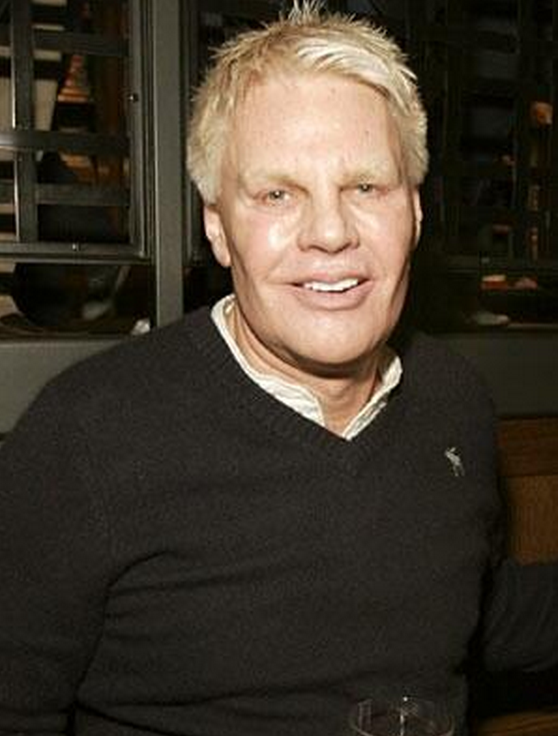
[CEO Michael Jeffries] has also personally discouraged unattractive, unpopular, and overweight customers from shopping at Abercrombie, and during Jeffries’ tenure as chief executive, the Screen Shot 2013-09-20 at 3.21.35 AMcompany has faced numerous discrimination lawsuits. Abercrombie’s most recent stain came earlier this month when a federal judge ruled the company had unlawfully fired a 19-year-old Muslim worker for wearing an Islamic headscarf, or hijab. …

Given that more than one-third of children and adolescents were overweight or obese in 2010, that means only 70 percent of the potential teen market can fit into Abercrombie & Fitch clothes, writes retail analyst Barbara Farfan. Crunching data from Pew Research and market research from Dove, Farfan reasons that only 41 percent of the potential teen market that can fit into Abercrombie clothes fit Jeffries’ definition of “all-American,” and only 9 percent of that group considers themselves to be the “good-looking” customers Abercrombie actively seeks.

Maybe that’s why sales are flagging. “With every public statement, every hiring decision, every look book guideline, … every lawsuit, and every news commentary about every one of those things,” Farfan argues, “the identity of the Abercrombie & Fitch brand gets a little clearer and the size of the Abercrombie & Fitch target market gets a little smaller.”

Update from a reader:

I’m a big, bearded, balding, 55-year-old bear.  (I am not A&F’s target market!  I’m Destination XL’s target market!) Some bear buddies and I, when we’re shopping at a place with an A&F, just LOVE to go in, pretend to shop seriously, and watch how distressed the sales staff gets.  We are almost never asked if we need help.  They look at us like we’re shoplifters.  I will never forget the look on a sales rep’s face when I asked if they had a tee-shirt in triple-XL.  I thought he was going to cry!

(Image of Jeffries via Twitter user Mily)

Economic Growth Is Good For The Environment?

The Economist makes the case:

[A]s people get richer, their interests begin to extend beyond necessities towards luxuries: for some people that means expensive shoes, for others a day’s bird-watching. Green pressure groups start leaning on government, and governments pass laws to constrain companies from damaging the environment. In the West, a posse of pressure groups such as Greenpeace and the Environmental Defence Fund started up in the 1960s and helped bring about legislation in the 1970s and 1980s.

Growth also has indirect benefits for biodiversity.

People clean up their environment in ways that help other species: through building sewage-treatment plants, for instance, and banning factories from pouring effluent into rivers. Prosperity and peace tend to go together, and conflict hurts other creatures as well as man, as the wars in the Congo have shown. Richer countries generally have better governments, and conservation cannot work without an effective state. Agricultural yields rise, allowing more food to be produced on less land. Population growth rates fall: in East Asia, fertility has dropped from 5.3 children per woman in the 1960s to 1.6 now.

Another Economist article notes that this process isn’t quick:

In its early stages economic growth often causes people to multiply faster as death rates come down but birth rates stay high, as is happening in Africa now. That intensifies competition for resources between humans and other species. But when countries become richer, more women get educated and take jobs, more people move away from farms and into cities and birth rates start falling.

A Pre-Tenderized Meal, Ctd

A reader writes:

Reading your roadkill thread, I’m surprised you haven’t had any Aussies write in. You haven’t really experienced roadkill until you’ve driven Down Under. Wombats regularly take out the OLYMPUS DIGITAL CAMERAundercarriages of cars and leave ugly skid marks and chunks down the road. But it’s really kangaroos that cause the biggest problems. With an estimated 20 million Big Reds – which easily grow to six feet tall in the vast Outback – and several million Eastern Greys that grow almost as big along the Pacific coast, driving Down Under can be downright dangerous. The PBS series Nature actually aired an episode titled Kangaroo Mob (available to watch here) about the dangers of kangaroo overpopulation around the city of Canberra, including driving hazards and the controversial practice of culling.

Rural citizens have what some call “roo-guards” on the fronts of vehicles (see attached photo), but that only offers minimal protection if they hit a big one. My friend who lives in Bathurst, NSW, showed me a photo of the front end of his family sized car after hitting an adult male grey and I was shocked that it looked like he had hit a telephone pole! Kangaroos go farther than just freezing in headlights, my Bathurst friend claims; they charge the lights, making for an especially frightening driving experience. His kids were in the back seat screaming as the animal charged and exploded on impact.

Because of such animal road obstacles, I’ve avoided driving at night in Australia and learned that many rural Aussies only do so when absolutely necessary. I opted for a bus to Uluru (Ayers Rock) in the summer of 2012 because we wouldn’t be returning to Alice Springs until midnight. Shortly after sunset I was attempting to doze when I was startled by my traveling companion letting out a blood-curdling scream that I had never heard before, immediately followed by THWACK-THUMP with the bus tires pitching up like they hit a large speed bump. My friend was frozen in place as I asked “Did we hit a roo?!” … all he could do was stare forward and nod in the affirmative while shaking like he had seen a ghost.

In the headlights I could see the road ahead was thick with roos hopping in all directions, many coming very close to suffering the same grizzly fate as their mangled comrade, but luckily they started to thin out and we didn’t have any other incidents. The roo-guard on the bus took most of the impact but the animal was in mid-hop when it hit so the head slapped the glass. But the only damage done was to my friend’s psyche. At a rest stop, the driver pointed out the dents on the side of the bus from other impacts, where we could see head and tail indentations. He bragged that he only brakes for cattle and camels. Comforting.

I’ve probably caused you to wonder if Aussies eat roadkill. Yes, they do, but only about as uncommonly as rural North Americans would butcher roadkill deer. I’ve eaten kangaroo that was properly marinated to remove the gaminess and it tasted like some beef I’ve had, but my Bathurst friend joked that roo meat is not very popular, since half the population considers them vermin and the other half feels guilty about eating the national animal.

Update from a reader:

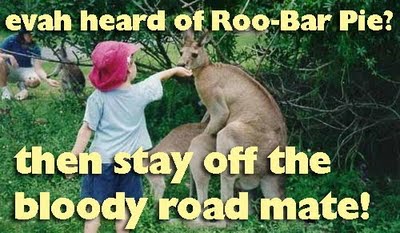
G’day Andrew. Mate, it’s a roo bar, not a roo guard. And it’s an emblem of a culture. No doubt while in Australia, the reader followed the tried and tested methods for effectively roo bar piedeterring Thylarctos plummetus (drop bear) attacks – placing forks in the hair, having Vegemite or toothpaste spread behind the ears or in the armpits, urinating on yourself, and only speaking English in an Australian accent.  In a dangerous land of colourful story tellers, you don’t want to be a few sangers short of picnic, eh?

Roo-bar pie, anyone?

Another:

Just a quick note for warning for people thinking of “car-harvesting” next time they hit a deer but also don’t know how to butcher a deer themselves. My dad owned a small locker store when I was growing up. One day a guy who had hit a pretty decent sized deer brought it in to be butchered. After we had processed it, my dad got a call from the guy’s insurance company. They wanted to know the value of the deer meat because they planned to deduct it from what they paid out for the damage to the vehicle. Seriously.