This Extraordinary Pope, Ctd

Thomas Reese declares, “I have never been prouder to be a Jesuit or prouder of my church or more surprised by the Spirit”:

For Francis, three words sum up the mission of Jesuits today: “Dialogue, discernment, frontier.” On the last point, he quoted Paul K43692CARAVAG 1VI’s speech about the Jesuits: “Wherever in the church—even in the most difficult and extreme fields, in the crossroads of ideologies, in the social trenches—there has been and is now conversation between the deepest desires of human beings and the perennial message of the Gospel, Jesuits have been and are there.”

Reading this interview gave me greater insight into my Jesuit vocation and into our Jesuit pope. What is clear is that he does not think like a classicist who sees the world in unchanging categories. He is a story teller like Jesus, not a philosopher. He thinks in narrative not philosophical principles. He thinks like a pastor understanding the history of the church but wanting to move with God’s people confidently into the future. He trusts that the Spirit is alive and well in the people of God.

James Martin nods:

Pope Francis is comfortable with gray.  In the interview, he speaks out against what he calls a “doctrinal security” and offers a gentle critique of those who “stubbornly try to recover a past that no longer exists.” Pope Francis asks Catholics to move away from a church that “locked itself up in small things, in small-minded rules.” Instead he invites Catholics, and invites the church, into the world of uncertainty, which is where most of us live anyway.

This is the world into which Jesus walked: the real world, in which people experience uncertainty and confront the need to make decisions.  It is the milieu of the everyday believer.  Jesus entered this world in the first century, and the church must be comfortable in that same world today.

Martin Longman feels odd praising the pontiff:

Pope Francis isn’t changing any doctrine with these kinds of remarks, but he is making a rather clean break with his two most recent predecessors, whose tone and emphasis was much more in tune with the Reaganite Right in this country. … I can’t say for sure how this new pope will influence American politics, but as a liberal I can say that it is a relief not to feel like the Vatican is fighting on behalf of my political opponents anymore. That’s not a comfortable feeling.

K-Lo glosses over the content and praises the tone:

The Francis factor, so to speak, is his focus on opening doors. How will anyone be open to Catholicism if they cannot get past knowledge of some of the prohibitions, without knowledge of the context, without invitation, without a love that compels them radiating from Christians? … That’s very much the Evangelical Catholicism George Weigel talks about, using that same Emmaus-road image, by my quick read. It’s the call of the Catholic to know Christ and make Him known, to set hearts ablaze. In this interview and by his daily witness and words, that’s what this pope is witnessing to, fascinating the world — which may misunderstand at times, as he reproposes some fundamentals and open doors of introduction and renewal.

Damon Linker throws some cold water:

[H]owever much those remarks signal a shift from the rhetorical style of popes John Paul II and Benedict XVI, progressive Catholics need to understand that the change is, and is likely to remain, a matter of words.

Consider what the pope did not say. He didn’t say that homosexual acts are morally permissible. He didn’t say that abortion can be morally acceptable in certain (or any) circumstances. He didn’t say anything to indicate he was interested in revisiting Pope Paul’s 1968 reaffirmation of the church’s ban on artificial contraception. He didn’t imply that he’s interested in revising the church’s strictures against married priests. He certainly didn’t indicate an openness to permitting the ordination of women. The interview contains no sign that the pope is willing to budge on any of the items on the progressive Catholic wish-list of reforms.

Tim Stanley nods, adding, “Some will see this as rewriting doctrine, especially those who exist outside the Church and have absolutely no intention of ever joining”:

The Pope has called for a rejection of a focus on “issues”. But, ironically, it’ll be liberals obsessed with “issues” who pay attention and embrace his message – all those folks who for years have been campaigning for the Catholic Church to jettison Catholicism and embrace women priests, homosexuality, contraception etc. The folks who loathed Benedict – people who willfully interpreted his words as ultra-conservative and who now interpret Francis’ language and hopefully liberal. In particular, those who loathe the traditional Mass will thrill at his warning that it must not develop into an “ideology”. No it must not. It hasn’t. It never will. Frankly, on this issue, I genuinely don’t know what my Pope is talking about.

That last sentence rings true, doesn’t it?
The Rebirth Of Catholicism

K43692CARAVAG 1

I am, I must confess, still reeling from Pope Francis’ new, lengthy and remarkable interview. I can barely believe that these words – so redolent of Jesus’ – are coming from the new Bishop of Rome, after so long an absence. Although the Pope is unfailingly respectful of his predecessor, let no one doubt the sharpness of Francis’ turn away from the dead end of Benedict. His message is as different as the context. Where Benedict, draped in ornate vestments, spoke from the grand edifice of the Vatican, Francis is in the same simple hostel in which he was ensconced during the Papal Conclave. Why?

Community. I was always looking for a community. I did not see myself as a priest on my own. I need a community. And you can tell this by the fact that I am here in Santa Marta. At the time of the conclave I lived in Room 207. (The rooms were assigned by drawing lots.) This room where we are now was a guest room. I chose to live here, in Room 201, because when I took possession of the papal apartment, inside myself I distinctly heard a ‘no.’ The papal apartment in the Apostolic Palace is not luxurious. It is old, tastefully decorated and large, but not luxurious. But in the end it is like an inverted funnel. It is big and spacious, but the entrance is really tight. People can come only in dribs and drabs, and I cannot live without people. I need to live my life with others.

An inverted funnel, which he now wants open to the world and to his fellow human beings. And there is throughout a premise of humility, doubt, mystery, openness to new things. How many times have you heard a Pope be as self-critical in retrospect as this:

My authoritarian and quick manner of making decisions led me to have serious problems and to be accused of being ultraconservative. I lived a time of great interior crisis when I was in Cordova. To be sure, I have never been like Blessed Imelda [a goody-goody], but I have never been a right-winger. It was my authoritarian way of making decisions that created problems.

And when at the outset of the interviews he is asked simply who he is, he replies

I am a sinner. This is the most accurate definition. It is not a figure of speech, a literary genre. I am a sinner.

He speaks of Carravagio’s painting ‘The Calling of St. Matthew” (see above):

That finger of Jesus, pointing at Matthew. That’s me. I feel like him. Like Matthew. It is the gesture of Matthew that strikes me: he holds on to his money as if to say, ‘No, not me! No, this money is mine.’ Here, this is me, a sinner on whom the Lord has turned his gaze.

But, for me, the most powerful argument Francis makes is about what Christianity is. It is not, in the end, about certainty. It is about faith as alive and open in doubt:

In this quest to seek and find God in all things there is still an area of uncertainty. There must be. If a person says that he met God with total certainty and is not touched by a margin of uncertainty, then this is not good. For me, this is an important key. If one has the answers to all the questions—that is the proof that God is not with him. It means that he is a false prophet using religion for himself. The great leaders of the people of God, like Moses, have always left room for doubt. You must leave room for the Lord, not for our certainties; we must be humble. Uncertainty is in every true discernment that is open to finding confirmation in spiritual consolation.

Our life is not given to us like an opera libretto, in which all is written down; but it means going, walking, doing, searching, seeing … We must enter into the adventure of the quest for meeting God; we must let God search and encounter us.

This profound mystery – that as soon as we claim certainty about the nature of God, we have lost the meaning of the nature of God – is at the heart of a Christian’s openness to the divine. Now think of this in contrast to the unrelenting fixation of John Paul II and Benedict XVI on enforcing total uniformity in even the tiniest details of sometimes esoteric doctrine, to banish debate entirely, to assert with more and more rigidity the impermissibility of dissent or doubt among the people of God. In the end, that rigidity is a neurosis, not a living faith. And to those who argue that a more open view of faith-in-doubt is tantamount to anarchy, to relativism, even to nihilism, Francis has a simple answer. No, it is not necessarily about these things, although they remain dangers. What makes all this work is what the Jesuits have long called “discernment.”

The wisdom of discernment redeems the necessary ambiguity of life and helps us find the most appropriate means, which do not always coincide with what looks great and strong. The Society of Jesus can be described only in narrative form. Only in narrative form do you discern, not in a philosophical or theological explanation, which allows you rather to discuss … The mystical dimension of discernment never defines its edges and does not complete the thought. The Jesuit must be a person whose thought is incomplete, in the sense of open-ended thinking.

Faith is not in the head; it is in the soul and heart and body. It is our acting in the world, not our debating the finer parts of infallible doctrine in an “inverted funnel”. And look how Francis uses the term “infallible.” He uses it not to refer to the papacy, but to the people of God, you and me, and not in terms of possession of the truth, but rather the open search for it:

The church is the people of God on the journey through history, with joys and sorrows. Thinking with the church, therefore, is my way of being a part of this people. And all the faithful, considered as a whole, are infallible in matters of belief, and the people display this infallibilitas in credendo, this infallibility in believing, through a supernatural sense of the faith of all the people walking together. This is what I understand today as the ‘thinking with the church’ of which St. Ignatius speaks. When the dialogue among the people and the bishops and the pope goes down this road and is genuine, then it is assisted by the Holy Spirit. So this thinking with the church does not concern theologians only.

This is the core message of the Second Vatican Council that John Paul II and Benedict XVI did their utmost to turn back in favor of papal authority. The hierarchy is not the whole church, just a part of it, in community with all the faithful. And he uses the example of the Blessed Virgin to buttress his point:

This is how it is with Mary: If you want to know who she is, you ask theologians; if you want to know how to love her, you have to ask the people. In turn, Mary loved Jesus with the heart of the people, as we read in the Magnificat. We should not even think, therefore, that ‘thinking with the church’ means only thinking with the hierarchy of the church.

And how we live is the only true expression of what we believe. Here is the rebuke to the theocons and their project:

If the Christian is a restorationist, a legalist, if he wants everything clear and safe, then he will find nothing. Tradition and memory of the past must help us to have the courage to open up new areas to God. Those who today always look for disciplinarian solutions, those who long for an exaggerated doctrinal ‘security,’ those who stubbornly try to recover a past that no longer exists­—they have a static and inward-directed view of things. In this way, faith becomes an ideology among other ideologies.

And where is real faith?

I see the holiness in the patience of the people of God: a woman who is raising children, a man who works to bring home the bread, the sick, the elderly priests who have so many wounds but have a smile on their faces because they served the Lord, the sisters who work hard and live a hidden sanctity. This is for me the common sanctity. I often associate sanctity with patience: not only patience as hypomoné [the New Testament Greek word], taking charge of the events and circumstances of life, but also as a constancy in going forward, day by day. This is the sanctity of the militant church also mentioned by St. Ignatius. This was the sanctity of my parents: my dad, my mom, my grandmother Rosa who loved ​​me so much. In my breviary I have the last will of my grandmother Rosa, and I read it often. For me it is like a prayer. She is a saint who has suffered so much, also spiritually, and yet always went forward with courage.

My own beloved grandmother was a saint of a similar kind. I learned so much about Jesus from simply observing her. She lived a hard life, the seventh of thirteen children raising four of her own with no formal education and earning money cleaning the houses of priests. I can never forget her reaching down on the sidewalks to pick up cigarette butts and teasing the last tobacco out of them to make a new one for her disabled husband. I remember her simple warmth and love for me. I recall watching her get lost in the Rosary at Mass – and realizing that however much education I ever got – more than she could comprehend – none of it could give me the faith she had and lived so effortlessly.

I hear her faith in the words of this new Pope: a faith of simplicity and openness, a faith that caused her not to live in the past or future, but now. As Francis says:

There is a temptation to seek God in the past or in a possible future. God is certainly in the past because we can see the footprints. And God is also in the future as a promise. But the ‘concrete’ God, so to speak, is today … We must not focus on occupying the spaces where power is exercised, but rather on starting long-run historical processes. We must initiate processes rather than occupy spaces…  Our life is not given to us like an opera libretto, in which all is written down; but it means going, walking, doing, searching, seeing…. We must enter into the adventure of the quest for meeting God; we must let God search and encounter us. Because God is first; God is always first and makes the first move.

And it seems that God has again made His move in a world that desperately needs Him; and His new servant, his new prophet, is Francis.

What The GOP Is Really After

Weigel explains the logic behind the GOP’s quixotic attempt to defund Obamacare:

As illusory as the “defund” campaign is, it’s flashy enough to obscure the gains won by hardliners. Every Republican leaving the meeting today suggested that a compromise funding bill or a compromise debt limit hike would set spending at the levels set by sequestration. At his short press conference, Boehner agreed with that. Nebraska Rep. Lee Terry sounded as cynical as Cole about Obamacare, saying it was “worth falling on your sword” to stop it, not saying that doing so would work. He was much more confident, and more insistent, that the eventual deals would force Obama to approve the Keystone XL pipeline.

These would be solid Republican wins, enabled—as far as the conservatives can tell—by the most hard-core members’ willingness to humiliate their leadership. Republicans can see exactly how this plan will make that happen. They’re not able to say how the plan will actually defund Obamacare.

Malkin Award Nominee

Video edition:

Cohn recoils:

The ad doesn’t have a lot of hits yet and I’m reluctant to give it more attention. But it comes from Generation Opportunity, which appears to be a well-funded conservative group staffed by young people and based in Virginia. According to Chris Moody, of Yahoo News, the group is about to launch a 20-college tour in which they will try to persuade young people to “opt out” of Obamacare—i.e., to pay the financial penalty for uninsurance rather than take up coverage.

Bernstein suspects that this ad, and the other ad in this campaign, are really about raising money from Obamacare opponents:

These ads could not be better designed to do one thing: to get condemned by liberals. Thus impressing easily scammed conservative marks, who tend to really believe that if liberals hate something, it must be terrific and effective.

The Size Of Your Balls And Your Kids, Ctd

They may not be related after all. Alex Sobel Fitts says the story is “only demonstrating a correlation between a man’s balls and his parenting abilities, not causation”:

Additionally, the study’s authors aren’t even really talking about “parenting skills,” they’re talking about the engagement of a region of the brain correlated with “nurturing” during an fMRI scan—another form of inquiry laden with journalistic misinterpretation. It might all be in good fun (and a burst of Web-busting unique views for shoving gonads into your lede), except that, as Gary Schwitzer points out in a Health News Review post, “This is the kind of news coverage about a study that results in science and journalism about science losing credibility.”

Well, it was too good to resist. But happy to correct.

Jimenez’s Dangerous Sources

In our latest video from the author of The Book Of Matt: Hidden Truths About the Murder of Matthew Shepard, he defends the use of anonymous sources in his book, given how perilous the drug underworld can be:

https://vimeo.com/74883426/

A reader dissents over the series:

I’m a big fan, but I’m also fascinated (and slightly disturbed) by your aversion to hate crime laws and your recent advertising campaign for The Book of Matthew. I think your readers deserve to know: Have you ever been minding your own business, hanging out on the sidewalk, talking with friends at the end of a fun night out, and had a complete stranger walk up to you and punch your fucking lights out just for being a faggot? How many Saturday nights have you spent in Meridian, Mississippi, or Albuquerque, or Cleveland? Not everyone gets to pedal around all summer in the “A-Gay” cocoon of P-Town. For countless LGBT people living in small-town America, being yourself means risking your life. Hate crime laws are not perfect, but they are a deterrent. For you to argue otherwise is classic homocon elitism.

I don’t believe in arguing from a single personal incident. But yes, I was “gay-bashed” once, though not seriously. Just rushed by a group of young Hispanic men in Adams Morgan a decade or so ago, knocked over, kicked a little, jeered at, and then left. I wasn’t seriously hurt. My view is that the right approach to hate crimes like that, and much more serious ones, is to enforce the existing law against assault. It is already illegal to bash someone for any reason. And recall that in Shepard’s case, the two perpetrators of the crime are serving life-sentences without parole – in a state that had no hate crime laws on the books. For hate crime supporters, that’s an extremely inconvenient fact. And yet they spent the next decade raising gobs of money arguing that hate crime laws was the only way to bring gay-bashers to justice. Another reader:

The death and destruction of the AIDS pandemic led to a period of PTSD and deep mourning and even survivors’ guilt in the community. Gay men of a certain age tried to reach back to a pre-AIDs world to experience what they had “missed” and the drug at hand was meth.  If the Matthew/meth connection had been better known at the time, it would merely have created a new backlash against an already devastated community by the wider world, which was already comfortable with blaming gay men for their “decadence.”

Should the historical record be changed? Certainly. Was it a tragic missed opportunity to have aired the dirty laundry in the 1990s? Unlikely.

This kind of defensive, cowed argument for deliberate lying is exactly what I think civil rights movements should avoid. I think Shepard deserves better than that. And it’s not “dirty laundry”. It’s simply a very relevant fact in the tragedy. And if we had seen  the role of meth up close earlier, we may even have been galvanized to tackle the meth epidemic more aggressively sooner – saving countless lives, careers and relationships.

Why Are So Many Americans Unbanked?

While working as a teller at a check cashing business, Lisa J. Servon was surprised to learn why its customers preferred it over commercial banks:

The primary critique of check cashers is that they are expensive. Sitting in my New School office eight miles south of Mott Haven, I had believed that, too. When I interviewed my customers, however, I learned that for many lower income people, commercial banks are ultimately more expensive. The rapidly increasing cost of bounced checked fees and late payment penalties has driven many customers away from banks, particularly those who live close to the edge, like many of my RiteCheck customers. A single overdraft can result in cascading bad checks and hundreds of dollars in charges.

She goes on to argue that the “banking industry needs to develop different fee and service structures designed to accommodate lower income depositors in much the same way banks currently provide VIP treatment to high-net-worth individuals.”

How Frequent Are Mass Shootings?

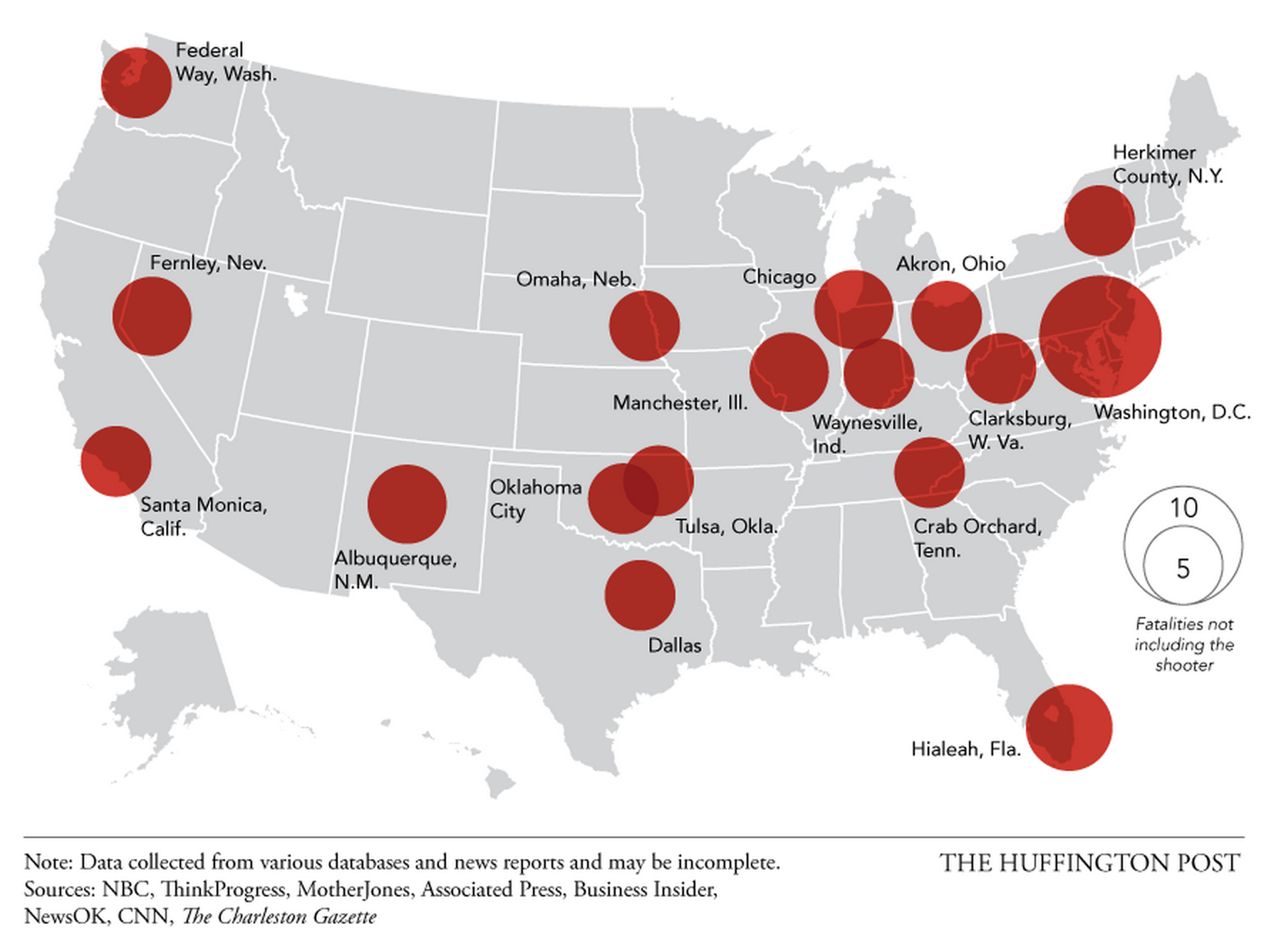
Screen Shot 2013-09-19 at 12.29.57 AM

A reader writes:

During your participation in last night’s AC360 Later, Emily Miller took issue with Anne-Marie Slaughter when she said there have been mass shootings “every couple of months” since Newtown, to which Miller countered strongly by saying that was not factual.

Here are the facts. According to an investigation by Emily Thomas (published yesterday, coincidentally), there have been “at least” 17 mass shootings in 2013 alone [defined by the FBI standard of four victims or more]. So not only is it factually accurate to say there have been mass shootings “every couple of months”, it’s factually MORE accurate to say there have been mass shootings every couple of weeks. In fact, Monday’s tragic Navy Yard shooting was the second mass shooting in September alone, and the month’s not even over. So, as a matter of fact, Anne-Marie was right and Emily was wrong. Chilling graphic here.

Paul Campos looks at a different standard over a longer period of time:

[Looking at shootings in which at least 14 victims died], it turns out that the rate of this type of mass shooting in America was nearly twice as high in the 25 years between 1966 and 1991 as it has been in the 22 years since (there were four such shootings in the former period, and two in the latter). Or we could use the FBI’s definition of a mass shooting: one in which at least four people, not including the perpetrator, are killed. This is a vastly larger category … : there were about 600 such incidents in the United States between 1980 and 2010.  As James Alan Fox, a professor of criminology at Northeastern University points out, the rate of such mass shootings does not appear to be rising

Another reader comments on a related post:

I agree with most of what Frum says about some moderate gun regulations based on personal behavior, but then he crosses into crazy land, both in terms of policy and politics. There are approximately 16,000 homicides each year in the US, 11,000 involving a gun.  How many of those deaths are the result of mass shootings?  Less than 100*. So when Frum says, “The classes of weapons associated with mass casualty shooting could be more strictly controlled,” he is basing a policy decision on a class of homicide that represent only .625% of all homicides.

In my class on risk assessment 20 years ago, this would be called example bias.  Mass shootings are traumatic, random events with huge media coverage that also happen to be very rare when compared to boring, and common, shootings related to criminal activities.  People will incorrectly claim that more people die in fires than in drownings for the same reason – the media covers fires because they are visual, and most people find dying in a fire more horrific than drowning.  Mass shootings are an edge case.  I would be fired as an engineer if I had a large problem to solve and I spent time obsessing on an edge case.

From a political point of view, spending time on the modern sporting rifle ban (technically they are not assault rifles because they cannot fire in fully automatic) is a bad idea not only because the votes do not exist but because the slippery slope arguments stops being crazy if the opposition walks up to the line and leans as far over that line as they can without crossing it.  Banning a gun is as close as you can get to taking guns as you can get.  Nothing riles up the pro-gun base more than the thought of people taking their guns, so even mentioning a ban is close enough to confiscation that you might as well be saying that you will take their guns.

So a word of advice for the gun-control crowd: never mention a gun ban again if you want to pass something like universal background checks that have a chance of actually saving a significant number of lives.  It ain’t gonna happen, and it will likely torpedo any chance of getting any other gun regulation.

*The FBI defines a mass shooting as one involving 4 or more deaths, committed within a 24hr period at a single location not related to criminal activity.  2012 was an exceptional year for mass shootings and exceeded 100, but generally it’s less than 100.

The above map by Jan Diehm is also based on that FBI standard for mass shootings.

A Civil War Within A Civil War, Ctd

Keating relays the latest from Syria:

Today brings news that the Islamic State of Iraq and the Levant, an al Qaeda-affiliated group, has overrun a town near the Turkish border after fighting with the western-backed Free Syrian Army. The development highlights the fact that the Syrian war is not a two-actor conflict anymore. As Time’s Aryn Baker put it a few days ago, “For the past several months rebel groups aligned with ISIS in Aleppo province have spent nearly as much energy battling factions serving under the umbrella of the Western-leaning Free Syrian Army (FSA) as they have fighting the [Assad] regime”.

Fisher analyzes the rebel-on-rebel violence:

Some analysts might be tempted to see a silver lining here.

The United States has long been wary of giving Syrian rebels much support because it doesn’t want to aid the al-Qaeda-allied ISIS, and it’s really tough to aid one rebel group without indirectly helping another. If the FSA and ISIS divorce, that would theoretically make it much easier for the United States and other Western countries to back the FSA without worrying about indirectly helping al-Qaeda. Indeed, as the FSA inevitably loses ground to ISIS, it could be an imperative. If you think that a stronger FSA is in Syria’s interests, either because you want to see the rebels win outright or just to balance the battlefield enough to convince Assad that he can’t win and should cut a negotiated peace deal, then it’s potentially good news that the United States might feel freer to give the FSA a boost.

It wouldn’t be Syria unless even the good news were also bad news, though. The United States has seen this movie before, in Afghanistan. During the 1980s, the United States backed its favored Afghan rebel groups to oust the Soviet military occupation. After the Soviets left, those rebel groups fought among one another, a second war that proved even worse than the first. Because chaos and militancy tend to breed extremism, the group that emerged from Afghanistan’s chaos was the Taliban.

Previous coverage here.