Rapprochement With Rouhani? Ctd

Fareed encourages the administration to engage with Iran:

Now of course this could all be camouflage and smoke screen. But there is another possibility. The international sanctions against Iran are hurting the country badly. Tehran’s support for Bashar Assad’s brutal regime in Syria is costing Iran money and arms every month and has tarnished its legitimacy at home. The Arab Spring, for all its problems, has put the spotlight on Iran’s Supreme Leader, who has been in power for 24 years. One of the chants heard in Tehran two years ago was “Mubarak, Ben Ali, now it’s time for Sayyid Ali [Khamenei].” In these circumstances, defusing some tensions, easing the sanctions and reviving the economy would be extremely useful to the regime in Tehran.

At the very least, the Obama Administration should come up with a reasonable offer that would signal to the Iranian people that if the regime is willing to credibly forswear nuclear weapons, ordinary Iranians will have a brighter future. But it is difficult to sound reasonable while you are beating the drums of war.

Relatedly, Fisher analyzes Rouhani’s interview with NBC (snippet above):

As Rouhani-skeptics often point out, the president is not the final authority in Iranian politics. Supreme Leader Ayatollah Ali Khamenei is ultimately in charge, especially on matters of national security and foreign policy. The best case for skepticism about Rouhani’s peace overtures is that he’s just freelancing and will inevitably be undercut by Khamenei. That’s still possible, but Rouhani told NBC News that Khamenei gave him full authority to cut a deal with the West over Iran’s nuclear program — the single biggest sticking point of any negotiations. If true, then for Khamenei to hand Rouhani that power would be a remarkably positive step just in itself, a sign of institutional weight shifting toward compromise and diplomacy. That Rouhani could actually see it through is even better.

Ask Trita Parsi Anything

[Updated with many more questions submitted by readers]

From his bio:

Trita Parsi is the founder and president of the National Iranian American Council and an expert on US-Iranian relations, Iranian foreign politics, and the geopolitics of the Middle East. He is the author of Treacherous Alliance: The Secret Dealings of Iran, Israel and the United States and ​A Single Roll of the Dice – Obama’s Diplomacy with Iran, and has contributed articles on Middle East affairs to the New York Times, WaPo, Wall Street Journal, and many others. He is also a frequent guest on CNN, PBS’s Newshour, NPR, the BBC and Al Jazeera. You can follow him on Twitter here.

We are sorry to note that Urtak, the great polling service we have used to collect and vote on questions, is no longer active. We hope the replacement format below will suffice. Vote on the questions below:


This embed is invalid

Our recent Iran coverage is here. Our Ask Anything archive is here.

What The Fed Said

Drum translates yesterday’s Fed decision to continue monetary stimulus:

The bottom line is simple: If Republicans really want to see monetary policy get back to normal, they need to stop sabotaging the economy with spending cuts and debt ceiling debacles. If they do that, the recovery will strengthen and the Fed will no longer be forced to sustain loose monetary policy as a way of offsetting stupid fiscal policy.

Soltas weighs in:

Here’s the most important thing anybody can tell you about the taper: It’s not the taper that matters, but the signal the taper sends. By the same logic, the Federal Reserve’s decision today to delay the taper matters little on its own. What counts for everything is the signal: This Fed is committed to restoring vigorous economic growth.

Wolfers argues that the “whole taper debate is one that should never have happened” and that it’s “the result of a failed communication strategy”:

Think back to the June press conference, and you’ll recall Chairman Bernanke signaled that the Fed was thinking about tapering quantitative easing. Taper-talk came to dominate the financial headlines, and a monetary meme was quickly born. The result — as I pointed out at the time–was that markets over-reacted, interpreting the Fed as being less committed to easy monetary policy in the longer run. Long-term interest rates rose, mortgage rates rose, financial conditions tightened. All of this was the result of a needless miscommunication.

Salmon was impressed by the market’s reaction:

If QE does no good, then you might as well not do it. But the lesson we learned on Thursday is that the markets really, really love QE. And insofar as robust markets feed through into a healthier economy, the logical conclusion is that we should retain current policy well into 2014. The downside is limited — and the upside is much bigger than we thought it was.

Barro’s bottom line:

The story of the last five years continues: Fiscal policymakers screw everything up, and the monetary policy authority is the only thing that works. For a guy who’s basically been singlehandedly been keeping the U.S. out of recession, people sure give Ben Bernanke a lot of crap.

Face Of The Day

IMG_0194

Aaron just found this photo from earlier this year in the apartment of our late friend, Norma Holt. That’s Dusty, peeking out down the long corridor. Most days, I manage not to think of her too much. And then you catch an image like this and you remember. Both Norma and Dusty are gone. But their spirit remains.

Our love is dead
but the dead don’t go away
They made us what we are
they’re with us every day

A Republican Plan For Working Families?

Reihan calls Republican Senator Mike Lee’s tax plan “the most promising development in Republican domestic policy in years.” His column explains why he supports the plan:

[T]he heart of the proposal is a new $2,500 per-child tax credit, which can be used to offset payroll taxes as well as income taxes. This is on top of the existing $1,000 child tax credit, which Lee leaves in place, along with a number of other tax benefits for low-income parents. In one stroke, large numbers of middle-income households with children will be removed from the federal income tax rolls altogether.

Lee argues that the current tax code unfairly punishes parents. The solvency of pay-as-you-go entitlement programs like Social Security depends on a steady stream of well-educated new workers. Alas, these new workers do not materialize from thin air. Parents invest considerable time and effort in educating their children and making them workforce-ready. Yet those of us who choose not to raise children are entitled to the same Social Security benefits as those of us who do choose to raise children, and who make enormous sacrifices in the process. Lee’s new per-child tax credit is designed to reduce this bias against parenting, which he describes as an investment in human capital at least as important as the investments savers make in their 401(k)s.

W. Bradford Wilcox also focuses on this feature of the plan:

As sociologist Andrew Cherlin and I wrote in a recent policy brief for the Brookings Institution, a policy move like this is likely to: “increase marriage rates and marital stability among low- and moderate-income families who would benefit from the economic security such a policy would provide to their family finances. It would also signal to them that the nation values the parental investments they are making in the next generation, who—it should be noted—will be helping cover the cost of Social Security and Medicare in the near future.” Indeed, experimental efforts to boost the income of working parents in Minnesota and Wisconsin have been linked to higher marriage rates and lower divorce rates among low-income couples.

Barro praises the plan but takes issue with some of the arguments above:

It seems to me that every generation is, by definition, fiscally neutral: Your kid who will be paying Social Security taxes in 40 years will be attending public school in 10 years and collecting Social Security in 70 years. I don’t really owe you anything, fiscally, for the fact you chose to raise a child.

That said, I favor higher child tax credits for a different and simpler reason: A family of four with an income of $100,000 has a significantly lower standard of living than a family of two with an income of $100,000 and therefore should not be expected to pay as much in tax. I’m with Lee on the policy end even if we don’t agree on the exact rationale.

Drum isn’t a fan of the plan:

[H]is plan leaves the current low capital gains rates and estate tax rates alone (good for the rich) and leaves the current high payroll taxes alone as well (bad for the poor). Put this all together, and the almost certain outcome is that the middle class would pay a little less; the upper middle class would pay somewhat more; and the rich would enjoy a big tax cut. In other words, it’s a pretty standard Republican plan.

Dylan Matthews assesses the plan:

There’s still a lot we don’t know about the plan, like how much revenue it’ll raise (Lee’s aiming for 18-20 percent of GDP but the Joint Committee on Taxation’s score will tell the tale) or its actual distributional outcome (hopefully the Tax Policy Center will run the numbers on that). But since the new child credit would probably increase the number of families not paying any income taxes, it’s an interesting proposal for a Republican to make.

And Yglesias, after discovering the he would get a tax break under Lee’s plan, wants Lee’s numbers to get double-checked:

Now if it’s actually true that you can meet all of Mike Lee’s goals consistent with giving me a small tax cut, then good for him. But I’m suspicious that what we’ve got here is simply a tax plan that doesn’t add up. If Lee wants to collect accolades for this plan, he’s going to need to get it rigorously scored by someone credible.

This Extraordinary Pope, Ctd

Pope Francis Attends Celebration Of The Lord's Passion in the Vatican Basilica

Well, if the theocons hadn’t got the message by now, they can only blame themselves. The new interview with Pope Francis is a revelation. This Pope is not the Pope of a reactionary faction obsessed with controlling the lives of others – a faction that has held the hierarchy in its grip for three decades. He is a Pope in the spirit of the Second Vatican Council, a Pope with a larger and more humane perspective than the fastidious control-freaks that have plagued the church for so long. I need to read and absorb the full interview – it’s 12,000 words long – before I comment at any greater length. But here are the key phrases that are balm to so many souls:

“This church with which we should be thinking is the home of all, not a small chapel that can hold only a small group of selected people. We must not reduce the bosom of the universal church to a nest protecting our mediocrity.”

And this with respect to the near-pathological obsession of the theocons with abortion, gay rights, and culture war politics:

“The dogmatic and moral teachings of the church are not all equivalent. The church’s pastoral ministry cannot be obsessed with the transmission of a disjointed multitude of doctrines to be imposed insistently. We have to find a new balance, otherwise even the moral edifice of the church is likely to fall like a house of cards, losing the freshness and fragrance of the Gospel.”

For me, obviously, it was wonderful to hear the true spirit of the Gospels with respect to homosexual persons:

“A person once asked me, in a provocative manner, if I approved of homosexuality. I replied with another question: ‘Tell me: when God looks at a gay person, does he endorse the existence of this person with love, or reject and condemn this person?’ We must always consider the person.”

Why must we always consider the person rather than abstract theological certitude? Because that is what Jesus did. And Jesus, quite obviously, is breathing life back into His church.

More soon, after I’ve had some time to read and absorb the whole thing.

(Photo: Getty Images.)

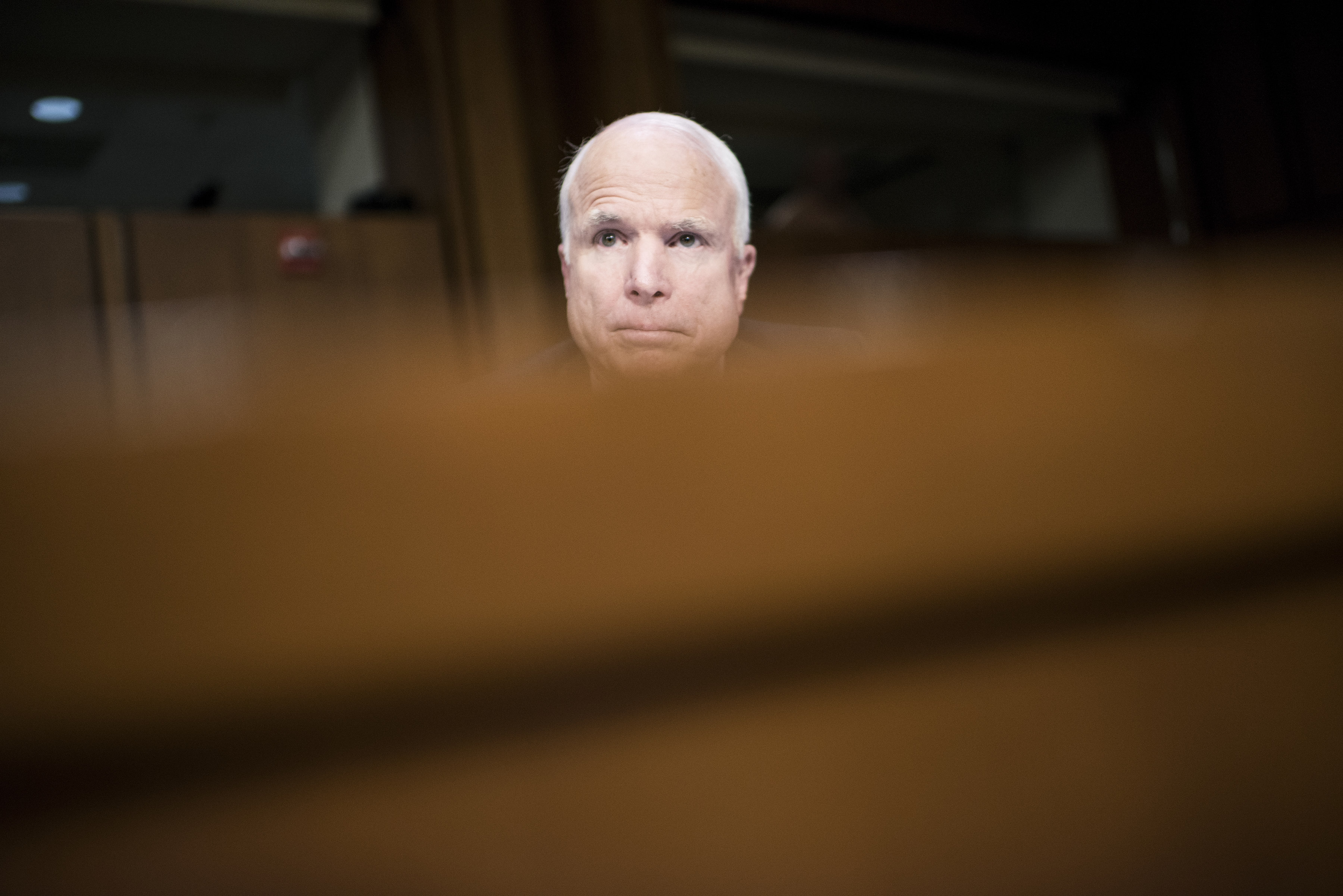
McCain First, Country Last

US-SYRIA-CONFLICT-CONGRESS

The man who crashed in the 2000 primaries, the man who acquiesced to CIA torture (the same methods once used on him) in 2006, the man who claimed to put country first in 2008 and then impetuously picked an unstable half-wit as a veep candidate, the man who wanted to launch a war with Russia over Georgia, and the man who has spent the last five years actively trying to undermine the president’s foreign policy when visiting Israel … well, we should expect stupid amateurish displays of ego like an op-ed in the wrong Pravda.

Yes, it was the wrong Pravda, one founded online in 1999 and not connected to the other Pravda founded in 1912. But McCain is not exactly known for his precision, is he? And at a moment when the US needs to keep relations with Russia stable – because Russia is critical to controlling and destroying Assad’s chemical weapons – McCain lobs a rhetorical hand-grenade at the Kremlin.

What on earth is the point of it? One assumes a riposte to Putin’s op-ed in the New York Times (unlike McCain, Putin didn’t mistakenly put his op-ed on Newsmax). And then you read it and you see the fathomless parochialism that has always clung to this vain, impetuous grandstander. He actually claims he has long been pro-Russia, something so transparently false it is perhaps appropriate it appears in an online outlet with the name of a paper, “Truth”, that became a synonym for its opposite. McCain has been itching for a war with Russia ever since the Cold War ended. But then he itches for war three times before lunch most days.

But this pointlessly provocative op-ed is also obviously serving a purpose. McCain wants the US to go to war in Syria in order to achieve regime change. For him, remember, Iraq was a huge success. Now that he has been stymied in this effort – stymied by the president and the Congress and a huge majority of the American people, 79 percent of whom back the US-Russia agreement – he has decided to try and sabotage it. Think for a minute how important it is right now to retain decent relations with Putin and Lavrov in the attempt to secure and destroy Assad’s chemical weapons. Now read these words:

How has [Putin] strengthened Russia’s international stature? By allying Russia with some of the world’s most offensive and threatening tyrannies. By supporting a Syrian regime that is murdering tens of thousands of its own people to remain in power and by blocking the United Nations from even condemning its atrocities. By refusing to consider the massacre of innocents, the plight of millions of refugees, the growing prospect of a conflagration that engulfs other countries in its flames an appropriate subject for the world’s attention. He is not enhancing Russia’s global reputation. He is destroying it. He has made her a friend to tyrants and an enemy to the oppressed, and untrusted by nations that seek to build a safer, more peaceful and prosperous world.

These sentences could have been written a month ago. There is truth to them – but as a matter of simple pragmatic judgment in this tricky period, could any such rant be more reckless? Directly and personally impugning the president of Russia in a Russian media outlet is the act of an impulsive ego-maniac who is perfectly willing to sabotage his own country’s recent deal with Putin to get some publicity for himself.

McCain First, Country Last, War Forever. That’s his motto. After the last ten years, it isn’t just repellent. It’s recklessly dangerous.

(Photo: Senator John McCain listens during a hearing of the Senate Foreign Relations Committee on Capitol Hill September 3, 2013 in Washington, DC. By Brendan Smialowski/Getty.)

Investing In Marital Bliss

Research showing that married couples that pool their money are happier doesn’t surprise McArdle:

These effects seem to peter out at some very high level — if you keep 5 percent of your income to yourself in order to have a little bit of discretionary spending, it won’t make you any less happy than you’d be if you pool 100 percent. But people who pool 80 percent are happier than those who pool 70 percent, and so on. People who keep it all to themselves are the least happy. …

[I]f you don’t pool the money, then you have to spend a lot of time arguing about the money. You have to decide how the expenses are split. Among other things, this tends to emphasize any earnings disparity between the two of you. It also provides rich fodder for fights over who should have to pay for what because I didn’t even want to go to Napa and get acid reflux drinking wine all week, I wanted to go to Nova Scotia, and I’m definitely not kicking in 50 percent for a stupid deluxe winery tour so I can meet the owner and have him make me feel bad about my taste in wine.

Stop Complaining About Gas Prices

us-euro-2

Drivers in the US get a crazy good deal:

Americans pay around $450 a year in road charges, according to the data compiled by Gomez and Vassallo. That’s roughly three to four times less than drivers from other countries in the study. Once again, the key culprit is the gas tax. U.S. gas tax rates are up to 83 percent lower for gasoline cars and 81 percent lower for diesel cars compared to the same taxes paid in European nations. …

Ideas for improving the U.S. funding model vary. Some feel that taxing miles traveled is the way to go. Others suggest tolling every interstate in the country. Still others suggest we stick it out with a higher gas tax. What’s clear, in any scenario, is that American drivers will have to start paying more to drive – because whetholler the realize it or not, they’ve paid too little for too long.