Making Your Characters Contain Multitudes

The novelist Paul Harding praises John Cheever’s short story, “The Jewels of the Cabots,” for teaching him how to write characters with convoluted and contradictory inner lives:

Cheever is a writer who helped teach me to think about characters like a sphere: You’ve got the north pole and the south pole, a polarity with opposite charges contained inside one whole. But then there’s these magnetic fields created between the two of them, which is where the real complexity is, where the real intermingling of those contradictory impulses take shape.

So I strive for these polarities in my own work. You have to be careful that you’re not dogmatic or schematic about it. But the more I think about it, I’m aware that—in all art forms—contradiction is the essential move or method for art.

In music it’s counterpoint. In landscape painting it’s the contrast between the foreground, which is always dark, and the background, which is light. And in writing, it’s death and life. The imminent arrival of death—what greater thing to set life in relief against? In Enon, the whole thing is just a sonata—it’s just one voice—against the threat of utter darkness. The darker it gets, when we arrives at just one remaining pinpoint of light, that pinpoint becomes all the more beautiful and resplendent for its rarity and clarity against the gloom. You put contradictory things next to each other, and in the intermingling of them you get something like the mystery of human experience.

When America Almost Nuked Itself

Michael Mechanic calls Eric Schlosser’s new book on nuclear weapons accidents “the most unsettling work of nonfiction I’ve ever read”:

Here’s the truth: Just days after JFK was sworn in as president, one of the most terrifying weapons in our arsenal was a hair’s breadth from detonating on American soil. It would have pulverized a portion of North Carolina and, given strong northerly winds, could have blanketed East Coast cities (including New York, Baltimore, and Washington, DC) in lethal fallout. The only thing standing between us and an explosion so catastrophic that it would have radically altered the course of history was a simple electronic toggle switch in the cockpit, a part that probably cost a couple of bucks to manufacture and easily could have been undermined by a short circuit—hardly a far-fetched scenario in an electronics-laden airplane that’s breaking apart.

In an interview with Mother Jones, Schlosser describes the extent of the problem:

Throughout the ’50s and ’60s, it was almost boilerplate for Defense Department officials to say that during an accident there was no possibility of a nuclear detonation, while privately, at the weapons laboratories, there were physicists and engineers who were extremely worried and were well aware that we had come close to having it happen on American soil. If you look at the official list of broken arrows that the Pentagon released in the ’80s, it includes 32 serious accidents involving nuclear weapons that might have threatened the public safety. The list is entirely arbitrary: Some of those accidents didn’t even involve weapons that had a nuclear core, so they never could have detonated. But many, many serious accidents aren’t on that list.

One document I got through a Freedom of Information Act request listed more than 1,000 weapons involved in accidents, some of them trivial and some of them not trivial. There’s somebody who worked at the Pentagon who has read this book, and one of his criticisms was that I’m so hard on the Air Force—he said that there were a great number of accidents involving Army weapons that I don’t write about.

In an interview with Rolling Stone, he discusses nuclear safety around the globe:

I am hugely concerned – and people who have more expertise than I do in this area are hugely concerned – about the possibility of terrorists getting ahold of a nuclear weapon, or the possibility of a nuclear weapons accident by one of the nuclear weapons powers. I’m critical of the management of our nuclear weapons, but we invented this technology. I think we probably build the safest weapons on Earth. And yet, when you think of countries like Pakistan and India and North Korea having nuclear weapons, a useful guide would be to look at the rate of industrial accidents in those countries, which is much higher than here, and their ability to manage this incredible, complex technology is really worrisome. People can disagree on what the best policy should be for the United States, but I think everyone should know what the options are and what the real risk is.

Face Of The Day

Markets React To Federal Reserve Policy Announcement

Traders signal offers in the Standard & Poor’s 500 stock index options pit at the Chicago Board Options Exchange (CBOE) following the Federal Open Market Committee meeting on September 18, 2013 in Chicago, Illinois. Federal Reserve policymakers unexpectedly voted today to continue its bond-buying stimulus program causing an immediate spike in the markets. The Fed also said it would keep short-term interest rates near zero. By Scott Olson/Getty Images.

Ask Trita Parsi Anything

From his bio:

Trita Parsi is the founder and president of the National Iranian American Council and an expert on US-Iranian relations, Iranian foreign politics, and the geopolitics of the Middle East. He is the author of Treacherous Alliance: The Secret Dealings of Iran, Israel and the United States and ​A Single Roll of the Dice – Obama’s Diplomacy with Iran, and has contributed articles on Middle East affairs to the New York Times, WaPo, Wall Street Journal, and many others. He is also a frequent guest on CNN, PBS’s Newshour, NPR, the BBC and Al Jazeera. You can follow him on Twitter here.

We are sorry to note that Urtak, the great polling service we have used to collect and vote on questions, is no longer active. We hope the replacement format below will suffice. Submit your questions at the bottom of the survey:


This embed is invalid

Our recent Iran coverage is here. Our full Ask Anything archive is here.

A Phone That Reads Your Fingerprint, Ctd

A reader notes:

Stealing fingerprints as shown in your Mythbusters clip will not work for the iPhone. I’m surprised Apple hasn’t publicized this more, given the amount of misinformation out there:

[L]ike the sensor in the iPhone 5S, the sensors that will be in laptops and keyboards and other phones can detect the ridge and valley pattern of your fingerprint not from the layer of dead skin on the outside of your finger (which a fake finger can easily replicate), but from the living layer of skin under the surface of your finger, using an RF [radio frequency] signal. That only works on a live finger; not one that’s been severed from your body. This will protect you from thieves trying to chop off your finger when they mug you for your phone (assuming they’re tech-literate thieves, of course), as well as from people with fake fingers using the fingerprint they lifted from your phone screen.

Another reader:

One of your readers commented that “a password you can remember equates to a password that can be cracked.” This is not necessarily true, especially if you change the paradigm of how we construct passwords.

Randall Munroe of XKCD noted that the normal way we make passwords for our systems is based on requiring a certain number of characters in the password, including requirements for uppercase and lowercase letters, numbers, and punctuation symbols. These kinds of passwords are modestly difficult for computers to crack, and they are rather difficult for humans to remember. This leads people to writing down their passwords, and that’s how the courts can get people to give up their password without violating the 5th Amendment.

A different password strategy altogether flips this script. Instead of requiring a certain number of characters, we could instead require a number of words pulled from the dictionary. These are inherently easier for people to remember. While dictionary words are much easier for a computer algorithm to crack on an individual basis than the complex passwords described above, adding a series of them together dramatically ramps up the difficulty of a computer cracking it while still being very easy for humans to remember. This means people won’t have to write down their passwords, so courts will have to recognize your 5th Amendment right to not give up the contents of your mind.

Regarding another recent thread on iPhone technology:

On that Phoneblok idea, I can assure you that the market will NOT be seeing such a easily-reconfigurable phone anytime soon, if ever.  I am an electrical engineer as well as tech market analyst with expertise in display technology as well as connectivity/interface technologies. Phoneblok appears to be something of an industrial engineer’s dream, but it would be the mechanical and electrical engineer’s nightmare come true.

I’m not saying something similar to the Phoneblok concept is impossible, but I can guarantee you that any such design would be so fraught with inefficiencies and design tradeoffs that just to achieve even a marginal amount of block swapping capability as described that the design would be either too large, too thick, too slow, too-everything that it would be dead on arrival in terms of consumer acceptance (if not simply too expensive in the long run for any OEM to even attempt to build it). In terms of forward compatibility, the rate of change in interface speeds, standards, pinout/interconnect physical design is occurring at a rate that by 3 to 4 years from now, your Phoneblok would likely be obsolete anyway.

Why Presidential Approval Matters

Obama Approval

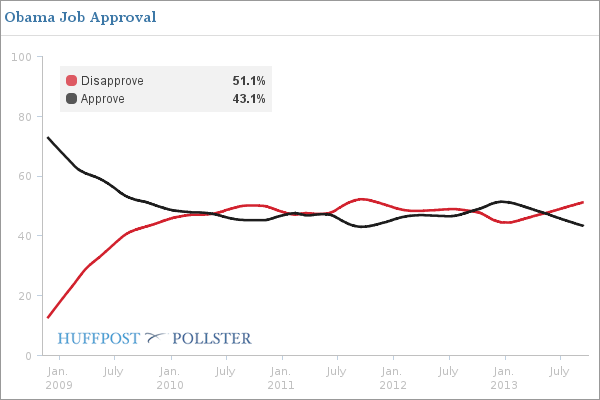
Harry Enten argues that Obama’s falling approval rating “will likely be an albatross around the neck of the Democratic party”:

Obama’s approval rating can greatly affect the 2014 midterm elections and, to a lesser extent, the 2016 presidential election – and the historical odds of it recovering much seem to be slim.

In midterms, electorates often take out their frustration with the president on the their party’s congressional members. A poor presidential approval rating will only add to that frustration. A president likely needs an approval rating in the mid 60s, like Bill Clinton in 1998 and George W Bush in 2002, to avoid the curse of “midterm loss”.

In every non-wartime midterm election since 1938, simply knowing how many seats the president’s party controlled and the president’s approval rating goes a long way in determining how the midterm is going to shake out. Not counting 1974, because Richard Nixon resigned and Gerald Ford took his place, more than 75% of the variation between the seats won in the House by the president’s party in the midterm is explained by the two aforementioned variables.

(Chart from Pollster)

The Vocabulary Of Intervention

Bernstein tsk tsks the media for its handling of the Syria debate:

The press, along with the political establishment, utterly failed to find, or at least to consistently use, a vocabulary for what was on the table. Certainly air or missile strikes are an act of war, and should be reported as such; just as certainly, those sorts of limited attacks always bring with them the risk of additional involvement – either from retaliation or from mission creep. At the same time, calling that “going to war” summons up images of, well, troops marching, and casualties coming home to hospitals or in body bags. Even keeping the risks in mind, that’s not what was being talked about. A vocabulary is really needed to make clear that it is “real” war, but that it’s also not at all similar to Iraq, the Gulf War, or other full-out invasions.

Larison rolls his eyes:

I don’t see why a new vocabulary is required. If firing missiles at the armed forces of another government is an act of war, and it certainly is, the vocabulary to describe this already exists. If many people have a certain idea of what it means to “go to war” that refers to a bigger commitment than “limited” strikes, that doesn’t change what the government is proposing to do. … it would have involved at a minimum using considerable military force to compel another state to punish it and to try to alter its behavior. That’s war, and it’s appropriate and necessary to call it that so that the public is not misled.

Viral Vitriol

Derek Mead flags a study of 200,000 users of Weibo – China’s Twitter-like social network – to gauge which emotions are most “shareable” via emoticons:

Joy is still a viral emotion, while sadness and disgust are much less so. But anger wins out. As Technology Review points out, a lot of this anger was found to be in relation to politics, both international and domestic. That’s not surprising, as political problems tend to be popular as well as incite anger and frustration. … I’d also venture to guess that sadness and disgust simply don’t translate as well. People want to share things they’re either passionate about or that they feel smart about sharing, and sad or disgusting things are harder emotions to fit into either of those categories. I guess the retweet barrier for “This guy is a shithead” is much lower than for “Life sux,” perhaps because sadness and disgust don’t jive with our carefully-manicured online images.

What triggers such anger the most?

The first are conflicts between China and foreign countries, such as the military activities of the US and South Korea in the Yellow Sea and a collision in September 2010 between a Chinese and Japanese ship. The second are domestic social problems like food security, government bribery and the demolition of homes for resettlement; all hot topics in China. “This can explain why the events related to social problems propagate extremely fast in Weibo,” say Rui and co.