Where The Public Is On Obamacare

Pew Obamacare

Suderman summarizes recent polling on the ACA:

USA Today/Pew poll taken last week and released today finds that 53 percent of the public disapproves of the health care law, with 41 percent saying they disapprove strongly. The same percentage of respondents—53—say they disapprove of the way that President Obama is handling health policy. A Reason-Rupe poll published last week finds similar skepticism about the way the law is being handled, with 62 percent of those surveyed saying that implementation of the health law is not going well.

A poll from NBC/WSJ contains similarly bad numbers. But it also finds that increased knowledge of the law correlates with more support for it:

34% say they don’t understand the law very well, and another 35% say they understand it only “some.” That’s compared with 30% who understand it either “very well” or “pretty well.” As it turns out, that 30% has more positive opinions about the health-care law (42% good idea, 45% bad idea), versus the 34% who don’t understand it very well (17% good idea, 44% bad idea). … The White House has tried to start health-care education campaigns a few times, but to no avail. If they could actually sustain one of their campaign-style pushes on health care, these numbers suggest it COULD pay off.

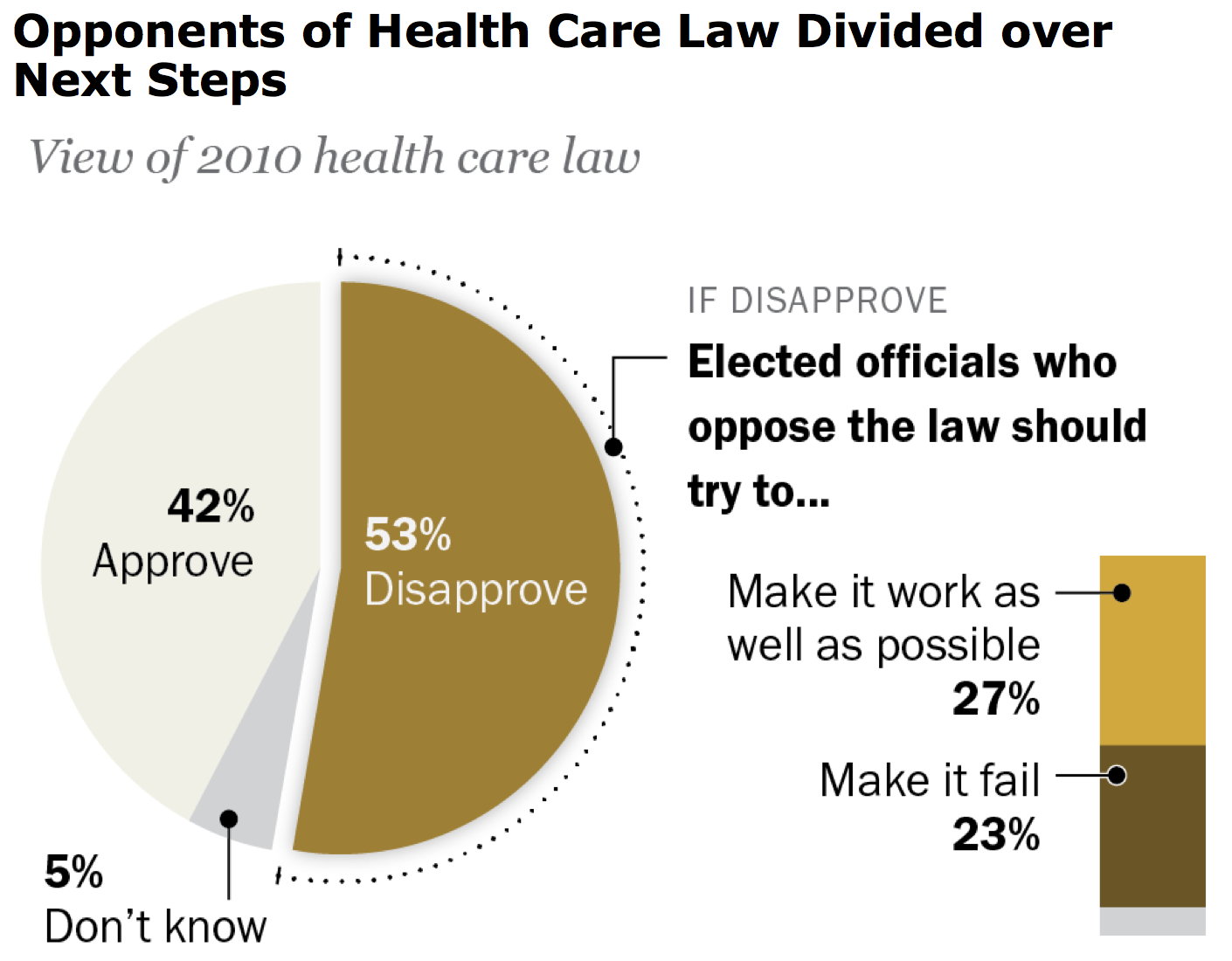
Greg Sargent focuses on the numbers in the above chart from Pew (pdf), which demonstrate that relatively few Americans want the law to fail:

[L]arge majorities overall either support the law or oppose it but want lawmakers to try to make it work. Simply put, the zeal to prevent the law from functioning as well as possible is well outside the American mainstream.

To some degree this mirrors the situation within the House of Representatives itself. A majority of Members would vote tomorrow to fund the government without any defund-Obamacare rider attached, or to raise the debt limit without any Obamacare delay attached. But because House GOP leaders are loathe to allow a vote on anything unless a majority of House Republicans approves of it, the result is that — if today’s Pew poll has it right — the delusional preoccupations of a small minority of the American people are having an outsized impact on, well, our entire political situation, with potential economic chaos looming as a result.

Chait expects the politics of Obamacare to change once the uninsured are in the system:

Any future revision will have to account for them. Anybody who wants to overhaul the health-care system will not merely have to protect insurers and medical providers but Americans in health exchanges, too. It will no longer be possible for Republicans to propose repealing Obamacare and making some vague hand-waving to do something for the uninsured at some future point. Republican health-care reform will have to include everybody. All this is contingent on the law actually getting up and running.

Republicans are afraid of that transformation, and they’re right to be.

Finding The Words Of Seduction

Last week marked the 1885 birth of D.H. Lawrence. To celebrate the occasion, The New Republic pulled Edmund Wilson’s 1929 review of Lady Chatterly’s Lover from their archives, an essay in which Wilson claims Lawrence “has written the best descriptions of sexual experience which have yet been done in English”:

The truth is simply, of course, that in English we have had, since the eighteenth century, no technique—no vocabulary even—for dealing with such subjects. The French have been writing directly about sex, in works of the highest literary dignity, ever since they discarded the proprieties of Louis XIV. They have developed a classical vocabulary for the purpose. And they have even been printing for a long time, in their novels, the coarse colloquial language of the smoking-room and the streets. James Joyce and D. H. Lawrence are the first English-writing writers of our own time to print this language in English; and the effect, in the case of Ulysses at least, has been shocking to English readers to an extent which must seem very strange to a French literary generation who read Zola, Octave Mirbeau and Huysmans in their youth.

But, beyond the question of this coarseness in dialogue, we have, as I have intimated, a special problem in dealing with sexual matters in English.

For we have not the literary vocabulary of the French. We have only the coarse colloquial words, on the one hand, and, on the other, the kind of scientific words appropriate to biological and medical books and neither kind goes particularly well in a love scene which is to maintain any illusion of glamor or romance.

Lawrence has here tried to solve this problem, and he has really been extraordinarily successful. He has, in general, handled his vocabulary well. And his courageous experiment, in Lady Chatterley’s Lover, should make it easier for the English writers of the future to deal more searchingly and plainly, as they are certainly destined to do, with the phenomena of sexual experience.

A Second Look At Science

This embed is invalid


Carl Zimmer praises Retro Report as a source of science journalism:

These videos remind us forcefully that the real meaning of stories about science takes time to unfold. That is very hard to remember, because there’s something intoxicating about a new science story. Suddenly some great truth about the world seems to be unveiled. That truth can be terrifying, or elating. I can’t count all the emails I’ve gotten when I’ve written a story about some very preliminary research on a disease, from people who suffer from the disease and want to know where they can go to get cured.

In reality, a lot of science-related conclusions fall apart or have to be revised in later years. Science itself is starting to grapple with its flaws, with papers like “Most Published Research Findings Are False.” On the other hand, some findings gain strength over the years, as more and more evidence supports them. But those studies pile up like sand grains, and so it’s easy for journalists to overlook them, even after they’ve grown into a mountain.

Zimmer recommends the above video on Biosphere 2, “the sealed building that was supposed to become self-sufficient and instead went wrong in a fascinating way.” Previous Dish on Retro Report here.

Decreasing Our Chances For Cheating

James M. Lang argues that classroom cheating has less to do with the students and more to do with the structure of coursework:

[C]heating levels are fairly high, but they have always been so. The better question to ask is why. Duke University researcher Dan Ariely and his colleagues have conducted dozens of experiments designed to see what makes people willing to engage in acts of cheating and dishonesty in their everyday lives. Their findings have been remarkably consistent: most people, under the right circumstances, are willing to engage in small acts of dishonesty. This seems to be a part of our human nature.  With enough incentives in front of us, most of will cheat at least a little bit.

Fortunately, Ariely’s formulation has a happy corollary:

Since most people are willing to cheat under the right circumstances, our best approach to reducing cheating will be to change those circumstances. If we open our minds to this possibility, we will have to reconsider the nature of the learning environments we are presenting to our students at both the high school and college level.  When we do so, we might find that a significant portion of college and university courses feature precisely the types of circumstances that induce cheating.

Daniel Luzer gets specific:

If you make students write papers by proposing ideas, submitting multiple drafts, they won’t cheat on the papers. Likewise, if you give examinations that are based on answers to essay questions (rather than Scantron multiple choice tests), students can’t cheat.

This isn’t to say students aren’t 100 percent responsible for the moral error of cheating, but if you want them to learn that requires more effort on the part of the teachers. This higher quality examination strategy is not just good for preventing cheating; it’s also a better way for students to learn.

Previous Dish on cheating here and here.

Letting Sunlight Through The Bars

Lex Berko explores ways to reduce inmate suicides:

According to the World Health Organization, hanging is the most common form of inmate suicide, a fact that guides most prisoner suicide prevention policies. Rooms should contain no protrusions to which a noose can be tied. That includes doorknobs, clothing hangers, and light fixtures. Items that can be used as nooses or ligatures should also be removed from cells. A seemingly harmless laundry bag cord can become fatal in the hands of someone intent on suicide. …

But what is also interesting are more subtle touches that Hayes lays out.

Housing placement should be based on increasing interaction with staff, “not on decisions that heighten depersonalizing aspects of confinement“. All cells should have a view of the outside world to connect inmates to the larger world. “The ability to identify time of day via sunlight helps re-establish perception and natural thinking while minimizing disorientation,” says Hayes’ checklist. So while it should be obvious, preventing inmate suicide is not just about confiscating the materials necessary to successfully kill oneself, but also about ensuring the general mental stability of those under correctional facility care. Sunlight makes humans feel human, something that can be elusive in the confines of a prison cell.

Ready For The Next Government Shutdown?

With Republicans threatening an end to federal operations unless Democrats gut Obamacare, Scheiber expects a shutdown in October, since “neither side has an incentive to back down”:

In 2011, Obama was willing to give on his demand that revenue increases accompany spending cuts because he understood the apocalyptic consequences of failing to raise the debt ceiling. In late 2012, Republicans knew that the alternative to a small tax increase was for taxes to rise automatically by a much larger amount. This time, on the other hand, every party to the negotiation has reason to welcome the government shutdown that would result if they can’t reach a deal.

He thinks a shutdown will be “a good thing,” since it “gives everyone a chance to sober up before we take on the substantially higher-stakes proposition of avoiding a debt default.” Elias Isquith is skeptical of this logic:

[W]hat I don’t understand is why we believe these Tea Party folks will be more susceptible to reason after a shutdown than they are now? We seem to be putting a lot of faith behind the power of public opinion — yet at the same time it’s well understood that many Republicans only fear a primary challenge from their right, and that top-line public opinion doesn’t sway them.

Quote For The Day

“I’m addicted to working. I mean, I have a list of 100 countries I want to play in. I’m basically killing myself by travelling so much, for no reason whatsoever. As you know, I can’t have one pair of shoes, I can’t have one CD, I can’t have one bunch of flowers, one car, one ornament, I mean, that’s my mindset. It’s like, if I do 120 shows in a year, I want to do 130 the next year. I’m very proud of doing over 200 flights a year. Why are you so proud? It’s fucking killing you. After I was ill, I sat down with David and had to admit to my addiction: ‘David, I can’t stop working,'” – Elton John, at 66.

A Real “Critique Of Pure Reason”

In which a Russian is shot in a dispute over Immanuel Kant:

A police spokeswoman in Rostov-on Don, Viktoria Safarova, said two men in their 20s were discussing Kant as they stood in line to buy beer at a small store on Sunday. The discussion deteriorated into a fistfight and one participant pulled out a small nonlethal pistol and fired repeatedly.

Not Monty Python, alas.