The dog-bootie high-step:
Month: September 2013
The Invisible Hand Of Censorship
Harvard political scientists designed a bogus social network in China and observed how it became blocked:
What they found was that the service providers and software firms provide a huge variety of choice in censorship methods, ranging from blocking certain keywords, to delaying publication on posts until they can be reviewed, to blocking certain users by IP address, to filtering out posts based on length. In other words, there isn’t a centralized set of guidelines banning any mention of Ai Weiwei, Tibet, or Tiananmen Square, companies are instituting their own guidelines in hopes of avoiding the government’s periodic crackdowns. As the MIT Technology Review put it, the experiment suggests that “China has created a kind of competitive market in censorship… Companies are free to run their censorship operations mostly as they wish, as long as they don’t allow the wrong kind of speech to flourish.”
Jeffery Wasserstrom adds:
[M]any know that Beijing uses a “Great Firewall” to try to keep the web free of things it dislikes. What fewer appreciate is how much energy the Chinese government puts into trying to flood the Internet with things it likes. People can earn small payments, on a post-by-post basis, for adding pro-government comments to sites. Bloggers mock this piece-rate system: those benefiting from it, they say, have joined the “Fifty-Cent Party” that props up the Communist Party.
How The Media Imagines Millennials
Daniel D’Addario feels that Meghan McCain’s new TV show represents “the worst of millennial culture”:
[U]ntil I saw “Raising McCain,” I had thought millennials got a bad rap.
The series, which [debuted] on the new network Pivot TV [on] Saturday, is a combination talk show and unscripted series — half “The View,” half “Sarah Palin’s Alaska.” It follows the exploits of one Meghan McCain, the daughter of the current U.S. senator from Arizona and one-time presidential nominee John McCain; she alternates between interviewing her guest and showing a slice of what it is like to be the daughter of a U.S. senator who lost the presidency in a landslide. She has been given 30 minutes a week on an aspirant cable network to prove that she has nothing to say.
Meghan McCain is the epitome of what it is to be not a millennial — a group of individuals of multifarious racial and class backgrounds — but the media perception of a millennial. The media wished that millennials, as a group, could be self-absorbed, entitled and unimaginative; Meghan McCain rose to the challenge.
But Emily Nussbaum thinks the millennial-targeted Pivot network, sans McCain, shows potential:
Pivot is barely a network yet—it’s more of a soft launch—but, at its best, it feels like a thoughtful attempt to reach young viewers without relying on pre-chewed assumptions about who they are. Traditionally, cable networks don’t find their identities until they create a hit: “The Sopranos” for HBO, “Buffy” for the WB, “Mad Men” for AMC. Yet there’s something to be said for watching an institution before it becomes a stable brand, when there’s still oddness and experimentation, and room for interesting mistakes. MTV was like that at first: although the v.j.s barely knew how to handle their microphones, if you were the right age you couldn’t stop watching. Pivot isn’t anywhere near that exciting yet, but it’s been around only a month. Give the kid a chance.
A Pre-Tenderized Meal, Ctd
Brendan Buhler argues that roadkill is the most ethical meat to eat:
Practical, culinary and even legal considerations make it hard for many to imagine cooking our vehicular accidents, but that needn’t be the case. If the roadkill is fresh, perhaps hit on a cold day and ideally a large animal, it is as safe as any game. Plus, not eating roadkill is intensely wasteful: last year, State Farm Mutual Automobile Insurance Company estimated that some 1,232,000 deer were hit by cars in the United States. Now imagine that only a third of that meat could be salvaged. That’d be about 20 million pounds of free-range venison, perhaps not much compared to the 23 billion pounds of beef produced in the U.S. in 2011 but significant.
Laws about consumption of roadkill vary by state:
In West Virginia, the roadkill must simply be reported to the state within 12 hours of its collection. Tennessee considered a similar law, but withdrew it under ridicule. In Massachusetts, you must obtain a permit after the fact and submit your roadkill to inspection by the state. In Illinois, the chain of title is somewhat complicated and no one delinquent in child support may claim a dead deer. Alaska practices roadside socialism: all roadkill belongs to the state, which then feeds it to human families in need.
On the other hand, Texas, California and Washington may not agree on much, but they are three of the very few states that agree that possession of roadkill is illegal. Apparently, they worry it will lead to poaching.
Earlier this year we looked at Montana’s move to legalize roadkill consumption.
How Safe Is Home-Birth? Ctd
A doctor writes:
Home-birth is every bit as dangerous as Laura Helmuth expected. The most comprehensive figures to date were collected by the state of Oregon, when home-birth midwives refused to release their death rates to the state. Oregon asked Judith Rooks, a certified nurse-midwife, to analyze the data, and what she found was appalling. The death rate from planned home-births with a licensed Oregon home-birth midwife was 800% higher than comparable risk hospital birth. Below is the chart that she included in her testimony before the Oregon legislature:
By the way, the Cochrane Review that you cited is worse than useless. They drew their conclusions from only eleven home-births. The data above was derived from 2000 home-births.
The Midwives Alliance of North America, the organization that represents home-birth midwives, has collected data on 28,000 home-births attended by their members. They have publicly released the C-section rate, intervention rate, transfer rate and prematurity rate, but they refuse to release the death rate. It doesn’t take a rocket scientist to figure out that they are hiding the death rate because it is extraordinarily high. Even home-birth midwives know that home-birth has a high death rate. They just don’t want the American public to find out.

Another reader:
I am a mother of three and a trial lawyer representing children injured during labor and delivery by obstetrical or nursing negligence. I recoil at the relentless drive of the right wing to control or limit the healthcare options of women, but when it comes to home birth, my job makes it impossible for me to view it as a wise choice for anyone.
My clients all had normal pregnancies, healthy babies, and developed difficulties during labor and delivery that warranted a C-section. No one knows what will happen in any given labor, and a healthy pregnancy is no guarantee you won’t draw that black bean. When a C-section is called for but delayed, the results can be tragic. My infant clients who were denied a timely C-section often have hypoxic ischemic encephalopathy, a condition where child will never walk, talk, eat, or be self-sufficient. Their families courageously soldier on through every day but their lives are never close to normal again. Other children in the family are always neglected. Often the couples divorce because the stress of becoming a nurse to a severely disabled child is just too much to bear. Every simple task is a strain. The medical care costs are enough to bankrupt anyone, and as a result, most families do without help because they can’t afford it.
Of course, you can’t always avoid this fate by being in a hospital, but it’s far more likely that a baby in distress will experience a dangerous, avoidable delay in delivery if the mother isn’t even AT a hospital. If home-birthers could see one day in my clients’ lives caring for a brain-injured child, I doubt they’d be so gung-ho. Someone should tell these women to stop gambling with their babies’ lives. The reason birth morbidity and mortality rates are so much lower now than in 1800 is because of medical advances, not because people avoid them.
Can you have a safe home birth? Maybe, if you’re lucky. I just can’t see how anyone’s preferences for a kumbaya birth experience that lasts for a few hours could outweigh a baby’s right to a normal, healthy life.
By the way, I don’t think most women will get any pushback if they refuse an epidural or drugs in the hospital. And I’ve had many friends deliver drug-free in hospitals.
On that note, another reader:
When my daughter was born, we were at the “baby factory,” home to the largest neonatal unit in a sizable city. Approximately a month before the birth, we took a tour of the facility, where they make a point of telling you all the options: lying down, squatting, water birth … the only thing NOT mentioned were drugs. There was, of course, discussion of C-section, and a show of the operating rooms. We were encouraged to pre-select our music/movies that we would like to e played during, and told that midwives were welcome. (we did not use a midwife).
The day of the birth my wife’s contractions were carefully monitored. Our nurse came in, noticing the scale of the contractions, and commented that the intensity suggested that the pain “was probably a 9 or a 10.” A nod through clenched teeth confirmed this assessment. The nurse then offered remedies: ice chips, waking around, shifting positions. Conspicuously absent: medication.
But we were big fans of better living through chemistry, so I offered that we would like drugs. The nurse smiled and then fetched the doctor. It was then later explained: they are specifically trained NOT to offer medication; we had to positively request it.
I heard so much strange advice during my wife’s pregnancy, but the one thing I have no patience for are people who insist that hospitals systematically force people away from their wishes. Every person we met at this alleged “system” was specifically trying to give us the widest berth to do it our way, while caring for our and our daughter’s health. We has a wonderful staff of people who genuinely respected our choices, but did so in an environment fully prepared to handle any eventuality.
I have no issues with midwives or those who use them – except with they claim that people who choose in perinatal medicine as their career, a truly exhausting job where you see people in very high stress who are not at their best, and you get a lot of irrational abuse, are interested in nothing more than pumping new mothers full of drugs. They deserve better.
Another looks at the middle ground between birthing at home and the hospital.
My wife and I have three children, all of whom were born in “home away from home” birthing centres at hospitals in London. The rooms are made up like spacious bedrooms with double beds and comfortable furnishings. My wife was able to deliver each of our children, with support from a midwife, in an environment that combined much of the informality of a home birth with immediate access to nurses, doctors, and medical equipment should they prove themselves necessary. The staff avoided medical terminology, introduced themselves by their first names, and gently and regularly reminded us that mum is not a patient, is not sick, and that pregnancy and birth are part of healthy life.
Several weeks before, we’d been shown around and saw the crash cart and noted the double doors that separated the centre from the hospital proper. The process of admission was explained to us. We were visitors unless something required medical intervention. Only then would my wife/baby would become patients of the university hospital. My wife was able to give birth comfortably and naturally and reassured.
The Syria Dodge
Have you noticed how almost all of Obama’s critics on Syria have berated him for the optics, but have never said what they would have done in each particular moment? Greg Sargent has. Money quote:
What this whole dodge comes down to is that one can’t admit to thinking that going to Congress and pursuing a diplomatic solution are the right goals for Obama to pursue, without undermining one’s ability to criticize Obama for betraying abstract qualities we all know a president is “supposed” to possess. It’s simply presumed to be a positive when a president shows “strength” by “not changing his mind,” and it’s simply presumed to be a negative when he shows “weakness” by changing course in midstream. That’s “indecisive,” and that’s bad, you see. But it’s a lot harder to sustain these “rules” if you admit you agree with the actual goals Obama is pursuing with these changes of mind. After all, if Obama’s changes of mind have now pointed him towards goals you agree with, how was changing course a bad thing?
People should come clean about what they really believe about all this stuff.
But that would require them leaving Politico-style bullshit and actually looking at the situation and trying to figure out the best way forward for US interests. And that’s hard. It’s sooo much easier to talk in crude and spectacularly dumb terms like “strong” or “weak” without any reference to the goals at hand. The dirty truth: pundits are so much more comfortable examining style because they’re actually too lazy or terrified of actually tackling the substance, let alone taking a stand on it.
The Hydration Hype
Michelle Obama is making a new push for drinking more water:
Sarah Kliff notes that science doesn’t seem to support drinking any particular amount of water and that the eight-cups-a-day idea has a suspect origin:
You’ve likely heard at some point that its prudent to drink eight cups of water a day. But that’s not part of any federal guideline right now, and tracking down where the number came from turns out to be surprisingly tricky. …. But that advice on how much to guzzle is still popular, and some of that appears to have to do with the water industry, which, of course, encourages people to drink as much water as possible.
Drum adds:
[I]f the First Lady’s message is to drink water instead of sugary crap, that would be fine. Unfortunately, that message got ditched long ago, a victim of corporate realities. According to food scientist/activist Marion Nestle, Obama’s anti-childhood obesity campaign “is premised on the idea that change won’t happen without buy-in from the food industry.”
Which is, sadly, probably true, and the article [here] suggests that the food industry has accepted the water message because beverage companies all make as much money from selling bottled water as they do from selling soda.
So why not try? It couldn’t harm us – and I’m one of the soda-freaks – to drink less soda and more water. And the message in the ad is much better than the usual nannying: it insists you’re in charge of what you drink, does not mention the alternatives and plugs water anyway. And although we don’t know how much more water we should drink, I cannot see why that matters. A little more would be good for all of us.
Stay-At-Home Adults
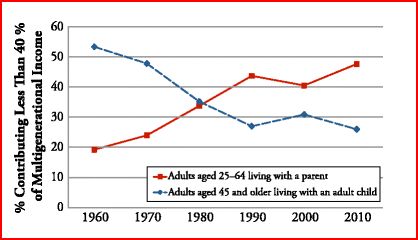
Lisa Wade relays data indicating that a significant number of adults share a home with their parents:
About 12% of 25 to 44-year-olds lived with their parents in 1960, that dropped to 9% by 1980
and, in 2010, topped out at 17%. Almost one-in-five adults were living with their parents at the turn of this decade.
There are two scenarios, here, however. One indicates the decreasing financial well-being of the elderly: parents move in with their children because they can’t afford to live alone, perhaps after retirement. The other indicates the decreasing financial well-being of young and mid-life adults: children are moving in with their parents because they can’t get a good start to life.
It turns out that the first scenario is actually on the decrease, while the latter is on the increase. The rise in co-residence is a consequence of the failure of our economy to integrate young people into jobs that pay a living wage. Literally, a growing number of Americans — both young people and those in mid-life — can’t afford to leave the nest. And, no, this didn’t start with the recession, it started in the ’80s.
A Polarizing Candidate For A Polarizing Time?
Frum claims that Democrats, having realized how polarized Obama’s presidency has made the country, will want a firebrand like Hillary Clinton:
In this mood, Democrats may care a lot more about toughness and combativeness than about minute gradations of progressiveness. And about Hillary Clinton’s combativeness, nobody has ever had any doubts. Maybe she voted for the Iraq War when Barack Obama opposed it. Maybe her husband’s administration lightened regulation of the financial industry and cut capital gains taxes. So what? “You know you can count on me to stand up strong for you,” Hillary Clinton told supporters in Pennsylvania on the night she won that state’s primary in 2008. “Standing up strong” is what Democrats will be looking for in 2016. Affect will matter more than policy, and Hillary Clinton has the affect of the tough and decisive leader.
To woo progressive Democrats, Hillary Clinton does not need to deploy a radical policy platform. She needs to go toe-to-toe with Republicans. She needs to breathe fire. She needs to reassure her party that she doesn’t believe that discredited old junk about “no red states and no blue states.” Democrats now accept that the divide is real, and in their politicians as in their preferred cable channel, they are looking for champions willing to take heat and return fire. The details of each candidate’s health care platform will matter a lot less than the candidate’s eagerness for the fight.
The Fight Over The Fed: Reax

Larry Summers will not be the next chairman of the Federal Reserve. I cannot say this is a subject I feel that strongly about – except for the symbolism that Summers’ buck-raking and deregulating past conveys about the administration’s view of Wall Street. Cassidy suspects it wasn’t Summers’ decision:
Faced with this rebellion on several fronts, it’s only reasonable to speculate that the White House political shop prevailed upon the President to give up on nominating Summers, that he reluctantly agreed, and that somebody told Big Larry the news and gave him the option of withdrawing gracefully before another name was announced.
How Chait understands Summers removing his name from consideration:
Summers’s candidacy is a rare opportunity for liberals to stymie Obama without committing political suicide. Withholding their votes on legislation simply allows Republicans to prevent any bill at all from being passed – that’s why liberals never had any leverage to push bills like the stimulus or Obamacare leftward. Likewise, if liberals joined with Republicans to block contested nominees for the cabinet or other posts, it would simply help the GOP keep those posts vacant.
But Republicans aren’t willing to completely obstruct the workings of the Fed – business wouldn’t allow it. The collapse of Summers’s nomination is thus the rare case where liberal opposition can result in a more liberal outcome.
Gross’s perspective:
To a degree, Summers has been punished for the shortcomings of President Obama and Wall Street. But he’s also been punished by his own shortcomings.
Let’s be clear. Larry Summers has all the academic, professional, government and intellectual credentials and skills necessary to run the Fed. Had he been appointed and confirmed chairman, he would doubtlessly have been an excellent one. But the job is a multifaceted one. It’s not enough simply to be the smartest economist around. You have to be a consensus builder, you have to demonstrate a capacity for empathy, to take the feelings, sensitivities, fears, of all sorts of actors into consideration.
And you have to possess a certain amount of humility—or at least try to feign it from time to time.
Heh. It always helps not to be a raging asshole. Ambinder’s two cents:
As POLITICO noted, a number of Democratic Senators are circling on the anti-Summers bandwagon and have elections in 2014. The presence of an absolutely qualified and more politically palatable alternative, Janet Yellen, made their decision more easy. Yellen will face fire from Republicans, and partisan fire, which Democratic senators will relish and gain momentum from. Our politics has taken a distinctively populist turn, even if only in tone, Yellen better fits the moment. It is extraordinary that liberal pressure groups have exerted influence on the Fed chair process, but indeed they have. And perhaps it’s a good thing: Not since Paul Volcker has the position been at the center of the debate about the way forward.
Krugman thinks “it’s really, really hard to see how Obama can justify not picking Janet Yellen at this point.” Ezra sees Yellen’s strong track record a primary argument for her nomination:
If you go back to the Fed’s December 2007 transcripts — the most recent we have — you’ll find the Federal Reserve predicting that the economy would avoid recession. William Dudley, now the chairman of the Federal Reserve Bank of New York, said that “fear is diminishing, which implies less risk of a crisis developing from this source” — “this source” meaning the bad mortgages that would imperil Wall Street and the world a year later.
You’ll also find Yellen voicing a prescient note of pessimism. “The possibilities of a credit crunch developing and of the economy slipping into a recession seem all too real,” she warned. In ensuing years, Yellen pushed for the Federal Reserve to do more to combat an employment problem that she didn’t see abating — advice that Bernanke and the rest of the FOMC eventually followed, when their optimistic forecasts proved terribly wrong.
Sarah Binder thinks the administration allowed opponents of Summers too much time to organize:
[N]early three months have elapsed since the president suggested to Charlie Rose that he would not reappoint Ben Bernanke. The extended flight of the Summers trial balloon lasted too long. Some argue that the intervening Syria debacle emboldened the left and helped to throw a roadblock in Summer’s path to confirmation. My hunch is that the Syria diversion mattered because it sucked all the wind out of White House efforts to recruit Senate support for Summers. More importantly, by never actually nominating Summers, the White House left his opponents in control of the confirmation contest. Opposition groups on the left (and supportive, list-prone economists) organized their troops for battle against Summers and in defense of Janet Yellen. The White House couldn’t publicly counter-lobby because they had no nominee to defend. A new Catch-22: The White House refused to nominate until confirmation seemed plausible, but failure to nominate helped to put confirmation out of reach.
Greg Ip notes that monetary policy “played almost no role in the controversy” over Summers possible nomination:
Mr Summers’s critics showed little interest in his views on inflation, unemployment or how the Fed should behave in a world where its main tool, the short-term interest rate, is impotent. If they had they would have found him as dovish as Mr Bernanke or Ms Yellen, all of whom are far more preoccupied with unemployment than inflation. That is testament to the consensus in mainstream macroeconomic circles about the right stance for monetary policy now, and the durability of the framework Mr Bernanke has assembled. This suggests that, even though the search for its next chairman has turned into a circus, the Fed will be fine in the end.
Felix Salmon zooms out:
[T]he Fed chairmanship should never become a political football. If Obama wanted to nominate Summers, he should have just done so, rather than raising a trial balloon in July and then letting it slowly deflate. Both Alan Greenspan and Ben Bernanke were nominated by a Republican and then re-nominated by a Democrat: that above-politics status is exactly as it should be. I hope that Washington will learn from this debacle, and that if the Republican candidate wins the next presidential election, he or she will feel free to re-nominate Janet Yellen. That would be the sign we all need that the Fed chair is a technocratic position, not a political one.
(Photo of Janet Yellen by Kathryn Scott Osler/The Denver Post via Getty Images)
 The Dish