St. Gervais?

Willa Paskin reviews Ricky Gervais’s new show Derek, in which he plays a man who works at an old-age home and “seems a little off”:

Derek is neither cringey nor particularly comedic: It’s the first show Gervais has done about characters for whom he feels nothing but admiration and sympathy. Tearing up after the death of a resident at the home, Derek says that the deceased told him, “It’s more important to be kind than clever or good-looking. I’m not clever or good-looking, but I am kind. ” This is Derek’s mission statement: It is better to be kind. Derek is loving and sweet guy who helps everyone he can, never complains, and never feels bad about his lot in life. … Gervais has created a selfless, innocent, all-forgiving savant who always turns the other cheek and whose simple, pure life is a demonstration to the neglected around him of humanity’s capacity for good. Gervais may be an ardent atheist, but Derek’s not a character, he’s a saint.

Phil Dyess-Nugent suggests Gervais may have shifted “too far in the extreme opposite direction” from his usual comic ruthlessness:

[I]t’s pretty amazing—like, “Music Of The Heart, a film by Wes Craven” amazing—that the man who gave us that scene in Extras in which Kate Winslet talked (cynically, hilariously) about wanting to make a Holocaust film (because it was a sure shot at an Oscar nomination) now wants to give us this, with his tongue nowhere near his cheek. His own performance is never convincing—you look at him and want to shout, “Jesus, man, I don’t vote for the Emmys, but if I could, I’d give you one if you’d just close your mouth!”—and it’s just one piece of a big gooey pile of treacle.
Myths Are Made To Remake

In an interview with The Paris Review, the lyric poet Gregory Orr muses on his Orpheus & Eurydice, a modernization and re-imagining of the Greek myth:

The beautiful thing about myths is that you’re never telling a myth, you’re retelling it. People already know the story. You don’t have to create a narrative structure, and you don’t have to figure out where it ends. As a lyric poet, you can take the moments of greatest intensity in the myth, or the moments that interest you most, or the ways of looking at the story that you think would be most fun to rethink—you don’t have to do the whole story. You want to know what human mystery can be revealed by retelling it. D. H. Lawrence said that myths are symbols of inexhaustible human mysteries. You can tell them a hundred, a thousand times, and you’ll never exhaust the mystery that’s coded into that story. That may be a little hyperbolic, but I believe it.

Mental Health Break

“Hollywood & Vines” is the first film directed via Twitter and shot entirely on Vine. For four days, people around the world worked with the director to share in the creation of a single story about travel, adventure and finding your place in the world. This is the result of that global experiment, featuring 100 Viners from everywhere from Kansas to Kuwait.

What Is A Book?

Leah Price’s answer is more complicated than you’d expected:

“[B]ook” has meant different things to different cultures. It sometimes refers to a sequence of words that’s long enough to form a whole, though short enough that it’s not impossible for one person to read the whole thing—and even then, most books are treated more like a buffet in which readers graze for quotable quotes than like a meal whose different courses need to be eaten in sequence and it’s an insult to the chef if you don’t finish everything on your plate.

At other times and places, a book hasn’t referred to a sequence of words but rather to a material object—a roll of a manageable size, for example, or a codex that’s thick enough for its title to be spelled down its spine. This is one reason that UNESCO defined “book” in 1964 as “a non-periodical printed publication of at least 49 pages, …made available to the public”; but the redundancy of “publication made available to the public” points to what remains slippery in that definition. Where do you draw the line between publication and internal circulation, for example? And “of” begs questions as well. The early modern Sammelband is a book made of different works bound together by what we would today call the end user—it’s the reader, not the publisher, who assembled those parts into a whole that we’d recognize as a book. So “book” is a term that has fluctuated and been fought over long before e-books began to face off with p-books.

What A Masterpiece Can Mask

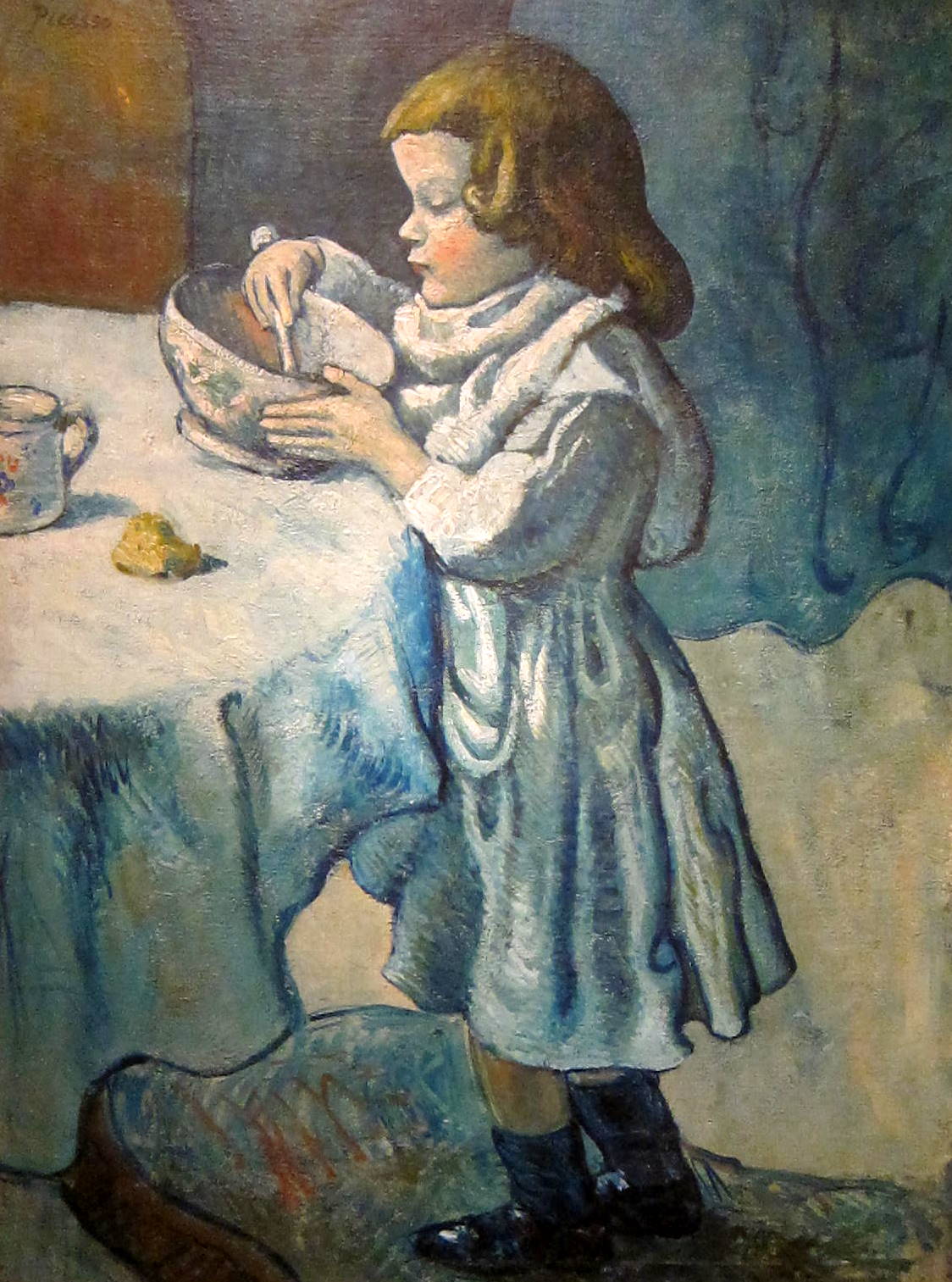
Harmony Huskinson highlights the work of John Delaney, the Natural Gallery of Art’s senior imaging scientist who uses a special camera to “reveal not just what’s under the paint, but also what is happening at each layer of paint that lies under the surface” of famed works of art. One example of how he deploys the technology:

One of Picasso’s most distinctive pieces from his Blue Period, “Le Gourmet,” depicts a child Le_Gourmetscraping his bowl for the last morsels of food. But underneath the azures and cobalts on the canvas, there’s a hidden portrait—of a veiled woman gazing serenely out into the distance. This hidden portrait, which Picasso worked on before his Blue Period, uses bolder dabs of  white paint and may contain other unknown pigments.

The ability to view early sketches and paintings hidden underneath the surface has been around for decades, thanks to infrared reflectography, which was used to uncover the veiled woman at the National Gallery in the mid-1990s.

But Delaney’s technology goes far beyond seeing a concealed drawing. His infrared imaging method takes pictures of Picasso’s mysterious woman at a range of infrared exposures. Delaney then turns these images into a flipbook of sorts, allowing viewers to see the little boy fading as the woman emerges from the canvas.

To see the portrait hidden beneath “Le Gourmet,” go here.

(Picasso’s “Le Gourmet,” 1910, via Wikimedia Commons)

Sympathy Is A Social Construct?

Claude S. Fischer claims that appeals to our sympathy wouldn’t always have been effective:

That humanitarian appeals tend to work is not a given of human nature. They work because we moderns have learned to sympathize with the suffering of others as far away as the Congo and as strange as leatherback turtles. Our feelings are the products of a humanitarian sensibility that has risen in the last couple of centuries. We, the Western bourgeois, became more sympathetic as we became more sensitive and sentimental.

Historians of emotions—yes, emotions have a history—have documented the construction of people’s feelings. Before roughly the 1800s, sympathy was less common and more restricted in scope, overwhelmed as people were by practical needs and circumstances. Cruelty ran through everyday life—animal torture, bloody brawling, severe punishment of criminals, child abuse, whipping of servants, and so on. Such atrocities repel us today but were less dreadful and sometimes even amusing to people then. (Steven Pinker’s 2011 book The Better Angels of Our Nature, which I reviewed in these pages, recounts the growing revulsion against such everyday violence.)

A possible reason for the shift:

Some scholars, the historian Thomas Haskell perhaps most explicitly, argue that the widening circle of sympathy resulted from growing participation in commerce. Commerce, especially at a distance, introduces participants to strangers. Success at trade both requires and teaches people to see situations from others’ perspectives, to make and to keep promises, and, by experience, to have sympathy, even empathy, for the other. Buyers and sellers, however much they struggle against one another, come to know one another. Commerce at a distance also instills a sense that one could successfully intervene at a distance.

“A Rebel, A Martyr, And A Creative Spirit”

The-Fall-of-the-Angel_Chagall_6001

Chagall: Love, War, and Exile, a new exhibit of Marc Chagall’s work at the Jewish Museum in New York, focuses on “the years 1930 to 1948, the darkest and most desperate time of Chagall’s life” and “examines the ways he responded in his painting (and poetry) to the rise of Fascism, the Holocaust, and the death of his wife, Bella, in 1948.” Perhaps the most surprising aspect of the show? Of the 53 paintings and drawings on display, 20 of them feature Jesus:

As the exhibition’s curator, Susan Tumarkin Goodman, notes in the catalogue, the museum is aware that some constituents might find the subject transgressive. Crucifixions are a staple of Western art, but not of Jewish museums, namely because they depict an event for which Jews were blamed and often persecuted.

The counterintuitive twist is that Chagall deployed the crucified Jesus as a tragic, urgent messenger whose purpose was to bear witness to the suffering of the Jews and bring it to the attention of the world.

Chagall, who was raised in a Hasidic home, had his own doubts about using Christian imagery, at various points consulting the Lubavitcher Rebbe and Israeli president Chaim Weizmann on the matter. But in the end, he kept painting Jesus, attracted to his qualities as a rebel, a martyr, and a creative spirit. In some paintings, the man on the cross is the artist himself.

Chagall described the act of painting Jesus as “an expression of the human, Jewish sadness and pain which Jesus personifies,” he explained. “…Perhaps I could have painted another Jewish prophet, but after two thousand years mankind has become attached to the figure of Jesus.”

(Marc Chagall, The Fall of the Angel, 1932-33-47, oil on canvas, 58 ¼ x   63 3/8 in.  Private Collection, on deposit at the Kunstmuseum Basel. © 2013 Artists Rights Society (ARS), New York / ADAGP, Paris)

Quote For The Day

“My dear God, I do not want this to be a metaphysical exercise but something in praise of God. It is probably more liable to being therapeutical than metaphysical, with the element of self underlying its thought. Prayers should be composed I understand of adoration, contrition, thanksgiving, and supplication and I would like to see what I can do with each without writing an exegesis. It the adoration of You, dear God, that most dismays me. I cannot comprehend the exaltation that must be due You. Intellectually, I assent: let us adore God. But can we do that without feeling? To feel, we must know. And for this, when it is practically impossible for us to get it ourselves, not completely, of course, but what we can, we are dependent on God. We are dependent on him for our adoration of Him, adoration, that is, in the fullest sense of the term. Give me the grace, dear God, to adore You, for even this I cannot do for myself. Give me the grace to adore You with the excitement of the old priests when they sacrificed a lamb to You. Give me the grace to adore You with the awe that fills Your priests when they sacrifice the Lamb on our altars. Give me the grace to be impatient for the time when I shall see You face to face and need no stimulus than that to adore You. Give me the grace, dear God, to see the bareness and the misery of the places where You are not adored but desecrated, ” – Flannery O’Connor, from a notebook she filled with entries addressed to God as a graduate student at the Iowa Writers Workshop.

A Reading Rainbow

dish_revelation

Artist Jaz Parkinson creates rainbow charts of books by counting the mentions of color in each text.  On the example seen above:

Also known as Apocalypse, The Book of Revelation is glamorously frightening as a Colour Signature. Gold, white, blood, jewels, and fire.

More about her process:

To create a colour signature, I read through the text, and whenever a colour is evoked in the mind, it receives a tally. I am interested in human interaction with objects and visual references (such as text), and how it changes through the process of this interaction, in this case, becoming a tangible colour in the mind. After the novel is finished, I order them through a spectrum as best and aesthetically pleasingly as I can, which is often tricky because some novels omit entire hues. I then use each tally as a ‘unit’ (in Photoshop), and draw the chart up accordingly. As a result each colour signature in this collection is completely unique to its corresponding novel.

(Hat tip: Smithsonian.  Image by Jaz Parkinson)