Taegan recommends – and I second:
Update from a reader:
The icing on the ad: not only is Wagner wearing boxer-briefs (rather than a swimsuit), but his briefs appear to be inside-out.
Taegan recommends – and I second:
Update from a reader:
The icing on the ad: not only is Wagner wearing boxer-briefs (rather than a swimsuit), but his briefs appear to be inside-out.
Leave aside the fact that the intellectual architect of the Iraq War and of the Bush-Cheney torture program has the gall to call any president “incompetent.” His column today conveys a very 20th Century mindset. It’s a zero-sum world and the US must control as much of it as possible. So we have this puzzlement:
Take at face value Obama’s claim of authorship. Then why isn’t he taking ownership? Why isn’t he calling it the “U.S. proposal” and defining it? Why not issue a U.S. plan containing the precise demands, detailed timeline and threat of action should these conditions fail to be met?
Because he does not want the US to “own” Syria or this proposal. How’s that for an obvious answer that Krauthammer cannot imagine – because he is so trapped in power trips for a second American Century? But Obama, reflecting American public opinion, is perfectly happy to have Putin assume responsibility for the Middle East. Let Russia be drained, bankrupted and exhausted by managing that fractious and decreasingly important part of the world.
Then we get an honest account of what the architect of the Iraq catastrophe wants now – more enmeshment in the sectarian warfare of the Middle East:
Assad is the key link in the anti-Western Shiite crescent stretching from Tehran through Damascus and Beirut to the Mediterranean — on which sits Tartus, Russia’s only military base outside the former Soviet Union. This axis frontally challenges the pro-American Sunni Arab Middle East (Jordan, Yemen, the Gulf Arabs, even the North African states), already terrified at the imminent emergence of a nuclear Iran.
At which point the Iran axis and its Russian patron would achieve dominance over the moderate Arab states, allowing Russia to supplant America as regional hegemon for the first time since Egypt switched to our side in the Cold War in 1972.
And that would be a terrible outcome for the US because … ? He doesn’t spell it out. Here’s what I think would be a terrible outcome for the US: taking sides in the intra-Muslim endless conflict between Sunni Islam and Shiite Islam. The US has no, zero, zilch, nada reason to take such a position. It infuriates each side in turn – we backed the Shia in Iraq (Krauthammer’s bright idea) and now he wants us to back the Sunnis in Syria. This latter strategy, as Leon Wieseltier explained on AC360 Later the other night, is all about Iran. Where Krauthammer and Wieseltier agree is on perpetual conflict with Iran. Because the other thing they agree on is running American Middle East policy as if it were indistinguishable from Israel’s.
Look: If you accept their premises – that we need to be even more deeply involved in the Middle East, by joining one side in a hugely explosive religious schism – their argument makes sense. But I do not accept the premise. I think engaging in the Middle East to back one sect’s interpretation of Islam over another’s is a mug’s game – as I also think is true of the entire paradigm of unchallenged US hegemony in a uni-polar world. That hubristic, over-bearing posture all but guarantees over-reach and disaster. It has already done a huge amount to destroy this country’s reputation, and thereby soft power. It has led us to alienate almost everyone in the world, including most of our allies. At some point, we ought to question the logic of such a cycle of self-defeat.
And look: We have no serious enemy like we did with the Soviet Union or Nazi Germany. No other power even faintly matches our strength. We are in a different world. Moreover, we are bankrupt as a nation.
There is no American public willingness to get involved, and any prolonged conflict right now would increase the already deep and justified disdain for meddling in the Middle East. (As they did with the Iraq war, Krauthammer and Wieseltier keep offering up the same mindset that has actually sowed the seeds for non-interventionism, but that paradox does not seem to have occurred to them.) Obama, in contrast, wants us, it seems clear to me, to withdraw from such self-defeating power trips and was elected precisely to do so. He is living up to that promise – and I see no reason to listen to the unrepentant architect of the greatest foreign policy fiasco since Vietnam when he’s simply calling – again – for a return to Bush-Cheney era policies.
This has not been Obama’s finest hour or finest month. But that should not mean taking the neocon bait of another endless, draining war in a region which has already done its bit to bankrupt us both morally and fiscally. The pressure on Obama to cave to these discredited experts is to be expected. They love to shriek and bully. The test now is not whether Obama can jump through enough hoops to please them (something he will never do anyway). The test is whether Obama can keep us out of that region’s metastasizing war and throw Putin into that nightmare. Just stop arming the Syrian rebels and don’t turn down Putin’s offer to take responsibility for all of it. Then get back to the crucial domestic challenges of immigration, healthcare and the small problem that the entire federal government could be shut down within a week.
Jon Nathanson assesses it:
Human milk isn’t exactly traded on the major mercantile exchanges. But as commodities go, it does look pricey. According to the San Francisco Chronicle, an ounce of breast milk can cost upwards of $3.00 to $5.00. On a per-ounce basis, that’s about 10,900% more expensive than whole milk at the supermarket and 2,627% more expensive than baby formula.
We might expect this sort of price premium on the natural breast milk. After all, it can’t be pumped at scale. Nor is it readily fungible: consistency, quality, and purity depend on hundreds of factors involved in a mother’s diet and lifestyle (even at the individual level, lactation volume changes constantly). Keeping a large quantity of universally suitable milk available throughout the year is a no small feat. Since production and collection are erratic, demand is continuous, and shelf life is limited, the logistics can be extremely challenging.

Tim Flannery warns that, thanks to climate change and human meddling, jellyfish are taking over the oceans:
From the Arctic to the equator and on to the Antarctic, jellyfish plagues (or blooms, as they’re technically known) are on the increase. Even sober scientists are now talking of the jellification of the oceans. And the term is more than a mere turn of phrase. Off southern Africa, jellyfish have become so abundant that they have formed a sort of curtain of death, “a stingy-slimy killing field,” as [Stung! On Jellyfish Blooms and the Future of the Ocean author Lisa-ann] Gershwin puts it, that covers over 30,000 square miles. The curtain is formed of jelly extruded by the creatures, and it includes stinging cells. The region once supported a fabulously rich fishery yielding a million tons annually of fish, mainly anchovies. In 2006 the total fish biomass was estimated at just 3.9 million tons, while the jellyfish biomass was 13 million tons. So great is their density that jellyfish are now blocking vacuum pumps used by local diamond miners to suck up sediments from the sea floor.
(Photo by Mark Ralston/AFP/Getty Images)
McArdle fears that liability issues will prevent the rise of driverless cars:
[E]ven if the overall number of accidents drops, the number of accidents where the automaker is perceived to be at fault will approach 100 percent. After all, they’re the ones who designed or installed the software that made the decision. And while in theory, a jury should be able to say, “Well, this was a hard design problem, you can’t make everyone happy, and this is an unfortunate tragedy,” in practice, this is unlikely. If the machine built by a corporation made a decision that killed or seriously injured a person, the jury is going to give the person money at the expense of the corporation.
These issues make me very worried for the future of driverless cars. Understand that I’d love to be wrong — I, too, want a car that will let me nap while it does the hard work. But I think this is a big hurdle for the nascent industry to jump. They may “jump” it by specifying that drivers are expected to be alert and at the wheel at all times. That would still be good from a safety standpoint — auto fatalities would fall a lot. But it would be far from The Dream.
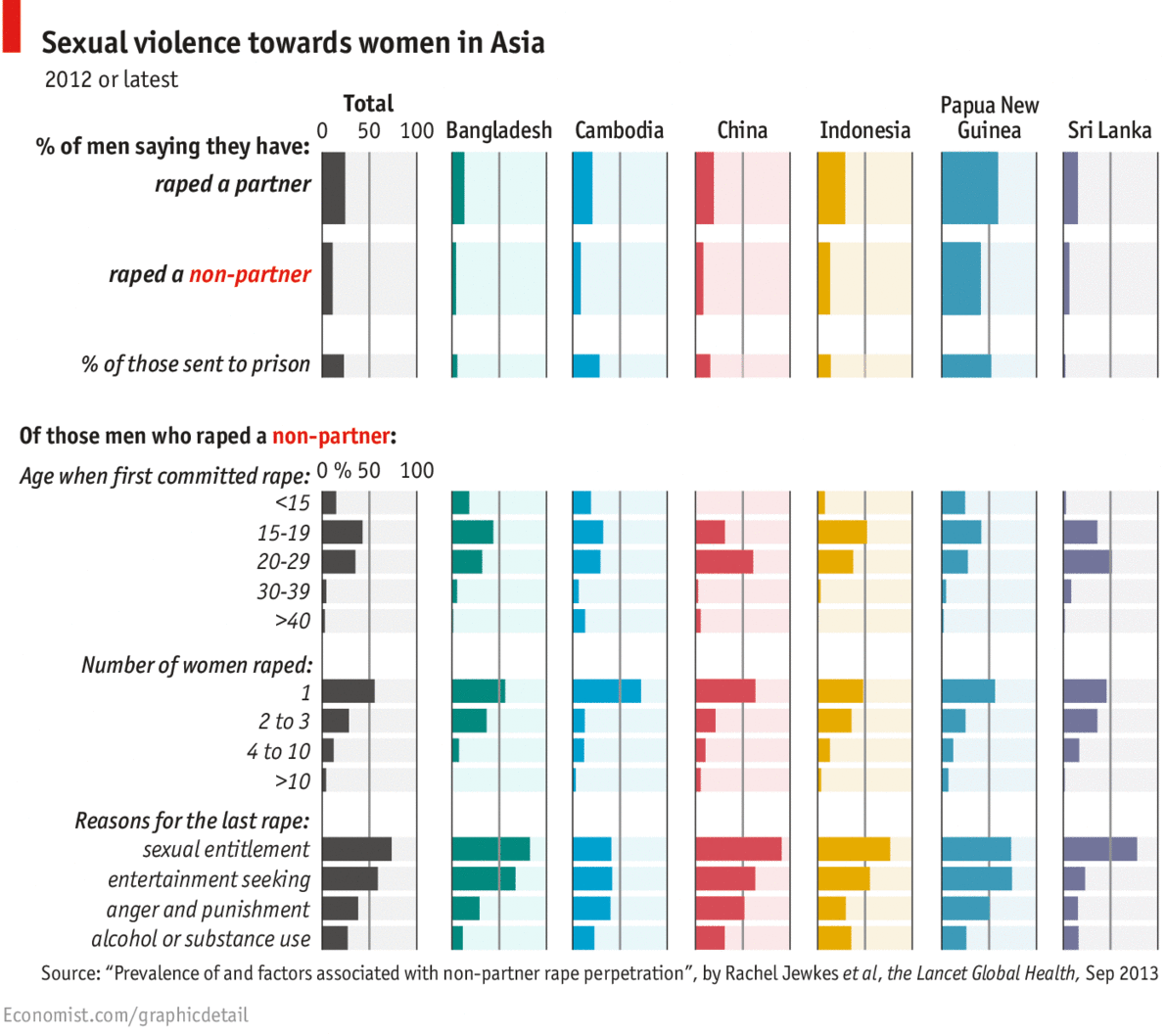
The Economist flags a disturbing new report:
The study, part of a United Nations project, is the first to give a comprehensive tally of rape in several Asian countries. The researchers surveyed more than 10,000 men in Bangladesh, Cambodia, China, Indonesia, Papua New Guinea and Sri Lanka. The men, aged 18-49, met male interviewers. They were never asked about “rape” explicitly; instead they were asked if they had “forced a woman who was not your wife or girlfriend at the time to have sex”. The answer varied from 4% in Bangladesh to a staggering 41% in Papua New Guinea. Shockingly, more than one in seven rapists committed their first rape when they were younger than 15. More than half did so before the age of 20.
Olivia Solon adds to the grim picture:
The vast majority of those men who admitted to rape (between 72 and 97 percent of men depending on the location) didn’t experience any legal consequences. In fact, many men felt that they had the right to have sex with women regardless of consent — more than 80 percent of men who admitted to rape in rural Bangladesh and China felt this way. Perhaps most startlingly, four percent of respondents said they had perpetrated gang rape against a woman or girl (although this varied between just one percent to 14 percent depending on the location).
To help understand the findings, Katelyn Fossett digs up some significant research from the 1970s on factors that encourage rape:
[Anthropologist Peggy Reeves] Sanday dissected the cultural variables that made societies more or less prone to rape, arguing that ideologies of male toughness, traditions of violence, and a lack of female participation in politics were key factors in “rape-prone” societies.
Some of these variables appear to be at play in the [UN-backed] Lancet study as well. Sanday, for instance, has observed traditions of “raiding other groups for wives” in the groups she studies; the Lancet study, similarly, hypothesizes that “the high prevalence of rape in Bougainville (Papua New Guinea) and Jayapura (Indonesia) could be related to previous conflict in these settings.” Sanday’s studies also find a correlation between low rates of female political participation and high rates of rape — a link that is echoed by the Lancet study’s findings. In the U.N. study, the country with the worst rape statistics by far was Papua New Guinea, which also happens to have the lowest rate of female parliamentary representation of the countries studied, with female MPs making up a mere 2.7 percent of Parliament.
A glimpse at the future of farming:
Over the past century, mechanization has shrunk the proportion of Americans working in agriculture from 41 percent to less than two percent. In coming years, families like the Finchers may continue to make their living from the land, but their jobs won’t involve much interaction with the actual dirt. John Deere and other companies are prototyping machines that won’t need any driver at all. It won’t be long before you can control a tractor via a laptop in your living room, just as today’s air-force pilots fly drones over Afghanistan from an air-conditioned control station in Nevada. American agriculture may soon be just one more business run from a cubicle farm.
Changing technology shapes how we understand our anatomy:
In the case of neuroscience, scientists and physicians across cultures and ages have invoked the innovations of their day to
explain the mind’s mysteries. For instance, the science of antiquity was rooted in the physical properties of matter and the mechanical interactions between them. Around the 7th century B.C., empires began constructing great aqueducts to bring water to their growing cities. The great engineering challenge of the day was to control and guide the flow of water across great distances. It was in this scientific milieu that the ancient Greeks devised a model for the workings of the mind. They believed that a person’s thoughts, feelings, intellect and soul were physical stuff: specifically, an invisible, weightless fluid called psychic pneuma.
Around 200 A.D., a physician and scientist of the Roman Empire (known for its masterful aqueducts) would revise and clarify the theory. The physician, Galen, believed that pneuma fills the brain cavities called ventricles and circulates through white matter pathways in the brain and nerves in the body just as water flows through a tube. As psychic pneuma traveled throughout the body, it carried sensation and movement to the extremities. Although the idea may sound farfetched to us today, this model of the brain persisted for more than a millennium and influenced Renaissance thinkers including Descartes.
What’s the dominant model for neuroscientists today? The computer, of course.
(Photo: Galenic ventricles in a 13th-century illustration by Albertus Magnus)
Laura Helmuth presents the two major perspectives:
One of the most fascinating debates in life science these days is between Olshansky and James Vaupel of the Max Planck Institute for Demographic Research in Rostock, Germany. They disagree fundamentally about whether and how average life expectancy will increase in the future, and they’ve been arguing about it for 20 years.
Olshansky, a lovely guy, takes what at first sounds like the pessimistic view. He says the public health measures that raised life expectancy so dramatically from the late 1800s to today have done about as much as they can. We now have a much older population, dying of age-related diseases, and any improvements in treatment will add only incrementally to average life expectancy, and with vanishing returns. He explains his point of view in this charming animated video.
On the other side of the ring is Vaupel, who says that people are living longer and healthier lives all the time and there is no necessary end in sight.
His message is cheerier, but he takes the debate very seriously; he won’t attend conferences where Olshansky is present. His charts are heartening; he takes the records of the longest-lived people in the longest-lived countries for each year and shows that maximum lifespan has been zooming up linearly from 1800 to today. One wants to mentally extend the line into all of our foreseeable futures.
Olshansky says the only way to make major improvements in life expectancy is to find new ways to prevent and treat the diseases of aging. And the most efficient way to do that is to delay the process of aging itself. That’s something that some people already do – somehow. Olshansky says, “The study of the genetics of long-lived people, I think, is going to be the breakthrough technology.” Scientists can now easily extend lifespan in flies, worms, and mice, and there’s a lot of exciting research on genetic pathways in humans that might slow down the aging process and presumably protect us from the age-related diseases that kill most people today. “The secret to longer lives is contained in our own genomes,” Olshansky says.
But as the above chart shows, the secret to longer lives also includes not killing each other.
Readers relate to the correlation between bike-share and gentrification:
I live in Chicago, where we’ve just seen the rollout of the “Divvy” bike-sharing program. If you know a bit about demographics in the city, a quick glance here says it all. Stations are dense on the north side, spread out a bit south of the Loop, and cease completely south of the University of Chicago area. According to Google Maps, the Pullman neighborhood, where I live, is about eight miles away from the nearest station by foot and eleven by car. Westward, it’s the same. There are no docks west of (the northern third of) California Avenue. The situation gets a little better if you include planned dock sites, but not by much, and those too avoid poorer parts of town in favor of the up-and-comers, with none planned anywhere near Pullman or the “wild hundreds”. Even the more affluent areas of the south side are left out.
A reader in a different city:
DC specifically put a number of Capital Bikeshare stations in the poor parts of town. DC also arranged for subsidized and free memberships for the poor. Even with that, those stations are barely used. Right now, there are several stations that have not been used in the last 24 hours. Check it out yourself.
And to New York:
Crime could be a reason for NYC’s stage one to avoid poor neighborhoods, but bike-share is not cheap. You pay for the choice of when and where to get a bike made to some else’s design specifications and to have someone else worry about maintenance. The fact is it’s much cheaper to own one’s own bike, or even rent from tourist dealers, but in my elevator-free building and aging hands and arms the yearly membership is a good investment, despite my severely limited income.
 The Dish