Another Meep-Meep Moment?

Screen Shot 2013-09-11 at 4.47.16 AM

A reader writes:

You and Charles Pierce both seem to have done a 180 on the Syria question, and neither of you seems to have explicitly admitted it.  You’ve gone from slamming Obama for being imperial, idealistic, bloodthirsty, foolhardy – and God knows what else – to praising him for his subtlety, nuance, willingness to listen, and so on. Which, fine. But maybe somewhere along the way, you could just throw in a bit of an acknowledgment along the lines of: “Oops, I jumped the gun on this one; I overreacted, got hysterical, and now I see the President doing his characteristic thing – seeing the big picture when others did not.”

I don’t think I’ve done a 180. I remain opposed to any military intervention that could be seen as a way to alter the outcome of the Syrian civil war. I remain of the belief that the Congress should have the final say on any war, large or unbelievably small. Where I have shifted – and this may be a function of being off-grid when this atrocity occurred – is a greater awareness of and concern about the breach of the international norm with respect to chemical weapons. I have acknowledged this shift – here. Money quote:

I have to say I found myself shifting a little – not a lot, but a little – after reading the transcript of the president’s press conference at the end of the G20 Summit.

A better grasp and appreciation of the entire history in this area also affected me. And as this has all shaken out, I see a way to reconcile all these apparently conflicting goals in Russia’s and Syria’s public acknowledgment of the chemical weapons stash and apparent willingness to sign up to the Chemical Weapon Convention. This may turn out to be illusory, or too difficult to accomplish, or some kind of ruse to keep Assad in power for a while longer, but no president would turn such an offer down. If only such an offer had been possible in Iraq in 2003. Another reader wonders if we are “finally hearing the meep meep”:

I’m so glad you have calmed down about Obama on Syria. He is on the verge of accomplishing, without firing a shot, what Bush launched an invasion to do.  Congress is going to get him out of bombing Syria, and yet Obama is going to be able to point to the Republicans and call them the ones who blinked as a dictator massacred his people.  He is re-establishing the precedent that going to war requires congressional approval. He will have enhanced internationalism.

Republicans are loving this right now because they think Obama looks incompetent. They are blindly stumbling into an outcome that gives Obama everything he has ever said he wants, ever. And they’re not going to realize it until it’s too late. It’s such a perfect outcome, how could this have not been planned? Is Obama on the verge of pulling off the greatest rope-a-dope in the history of US politics?

Another isn’t buying it:

Your reaction to Obama’s address last night sounds suspiciously like you’re getting ready to declare another “meep, meep!” victory for Obama’s long-view, chess playing strategy:

Will Assad be more likely to surrender his chemical weapons if the US attacks or if Russia insists on their destruction? Please. It isn’t close.

As if Obama planned on this all along!  Putin may very well have just pulled Obama’s chestnuts out of the fire, while saving Assad and further ensconcing Russia as Syria’s and Iran’s protector (assuming, of course, that Syria indeed does hand over those weapons and this transfer can be verified). So Russia might have just saved Obama from himself. His policy and performance in regard to Syria has been jaw-droppingly amateurish, beginning with his drawing of “red lines” a year ago that he had no will to enforce, and the absurdly thin arguments he has advanced for military action, contradictory goals, general incoherence and flailing of these past weeks.

Even if this all works out in the end, this has not been Obama’s finest hour. Even admirers of Obama like myself must admit this. He was more than willing to get us into another stupid fucking war until the American people rejected it and the Russians intervened.

Has it occurred to my reader that it was necessary to actually risk another war to get the diplomatic solution we now have? Obama had to make that proposal credible and serious for it to work. Yes, it was a huge risk. Yes, it places a premium on restricting WMDs that may be too ambitious. But it may have paid off. And in the end, a president needs to be judged on results, not news cycles. And those alleging incoherence have not acknowledged that diplomacy – always Obama’s first preference with respect to Syria – sometimes requires a deadly serious intent to do something you don’t really want to do. It requires some level of nerve-wracking bluff. Bluff is not incoherence, although it sure can be risky. And a president who can live with that risk is a president with some cast-iron balls. And that’s why the view that this has revealed weakness in Obama seems completely wrong to me. It has revealed steel.

And you don’t have to argue that Obama is some kind of Jedi warrior who saw all this from the start (a silly idea) to see that he was able to pivot, shift, test, improvise and flush out new options in a horrible situation as the crisis careened from one moment to another. This is what leadership can be – and you saw a very similar set of patterns in Eisenhower’s administration, and even, as Michael Dobbs noted today, in John F Kennedy’s haphazard, contradictory, and risky maneuvers in the Cuba missile crisis. Eisenhower was ridiculed, and regarded as an idiot from day to day in Washington. Can you imagine what the neocons today would say if a president cut off a war as Eisenhower did in Korea? He’d be Carterized immediately. And Eisenhower was indeed regarded as out of his depth by the hard right, if not an active Communist appeaser. But he endures as one of the greatest foreign policy presidents of the last century.

Another reader ladles on the scorn:

Assad and the Russians have no intention of agreeing in a meaningful and substantive way to giving up all these weapons and allowing a verifiable implementation of any agreement.  They are going to make us a laughing stock by delay, denial, and obfuscation.  On the other hand, it does give President Obama a little face-saving in the short run from the big mess he let himself get into. There are no good alternatives in this morass, but I think this might be the least worst alternative.

But again: why is the US on the hook for this? Russia has said this is what it wants; so, staggeringly, has Syria. They are the ones now on the hook. And the key objective is to stop future chemical attacks by Assad and to minimize the dangers of those weapons being dispersed or in the hands of Sunni Jihadist terrorists. Isn’t that far more likely now than, say, a week ago? Mission advanced. Another pivots back to domestic politics:

I hope that Assad can be made to back down. But in a way, the best thing that could happen at home would be for the Republicans to vote down the use of power.

It would inoculate Democrats for a generation against going to war: “The Republicans voted against punishing Syria, which was a threat to Israel, why should we support this next war?” Who would have predicted that in a long interview on NPR, Republican Tom Cole would have said that Assad’s use of chemical weapons did not result in any direct security threat to America or its allies.  Democrats will be able to play back that interview for years: “Syria, Israel’s most hostile neighbor, deployed chemical weapons and the Republicans voted against any use of force.” Meep meep?

Another adds:

Seems to me that AIPAC and the Israeli government are still pushing for a strike, latest developments be damned. If, as it appears likely, the US Congress either votes down the authorization to strike, or doesn’t bring it to a vote, it’d be the first Congressional rebuke of AIPAC that I can remember. Does your crack staff know the last time that happened?

Another awesome development. Another reader references Kerry’s historic gaffe:

Just a funny thought: remember another time that an Obama surrogate went out in public and accidentally blurted out a major shift in policy that immediately set in motion a process no one expected would start, and is at this point now a reality? Marriage equality?

Another points to another major achievement that many, including me, thought would never come:

I’m with you on Syria. I don’t think Obama gives two shits how he gets there; he’s just concerned with the final destination.  Does anyone remember all the ups and downs and sausage-making over the ACA? Nope. They just know it’s Obamacare.

The way I see it, we have a president confident enough and secure enough in his authority to let others take the credit, to let the Russians lead.  Because in the end, who cares how we get there? What matters is that the weapons are gone.

But of course the Washington class will frame this as a huge loss for the president, because.  Can you imagine George W. Bush or Dick Cheney taking this route?  Not a chance.  They would’ve bombed the shit out of Syria just to show they could.

The current solution doesn’t have the drama of dropping bombs or sending sorties over Damascus, so Obama comes off as a bit of a dull president.  And in this case, that’s fantastic, because he’s getting shit done.  He always does.

Meep meep.
Lies Your Memory Tells You

Psychology researcher Elizabeth Loftus explains how easy it is to implant false memories in unwitting subjects:

We gather a whole bunch of data from you, about your personality, thoughts about different foods, all kinds of things. Later, we hand you this computerized profile, which reveals certain things that probably happened when you were a child. In the middle of the list is, say, that you got sick eating strawberry ice cream. We give you false feedback about your data, and then encourage you to elaborate and imagine. Later we ascertain whether you have a belief that it happened to you. Then we offer you a choice from all these different foods. In that example we found that participants didn’t want strawberry ice cream as much. … We did a similar kind of false-feedback study with vodka. If we make people believe that before the age of 16 they got sick drinking vodka, they don’t want to drink as much vodka.

See another Loftus test demonstrated above.

When Bedside Manner Is A Must

Oncologist Mary Mulcahy supports a bill that would encourage doctors to provide end-of-life counseling:

The need for a bill is revealed in a recent study in the Journal of the American Medical Association.  As background, physician payment is currently based on a value assigned, by Medicare and Medicaid Services, to the physician-specific work. The hourly revenue generated by a physician providing a cognitive service, one that involves thinking, reasoning and judgment without a procedure, is $87. That same physician – if conducting a procedure such as a colonoscopy or a cataract extraction – will make more than $300 per hour for the physician time associated with that service. This discrepancy results in fewer physicians entering cognitive fields and less time allotted per patient, at a time when more people are living longer with chronic illness. Medical conversation, the intimate kind that often only occurs within an examination room in the presence of a physician, is not valued highly by the American health care system. …

Among other things, the new legislation will assign a code and value to the complex discussion of end of life planning. Some may argue that this cannot be compared to the complexity of a procedure such as a colonoscopy or a cataract extraction. However, having an advance care planning discussion that results in a documented care plan to reflect informed choices is a skill that must be taught, learned and practiced just as intensively as any medical procedure. A poorly conducted end-of-life discussion will leave a scar deeper than any surgeon’s knife.

The Rise Of The Tech Villain?

Noreen Malone wonders if Silicon Valley is inheriting Wall Street’s image of flagrant wealth:

Tech world conspicuous consumption isn’t quite the same as Wall Street conspicuous consumption. A Silicon Valley executive isn’t likely to spend his cash on bottle service and a Porsche; a trip up Kilimanjaro and a Tesla is far more the norm. Slate’s Farhad Manjoo, who lives in San Francisco and is hardly a kneejerk critic of wealth, told me he plays a little game with himself where he counts the number of Teslas he sees in any given day. It used to be one a day, now it’s up to five or ten. That kind of lifestyle is certainly expensive (Teslas start at $62,000 or so, without any of the add-ons), but there’s also an element of virtuousness to it—which to some can be more grating than the unapologetic materialism of a stereotypical banker: I spend a lot of money, but it’s to save the earth, not to burnish my own image. And then there’s Google Glass: an unsettling-to-the-rest-of-us status symbol that only a tech-head could love.

Alexis Tsotsis recently sized up the reason for the increasingly hostile perception of the tech industry:

Many argue that our corporate shuttles, inflated housing prices, social bubble, iPhones for day and for night, and enthusiasm in replacing labor with capital, are worthy targets of mass resentment. The creation of a “resentocracy.” In 2010, The Social Network topped the box office. In 2013, The Internship barely cracks the top four because of general Silicon Valley weariness and fatigue. And then there’s that whole “aiding-the-government-in-aggregating-the-world’s-private-data-without-our-knowledge” thing. “Trust us.” Remember Enron? That’s now us.

The fallacy of the tech industry is that we think our “change the world/connect the world” intentions are enough, or at least that they should shield us from reproach, much like our gated communities of Ubers, Airbnbs, and TaskRabbits. We revel in our massive concentration of wealth, private-public transportation, private tech-heavy schools, and the underlying ideology that the government is stupid. We are exempt.

The Great White Outdoors, Ctd

A reader writes:

There might be something interesting about the ethnic makeup of outdoors participants, but it’s certainly not, as Ryan Kearney puts it, that “White people love hiking. Minorities don’t.” The first chart in his article does show that outdoor participants are 70% white and 11% black. But the US as a whole is 72.4% white and 12.6% black, so all this shows is that, by and large, whites and blacks are equally likely to be outdoor participants.

One potentially interesting story is that while 16.3% of Americans identify as Hispanic, only 7% of outdoor participants do (though there might be some ambiguity depending on how the Outdoor Foundation calculated the Other category). But most interesting to me is that, while Asians/Pacific Islanders are 5% of the population, they are 7% of outdoors participants. In other words, they are 40% more likely than whites to be outdoors participants! The article should really be titled, “Why do Asians love the outdoors so much?”

A few readers assess the costs of camping:

The New York Times article isn’t about the aversion of non-whites to camping; it’s about visiting national parks. Thus, Kearney’s talk about the expense involved in camping makes little sense.

I’ve been to a number of national parks but have never camped in any of them. Furthermore, someone in either Denver or Washington DC – cities both mentioned in Kearney’s piece – could rent a car (assuming they don’t own one) and drive to Shenandoah or Rocky Mountain National Parks, go hike, and then return home. Total cost would be car rental (I have rented cars in both places within the last 12 months for under $30/day) plus gas and and any park entrance fees. If you want to spend the night nearby, a Red Roof Inn or Days Inn typically runs around $50/night (I know this because I stayed in both over the last two weeks). While obviously there are some people who cannot afford this, this is no way constitutes a huge economic barrier.

Another agrees:

I’ve got a serious beef with Kearney’s suggestion that “a backpack, tent, and the necessary gear will run you $1,000.”  If he’s looking at doing some serious multi-day backpacking treks, then that’s entirely possible (although still excessive).  But if you’re talking about a weekend trip to a state park, all you really need is a tent and some sleeping bags.  Just looking at Wal-Mart and Target, you can find a decent tent for $40 and sleeping bags for $20 or less each.  A family of four could be set up with brand new gear for well under $150.  Look around at garage sales or inherit some hand-me-downs from friends and you can get set up for substantially cheaper than that.

Sure, a camping stove, lantern, camping chairs, etc. would be nice, but that’s stuff you can always add later, and there’s no need to get any of the high-end ultralight backpacking gear for the vast majority of campers.  I understand that $150 is still pretty high for a lot of families, but if the alternative is staying at a cushy hotel, you’re probably already ahead.

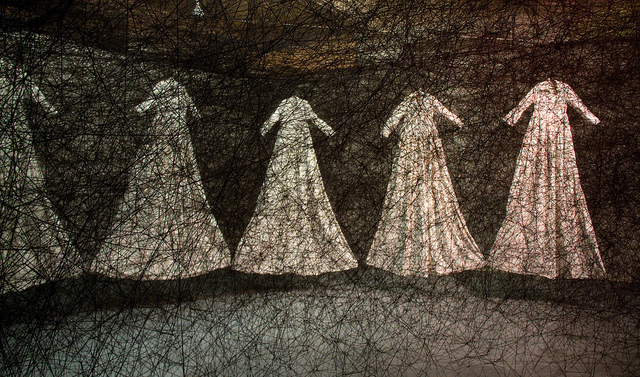
Captured In Cobwebs

dish_shiota

Kevin Hartnett observes how the works of Japanese artist Chiharu Shiota “play off of the intrinsic spookiness of cobwebs”:

Shiota takes objects-wooden chairs, hospital beds, musical instruments, a woman’s dress-and shrouds them in a thick, dark web of thread. Her art, which she’s been producing for more than a decade, and which is currently on display at the Museum of Art, Kochi, in Japan, emphasizes how the accretion of cobwebs marks time. It makes you wonder: Who sat here last before the first strand was spun? It also nicely realizes the metaphorical way we talk about cobwebs clouding memories.

(Photo by Flickr user ahisgett)

Where Are All The Female Philosophers?

Katy Waldman puzzles over the absence of women in philosophy, where “fewer women are earning doctorates in Plato’s (and Mary Wollstonecraft’s) discipline than in the notoriously male fields of math, economics, and chemistry”:

According to one estimate, only 21.9 percent of the tenure-track faculty in 51 philosophy graduate programs were women in 2011 (and the percentage of black woman professors was vanishingly small). Then Linda Martín Alcoff, from Hunter College, zeroed in on one explanation for the gender gap: that female would-be philosophers are deterred by the academy’s combative, “rough-and-tumble” style of debate. (She refuses to smear these women as too fragile; instead, she argues, prominent members of the community have a duty to “check in” with those who wield less power, especially after eviscerating them in discussion section.) Next, Cambridge University’s Rae Langton held the emblematic image of the philosopher up to the light. That stern, gray-bearded man—a “serious, high-minded Dumbledore”—creates a stereotype threat for any thinker who looks less white or male, she claims, meaning that women and blacks may underperform because they don’t feel like “proper” philosophers.

She points to a 2005 article by Camille Paglia, who figured contemporary women are simply uninterested in joining a dying field:

Now that women have at last gained access to higher education, we are waiting to see what they can achieve in the fields where men have distinguished themselves, above all in philosophy. At the moment, however, the genre of philosophy is not flourishing; systematic reasoning no longer has the prestige or cultural value that it once had. The entire way we approach the world has changed. Philosophy once claimed to provide a rigorous method to search for the meaning of life, and it was a precious substitute for dogmatic religion. But in modern times, religion among the educated classes in Europe and North America has lost ground, and intellectuals are neglecting the basic human need to find answers. Philosophers are now at the margin. Philosophy has shrunk in reputation and stature – it’s an academic exercise.

The Wrong Way To Adopt

Megan Twohey has published a harrowing five-part report on the practice of “private rehoming,” in which adoptive parents use social media to give away their troublesome kids to strangers:

Reuters analyzed 5,029 posts from a five-year period on one Internet message board, a Yahoo group. On average, a child was advertised for re-homing there once a week. Most of the children ranged in age from 6 to 14 and had been adopted from abroad – from countries such as Russia and China, Ethiopia and Ukraine. The youngest was 10 months old.

Many of them were physically or sexually abused by their new parents, and at least one child was placed with a pornographer. Aja Romano is aghast:

The term “rehoming” is a term that’s typically used to weed out pet owners by requiring them to pay a “rehoming fee.” But as Reuters points out, to “rehome” a small child, sometimes all you need is an Internet connection and a transfer of guardianship – the human equivalent of a bill of sale. “We have a 13-month-old adopted son who has special medical needs,” reads a typical notice on the now-defunct Yahoo Group Adoptions From Disruption. “We are very overwhelmed and feel this little guy would do better in a family who had the time and emotional resources to offer him.” Another adoptive family sought a way out of their adoption after having had the child for only 5 days.

But one foster mother and member of the infamous Yahoo group defends rehoming:

Most [adoptive parents] were seeking a formal adoption through the courts and not a cavalier transfer of guardianship. The under- and over-current was always shame. Parents listed dozens and dozens of professional counseling routes and treatments they had exhausted while simultaneously begging not to be judged for their decision.

Now, that one safe place parents could go and talk about the decision to re-home is gone. The problem, however, is not. Adoptive parents in crisis are pushed even further into secrecy and back-alley swaps. Instead, post-adoption services need to be more intensive and widely available. Finding new adoptive parents for children should not be a routine practice but it should be an option and supported by the agencies who facilitated the first.

Katie J.M. Baker underscores the weak oversight:

The government isn’t great at relocating kids; no authority tracks what happens after a child is brought to America, so no one knows how often international adoptions fail, and many states say they don’t track cases in which they take custody of children from failed international adoptions, even though they are required to do so by law. But at least they don’t deliver them instantaneously, Amazon-Prime style, into the arms of abusers.

Meanwhile, philosopher Tom Douglas mulls over the ethics of rehoming:

Reflecting on this sort of case leads me to think that we (or at least I) intuitively hold adoptive parents to higher moral standards than natural parents. When adoptive parents realize that they are not up to parenting, we are more inclined to think ‘you should have thought harder about that earlier’ than in cases where non adoptive parents realize that they are not up to parenting. In other words, we think that parents who adopt must be more confident in their future parenting abilities and commitment than other parents. This, I think, at least partially explains our negative intuitive reactions to ‘re-homing’.

Of course, even if this succeeds in explaining our intuitive reactions, it may fail to justify them. Perhaps there are good arguments for holding adoptive parents to higher standards than others. For example, perhaps the fact that adoptive parents have generally had to ‘outcompete’ other candidate parents in order to complete the adoption places them under a special obligation to make good on the adoption. But I’m not at all sure about this.

Previous Dish on adoption herehere and here.

A Kafkaesque Style Guide

Liz Tung reflects on how Western journalists working in China cope with the confines of state censorship – an apparatus that “remains murky even to those who deal with it every day”:

At a cultural magazine where I worked for a year, called The World of Chinese, we had a style guide that included an entire section dedicated to “political incorrectness.” It contained rules common among Chinese publications: “mainland China” had to always be written as “the Chinese mainland”; Taiwan, Hong Kong, and other disputed parts of China could not be implied to be separate countries (i.e. “the company has branches in Taiwan and Japan,” was prohibited); and we were never, ever to use the old name for Taiwan: Formosa.

Once, while I worked there, we had to strike a map of China from the travel section because there was too great a risk of it not including disputed territories, such as the Diaoyu Islands (known as the Senkakus in Japan). In another, we were forced to get rid of an image of a cupcake sporting the Chinese flag in honor of National Day because, we discovered, the Chinese flag must not be displayed so casually.

The President Makes The Case: Reax

Fred Kaplan analyzes Obama’s speech:

The upshot is this: If Russia backs away from a real deal, after exciting so many players to its possibilities, Obama could emerge with his air strikes gaining greater support—at home and abroad. To this end, Obama and his aides have crafted a narrative that makes everything they’ve done in recent days—the slips and slides, as well as the shrewd moves—seem smart and bold: namely, that Putin proposed this plan (and Assad subsequently announced that Syria would join the other 189 nations that have signed an international treaty prohibiting the use of chemical weapons) only because the United States had threatened to use force.

This narrative may even be true.

John Judis argues along the same lines:

Obama attributed the Russian initiative partly to “the credible threat of U.S. military action.” That’s certainly the case. The Russians and Syrians would not have budged without the threat of American force. And even if the protracted negotiations over the next months don’t result in a clear and firm proposal. Assad will have acknowledged his use of chemical weapons and be far less likely to use them again, as will other dictators who find themselves facing popular rebellions. And if by any chance he does use them, Obama should have less trouble in building an international coalition to punish him. That’s all to the good, and is the result—even with all the bungling diplomacy—of Obama’s initial threat of force.

Ezra Klein points out that “Obama needs the country’s backing to strike Syria so he can strike a diplomatic bargain to get rid of Assad’s chemical arsenal, thus ending America’s interest in striking Syria”:

At this point, the White House has a surprisingly good plan to avoid war while achieving the limited goal of disarming Assad’s nuclear arsenal. But it relies on them making a very bad argument for a much larger war with much broader, more humanitarian, objectives.

George Packer doubts that disarmament will work:

There’s a brutal and chaotic war going on.

The United Nations would evacuate its advisers from Syria if a single one of them were killed, something that Assad or his extremist enemies could easily arrange. Armed factions will be trying to grab control of the weapons the whole time. Assad will have every incentive to withhold some part of his arsenal in case of ultimate need, and he’ll have a friend on the Security Council to help him delay and deceive.

Chait is puzzled by pundits’ opposition to a non-military path:

The sudden onset of diplomacy has produced a widespread skepticism that I find baffling. Remember, the purpose of air strikes is not to topple Assad. It can’t prevent the attack that has already happened. All it can do is prevent him – and, to a lesser extent, future dictators — from using chemical weapons. The skeptical reactions I’ve seen, from the likes of Jeff GoldbergJulia Ioffe, and Max Fisher all seem to lose sight of this, judging diplomacy against a standard of success higher than the air strikes could possibly have achieved.

David Graham felt that Obama’s speech left several paradoxes unresolved:

If Assad can’t hurt Americans, why is it a national-security concern? If American attacks will be so limited, will they even really make much difference, either to stop the slaughter or as a future deterrent? And if it’s so important to prevent gas attacks that “brazenly violate international law,” why is Obama so willing to conduct a punitive strike that seems to most experts to violate international law? With the nation watching, Obama had a chance to resolve these contradictions, and he didn’t do it — he didn’t even try.

Douthat thinks the speech should not have taken place:

A prime time presidential address should either announce a policy course or make a specific appeal to Congress; it should not be wasted on a situation where the course is so unclear and the appeal so vague and undirected. Yes, it’s been on the schedule since last week, but there is no rule saying that a president must speak when he’s announced that he will speak if significant events intervene. And after the Russian gambit and the Congressional vote’s postponement, it would have been the better part of valor to simply postpone this speech as well.

Larison agrees that the speech was unnecessary:

It’s impossible to take seriously Obama’s claim that he doesn’t think “world’s policeman” is the proper U.S. role when he is delivering a speech defending the necessity of enforcing an international norm with military action. He recycled several of his officials’ worst fear-mongering arguments about proliferation, Iran, and terrorism, but these have not improved through repeated assertion. All in all, this was a speech that Obama didn’t need to give, and he said nothing that would persuade anyone not already supportive of his policy.

And Dreher is skeptical that the speech made a difference:

Was anybody’s mind changed by that speech? I can’t imagine it. It wasn’t terrible, but it wasn’t convincing either. It’s about the best attempt one could imagine to sell an incoherent, bad policy.