Left Behind By Suicide

On World Suicide Prevention Day, Amanda Lin Costa observes that the stigma attached to suicide extends even to the friends and family of victims:

William Feigelman, Ph.D, is a suicide counselor who himself lost a child to suicide. When studying the stigma related to a child’s suicide he found that “53 percent of suicide survivors reported harmful responses from one or more family member groups following their loss and 32 percent reported harmful responses from at least one non-kin group.” These responses were divided into seven types: 1) Avoidance: “People who I thought would be at the funeral or send a sympathy card didn’t show any acknowledgment of the death.” 2) Unhelpful advice: “Haven’t you grieved enough already?” 3) Absence of caring interest: “If I started talking about my lost child, they quickly changed the subject.” 4) Spiritual advice: “He’s in a better place now” or “It was meant to be.” 5) Blaming the victim: “That was a cowardly thing he did.” 6) Blaming the parent: “Didn’t you see it coming?” 7) Other negative comments: “Well at least he didn’t kill anyone else when he died.”

In the United States, at least the stigma of suicide is being addressed by the acknowledgment that suicide is a mental health issue. In some countries mental illness carries such a heavy stigma that it compounds the problem. South Korea currently has the highest suicide rate per capita, according to The World Health Organization. South Koreans, like residents of many Asian countries rarely seek support for mental illness or depression, the leading cause of suicide. In Japan, suicide survivors are often forced to pay for expensive purification rituals, or even the remodeling of an apartment or buildings, because a loved one’s suicide has made the property un-rentable.

It was once even worse: As the historian Georges Minois notes in History of Suicide: Voluntary Death in Western Culture, suicide victims’ families were once forced to surrender all of their property to the state, a practice that endured well into the late 17th century. And, as recently as the late 19th century, “attempted self-murder” was a crime punishable by death.

The World’s Most Important Places

Species Density

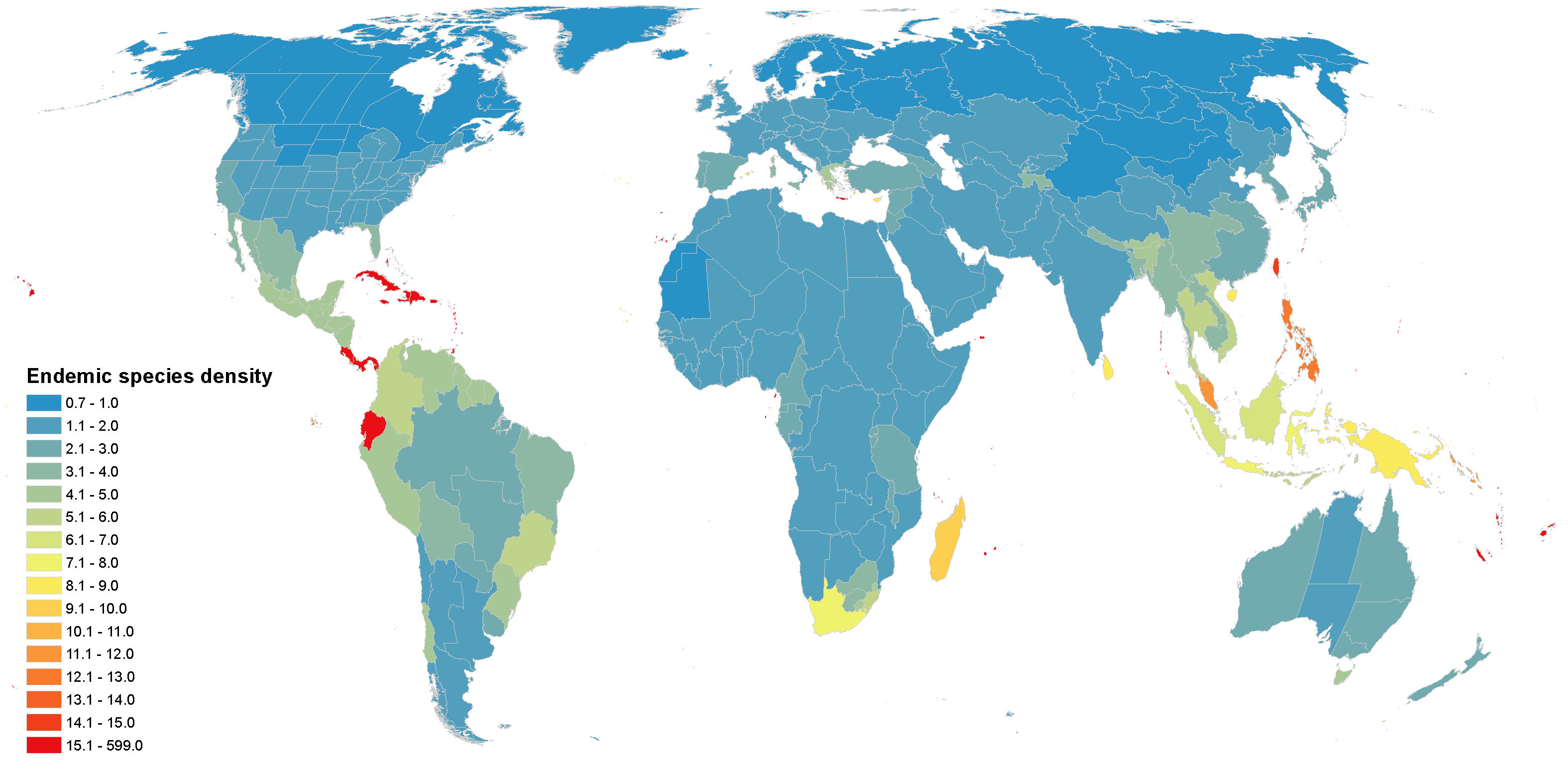
According to a new paper, we aren’t protecting enough of them. Jason Koebler summarizes key points:

In 2010, the Convention on Biological Diversity (an international treaty with 193 member countries–the US signed but never ratified the treaty, shocker) set a goal to protect 17 percent of Earth’s most biodiverse land by 2020. By doing that, they argued, we’re be protecting roughly 60 percent of all of the planet’s plant species. …

If we’re looking only at the numbers, Earth as a whole isn’t too far off from meeting that 17 percent goal. The only problem, according to the authors, is we’re protecting the wrong areas (if we’re looking to preserve biodiversity). As of 2009, about 13 percent of all of Earth’s land was protected in some way. But a lot of that land is not terribly important, biodiversity-wise.

The above map shows where we should be focusing:

Plant species aren’t haphazardly distributed across the planet. Certain areas, including Central America, the Caribbean, the Northern Andes, and regions in Africa and Asia, have much higher concentrations of endemic species, that is, those which are found nowhere else.

Novel Critiques

Zoë Heller encourages novelists to take on their own kind in criticism:

If nonfiction writers are, by and large, less squeamish [than fiction writers] about criticizing one another’s work, this is not, one suspects, because they are a bolder or less compassionate bunch, but rather because the criticism of nonfiction tends to be a more impersonal business than that of assessing novels. The critic of nonfiction contests matters of fact, of interpretation, of ideological stance. The critic of fiction, by contrast, has only aesthetic criteria to work with. You may respectfully take issue with another writer’s analysis of the Weimar Republic without impugning his skill and dignity as a historian. But when you argue that a novelist’s characters are implausible or that his sentences are inelegant, there’s no disguising the rebuke to his artistry.

Given these powerful deterrents to candor, why urge novelists to write criticism at all?

Certainly not because the world needs more “hatchet jobs” or literary “feuds.” (The fact that literary argument is so often spoken of in these debased terms can only act as a further disincentive for the review-shy novelist.) No, the real reason for encouraging novelists to overcome their critical inhibitions is that their contributions help maintain the rigor and vitality of the public conversation about books. Practical experience in an art form is not an essential qualification for writing about that art form. (As Samuel Johnson pointed out, “you may scold a carpenter who has made you a bad table, though you cannot make a table.”) Yet an artist’s perspective is clearly useful to the critical debate. (The thoughts of a master carpenter on what went wrong with your wonky table will always be of some interest.)

Funny Business

Manjoo isn’t laughing at The Onion as much as he used to. He blames the newspaper’s “new Internet-focused publishing process”:

I ran my criticisms by some former Onion staffers, and a few agreed with my take. (Though none for the record: “I lived in fear of articles just like this one pointing out that the Onion wasn’t funny anymore,” one former editor told me.) But they also suggested something I hadn’t considered—that with the CNN piece and many others, the Onion’s writers might be making fun of themselves as much as they’re taking on the rest of the media.

“If you look through the Onion over the last half-year, there’s a ton of stories about how horrible it is to work for the Onion,” one former staffer told me. Among them:

Executive Creative Too,” about the CEO of a media company who claims “his sensibilities are very refined and even edgy, and that he thinks of himself as ‘at heart, more of a writer and idea guy than a businessman.’ ” In January, after the Atlantic ran a “sponsored” story by the Church of Scientology, the Onion shot back with, “SPONSORED: The Taliban Is A Vibrant And Thriving Political Movement.” But that joke (and “Sponsored Content Pretty Fucking Awesome,” from May) was likely aimed at the paper’s bosses, too, who’ve been warring with the editorial side over whether the paper should run sponsored stuff.

In other words, now, more than ever, the Onion is in the same boat with the rest of the media. Writers and editors at the Onion face the same pressures as their straight-news brethren—a mandate to be faster, to do more with less, to have insta-opinions on everything even if it means sometimes being wrong.

Weigel seconds Manjoo’s complaints. Noreen Malone, on the other hand, calls the publication “the country’s best op-ed page”:

The Onion isn’t Democratic or Republican. It’s clearly got a left-leaning outlook, but the editorial position is more properly characterized as against bullshit. This can include everything from the highhanded way Barack Obama deals with the press (“Dear The Onion,” reads a letter to the editor “from” him, “Just a polite reminder that you have to print whatever I send you”) or the appalling things campaigns make politicians do (“Romney Murdered JonBenet Ramsey, New Obama Campaign Ad Alleges”) or CNN’s unseemly pageview-trolling (“Let Me Explain Why Miley Cyrus’ VMA Performance Was Our Top Story This Morning.”) Bullshit also includes the way people go through the motions of “dialogue” (as in this faux opinion column titled “America Needs To Have a Superficial Conversation on Race”) or fake-apologize (“The Onion isn’t sure exactly what it did wrong but it’ll apologize if that’s what you need to hear to move on”). Bullshit is even the way people deal with veterans, and what war does to people. (“Town Nervously Welcomes Veteran Back Home.”)

Should We Treat E-Cigs Like Cigs?

Since e-cigarettes remain unregulated by the FDA, some health officials worry that more young people are getting hooked on nicotine:

Dr. Thomas Frieden, director of the CDC [Centers for Disease Control and Prevention], believes that e-cigs could become a gateway into cigarette addiction. In an interview with the Times, Frieden argued that “the adolescent brain is more susceptible to nicotine, and that the trend of rising use could hook young people who might then move into more harmful products like conventional cigarettes.”

Kleiman puts the dangers in perspective. He writes that “the risks of nicotine are a tiny fraction – almost certainly less than 10%, arguably even lower than that – of the total health risks of smoking”:

If e-cigarettes substitute for smoking, the health benefits are likely to be very large. Even if they substitute for not smoking or for quitting, the damage is likely to be limited. … The FDA’s desire to have enough authority to require e-cigarette sellers to manufacture them properly and label them accurately, to limit marketing aimed at minors, and to be able to force the removal of unsafe product from the market, seems quite reasonable. What’s not reasonable, and what is likely to be bad, on balance, for health, is the idea that anything that delivers nicotine vapor should have the same rules applied to it as an actual cigarette.

Previous Dish on e-cigs, health risks and branding here, here and here.

Obama Gets What He Asked For

Ezra argues that, if the news above is true, that the “White House just achieved its goal”:

Remember: The White House’s aim here wasn’t to topple Assad, or even hurt him. It was to affirm and reinforce the international norm against chemical weapons. … Assad is now agreeing to preserve and strengthen that norm. He’s agreeing to sign the treaty banning chemical weapons — a treaty Syria has been one of the lone holdouts against. He’s creating a situation in which it would be almost impossible for him to use chemical weapons in the future, as doing so would break his promises to the global community, invite an immediate American response, and embarrass Russia.

The Anti-Keystone Movement

Ryan Lizza covers it. For those unfamiliar with the controversial pipeline, the basics:

[T]he major controversy is over the Keystone XL, a proposed “bullet” pipeline connecting Alberta to Nebraska and a new southern leg that runs from Cushing to the Gulf. The southern project didn’t require Presidential approval and is nearing completion, despite some local efforts to stop it. Keystone XL would increase Canada’s oil exports to the U.S. by as much as eight hundred and thirty thousand barrels a day, and, environmentalists argue, it would increase the speed at which the oil sands are exploited.

“The pipeline would completely change the rate at which the oil comes out of the ground,”[Keystone foe Tom] Steyer said. “It would enable a much faster development, three times as fast. This is the size of Florida. . . . This is going to go on for decades. It’s not like we’re enabling a Shell station to be open after midnight.”

Anti-Keystone activists believe that, if they can prevent Canadian crude from reaching Texas, they can dramatically slow the development of the oil sands. The industry concedes the point. In February, a pro-oil Canadian think tank issued a report called “Pipe or Perish: Saving an Oil Industry at Risk.” It noted that without Keystone XL the amount of oil produced in northern Alberta, which is projected to double by 2030, will soon outpace the industry’s ability to export it: “If this happens, investment and expansion will grind to a halt.”

Molly Redden notes that Canadian Prime Minister Stephen Harper recently “promised to accept targets proposed by the United States to reduce its emissions, if the Obama administration agrees to greenlight the pipeline.” Redden hears from several environmentalists who dismiss that offer:

Danielle Droitsch, the director for the Natural Resources Defense Council’s Canada project, pointed out that under Harper, Canada’s record of actually keeping its climate change promises has been deplorable. “He had promised that all tar sands operations after 2012 would only be permitted if the industry used carbon capture and sequestration technology—that never happened,” she said. “In 2011, Canada formally withdrew from the Kyoto Protocol, the only country in the world to do so.” The year 2010 was supposed to bring new coal regulations, to no avail. In 2008, Canada committed to reduce its emissions by 580 million metric tons by the year 2020. In 2009, they upped that commitment to a reduction of 626 million metric tons. Today, Droitsch said, the country is on track to exceed their 2020 goals by a huge margin—”more emissions than Canada’s entire electricity sector produces today.”