Why We’re Creeped Out By The Uncanny

Rose Eveleth outlines the reasons:

One is that not being able to tell whether something is human or not can be a deeply unsettling feeling in itself. Artists and directors take advantage of this all the time for dramatic effect. The dread that viewers feel while trying to figure out who is a zombie, or Cylon, or alien might be the very same dread they feel when faced with a very realistic robot.

Another explanation focuses on the disconnect between how realistic something looks, and how well it moves.

There’s always been a lag time between how quickly designers can make things look like people, and how quickly engineers can make them move like us. If a figure that you thought was human started to move jerkily, you would recoil. Similarly, if you were to shake a robot’s hand while expecting a human touch, but instead felt cold rubber, you would be caught of guard. An unexpected break in humanness can be an unpleasant shock, one that sets off fearful and distrustful instincts. “Whenever we see something move, and we’re not familiar with the mechanism of movement, it grabs our attention,” says Andrew Olney, a psychologist at the University of Memphis who works on designing intelligent robots. “If your coffee cup started slowly moving across the table, that would kind of freak you out a bit.”

Finally, a third theory turns to evolution. It suggests that if a robot looks like a human, but moves unnaturally, our brains subconsciously classify what we’re seeing as someone with a disease. This is the same explanation proposed for most feelings of disgust. When we stand near something like faeces, rotting flesh, or a jerking robot, we experience a sudden urge to get away from it so as to avoid catching the infections it may harbour.

Previous Dish on the “uncanny valley” here, here and here.

Therapy For Losers

Robert L. Strauss provides a glimpse into the training methods of psychiatrist David Burns, a leader in cognitive behavioral therapy and the author of Feeling Good.  “Theo” is a fellow therapist who is frustrated that a patient dropped out of his practice:

Although Theo is obviously upset, this is a training session, not a therapy session, and so Burns asks what the two of them should do next. Theo suggests the “externalization of voices” technique, in which the therapist (or friend or spouse) hurls the patient’s negative thoughts right back at him. It’s the patient’s job to defeat those thoughts.

“People will think I’m a loser,” Burns says, as Theo’s inner voice.

“And they’d be right,” Theo answers, disheartened. “I am a loser.” (Theo has an advanced degree from Stanford.)

Burns reminds Theo that in this exercise he needs to find positive thoughts he “believes in 100 percent” that will crush his negative thoughts completely.

Round Two.

“You have to accept that you’re not going to have a successful practice,” Burns jabs.

“It’s silly to jump to conclusions,” Theo answers.

“Well, you failed the patient who dropped out,” Burns says.

“We don’t know that,” Theo answers. “That’s black or white. That’s not how the world works.”

“Still, you don’t know what you are doing.”

“I’m learning every week. I’m having some remarkable success,” Theo says more assertively. “Openings just mean that people’s schedules change. The reality is that therapists have openings.”

“The reality is that you are a loser.”

“That’s just not true!” Theo retorts with a conviction that was entirely missing moments before.

Burns asks who won the exchange.

“I did,” Theo says.

When Theo quantifies his “after” feelings, anxiety has dropped from 75 to 40 percent, inferiority from 75 to 30. He reminds himself that therapy is a science and an art.

Taking The Me Out Of Memoir

Beth Kephart praises memoirs that move beyond self-absorption:

[W]hat does memoir offer? What can it yield? Why am I, after all these years, still reading it, teaching it, shaping it, seeking it? The answers are many, but here I offer just one: Because memoir at its very best is the start of a conversation. It makes its interest in readers explicit, offering not just a series of life events, but a deliberate suggestion of what it is to be a human being – to experience confusion, despair, hope, joy, and all that happens in between. True memoir is a singular life transformed into a signifying life. True memoir is a writer acknowledging that he or she is not the only one in the room.

One memoir she claims gets it right:

Consider, for example, Jean-Dominique Bauby’s international bestseller The Diving Bell and the Butterfly, which later became a major motion picture. It’s a slender book – a mere 132 pages. It’s a terrifying book, written by a man who, in December 1995, suffers a massive stroke that leaves him permanently paralyzed. Bauby is “locked in,” unable to move or speak. It’s his left eye that saves him – his left eye, which he relies on to blink at the slate of letters an assistant shares. Blink by blink, letter by letter, Bauby communicates his story. He was a famous magazine editor, we learn. He is trapped, we learn. But he is still alive – and still, miraculously, hopeful. And even though each word comes slowly, even though he has no words to spare, Bauby makes the explicit effort to tell us about ourselves. He looks up from where he is and acknowledges our presence.

Don’t Rush Off To Homs Just Yet

Ann Friedman worries that freelance reporters are entering war zones without proper preparation or support:

I confess that I’ve been watching all the coverage of Amanda Lindhout’s book [profiled above] with a bit of chagrin. Lindhout, who traveled to Somalia as an aspiring journalist in 2008, was kidnapped along with her photographer companion and their guides. She spent 15 months in captivity before her family finally hired a private security firm and raised the ransom money. Later she collaborated with established journalist Sara Corbett – “we rented a really remote house in the Bahamas together and spent seven straight days in conversation” – to write a book about her ordeal. On Twitter she describes herself as an “adventurer,” but in much of the coverage, including a recent Today show appearance, she’s identified as a journalist.

“Why her and not me?” asks veteran journalist Robert Draper, who met Lindhout in a Mogadishu hotel before she was kidnapped, in an essay in ELLE. The answer seems pretty clear. She had traveled widely as a tourist but had zero institutional support and very little experience as a reporter.

As young journalists survey the professional landscape—the layoffs, the closure of foreign bureaus—just packing up and buying a plane ticket starts to seem like a viable option. As one guy wrote to me recently, “I am interested in getting to the Middle East as some sort of war correspondant [sic] or novice freelance frontline reporter. I believe I could find the connections with publishers to make the journey successful. What are some steps I could take to set up a trip and get a sponsorship loan on equipment in order to begin preparing for a deployment?” Every single hard-bitten war correspondent has had to start somewhere. It’s just that more and more of them are trying to get that start without the support or backing of an established news organization and without the mentorship of an experienced international reporter.

How Effective Is Air Power?

Ronald Bailey digs up data on the question:

[W]ill raining missiles down on Damascus stop Assad from gassing his people in the future? Quantitative research by Michael Horowitz of the Center for Strategic and International Studies and Dan Reiter of Emory University suggests that threatening such aerial attacks works about a third of the time. In their 2001 article “When Does Aerial Bombing Work?” in the Journal of Conflict Resolution, the two define coercion as “a threat to inflict pain on a target if the target does not accede to a demand.” The two identify and analyze all attempts to use air power to coerce countries between 1917 and 1999. “Of our 53 cases of air power coercion, 19 (36 percent) were successes and 34 (64 percent) were failures,” they report.

Horowitz and Reiter define air power coercion a “success” when a target changes its behavior as demanded without being attacked. (“Successful threats are those that do not have to be carried out,” as the economist Thomas Schelling wrote in his 1966 book Arms and Influence.) Clearly, the threat of U.S. air power has failed to dissuade Assad from poison gassing his people. The researchers also count air-power coercion as successful if a target yields shortly after being attacked. With regard to Syria, that kind of “success” is still up in the air, so to speak.

The Growing Opposition To War

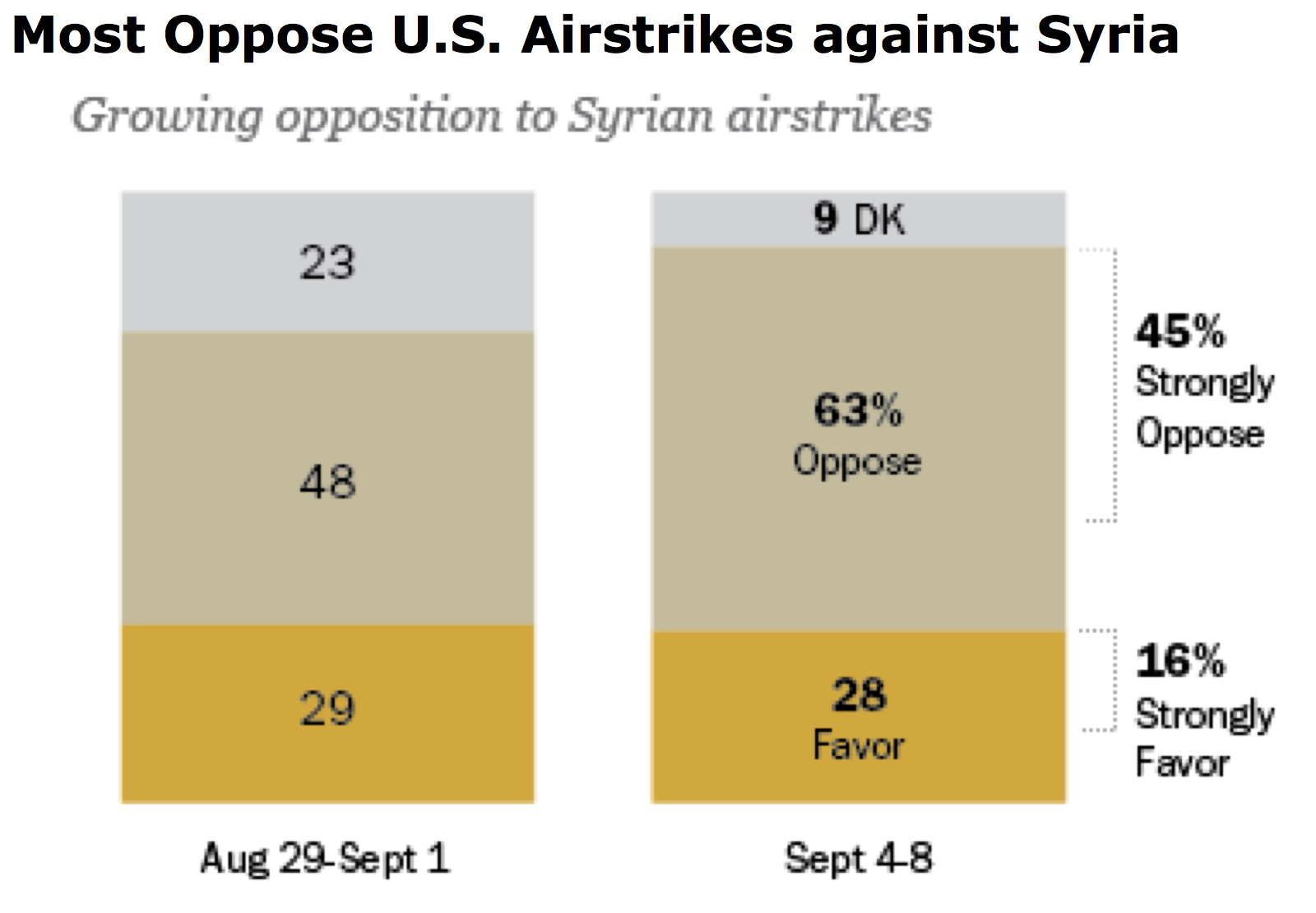
Syria Pew Poll

The latest from Pew:

Over just the past week, the share of Americans who oppose U.S. airstrikes in Syria has surged 15 points, from 48% to 63%, as many who were undecided about the issue have turned against military action. By contrast, the share of Americans who support airstrikes remains virtually unchanged: Just 28% favor U.S. military airstrikes against Syria in response to reports that its government used chemical weapons.

Nate Cohn notes “the total collapse in Republican support”:

Back in April, when Pew asked voters whether they would support strikes if Syria used chemical weapons, Republicans were pretty supportive; 56 percent were on board, compared to just 24 percent opposed. By last week’s Pew Research survey–now simply asking voters whether they would support strikes now that Syria had used chemical weapons–Republicans were basically divided. But today, Republicans are overwhelmingly opposed by a 49 point margin, with just 21 percent in support and 70 percent opposed. There hasn’t been similar movement among Democrats.

Ed Morrissey parses a CNN/ORC International poll:

The only good news for Obama in this poll is that a majority of respondents say that their votes in the midterms won’t be impacted by the vote on the authorization (57%).  However, among those who will take that into account fourteen months from now, sentiment runs nearly 3:1 against at 11/31.  It’s 4:1 among independents at 9/36, and 5:1 in the West (7/38), where Democrats hoped to make gains against Republicans with social-libertarian policies.

“Expect Everything”

Chilling words from Bashar al-Assad to Charlie Rose and the American people:

This embed is invalid


How Denver Nicks describes the exchange:

In response to questions about how the regime would respond if attacked by the United States, Assad said Washington should “expect everything,” including terrorist attacks. “The governments are not the only player in this region. You have different parties, you have different factions, you have different ideologies, you have everything in this region now,” he said. When Rose asked him if he meant that a response could include the use of chemical weapons, he said, “That depends. If the rebels or the terrorists in this region, or any other group in this region have it, it could happen, I don’t know, I’m not a fortune teller.” Hinting at unforeseen consequences that could come from an attack in a region he described as “on the brink of explosion,” Assad said, “Nobody expected the 11th of September.”

How Marc Tracy interprets the dictator’s words:

If this seems familiar, it is because you have seen it in a dozen movies and television shows about the mob. Assad comes across as a thug. Nice legs you’ve got there—shame if you broke them. I’m not saying American bases will be struck if you attack Syria, but I sure wouldn’t do it if I were you. Lotta crazy people in this region.

Weigel parses more quotes from Assad regarding WMDs, terrorists and Iran.

Face Of The Day

Jay Carney Briefs The Media At The White House

White House Press Secretary Jay Carney takes questions from reporters during the daily press briefing at the White House on September 9, 2013. Carney fielded numerous questions about President Barack Obama’s push for Congressional approval for limited military strikes against the Syrian government after President Bashar al-Assad allegedly used chemical weapons against his own people. By Chip Somodevilla/Getty Images.

Quote For The Day

“Christian realism requires the disavowal of war. Christians do not disavow war because it is often so horrible, but because war, in spite of its horror – or perhaps because it is so horrible – can be so morally compelling. That is why the church does not have an alternative to war. The church is the alternative to war. When Christians lose that reality – that is, the reality of the church as an alternative to the world’s reality – we abandon the world to the unreality of war,” – Stanley Hauerwas.

Previous Dish on the Christian pacifism of Hauerwas herehere and here.