Is Iran Part Of The Solution In Syria?

IRAN-POLITICS-EXPERTS-ROWHANI

Jay Newton-Small floats the idea:

When I was there late last summer, it was clear that Iranians weren’t particularly happy with Tehran’s unwavering support of Syria. Most of the bazaari wanted to see the money flowing to Syria spent instead propping up Iran’s faltering currency and economy. Add to that Assad’s use of chemical weapons, which are much reviled in Iran, and Rouhani might find popular support to weaken, if not break ties with Assad. And Iran might just be the only country Assad would listen to if they asked him to step aside. It is in both Washington and Tehran’s interests to prevent a failed state in Syria, and to stop Sunni radical al Qaeda factions from taking over the country. Such cooperation has been done before: Iran was a key ally in the U.S. invasion of Afghanistan, an Iranian neighbor, and with the toppling of the Taliban.

Packer also raises the possibility of Iran and the US working together:

Some Iranians point to the Bonn Conference of 2001—where Iran and the U.S. coöperated in the formation of an Afghan government, after the fall of their mutual enemy, the Taliban—as a model for what might take place with Syria. The U.S. and Iran have a common interest: preventing Salafi extremists, affiliated with Al Qaeda, from gaining power in the region. If this appeared probable in Syria, Iran might be willing to drop its support for Assad in exchange for a face-saving transition, backed by Turkey, Jordan, and the Gulf states: a ceasefire, a peacekeeping force made up of Muslim troops from the region, protections for Alawites and other minorities, U.N.-sponsored elections, and exile in a comfortable dacha for the Assad family.

None of this is likely.

It would take imaginative diplomacy of the kind that the Administration has shown little taste for in the Middle East. Iran would have to be convinced that it can’t win but also that it needn’t lose, and this would not be possible without deeper American engagement.

Judis nevertheless hopes for a diplomatic solution:

In Ha’aretz, Zvi Bar’el reports that Iran and Russia are working on a compromise proposal that could forestall an American attack on Syria. It would consist of a transfer of power in Syria in stages that would culminate in an election in which Bashar al Assad would not run and the transfer of Syria’s chemical weapons arsenal to Russia or another country. … Who knows whether these proposals are genuine, but they could represent a constructive way out of the current morass.

And that, it appears, is what just happened. And this moment might offer Obama an opening with the new administration in Tehran – an opening we all desperately need to avoid another war in the region.

(Photo: Iranian President Hassan Rowhani attends a session of the Assembly of Experts in Tehran on September 3, 2013. Iran’s Assembly of Experts is a body that selects the supreme leader and supervises his activities. By Mehrouz Mehri/AFP/Getty Images.)
Lavrov’s Move

G20 Leaders Meet In St. Petersburg For The Summit

https://twitter.com/jetpack/status/377095498445762560

The Russian foreign minister’s support for international control over Syria’s chemical weapons arsenal is a big deal, it seems to me. And the scenario for this sweet spot in dealing with Assad’s chemical weapons is not new. Here is Israel’s former intelligence head, Amos Yadlin, on how that compromise could turn a disaster into something far more constructive:

Were Putin to offer to take Assad’s chemical weapons out of Syria, said Yadlin in an Israeli Channel 2 news interview, “that would be an offer that could stop the attack.” It would be a “genuine achievement” for President Barack Obama to have ensured the clearing out of Assad’s capacity, and that would justify holding fire, said Yadlin. For Putin, such a deal would also keep the US from acting militarily in a state with which Russia is closely allied.

The UN Secretary General has also now endorsed the idea. And just in:

Kerry gave a deadline of one week. That could be negotiated a little. But the key thing is that Russia is now pursuing an actually constructive proposal. That’s a huge win for president Obama’s strategy. And for the security of the world.

If Obama can take yes for an answer …

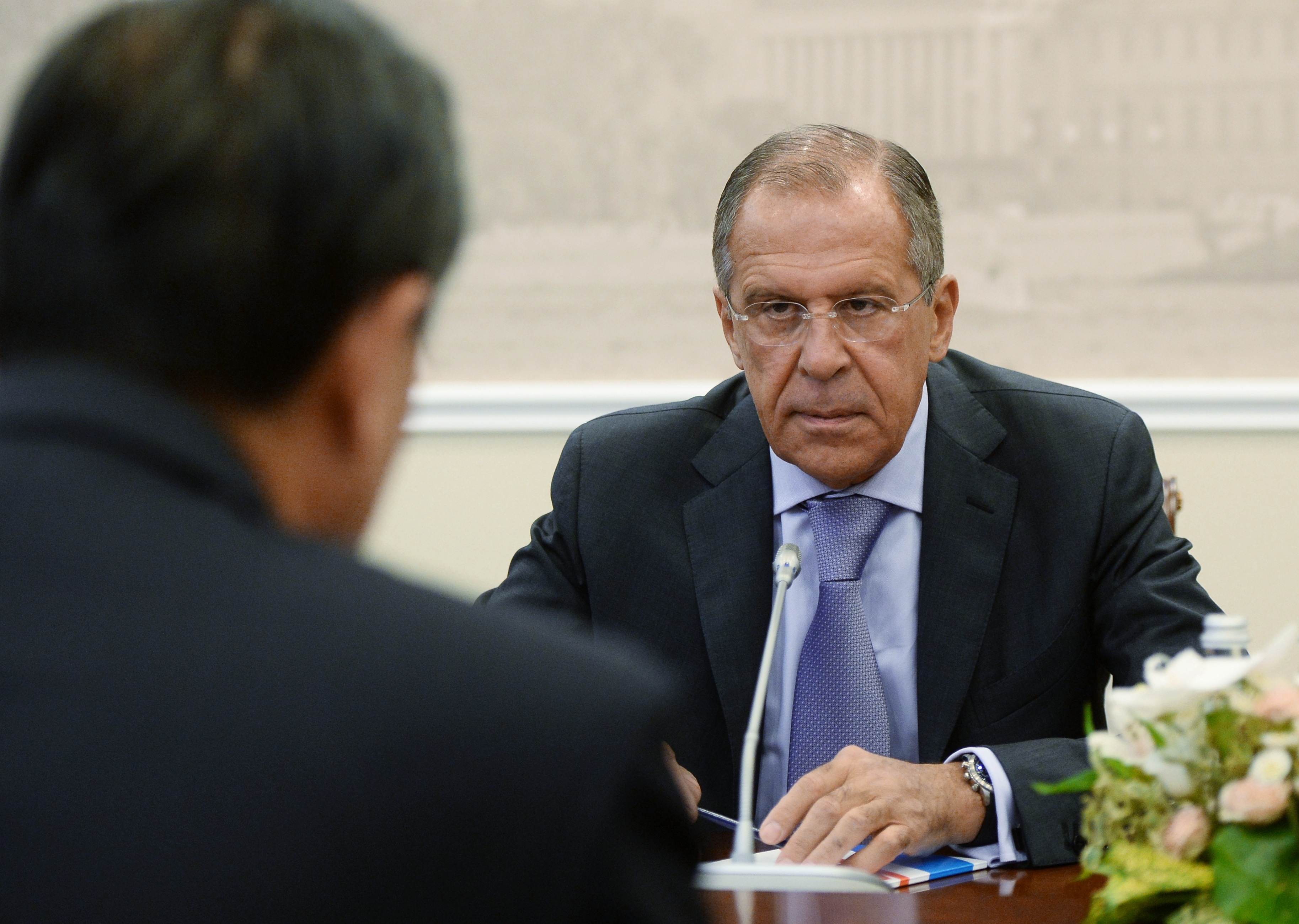
(Photo: Sergey Lavrov, Minister of Foreign Affairs of the Russian Federation, attends a meeting at the G20 Summit at the Constantine Palace at the G20 Summit on September 6, 2013 in St. Petersburg, Russia. Leaders of the G20 nations made progress on tightening up on multinational company tax avoidance, but remain divided over the Syrian conflict as they enter the final day of the Russian summit. By Roman Yandolin/Host Photo Agency via Getty Images)

Kerry Gaffes; The Russians Blink

US Secretary of State John Kerry Visits The UK

In his latest stream of unpersuasive self-righteousness, John Kerry today threw out an idea. Instead of threatening an imminent military strike, Kerry actually got creative:

Asked if there were steps the Syrian president could take to avert an American-led attack, Mr. Kerry said, “Sure, he could turn over every single bit of his chemical weapons to the international community in the next week — turn it over, all of it, without delay and allow the full and total accounting.”

He was, apparently, just being hypothetical. The State Department had to walk him back:

“Secretary Kerry was making a rhetorical argument about the impossibility and unlikelihood of Assad turning over chemical weapons he has denied he used,” Jen Psaki, the State Department spokeswoman, said in an e-mail to reporters after Mr. Kerry’s comments. “His point was that this brutal dictator with a history of playing fast and loose with the facts cannot be trusted to turn over chemical weapons, otherwise he would have done so long ago. That’s why the world faces this moment.”

I’d have thought a pretty basic qualification for being secretary of state is not to air hypothetical ideas in a public forum that the US does not intend to pursue. But Kerry, who is already doing a huge amount to make Hillary Clinton’s tenure at Foggy Bottom look magisterial, winged it. And the Russians immediately reacted:

“We don’t know whether Syria will agree with this, but if the establishment of international control over chemical weapons in the country will prevent attacks, then we will immediately begin work with Damascus,” Mr. Lavrov said at the Foreign Ministry. “And we call on the Syrian leadership to not only agree to setting the chemical weapons storage sites under international control, but also to their subsequent destruction.”

Wow. So we have the possibility of two things: that Russia might actually act decisively to rein Assad in, and also support the only viable policy to accomplish what Obama wants – protecting the world from these vile weapons. I have no idea whether this is a serious move by Lavrov – but it sure seems so, and it presents a fascinating non-binary option. It would manage to bring Russia in to solving this problem, without its having to acquiesce to what Putin regards as American grand-standing. And it would surely have some traction at the UN.

Sometimes, it seems, Kerry’s incompetence strikes gold. Here’s hoping.

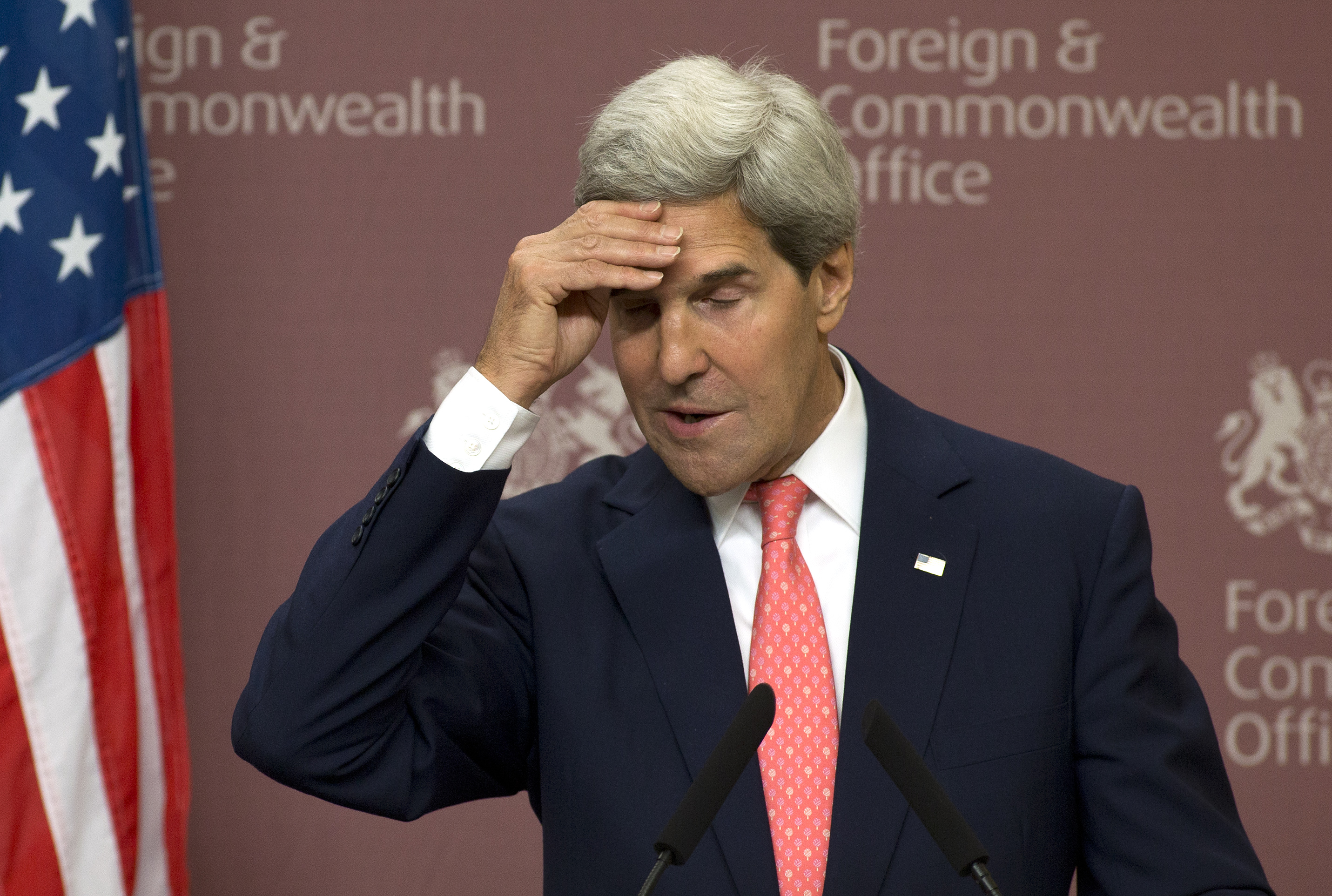
(Photo: US Secretary of State John Kerry gestures during a joint press conference with Britain’s Foreign Secretary William Hague at the the Foreign and Commonwealth Office on September 9, 2013 in London, England. By Alastair Grant – WPA Pool/Getty Images.)

Creepy Ad Watch

pi_pem_downsides_dog_aotw

Ryan Glasspiegel explains the WTF seen above:

A recent ad from apparel company Pearl Izumi was predicated on one simple idea: That the brand’s new running sneakers are so robust that your dog will perish while attempting to keep up with you. The thing about that simple idea, however, is that people like dogs. A lot. So, after the whole market-our-shoes-by-showing-a-dog-that-appears-to-be-dying approach drew ire from presumably every single person and object that saw it, the brand took to its Facebook page to apologize, and note that they were taking the ad out of circulation.

Update from a reader:

I agree the Pearl Izumi ad is hideously bad, but interestingly it’s also correct. Humans are weaker and slower than other animals in every category but one: long-distance running. Over marathon distances in hot climates, humans can outrun horses, dogs and just about everything else through a combination of better cooling (naked apes) and the design of the tendons in our legs. See here for a layman’s introduction.

If Congress Votes Against The President

Douthat expects major consequences for Obama’s presidency:

It is to President Obama’s great discredit that he has staked this credibility on a vote whose outcome he failed to game out in advance. But if he loses that vote, the national interest as well as his political interests will take a tangible hit: for the next three years, American foreign policy will be in the hands of a president whose promises will ring consistently hollow, and whose ability to make good on his strategic commitments will be very much in doubt.

I think Ross is hyper-ventilating. The simple fact is that American power was largely destroyed by the previous administration: Bush and Cheney both managed to gut US credibility on intelligence and prove that our vast military supremacy counts for nothing when it comes to actually bending the world to our will (see Iraq). Obama inherited that destroyed soft and hard power and has done his best with it. But the destruction itself was instructive. After the end of the Cold War, with no huge conventional military rival or threat, the US war-machine was far too big for the needs it was supposed to serve; and global views of America had soured more profoundly than at any point since the Second World War. The result is too big a weapon with too little international support. That’s one reason why Syria, a very tough issue in any era, is so particularly difficult for the US right now.

Millman is less excitable than Ross:

Presidents Ford and Carter faced much more serious rebukes from Congress in foreign policy where there was far clearer damage to Presidential credibility. We don’t generally count their Presidencies as successes – but America’s foreign policy was not crippled. If President Obama loses this vote, he will just have to count his votes more carefully in the future before committing himself where America does not already have clear and binding treaty obligations. Why again would that be so terrible?

And are we so certain that the president didn’t game this out? We may end up with a very Obama-style conclusion: putting Assad on notice, isolating Putin, and shifting the center of power in Washington over war and peace to a more democratic and constitutional place. Drum echoes:

Presidents suffer defeats all the time. Obama lost on cap-and-trade. He’s lost on plenty of judicial and executive branch nominations. He couldn’t get agreement for a grand bargain. He lost on gun control. What’s more, Republicans have been opposing him on virtually everything from the day he took office. In what concrete way would a defeat on Syria change this dynamic in even the slightest way?

A War The American People Don’t Want

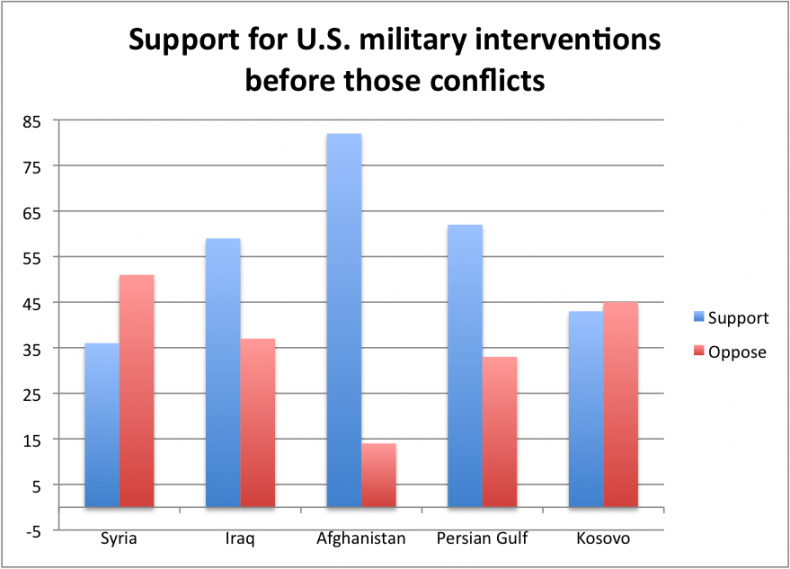
Attacking Syria is less popular than any other recent conflict was at the outset:

Support For War

Ezra examines the polling:

The latest CNN/ORC poll shows that 80 percent of Americans believe Bashar al-Assad used chemical weapons against his citizens. But even so, more than 70 percent of Americans say they oppose air strikes without congressional authorization and 55 percent say they oppose air strikes even with congressional authorization.

This, in a nutshell, is the White House’s problem: The American public believes the intelligence. They just don’t care. They don’t believe Syria poses a threat to the United States. They don’t believe the U.S.’s national interests are served by getting involved in Syria.

And they’re right, aren’t they?

Why Won’t Vegetarians Eat Fake Meat?

Julian Baggini considers the question:

In a poll run on the website of the Vegetarian Society, nearly four in five said they would not eat IVM [in vitro meat], while fewer than 7 per cent said they would. But why should there be such reluctance among vegetarians (who, for the purpose of this argument, I’ll take to include vegans) to welcome IVM when, from an animal-welfare point of view, it is nothing other than good news? Even if it doesn’t turn out to be commercially viable, the case for cultured meat rests very heavily on the unacceptability of intensive animal farming, and so shines a light on the ethical objections to the meat industry.

The only logical way to make sense of the reluctance of many vegetarians to back IVM is that their choices are not as driven by animal welfare and environmental considerations as we — and they — assume. Perhaps a distate for eating meat is a visceral feeling that is only loosely connected to a ethically motivated imperative not to cause undue suffering to animals.

Many people cannot distinguish between their ‘all-things-considered’ moral judgment and their unmediated gut feelings, mistaking reflex revulsion for ethical insight. Ingrid Newkirk, the president and co-founder of PETA, is refreshingly free of this confusion, which is perhaps why she can welcome IVM, even though she would not eat it. ‘Any flesh food is totally repulsive to me,’ she told NBC News. ‘But I am so glad that people who don’t have the same repulsion as I do will get meat from a more humane source.’

All of us, not just vegetarians, are at risk of confusing our base disgust and distaste with high principle. ‘Natural’ food feels right, ‘synthetic’ food feels wrong, so we are all-too-quick to dismiss the evidence that lab meat might be a good thing after all. And if you’re motivated to find the evidence that supports your gut feeling, there’s plenty from which you can pick and choose. But there is a huge difference between building your position on a firm evidence base and building an evidence base to support your position. We might believe our moral reasoning is evidence-led, but more often than not, we find ourselves led only to the evidence that conforms to our existing views.

Recent Dish on IVM here, here, here and here.

New Frontiers In Propaganda

Screen Shot 2013-09-09 at 3.26.58 AM

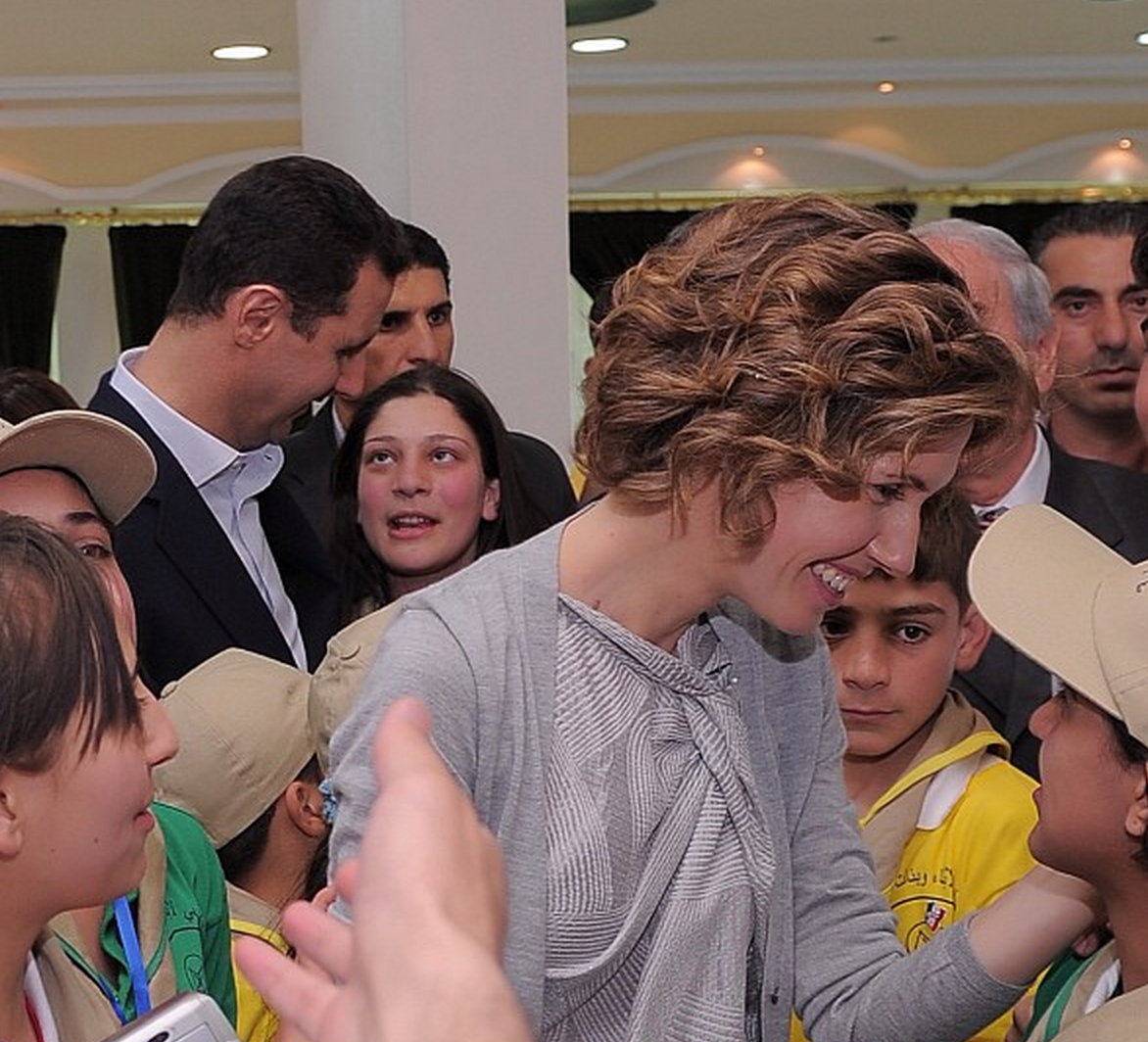
Megan Garber investigates the Assad family’s Instagram presence:

The account gives Syrians and non-Syrians alike a supposed little insight into the supposed little sitcom that is The Assads – that quirky family-next-door, comprised of people who are wacky and relatable in equal measure. The Instagrams attempt to humanize Syria’s first family, to place them in a familiar context – which is also to say, if you’ve been following the news out of Syria, a totally unfamiliar context. A context that is unfamiliar because it is untrue. It’s not, of course, that there’s no joy to be found in Syria, despite all the conflict and chaos in the country; it’s that syrianpresidency, with every implication of business-as-usual, commits a sin of informational omission. Which is all to say that this particular Instagram feed does what most Instagram feeds tend to do: It offers a carefully crafted performance of daily banalities. With the difference here being that most Instagram feeds, and most of their mundanities, do not belong to dictators.

Marin Cogan notes that the Syrian mass-murderer is hardly being creative:

Assad is the latest in what one news site has called “the dictators of Instagram.” Chechen President Ramzan Kadyrov has famously used the social-networking site as a platform to project his very Russian style of masculinity (photo montages of the impossibly barrel-chested despot weight-lifting and posing with wolves and wildcats.) The minions of Ayatollah Khamenei have posted several close-ups of Iran’s septuagenarian Supreme Leader on his photo-sharing page.

Unsurprisingly, the Instagram presence of Bashar’s beautiful wife Asma has increased recently:

The Daily Mail, based in Great Britain where Asma al-Assad was born to affluent Sunni Muslim Syrian expats, and where she met her husband when he was an optometry student, called the Screen Shot 2013-09-09 at 3.30.48 AMphotos a “sickening propaganda tool.”  The paper blasted her as “a stooge in this shameless PR exercise,” a woman who “seems is all too willing to try and mask the horrific atrocities being carried out by her husband’s forces.” Unlike other news sites, which ran the Instagram photos as stand-alone image, the Daily Mail paired each with a picture of Syrian carnage. …

The first lady’s family of Sunnis come from Homs, Syria’s third-largest city, which has been largely destroyed by Assad forces, Tabler said. But because she married into her husband’s ruling Alawite family and is the mother of their three children, “she is not about to break ranks. If she did, that would be great.”

But fortunately Instagram doesn’t shield the photos from criticism. Regarding the photo seen right:

Screen Shot 2013-09-09 at 3.29.34 AM

Strangers In The Sky

Lisa Wade informs us that “on any given flight anywhere in the world, most flight attendants are meeting their co-workers for the very first time”:

There are about 100,000 flight attendants in the U.S. alone and they get their flights through a process of bidding, one month at a time, one month ahead.  Most really do “see the world,” as the old glamorized image of the intrepid stewardess suggests, instead of working the same route over and over again.  As a result, explains Drew Whitelegg in Working the Skies, they rarely run into the same flight attendant twice.

This means that flight attendants must get to know one another quickly once they get on board.  They need to do so to make food and beverage service efficient, to coordinate their actions in the tight galleys in which they work and, most importantly, so that they will trust one another if they are called upon to do what they are really there for: acting in an emergency, one that could theoretically happen within seconds of take-off.  There’s no time to lose. “[F]rom the moment they board the plane,” writes Whitelegg, “these workers — even if complete strangers — begin constructing bonds.”

Previous Dish on flight attendants here and here. Update from a reader:

Generally true for airline pilots, too. Two of my old college roommates are now captains on major US airlines. They almost never fly with same co-captains; sometimes more than a year passes before they fly with same crew. You can tell by watching them introduce themselves to each other as they’re getting on board.