Infomercials finally get their Smiths tribute:
Month: September 2013
How Merciful Should Critics Be?
Lee Siegel reflects on how becoming an author made him a more generous appraiser of others’ work:
Having become an author of books myself, I now find that the shoe is most definitely on the other foot. I once dismissed as maudlin the protest that one shouldn’t harshly disparage a book because the author poured the deepest part of herself into it. What, I replied, has that got to do with defending civilization against bad art and sloppy thinking? Nowadays the abstractions of aesthetic and intellectual criteria matter much less to me than people’s efforts to console themselves, to free themselves, to escape from themselves, by sitting down and making something. In my present way of thinking, mortality seems a greater enemy than mediocrity. You can ignore mediocrity. But attention must be paid to the countless ways people cope with their mortality. In the large and varied scheme of things, in the face of experiences before which even the most poetic words fail and fall mute, writing even an inferior book might well be a superior way of living.
Isaac Chotiner shakes his head:
Siegel should take a deep breath, re-read this paragraph, and ask himself if he really wants to live in a world without negative cultural criticism. He should also explain whether he is willing to review books at all, since accepting a book reviewing assignment should entail a willingness to be honest about the book. I am happy for Siegel that he has started writing books himself, and thus, according to his logic, begun wrestling with mortality. But people write books for all sorts of reasons, not all of them so wince-makingly self-serious. And since no one can read every book, it’s worth having critics around to be honest about which ones are worth our time, and to help explain their larger importance, even if doing so makes those critics occasionally sound mean.
Face Of The Day
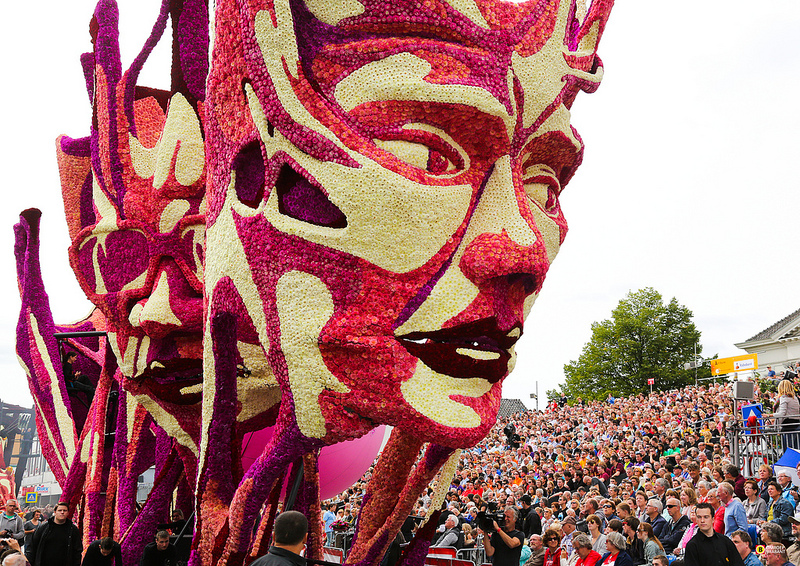
A float made of dahlia flowers cruises through Corso Zundert, an annual flower parade in the Netherlands.
(Photo copyright Omroep Brabant)
Flash Fiction
Nuala Ni Chonchuir describes the genre, also known as “short-short stories, micro fiction, pocket-size, postcard, palm-size and smoke-long stories”:
In my world a flash has about 500 words and is part poem, part story. Plot is not as crucial as atmosphere and significant detail, and, for me, language is paramount. Though short on words, the flash story is long on depth and should sting like good poetry. Punchy, succinct and surprising, the best flash will shift the reader’s heart but also keep it beating hard. Just like poetry, every word in a flash must deserve its place. Flash stories revel in musical prose. There is no room for frills and furbelows but there is for hints, implication and mystery. They accommodate the surreal and quirky well. Backstory cannot exist in flash: everything must be right here, right now. Flash thrives on punchy openings and breath-sucking endings. And, like its sister art poetry, it bears rereading very well.
Writing about John Cheever’s very short story Reunion, Richard Ford said it worked because of its “interconnected, amalgamated, shapely and irreducible self”, and this is a good analogy for flash fiction. The opening complements the ending which complements the subject matter which complements the language: everything connects and folds into a pleasing oneness.
A Trip To The Zoo
Bert Haanstra filmed his 1962 short documentary Zoo in Amsterdam:
Zoo is a touching and humorous look at the way people and animals behave. This was the first time that Haanstra used a hidden camera. He said: “observing people and animals when they don’t know you’re there is fascinating. I bonded with them”. Making a film of this kind required tact and integrity, and Haanstra and his team were aware of their responsibilities throughout and respected the privacy of their subjects. In “Zoo”, Haanstra and cameraman Anton van Munster filmed people with a hidden camera to see how people behave in different situations and environments, without the self-consciousness created by the camera. They concealed the camera in a huge shopping bag, and hid their equipment in bushes, and built sheds with one-way glass.
The Dish posted Haanstra’s Oscar-winning short Glas here.
(Hat tip: kottke)
The Poetry Of Impersonation
Stephen Burt enumerates the many ways poets can show up in their work:
It seems to me that poetry in general lets you create a voice that is you-but-not-you, you-but-like-you, you-as-someone-else, for the writer and also for the reader: that character can speak about you, for you, to you, in ways that you couldn’t pull off speaking “as yourself.”
Sometimes the persona, the you-who-speaks-the-poem, has no name and not much extension other than what’s brought about by the author’s style (the “I” in a lot of poems by Emily Dickinson), and sometimes the persona has a great deal of extension, a prior life as a historical or fictional character (Robert Browning’s Andrea del Sarto), and sometimes the persona’s somewhere in between (Philip Sidney’s Astrophel). Even a poem that looks autobiographical constructs a character anyway — it’s just that the character shares obvious attributes, such as location, approximate age, and marital status, with the “bundle of accident and incoherence who sits down to breakfast,” as Yeats put it, the real-life poet who wrote the poem.
The View From Your Window Contest
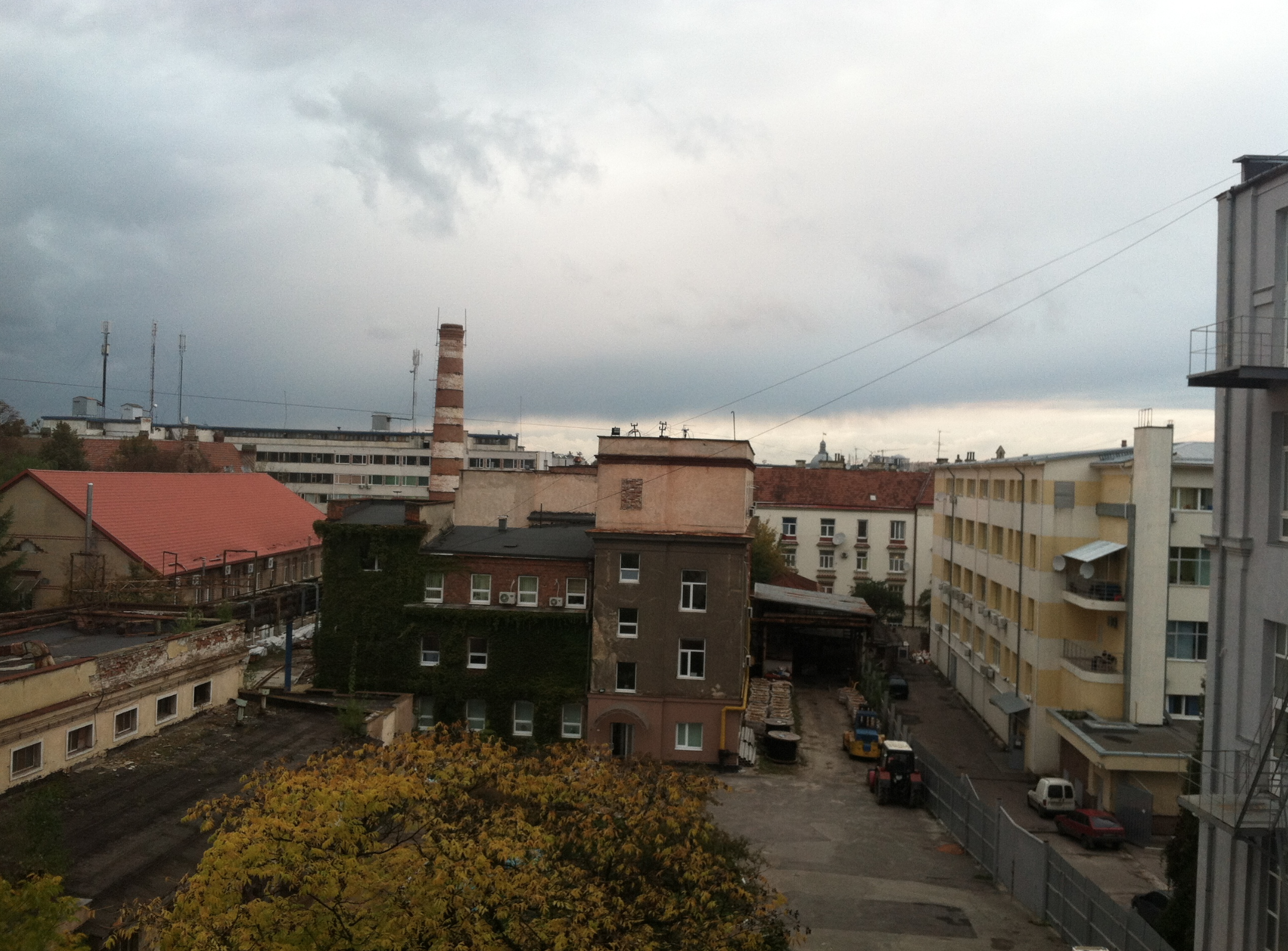
You have until noon on Tuesday to guess it. City and/or state first, then country. Please put the location in the subject heading, along with any description within the email. If no one guesses the exact location, proximity counts. Be sure to email entries to contest@andrewsullivan.com. Winner gets a free The View From Your Window book or two free gift subscriptions to the Dish. Have at it.
Missing A Tweet For Help
Jacqui Chang argues that forbidding teachers from following students on social media actually does more harm than good:
The result of such policies is a group of adults—those who are largely responsible for our kids’ intellectual development—plugging their ears and yelling “LA LA LA LA” when it comes to students on social media. That is a terrible thing, especially since social media is arguably the number one place we should look when we want to find out how our students are feeling, and where they need help. … [T]hose students are tapping away on their phones, broadcasting their thoughts to everyone and no one as they try to progress into the next stage of their lives—mostly on their own. “I just want to die. Please leave me the fuck alone,” tweeted one of my students recently, just before the school year started again. “Somebody to talk to would be nice.”
Specialty Strip Clubs
This week, Cory Booker’s senatorial campaign hushed a media tizzy over revelations of his Twitter flirtations with a stripper from Portland by saying, “The most shocking part of this story was learning there is a vegan strip club in Portland.” Mauren O’Connor agreed and assembled a FAQ about the club, Casa Diablo:
Portland’s strip-club scene is kind of weird, huh?
A bit. As Casa Diablo demonstrates, Portland’s strip club scene has some prominent alterna-sexy offerings of the Suicide Girl variety. (Portland has a pirate-themed strip club, too.) On Yelp, reviewers alternately celebrate and complain about Portland strip clubs that are no more than “dive bar atmosphere with a naked girl in the corner.” In his IFC interview, [Casa Diablo owner] Johnny Diablo refers to Portland as the “strip club capital of America,” a title that several other cities also claim. Legend has it that Portland has “more strip clubs per capita” than any other city, due in part to Oregon’s remarkably liberal strip club and liquor regulations. Some outsiders contest the strippers-per-capita claim, too, though. …
What other unusual strip clubs should I know about?
A science-fiction strip club; an underwater strip club; a strip club this one guy opened in his living room; and Larry Flynt’s “barely legal” strip club, decorated to resemble teen girls’ bedrooms.
Facebook’s Sarcasm Detector
The social network is increasingly relying on “deep learning,” where artificial intelligence develops the ability to read between the lines:
In the context of your Facebook day-to-day musings, the idea is the AI software would be used to better determine the meaning behind your ramblings. For instance, it could pick up on a note of sarcasm, such as “yes, all I need today is another fun piece of news about an impending birth/engagement/wedding” and thus put an end to the constant stream of age-related adverts for baby clothes, wedding bands and such like.
Facebook’s news feed currently runs on an algorithm that determines rankings and selections according to three things:
whether you’ve shown interest in a post from a specific member before, how the post has fared so far and how you’ve responded to posts of a similar nature in the past. Of course, if it isn’t able to pick up on nuances in language, in either your or your friends post, it’s impossible to correctly determine your authentic likes and dislikes.
Meghan Neal sounds a note of caution:
Technology Review reported that deep learning technology could figure out the emotions in status updates or events even if they aren’t explicitly shared, recognize objects in photos, and even predict how people will likely behave in the future. The implications of that level of knowledge and insight are many, and scary.
To some extent, it’s happening already, just with the traditional machine learning that Facebook currently uses to improve user experience and develop new features. The news recently broke that Facebook knows traits and details about you that you never told it—like if you’re gay, or a Democrat.
 The Dish