The Aesthetics Of Death

3220110683_1f28060a20_o

Upon examining the anatomical models made in early modern Europe, Ron Miller sees an age-old tension between realism and idealism:

Those [wax anatomical figures] made by Italian artists were usually refined with everything that could provoke repulsion or disgust in the viewer removed. Models from northern countries such as the United Kingdom, the Netherlands or Germany were usually more realistic, almost brutally so, leaning more toward anatomical accuracy than aesthetics. Italian models seem more ‘alive’ while those from the United Kingdom seem more “lifeless.” The figures produced in Florence seem to be alive and breathing; the faces are languid and their hair of female figures is left loose or gathered into seductive plaits that were often adorned by pearl necklaces. On the other hand, English waxes merely reproduced cadavers. Perhaps the most disturbing direction taken by the Italian school was the creation of what came to be known as “Venuses.” These were nothing more than excuses to create life-size, hyperrealistic depictions of beautiful dead or dying women.

(Photo of a wax anatomical study at the Palazzo Poggi Museum by Shiralee Saul)

Talking To A God You Don’t Believe In, Ctd

A few readers can relate to the embattled atheist Sigfriend Gold:

OMG, I thought it was just me!  I pray to God all the time.  I don’t really think He’s real, though. Am I hedging my bets? Am I hypocritical? Am I not really an atheist? No to all of the those. Praying and talking to God helps me. Period. I wish I did believe. I wish I had not “fallen” from my religion and I wish I could get that feeling back that I once had when I walked into church – of awe, of connection.  When I first started talking to God again, after resisting the behavior for many years, I thought perhaps I was regaining my Faith. I contemplated going to Church again. That became too complicated a thought. For now, I am comforted by God. Even if it’s only just me talking to the walls.

The other reader:

I, too, often pray, without believing there is some supernatural persona listening to me. If the only prayer you’ve ever engaged in is asking for petty favors, it’s easy to mock when you don’t believe it works anymore. But look, I can tell you simply why I still pray. It is by hearing the words come out of my mouth “to God” that I know what’s important to me. I suppose that can be mocked too. Maybe I am childish for not finding some more advanced way to understand and prioritize what is going on in my life. But it works, it’s comfortable to me, and I like it. So I will carry on.

Minding Our Minds

Adam Gopnik considers how we interpret knowledge of neuroscience:

Neurology should provide us not with sudden explanatory power but with a sense of relief from either taking too much responsibility for, or being too passive about, what happens to us. Autism is a wiring problem, not a result of “refrigerator mothers.” Schizophrenia isn’t curable yet, but it looks more likely to be cured by getting the brain chemistry right than by finding out what traumatized Gregory Peck in his childhood. Neuroscience can’t rob us of responsibility for our actions, but it can relieve us of guilt for simply being human. We are in better shape in our mental breakdowns if we understand the brain breakdowns that help cause them.

This is a point that [Brainwashed authors Sally] Satel and [Scott O.] Lilienfeld, in their eagerness to support a libertarian view of the self as a free chooser, get wrong.

They observe of one “brilliant and tormented” alcoholic that she, not her heavy drinking, was responsible for her problems. But, if we could treat the brain circuitry that processes the heavy drinking, we might very well leave her just as brilliant and tormented as ever, only not a drunk. (A Band-Aid, as every parent knows, is an excellent cure whenever it’s possible to use one.)

The really curious thing about minds and brains is that the truth about them lies not somewhere in the middle but simultaneously on both extremes. We know already that the wet bits of the brain change the moods of the mind: that’s why a lot of champagne gets sold on Valentine’s Day. On the other hand, if the mind were not a high-level symbol-managing device, flower sales would not rise on Valentine’s Day, too. Philosophy may someday dissolve into psychology and psychology into neurology, but since the lesson of neuro is that thoughts change brains as much as brains thoughts, the reduction may not reduce much that matters. As Montaigne wrote, we are always double in ourselves. Or, as they say on the Enterprise, it takes all kinds to run a starship.

The Massacre Of Christians We Might Unleash, Ctd

Julia Ioffe is uncomfortable with Rand Paul focusing, almost exclusively, on the effect Assad’s fall could have on Syria’s Christians. Dreher spots a double standard:

 What she ought to understand is that Paul is a Republican politician trying to explain to a big part of the GOP base — conservative Christians — why they should pay particular attention to the Syria situation, and oppose the US government’s plans to enter the war on behalf of the Islamist rebels. I very much doubt Ioffe would complain about Jewish politicians speaking to American Jews to rally them behind an American foreign policy proposal that protected the interests of their co-religionists in Israel, or US Muslim politicians like Keith Ellison doing the same when talking to American Muslims about his co-religionists in the Mideast, and American foreign policy. And she should not! Why must Christian politicians only speak about US foreign policy in universalist terms? Why do people like Ioffe consider it immoral for a Christian politician to speak up for Christians?

Mark Movsesian is like-minded:

In a pluralistic society, people have multiple commitments–religious, ethnic, ideological, familial—that cut across national borders. Everyone knows these commitments influence people’s decisions about foreign policy. African-Americans cared deeply about US policy with respect to South African apartheid in the 1980s and care deeply about US policy in Africa today; Americans Jews care deeply about US policy toward Israel; American Muslims care deeply about US policy toward Palestine; and so on. Should Christians alone check their commitments at the door? Should they alone be embarrassed to raise the dire situation of co-religionists in other countries? Where’s the sense in that?

Dreher seconds him.

A Poem For Sunday

Bible and rosary

“The Argument of His Book” by Robert Herrick (1591-1674):

I sing of Brooks, of Blossomes, Birds, and Bowers:
Of April, May, of June, and July-Flowers.
I sing of May-poles, Hock-carts, Wassails, Wakes,
Of Bride-grooms, Brides, and of their Bridall-cakes.
I write of Youth, of Love, and have Accesse
By these, to sing of cleanly-Wantonnesse.
I sing of Dewes, of Raines, and piece by piece
Of Balme, of Oyle, of Spice, and Amber-Greece.
I sing of Times trans-shifting; and I write
How Roses first came Red, and Lillies White.
I write of Groves, of Twilights, and I sing
The Court of Mab, and of the Fairie-King.
I write of Hell; I sing (and ever shall)
Of Heaven, and hope to have it after all.

(Photo by Godong/Universal Images Group via Getty Images)

Learning Piety From Parenting

Danya Ruttenberg ponders what would happen if “the experiences, issues and questions that come out of parenting were taken seriously in our thinking about prayer, theology and religious practice”:

Jewish law suggests that you shouldn’t hold a child during prayer, lest she disturb your concentration; that you shouldn’t kiss your children in synagogue, to help you learn that no love compares to love of God; that if your child is crying, you should indicate to the child — without speaking — to stop crying, and if that doesn’t work, you should walk away from her so that her crying does not disturb your prayer. Another source reminds fathers not to hold a diapered child before afternoon prayers, lest he become soiled and miss the start of services.

There is a not-very-implicit assumption that someone else, somewhere, is in charge of the sticky, cuddly, needy, emotional little humans who evidently impede a person’s ability to live a life of spiritual service. Spirituality and young children are placed in opposing, incompatible spheres. Women, in particular, are relegated, along with the children, away from wherever it is that they are keeping a connection with the transcendent. People actively engaged in parenting are not wanted there.

The idea that loving and caring for children could be a core, crucial, even transformative aspect of a religious life is totally absent from this tradition.

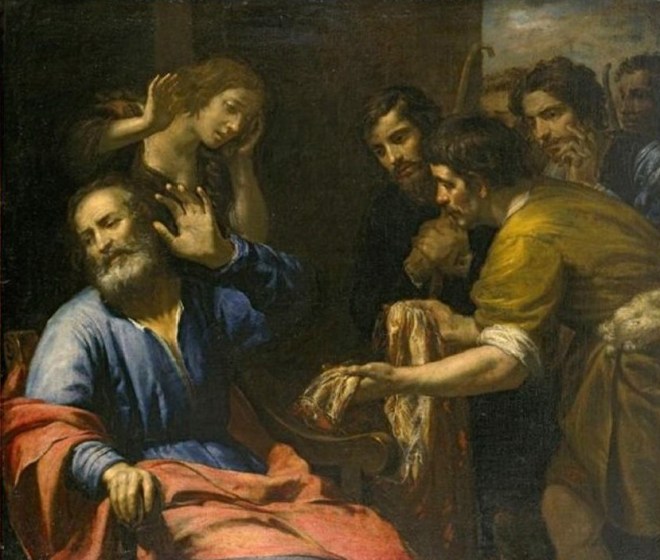
Coat Of Many Colors, Tale Of Many Textures

Giovanni_Andrea_de_Ferrari_-_'Joseph's_Coat_Brought_to_Jacob',_oil_on_canvas,_c._1640,_El_Paso_Museum_of_Art

Sam Sacks pens an extended essay on the biblical story of Joseph and his brothers, which he approaches from a literary perspective, claiming the tale “stands out for the perfection of its design, the mastery of its techniques, and the power of its climax.” One point he makes:

Perhaps what most stands out on the first reading of the Joseph story is the restrained use of the fantastical devices that haunt the rest of Genesis. God is here, but only tacitly, and the exact extent of His involvement is unclear to the characters and the audience alike. The story begins with a supernatural occurrence that is handled with such irreverence that it seems almost ironically deployed. Joseph is 17 and the most beloved son of Jacob, who has ostentatiously advertised his favoritism by giving Joseph the iconic coat of many colors. Joseph has become, as a result, a coddled brat—the very first thing we see him do is tattle to Jacob about some talk he overheard while tending to his sheep. The next thing we see him do is announce to his father and his steamingly resentful older brothers the prophecies revealed to him in dreams:

And Joseph dreamed a dream and told it to his brothers and they hated him all the more. And he said to them, “Listen, pray, to this dream that I dreamed. And, look, we were binding sheaves in the field, and, look, my sheaf arose and actually stood up, and, look, your sheaves drew round and bowed to my sheaf.” And his brothers said to him, “Do you mean to reign over us, do you mean to rule us?” And they hated him all the more, for his dreams and for his words. And he dreamed yet another dream and recounted it to his brothers, and he said, “Look, I dreamed a dream again, and, look, the sun and the moon and eleven stars were bowing to me.”

Here, at the outset, is the first signaling of a narrative complexity that will become more and more enfolding as the story progresses. Joseph is the hero of this tale, his dream is divinely inspired, and in time events will vindicate his visions. But the story is only passingly interested in the predictive accuracy of his dreams—its emphasis is instead on Joseph’s boastfulness, his spoiled naiveté, and the contempt he blithely incites among his brothers. The story is prioritizing the conflict of familial envy over the more grandiose problem of divine revelation.

(Giovanni Andrea de Ferrari’s Joseph’s Coat Brought to Jacob, 1640, via Wikimedia Commons)

Left To Wonder

Explaining the loss of her religious faith, Michelle Syba emphasizes that her story is not just about “reason’s triumph over emotion,” but rather coming to appreciate “the kinds of emotions possible before and after faith”:

If anything, losing faith made possible not an efflorescence of rationality, but instead new kinds of emotion.  Where once there was anxiety at uncertainty (am I damned?), now there is the bewildering thrill of living in the face of uncertainty. …

Now that I’m damned I’ve discovered a new capacity for wonder.  I was never able to feel the right kind of awe at the thought of God creating my best friend down to her pinky toe; the scenario felt at once too grandly calculated but also trivial, scripting God as some conscientious plastic surgeon of the cosmos.  Now I marvel at having met my best friend in the first place, despite our disparate backgrounds and lives.  Wonder has become a riskier, more provisional business, less a preview of eternal magnificence than the fleeting, local emotion of a mayfly striving in early summer before it dies.