Hit The Road, Jack

Bruce Bawer has damning words for the work of Jack Kerouac and his fellow Beats:

Objectively speaking, Kerouac and his pals were little more than a bunch of unprepossessing misfits. And yet—with their glib contempt for capitalism and mainstream society, their romanticization of criminality, drug abuse, and the tragedy of mental illness, and their narcissistic rebranding as virtues of their own shiftlessness and dissolution—they would turn out to be, to an amazing extent, the seed of pretty much everything that was rotten about the American 1960s and their aftermath.

Echoing Burroughs’s dictum that “the only possible ethic is to do what one wants to do,” Kerouac—who viewed himself as one of history’s “great ravaged spirits,” along with Dostoevsky, Nietzsche, and Hitler (yes, Hitler)—justified his colossal selfishness by pretending it was a philosophy of life, which he called “self-ultimacy.” It’s hard to decide which is more of a miracle—that all these self-regarding pseudo-intellectuals managed to find one another, or that they then managed to spark a cultural revolution that transformed the Western world. …

In the end, perhaps the most complimentary thing one can say about Kerouac is that he was the only Beat who wavered in his commitment to their facile rejection of responsibility and embrace of eternal childishness. He had, [biographer Joyce] Johnson writes, a “love affair with decadence,” but also “railed against [his fellow Beats’] decadence”—now and then making an effort, at least, to find and keep a job, be a good husband, make his father proud, scrape together some cash for Mom. It’s too bad he never made a comparable attempt to lift his poetry above the level of drivel, but then again, contemporaries of his who spent their adult lives producing luminous, powerful, and brilliantly crafted poems—among them Louis Simpson, Donald Justice, and Frederick Morgan—have yet to be immortalized by the Library of America.
Previous Dish on Kerouac here, here, and here.

Weighing Walser’s Words

Ben Lerner perceives a peculiar energy in the work of Robert Walser:

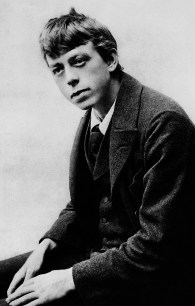
Robert Walser / Jugendbildnis - - Walser, RobertThe force of Walser’s writing derives from this simultaneous valorization of irreducible individuality and of sameness, smallness, interchangeability. In the most various terms, Walser praises monotony; it makes it wonderfully difficult to read his tone. When is he serious? When is he mocking the will to conform?

Susan Sontag wrote that “the moral core of Walser’s art is the refusal of power; of domination.” And yet, paradoxically, part of the power of Walser’s art lies in how that refusal of domination interacts with his narrators’ demands to be dominated. Walser’s voice is a strange mix of exuberance and submission, lyrical abandon and self-abnegation. His refusals are anti-heroic, wavering; they reveal—sometimes comically, sometimes tragically—how the desire to be ruled enters the subject, the son, the servant, the pupil.

How can a writer refuse even the power of refusal, preserve his freedom while falling all over himself to give it away? Maybe the answer has to do with how Walser’s singular sentences themselves “step aside”: one of the most notable effects of his prose is how it seems to evaporate as you read. Walter Benjamin said of Walser’s “garlands of language” that “each sentence has the sole purpose of rendering the previous one forgotten.” This is not to say there aren’t depths of meaning and memorable passages, but Walser’s genius often involves a kind of disappearing act.

Previous Dish on Walser here.

The View From Your Window Contest

image001

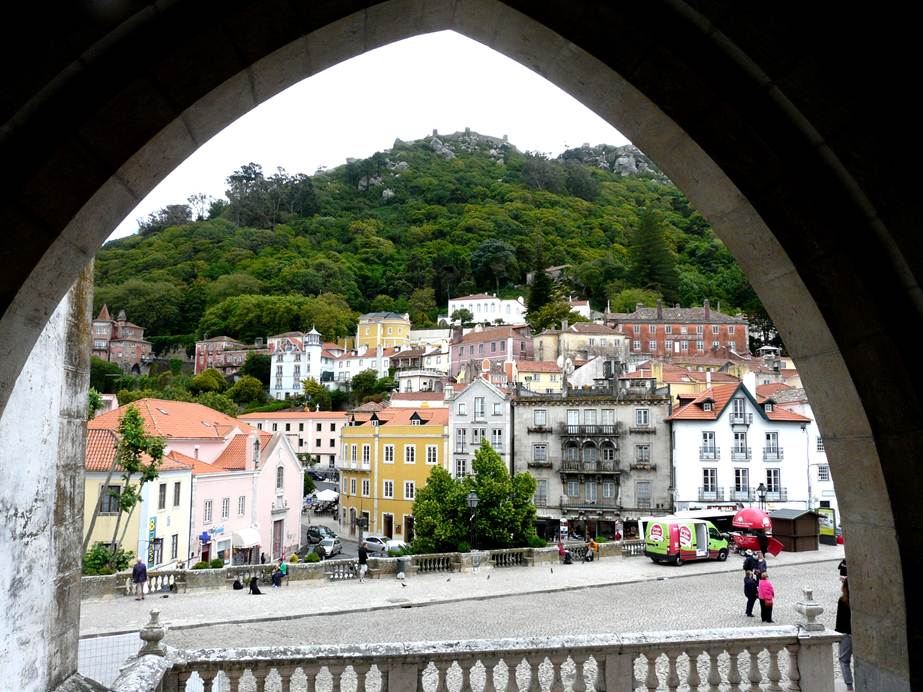
You have until noon on Tuesday to guess it. City and/or state first, then country. Please put the location in the subject heading, along with any description within the email. If no one guesses the exact location, proximity counts.  Be sure to email entries to contest@andrewsullivan.com. Winner gets a free The View From Your Window book or two free gift subscriptions to the Dish. Have at it.

What Makes A Genius?

Joseph Epstein assesses the question in a review of Darrin M. McMahon’s Divine Fury:

[G]eniuses tend to emerge in those areas of life dominant in specific cultures at specific times. For the Greeks, the main games were philosophy and art. For the Romans, it was military exploits and administration, and the only two Romans up for genius whom McMahon mentions prominently are Julius and Augustus Caesar. During the Middle Ages, devotion and piety, with an emphasis on asceticism and personal sacrifice, won the genius laurels, and the genius that occupied the souls of men and women was thought to be imbued by angels. Augustine of Hippo and Thomas Aquinas were both made saints. (“Genius,” wrote the Russian philosopher Nikolai Berdyaev, “is another kind of sainthood.”) For the Renaissance, it was art, chiefly visual art, painting and sculpture and architecture, that rang the gong. For the modern age, beginning with the 18th century, scientific geniuses predominate.

For our own age, the main game, once thought to be invention—Thomas Edison and Henry Ford held genius status for a while—has yet to be determined, especially with so much science now being done not individually but in teams. Hence the paucity of agreed-upon geniuses in our day. Those master marketeers of the digital age, Bill Gates and Steve Jobs, need not apply.

Face Of The Day

Revelers Gather For Banyuwangi Ethno Carnival 2013

A model wearing a Kebo Geni costume attends the Banyuwangi Ethno Carnival 2013 in Banyuwangi, Indonesia on September 7, 2013. The central theme to the carnival is the Legend of Kebo-keboan Blambangan and consists of three main parades which are Kebo Geni, Kebo Tirto Bayu, Kebo Bumi, comprising more than 250 performers. By Robertus Pudyanto/Getty Images.

Doping Is Hard Work

Malcolm Gladwell examines the use of performance-enhancing drugs, quoting from cyclist Tyler Hamilton’s The Secret Race:

“Dope is not really a magical boost as much as it is a way to control against declines,” Hamilton writes. Doping meant that cyclists finally could train as hard as they wanted. It was the means by which pudgy underdogs could compete with natural wonders. “People think doping is for lazy people who want to avoid hard work,” Hamilton writes. For many riders, the opposite was true:

EPO [erythropoietin, a hormone that boosts production of red blood cells] granted the ability to suffer more; to push yourself farther and harder than you’d ever imagined, in both training and racing. It rewarded precisely what I was good at: having a great work ethic, pushing myself to the limit and past it. I felt almost giddy: this was a new landscape. I began to see races differently. They weren’t rolls of the genetic dice, or who happened to be on form that day. They didn’t depend on who you were. They depended on what you did—how hard you worked, how attentive and professional you were in your preparation.

A Poem For Saturday

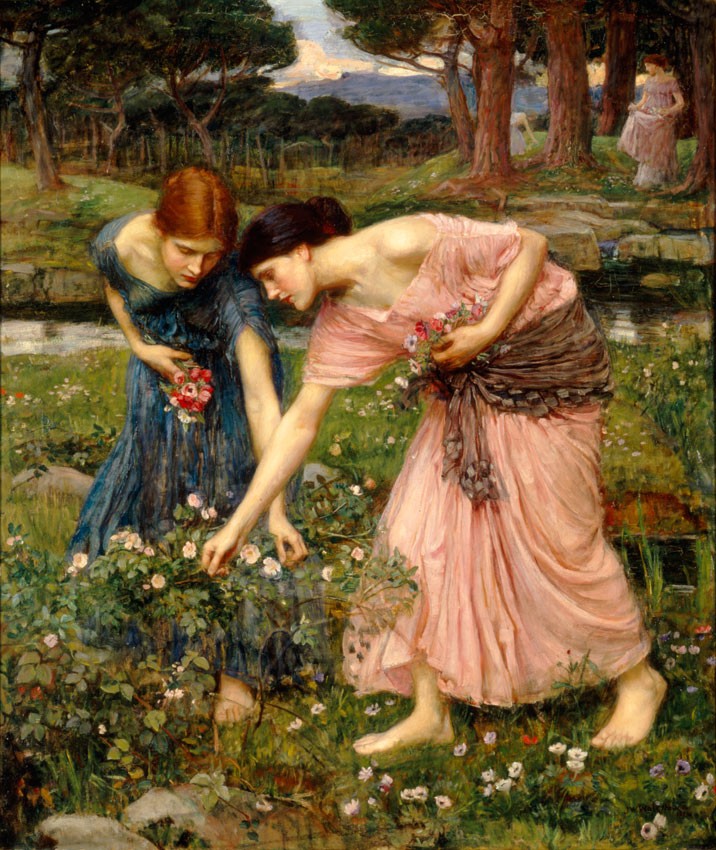
Waterhouse-gather_ye_rosebuds-1909

Robert Herrick (1591-1674) is one of the most noteworthy figures of early 17th-century British poetry and primarily known for his slew of poems chosen by anthologists W.H. Auden and Norman Holmes Pearson for Poets of the English Language, a superb five-volume set published by the Viking Press in 1950. Posting poems by Herrick over the next few days also allows us to champion the Poetry Foundation’s excellent website, where readers can find a fascinating bio on Herrick, the courtier poet to King Charles I who “died a poor country parson, whom no fellow poet seems to have commemorated with a verse-epitaph, much less an elegy.” The first poem we’re featuring is “To the Virgins, to Make Much of Time”:

Gather ye Rose-buds while ye may,
Old Time is still a flying:
And this same flower that smiles to day,
To morrow will be dying.

The glorious Lamp of Heaven, the Sun,
The higher he’s a getting;
The sooner will his Race be run,
And nearer he’s to Setting.

That Age is best, which is the first,
When Youth and Blood are warmer;
But being spent, the worse, and worst
Times, still succeed the former.

Then be not coy, but use your time;
And while ye may, goe marry:
For having lost but once your prime,
You may for ever tarry.

(Painting: Gather Ye Rosebuds While Ye May by John William Waterhouse, 1909, via Wikimedia Commons)

The Global Learning Gap

Charles Kenny examines it:

Of the world’s population, about 7 out of 10 live in a country where pretty much every child completes primary school. The proportion of secondary-school-aged kids who are in classes has climbed from about half to two-thirds over the past 15 years. The trouble is, a lot of those enrolled appear to be learning very little. In India only a little more than a quarter of the children who complete primary school can read a simple passage, perform division, tell time, and handle money—all skills that should be mastered by the end of second grade. And while eighth-grade enrollment increased to 87 percent from 82 percent of school-aged children in the country from 2006 to 2011, the fraction of enrolled children who could do long division fell to 57 percent from 70 percent—suggesting that despite more of them going to school, fewer kids actually learned basic math over that time.

Salinger Didn’t Want The Spotlight

According to Adam Gopnik, both the new book and film on J.D. Salinger miss the point:

The subject of the book and documentary is not Salinger the writer but Salinger the star: exactly the identity he spent the last fifty years of his life trying to shed. Cast entirely in terms of celebrity culture and its discontents, every act of Salinger’s is weighed as though its primary purpose was to push or somehow extend his “reputation”—careerism is simply assumed as the only motive a writer might have. If he withdraws from the world, well, what could be more of a come on? If it turns out that he hasn’t entirely withdrawn from the world but has actually participated in it happily enough on his own terms: well, didn’t we tell you the whole recluse thing was an act?

This kind of scrutiny might possibly say something about a writer like Mailer, whose loudest energies (if not his best ones) were spent playing in the public square, not to mention Macy’s windows. But it couldn’t be worse suited to a writer like Salinger, the spell of whose work is cast, after all, entirely by the micro-structure of each sentence—on choosing to italicize this word, rather than that; on describing a widower’s left rather than right hand; on the ear for dialogue and the feeling for detail; above all, on the jokes.

Dana Stevens is also underwhelmed by the film:

The mystery of J.D. Salinger—why he wrote, why he stopped publishing, who he was—has survived half a century of attempts at desecration, from the importuning, wisdom-seeking fans who for decades staked out his house in Cornish, N.H., to the sickening second life of The Catcher in the Rye as a manual for high-profile murderers. That mystery is certainly hardy enough to withstand the voyeuristic onslaught of this self-aggrandizing, lurid documentary, which leaves the viewer feeling that we’ve been given a tour of Salinger’s septic tank in hip waders without ever getting to knock on his door and say hello.

But Tom Shone finds a redeeming quality:

[J]ust as you’re about to pelt the screen with peanuts for sheer phoniness, we get the real thing: the only known film footage of the actual Salinger, shot during the war, when he was at his most tall, dark and Clive Owenish, doffing his hat to Parisian women offering him flowers. He takes a single flower and tucks it into his hat brim — a piece of gallantry he nonetheless performs with ineffable and beguiling shyness.

Justice For Revenge Porn? Ctd

Derek Mead dissects the myriad problems with California’s push to make revenge porn illegal:

Proving intent will already be difficult at a criminal trial, as the law essentially sets up a he said, she said situation (or whichever pronouns you prefer) in every single case, which are difficult to prosecute. … It’s also more disgusting than a contract dispute over plumbing services or something more mundane, which adds an extra barrier for victims to overcome when thinking about a civil suit. That’s not to mention the extreme cost: Spending thousands, if not tens of thousands, of dollars in the hope of winning a judgment against an ex is a course of action few people can justify.

That, combined with the fact that photos online will never go away, is a good reason to try to deter revenge porn by criminalizing it. With lawmakers already making hamfisted laws to ban or restrict photography in the name of privacy as well as protect copyright as aggressively as possible, it’s easy to wonder why legislators have been reserved in this case. But adding more broad laws that improperly regulate the internet isn’t the answer.

Recently, law professor Mary Anne Franks criticized a Florida bill attempting the same thing:

[S]he says the law is ultimately “both too broad and too narrow.” For example, the bill applies to “any photograph or video of an individual which depicts nudity,” but doesn’t define nudity. It’s “an extremely broad formulation that could potentially include a photograph of someone standing next to a picture of Botticelli’s Venus,” says Franks. At the same time, it’s “a narrow definition, in that it would presumably not apply to depictions of graphic sexual activity unless certain parts of the body are visible,” she says. Franks tells me of an actual case in which a man ejaculated on his sleeping girlfriend’s face and then uploaded pictures to the Internet — that would not violate Florida’s law.