Is House Passage Still Possible?

Beutler warns against taking the Syria whip counts too seriously:

If you take members at their word, most of the 217 or so “nos or lean nos” are actually “lean nos.” Anyone who’s leaning is by definition “gettable” by either side, and that right there demonstrates that the committed opponents are less numerous than the whip wielders would have you believe. But members aren’t exactly honest when they’re positioning themselves ahead of important votes. They take positions designed to both avoid scrutiny and maximize leverage. If you’re a member who secretly supports attacking Syria but want to avoid a week of political backlash, and also want to make your mark on the authorization somehow, or secure a favor from your leadership or the administration, you say you’re “leaning no.”

Now whip counts aren’t totally meritless. If interpreted correctly they serve very useful journalistic and organizing functions. They’re great for helping reporters and activists identify and press wishy-washy pols. They also begin to resemble reality just ahead of the actual vote. But as others have noted, you’ll mislead yourself if you use them to extrapolate roll call votes

Meanwhile, John Fund reports that the House might not vote if there isn’t enough support for passage:

“I just don’t believe that if defeat is certain, the House leadership will want to see a president utterly humiliated on the House floor in a public vote,” one top aide to the Republican leadership told me. Should the full Senate vote to approve an attack on Syria — as still appears somewhat likely — the battle would shift to the House. “An attempt would be made to let the whole thing go away. I don’t think it would be done to give the GOP any extra leverage in debt-ceiling or budget negotiations — Obama isn’t the grateful type — but simply because the weakness it would demonstrate wouldn’t be good for the country,” the aide told me.
The Weak Recovery Gets Weaker

Recovery

Justin Wolfers analyzes today’s disappointing jobs report:

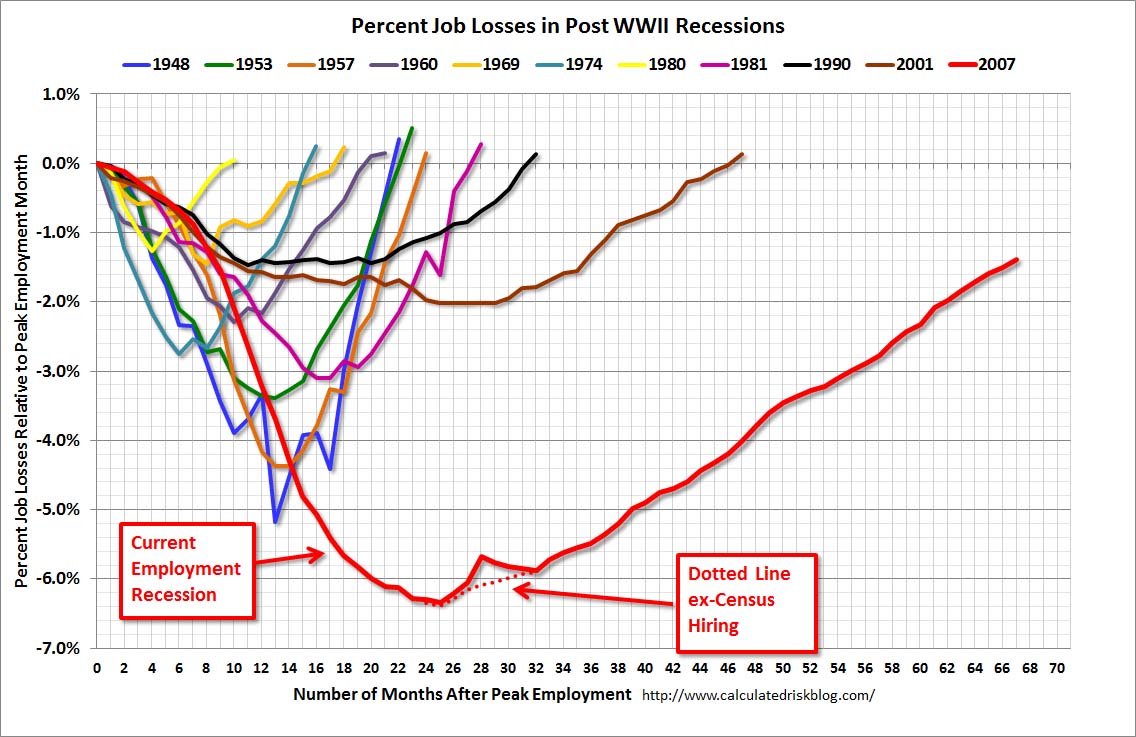
This report says that we’re barely creating enough jobs to keep the unemployment rate falling from its current high levels. Policymakers have been looking for a signal that the recovery has become self-sustaining. This report doesn’t provide it. And until we’re confident that the recovery will keep rolling on, we should delay either any monetary tightening, further fiscal cuts, and definitely postpone the legislative shenanigans that Congress is threatening.

Neil Irwin finds no silver lining:

Yes, the unemployment rate fell a notch to 7.3 percent, from 7.4 percent in July. Yes, the nation added 169,000 jobs, broadly consistent with the pattern of recent months. But in almost all the particulars, you can find signs that this job market is weaker than it appeared just a few months ago, and maybe getting worse.

The drop in the unemployment rate was caused by 312,000 people dropping out of the labor force. The number of people actually reporting having a job actually fell by 115,000 in the survey on which the unemployment rate is based.

Ezra lists five reasons to be depressed. Among them:

In truth, the most important parts of any jobs report are the revisions to the past two jobs reports. That’s because the initial estimate of how many jobs we added or lost in any given month is typically off by about 100,000 jobs. That’s how you get situations like August 2011, when the jobs report said we created no jobs but we later learned we’d created more than 100,000.

Revisions are where we get that better information. They’re the most accurate part of the unemployment numbers. And in this latest jobs report, they’re a huge disappointment: “The change in total nonfarm payroll employment for June was revised from +188,000 to +172,000, and the change for July was revised from +162,000 to +104,000.” That means we added 74,000 fewer jobs than we thought in June and July.

Annie Lowrey focuses on the long-term unemployed:

The slowly improving economy is not really improving for the long-term unemployed: Short-term joblessness has actually declined a smidge since 2007. Long-term joblessness is up 244 percent.

Felix hopes that this report will stop the Fed from tapering off its stimulus:

[T]his report is something of an unwind of what we saw this summer. It shows that the reality of the economy was not as good as we thought it was, and that the market probably got ahead of itself in anticipating a taper beginning very soon. We can’t take any solace in the mediocre economy. But if you’re desperate for good news, here it is: at least we know, now, how mediocre the recovery is, especially on the jobs front. And we’re going to stop hobbling ourselves by pushing long-term interest rates inexorably upwards, thereby making that recovery even harder.

Binyamin Appelbaum is unsure whether or not this report will prevent the Fed from tapering. Ryan Avent feels that the Fed is repeating the same mistake over and over again:

It is painfully obvious that the Fed dislikes having to deploy unconventional policy and wants to stop using it as soon as possible. One of these days it will realise that the best way to get off and stay off unconventional policy is to push forward with it until the economy is back to full employment and inflation pressures are firm enough to justify interest-rate rises. If you don’t kick the ball past the crest of the hill, it just rolls back down and you have to kick it again. Sadly, it may fall to Mr Bernanke’s successor, and early 2014, to give the economy the boot it really needs.

(Chart from Calculated Risk)

Iran’s Tweet Diplomacy

Iran expert Scott Lucas comments on the disparate messages coming from Rouhani’s advisers, namely the one who denied the legitimacy of the Rosh Hashanah tweet via the state-run Fars News Agency:

We believe this is pressure from Fars and the Revolutionary Guards to Rouhani’s team to back off from their moderate positions on Israel and especially Syria. … It’s a legitimate account and [Rouhani] has said that this is the only official account of the president on Twitter.

Fisher points out that the advisor did not “directly dispute the English-language account or say the tweets don’t represent Rouhani’s views”:

The non-denial denial is perhaps in response to the Western media attention to this tweet, but it raised more questions that it answered. Tehran-based reporter Amin Khorami, Al-Monitor’s Arash Karami and others say that the account is actually run by the media office of Rouhani’s presidential campaign team. The campaign has been over for a couple of months, so it raises the question of whether the people running the account continue tweeting in an official or unofficial capacity and whether or not they coordinate directly with Rouhani or his office. The prevailing speculation among Iran-watchers is that Rouhani may be keeping the account semi-official to inure him from criticism by internal hard-liners while allowing continued gestures of good faith toward the West. Although one Iran analyst suggested to me that Washington may be overstating the account’s significance in representing Rouhani’s views.

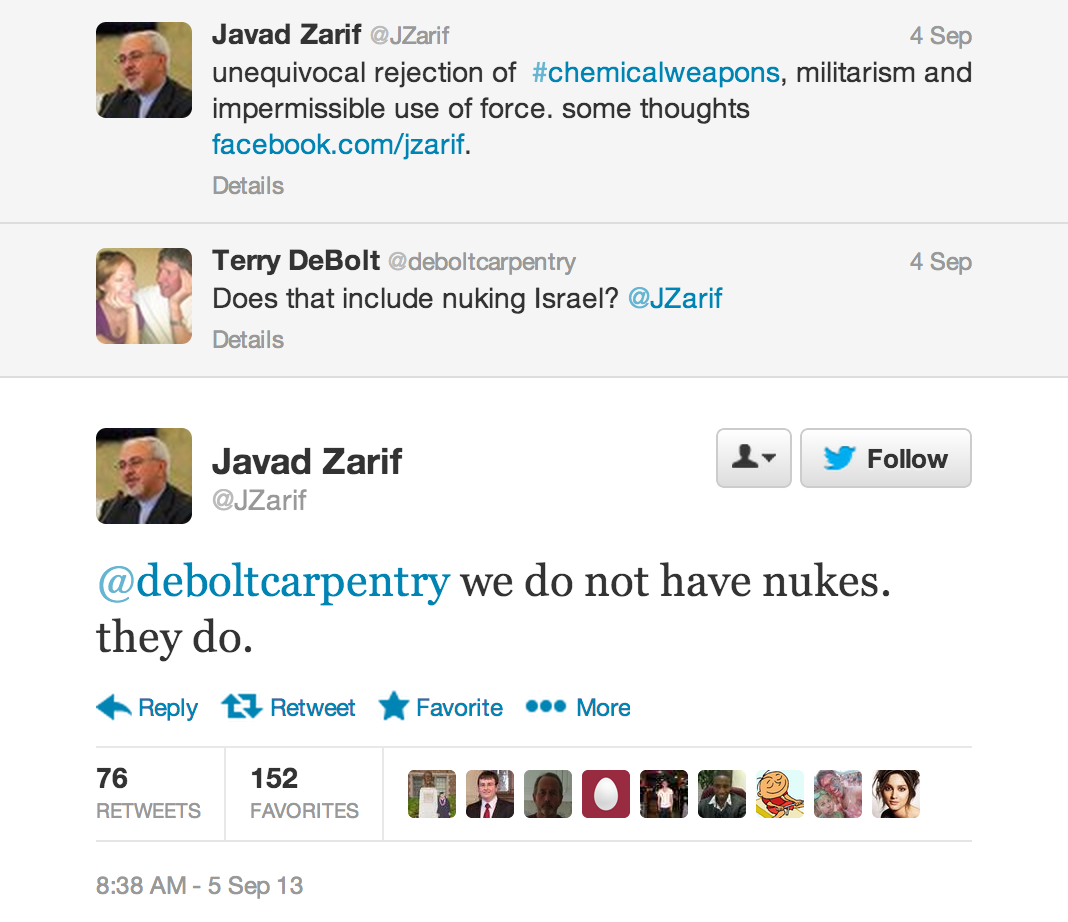
Meanwhile, the Iranian foreign minister continues to mix it up on his new Twitter account:

Screen Shot 2013-09-06 at 2.44.00 PM

The Journalistic Ethics Of The WSJ Op-Ed Page

The editors recently ran a piece by one Elizabeth O’Bagy on how moderate the Syrian opposition is. Fair enough. But why was she not properly identified as the political director of the “Syrian Emergency Task Force” – a lobby group directly arguing for war against Syria? You’d think they were trying to hide something, wouldn’t you? This paid lobbyist for the rebels was even touted by secretary of state John Kerry as an objective source.

This really is like Iraq, isn’t it? Paid lobbyists being passed off as independent experts? You just never know who’s trying to spin you. And the WSJ wants to keep it that way. Update from a reader:

Elizabeth O’Bagy wasn’t just on the WSJ page.  She was being touted as a Syria expert by NPR this morning. They cite John McCain in her intro (which should give the astute reader a clue), but they also tied her in to John Kerry as well – not in this interview directly – but by playing this immediately after playing a story on Kerry and his support for the same thing.  I wasn’t paying close attention, as I had just gotten in my car and was trying to make a turn.  And didn’t think about it closely until I saw your post.  But there it is.

In the linked transcript, O’Bagy is only cited as a representative for the Institute for the Study of War think tank – no mention of her lobbying role for the Syrian Emergency Task Force.

The Best Way To Help The Syrian People

Pascal-Emmanuel Gobry advocates granting asylum to all refugees who apply:

Even from the most cynical perspective, you can and should view tragic conflicts such as Syria as moments where countries and regions are selling their human capital on the cheap, and where opportunistic buyers should swoop in to take advantage of the bargain. Sweden has recently said that it would grant asylum to all Syrian refugees who apply. The US should do the same. As Hayes suggests, the model here should be the expedited procedure that the US grants to Cuban refugees. Welcoming Cuban refugees has been the right thing to do and a boon to America’s standing in the world, its economy and its culture. It was the right thing to do then, and it’s the right thing to do for Syria now.

Lydia DePillis agrees:

To actually alleviate the refugee crises in Jordan and Lebanon, the United States could dramatically increase the number of people it accepts from Syria. Sweden has already accepted 14,700 since 2012, and just threw open its doors to all comers. If a country with fewer than 10 million people can handle tens of thousands of refugees, surely the U.S. can, too.

Weber Was Wrong

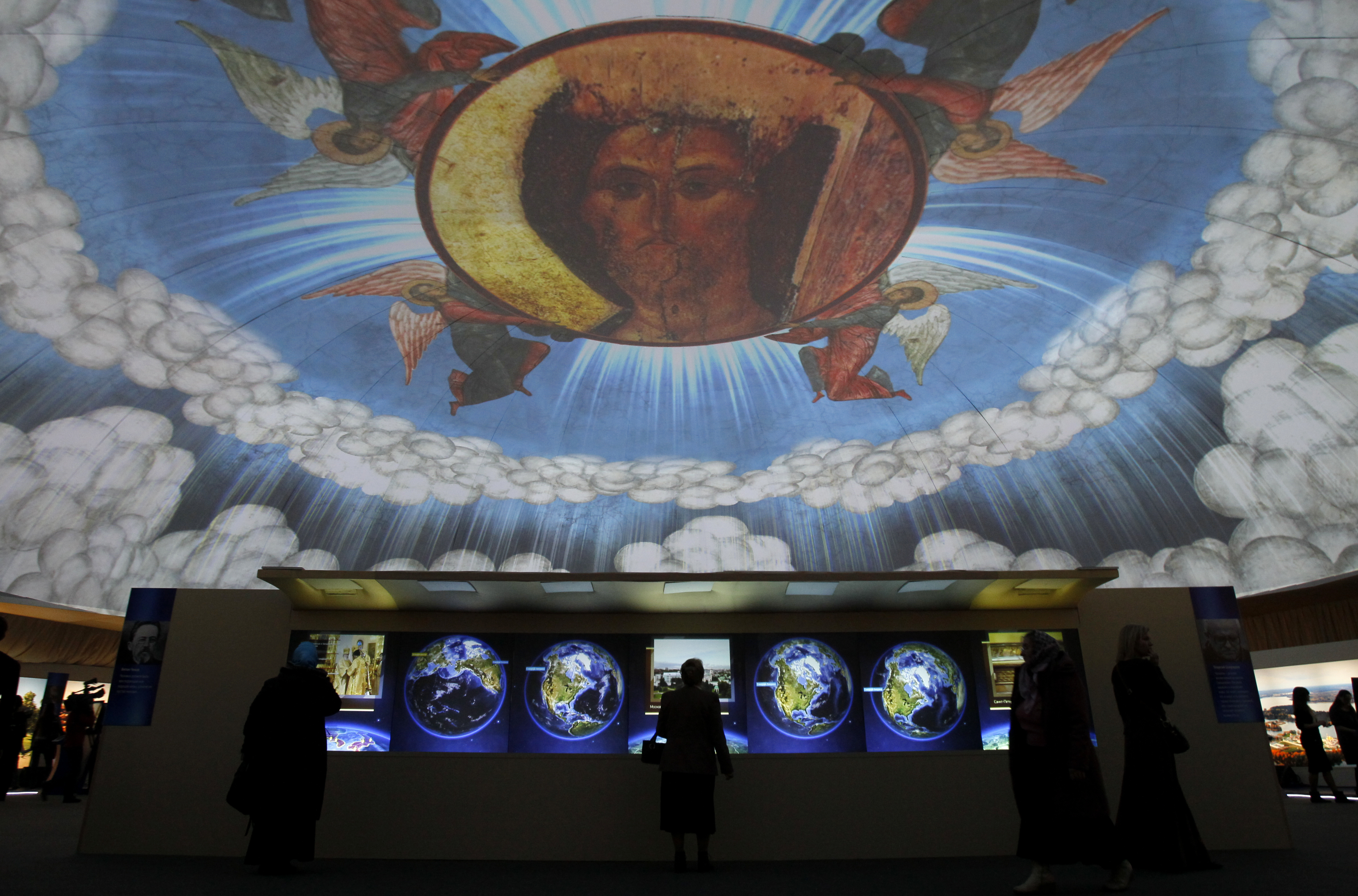
A multimedia show is projected on a spec

Irina Papkova explores how post-communist Russia’s religious revival has forced theorists to rethink the role of spirituality in modern society:

Since the Enlightenment, prominent social thinkers like Auguste Comte, Max Weber and Emile Durkheim have promoted the “secularization thesis.” In a nutshell, this theory proposes that as a society modernizes, the importance of religion will inevitably decline. …

But real life has a disconcerting way of overturning established assumptions.

Once the Soviet Union collapsed in 1991, religion (understood as both levels of faith and institutional structures) resurfaced with such vigor that it challenged not only previous beliefs about the atheistic nature of the Soviet population, but also globally undermined the “secularization thesis.” In 1991, there were 3,451 Orthodox parishes registered on the territory of the Russian Federation. By 2003, this number had risen to 11,299, a rate of expansion of about 300 percent. Other konfessi (religious groups) across Russia developed at even faster rates. For example, registered Islamic communities grew by 400 percent during the same period, while the number of Pentecostal parishes increased from 72 parishes to around 1,500.

And Hitch can only curse from afar.

(Photo: A multimedia show is projected on a specially designed dome as visitors attend the “Russian Orthodox Church – Revival. 1991-2011” exhibition in Moscow on November 5, 2011. By Ivan Sekretarev/AFP/Getty Images)

The Virtue Of Steel And Silence, Ctd

Like Fareed, Daniel Larison speaks up about the need for the US to pipe down about lousy foreign situations:

Future presidents and this one would do well to abide by a few basic guidelines for how and when to comment on foreign conflicts and disputes. First, there should be an overall aversion to having the president comment at length on another country’s internal conflict or dispute. If that is unavoidable for some reason, the president ought to refrain from making any declarations about the legitimacy of the foreign government, and as a general rule he shouldn’t call for the removal of a foreign leader unless he wants to be saddled with the responsibility for removing him. There should be no indications made that the U.S. intends to offer material or military aid to the government’s opponents when that aid is not likely to be forthcoming, and statements to that effect should be made only after carefully considering whether providing any kind of aid would be useful and in the American interest. There has been a default assumption in Washington over the last decade and more that the U.S. should usually side with foreign protest movements and political oppositions, and thereby adopting their political goals as our own. That impulse to take sides in foreign disputes and conflicts needs to be curbed if not banished entirely.

Don’t Try To Deduct Your Grow Supplies

The DOJ may be mellowing on marijuana, but tax attorney Robert Wood says the IRS still has a drug-war mentality:

The reason is that even legal dispensaries are drug traffickers to the feds. And the main culprit is Congress, not the IRS. Section 280E of the tax code denies even legal dispensaries tax deductions.

In the past the IRS has said it has no choice but to enforce the tax code passed by Congress. “The federal tax situation is the biggest threat to businesses and could push the entire industry underground,” the leading trade publication for the marijuana industry reported. … Consider that Harvard Law School offers ‘tax planning for marijuana dealers’ Perhaps this fact suggests that the industry has really arrived. In other respects, though, including tax, banking and credit card processing for patients, the industry is still barely off the ground. And that is doubly disturbing, since the tax law seems an entirely inappropriate way to hinder (if not outright doom) these businesses.

Meanwhile, a glimmer of good news from the GOP last night:

Assad And The Eschatologists

Tim Murphy notes that bestselling novelist Joel Rosenberg (see his rant below) thinks the Syrian conflict was foretold in the Bible. More troublingly, some politicians are listening:

On Saturday, Rosenberg will travel to Topeka, Kansas, at the invitation of Republican Gov. Sam Brownback, to discuss the situation in the Middle East. The idea behind the prophecy is a fairly straightforward one. In Isaiah 17, the prophet explains that, in the run-up to Armageddon, “Damascus is about to be removed from being a city, and will become a fallen ruin.” The implication is that it will be leveled by God on behalf of Israel as part of the last great struggle for mankind. How exactly that will happen is a bit less clear.

“The honest answer is that the Bible does not say,” Rosenberg wrote on his blog last June. But in Rosenberg’s Twelfth Imam series, he postulates that the emergence of the Mahdi, the Muslim messiah, leads to the rise of a new Islamic caliphate in the Middle East that prepares to decapitate Israel by launching nuclear warheads from Damascus. As the top-rated Amazon review for the final book in the series, Damascus Countdown puts it, “This is a great read for anyone interested not only in the prophetical future of Israel but for Iran and Syria as well.”

Rosenberg may seem like a fringe figure, but he has a large base of support and friends in high places.

Damascus Countdown was, like the two preceding books in the series, Twelfth Imam and Tehran Initiative, a New York Times bestseller. He has been cited as an expert on nuclear policy by Fox News, where host Shannon Bream noted that he had been referred to as a “modern-day Nostradamus.” Former (and future) Republican presidential candidate Rick Santorum wrote a blurb for the hardcover edition of Damascus Countdown and brought the author onto his radio show, Patriot Voices, to discuss the book last spring. In March, Rosenberg met privately with Texas Gov. Rick Perry and Rep. Louie Gohmert in Austin. Gohmert was such a big fan of the novelist he brought a copy of Damascus Countdown as a gift to Israeli prime minister Benjamin Netanyahu in 2011.

They’re all out of their tiny minds.

Empire Watch

dish_africamap

Nick Turse has investigated and mapped the growing US military presence in Africa:

[The above map] documents U.S. military outposts, construction, security cooperation, and deployments in Africa. It looks like a field of mushrooms after a monsoon. U.S. Africa Command recognizes 54 countries on the continent, but refuses to say in which ones (or even in how many) it now conducts operations. An investigation by TomDispatch has found recent U.S. military involvement with no fewer than 49 African nations.

In some, the U.S. maintains bases, even if under other names. In others, it trains local partners and proxies to battle militants ranging from Somalia’s al-Shabab and Nigeria’s Boko Haram to members of Al-Qaeda in the Islamic Maghreb. Elsewhere, it is building facilities for its allies or infrastructure for locals. Many African nations are home to multiple U.S. military projects. Despite what AFRICOM officials say, a careful reading of internal briefings, contracts, and other official documents, as well as open source information, including the command’s own press releases and news items, reveals that military operations in Africa are already vast and will be expanding for the foreseeable future.

Did anyone ever ask the American people about that? Of course not.