The American People Tell Washington A Few Things

I have yet to talk to anyone – even in this super-liberal little ash-tray of a town – who supports the president’s proposed new war. The polls tell the same story. The NYT has this revealing nugget from the left:

Representative Elijah E. Cummings, who represents a district that includes parts of Baltimore and has not decided how he stands on attacking Syria, said the pressure from his constituents to oppose the president’s plan is unmistakable. When he visited a grocery store on Wednesday, he said, almost a dozen people told him they thought intervening in Syria was a bad idea. None of them expressed support.

“If you’ve got 95 percent of them saying one thing, it becomes far more difficult to go against them,” he said, adding that the president needed to make a more forceful and convincing case to the public if he wanted Congressional consent for an attack. “As a good friend of his and someone who supports him, I think he’s got to help the Congress help him.”

Ezra’s impression?

“The active public is against this,” Rep. Brad Sherman, who supports intervention, told me. “I don’t know a member of Congress whose e-mails and phone calls are in favor of this.” …  Jonathan Allen and Jake Sherman report that House Republicans are not inclined to back President Obama on Syria. “Several lawmakers and aides who have been canvassing support say that nearly 80 percent of the House Republican Conference is, to some degree, opposed to launching strikes in Syria. Informal counts by Obama allies show that support in Congress for Obama’s plans is in the low dozens.”

House Republican leadership, meanwhile, isn’t inclined to change their members’ minds. “Speaker John Boehner’s spokesman said that he ‘expects the White House to provide answers to members’ questions and take the lead on any whipping effort.’”

This ship is sinking fast. And a new constitutional order may be emerging. Call your Senator and representative and let them know you’re against it, if you are. Now is the time for the people to save their president and their country from another Bush-Cheney-style folly.

Saving Obama From Himself

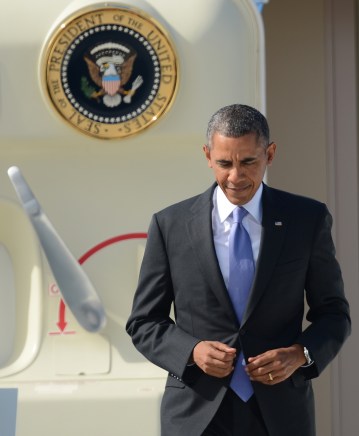
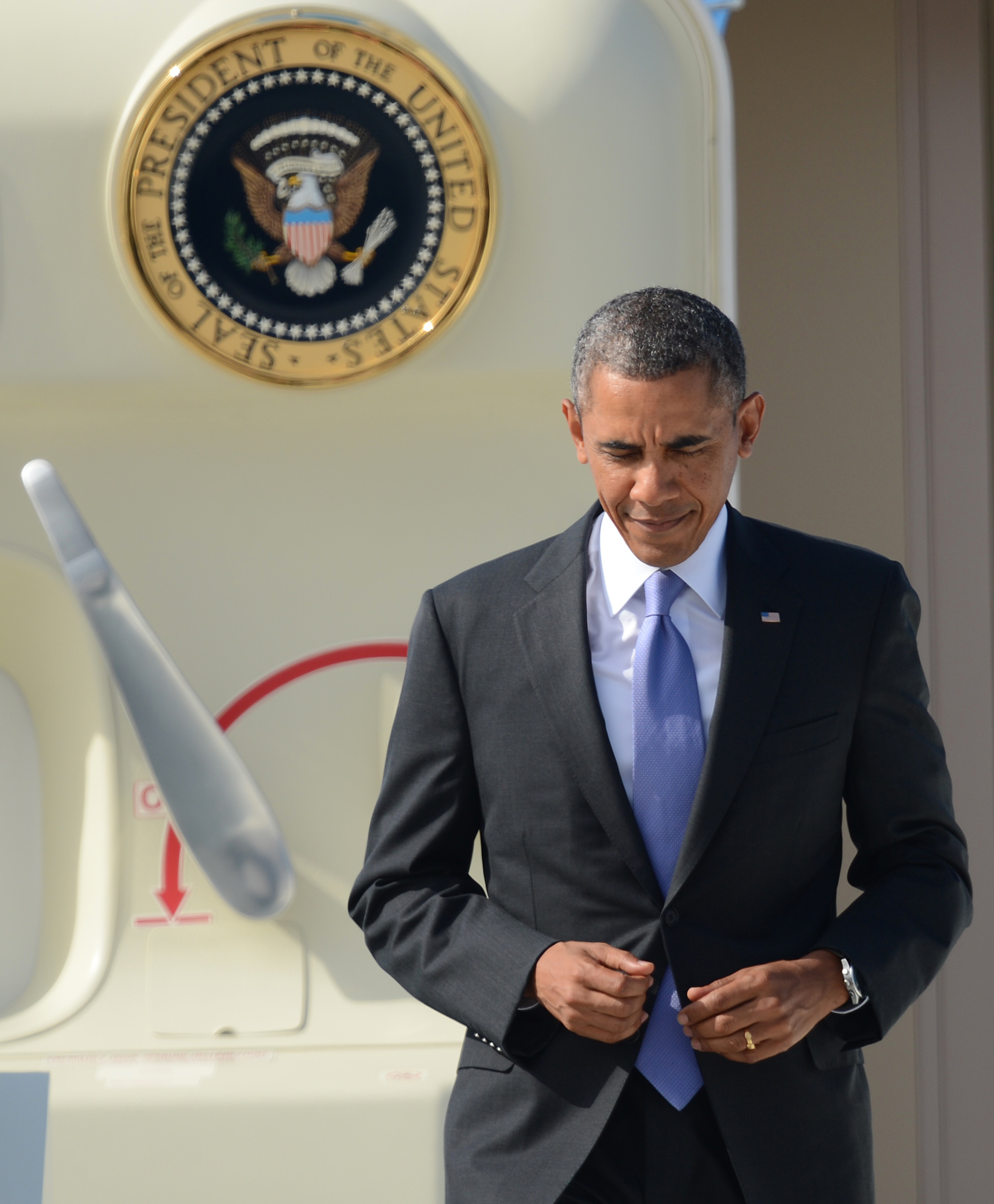
The next couple of weeks will be full of surprises, twists and turns, as this country debates in its Congress and media and living rooms whether to launch another war in the Middle East. But I think it’s fair to offer a preliminary assessment of where the wind is blowing. Obama’s case for war is disintegrating fast. And his insistence on a new war – against much of the world and 60 percent of Americans – is easily his biggest misjudgment since taking office. His options now are not whether to go to war or not, but simply whether he has the strength and sense to stand down and save his second term before it is too late.

Here’s what we know now for sure already: even if the president were somehow to get a majority in House and Senate for entering into RUSSIA-G20-SUMMITSyria’s vortex of sectarian violence, it will be a profoundly divided one. The 10-7 vote in the most elite body – the Senate Foreign Relations committee – is an awful omen. To make matters worse, there is currently a clear national majority against war in the polls and the signs from the Congress suggest a nail-biter at best for the president. Under these circumstances, no president of any party has any right or standing to take this country to war. He is not a dictator. He is a president. Wars are extremely hazardous exercises with unknown consequences that require fortitude and constancy from the public paying for them. Even with huge initial public support for war, as we discovered in the nightmare years of Bush-Cheney, that can quickly turn to ashes, as reality emerges. To go to war like this would be an act of extreme presidential irresponsibility.
And on one thing, McCain is right. To launch strikes to make a point is not a military or political strategy. It will likely strengthen Assad as he brazenly withstands an attack from the “super-power” and it would not stop him using chemical weapons again to prove his triumph. We either lose face by not striking now or we will lose face by not striking later again and again – after the initial campaign has subsided and Assad uses chemical weapons again. McCain’s response, as always, is to jump into the fight with guns blazing and undertake a grueling mission for regime change. Let him make that case if he wants – it is as coherent as it is quite mad. It’s as mad as picking a former half-term delusional governor as his vice-president. There is a reason he lost the election to Obama. So why is Obama now ceding foreign policy to this hot-headed buffoon?

The only conceivable way to truly punish Assad and assert international norms would be to get a UN Resolution authorizing it. That is, by definition, the venue for the enforcement of international norms. The US Congress cannot speak for China or Russia, Germany or Britain. And in Britain’s case, the people – through their representatives  – have spoken for themselves. That means that, if we go through the proper route, nothing will be done. But that is the world’s responsibility, not ours’. And we are not the world.

The US has no vital interests at stake in the outcome of a brutal struggle between Sunni Jihadists and Alawite thugs. None. Increasingly, as we gain energy independence, we will be able to leave that region to its own insane devices. Our only true interest is Saudi oil. And they will keep selling it whatever happens. Israel is a burden and certainly not an asset in our foreign policy. The obsession with the Middle East is increasingly a deranged one. Taking it upon ourselves to ensure that international norms of decency are enforced in that hell-hole is an act of both hubris and delusion. We can wish democrats and secularists well. But we can control nothing of their struggle, as the last few years have definitively shown. And when we try, we create as many problems as we may solve. Look at Libya.

My own fervent hope is that this is the moment when the people of America stand up and tell their president no.

I support and admire this president and understand that this impulsive, foolish, reckless decision was motivated by deep and justified moral concern. But the proposal is so riddled with danger, so ineffective in any tangible way (even if it succeeds!), and so divorced from the broader reality of an America beset by a deep fiscal crisis, a huge new experiment in universal healthcare, and a potential landmark change in immigration reform, that it simply must not be allowed to happen.

We can stop it. And if Obama is as smart as we all think he is, he should respond to Congress’s refusal to support him by acquiescing to their request. That would damage him some more – but that damage has been done already. It pales compared with the damage caused by prosecuting an unwinnable war while forfeiting much of your domestic agenda.

This is not about Obama. It’s about America, and America’s pressing needs at home. It’s also about re-balancing the presidency away from imperialism. If a president proposes a war and gets a vote in Congress and loses, then we have truly made a first, proud step in reining in the too-powerful executive branch and its intelligence, surveillance and military complex.

In other words, much good can still come from this.

If Congress turns Obama down – as it should – Obama can still go to the UN and present evidence again and again of what Assad is doing. Putin is then put on the defensive, as he should be. You haven’t abandoned the core position against the use of chemical arms, and you have repeatedly urged the UN to do something. Isn’t that kind of thing what Samantha Power longs for? Make her use her post to cajole, embarrass, and shame Russia and China in their easy enabling of these vile weapons. Regain the initiative. And set a UN path to control Iran’s WMD program as well.

Obama once said his model in foreign policy was George H W Bush. And that president, in the first Gulf War, offers a sterling example of how the US should act: not as a bully or a leader, but a cajoler, a facilitator and, with strong domestic and international support, enabler of resistance to these tin-pot Arab lunatics. Obama, in a very rare moment, panicked. What he needs to do now is take a deep breath, and let the people of this country have their say.

Democracy is coming to the U.S.A.
Finding The Right Words

Almeida_Júnior_-_Saudade_(Longing)_-_Google_Art_Project-x0-y0

Robert Lane Greene says that while lists of untranslatable concepts are fun to peruse, in reality, “almost nothing is truly untranslatable”:

Statements of the “no word for” type have two potential implications. One is that “Society X has been without item A for so long that it has no word for it.” Language reflects society, in this view. The other possibility makes language the cause rather than the effect: “Because society X lacks word A, its members are unable to understand A.” Both of these arguments are usually wrong. …

There is no native English word that means ennui, exactly, with its perfect little package of weariness, boredom, emptiness and sadnessSo English borrowed it. But does anyone think ennui did not exist among Anglophones before then? Of course not. Does it mean that ennui can’t be explained in English? Again, of course not. (“Weariness, boredom, emptiness and sadness”.) The fact of its borrowing doesn’t make ennui “untranslatable,” nor uniquely French. Language is a little bit like an economy. If a foreign country makes something useful, it’s often easier to import it rather than make it yourself.

(Detail from Almeida Júnior’s 1899 painting Saudade. The Portuguese word roughly translates as “longing.”)

A Gold Rush For E-Textbooks, Ctd

A reader responds to this post:

Given the staggering costs associated with textbooks these days and the highly restrictive licensing schemes for most e-textbooks, you might want to mention groups like Open Stax. Their goal is to develop a series of high quality, peer-reviewed, free, open-source textbooks for most introductory level college courses. Textbooks are one of the hidden costs of college: prices have increased by over 800% in the last 35 years, outstripping the rise in costs of virtually everything else like health care, homes or tuition. Standard texts don’t change much from year to year, and the costs to deliver a PDF of a book are close to zero. Why is it necessary for college students to pay ~$1000/year (the current average) for something that could be free?

Update from a reader:

He or she shows real ignorance of, and contempt for, the people who produce textbooks. Textbooks, even introductory books in standard subjects, don’t grow on trees. Scholars and academics write and design them, and ought to get paid for doing so.

And this commenter, and, so far this thread, ignore one key reason why textbook prices are so high: the used textbook market. Once a text is widely adopted, students sell them back to local college booksellers, who then sell used texts as long as that book is assigned. This cuts off the payments to the writers and publishers of the standard text, so they stop printing it and produce a new edition, which could be very different or almost entirely the same. If enough faculty adopt that new edition, start the process over again.

Why Did Assad Do It? Ctd

Alastair Smith, co-author of The Dictator’s Handbook, has a theory:

First of all, using chemical weapons has absolutely cemented that for Assad there can be no soft landing. That has two effects: Domestically, it has signaled to his coalition that they should stick with him. He’s there for the long run and there’s no easy way out for him, so they know he won’t desert them. These crimes against humanity have also made it very clear that it’s going to be very bad for the Alawites if there’s any political transition, which makes them even more loyal to him. They have nowhere else to go.

It’s also been a brilliant play internationally. The extent of the chemical weapons has not been so much that Obama’s willing to put ground forces in. The airstrikes they are discussing are unlikely to be a decisive military factor. And Russia and Iran would love to snub the nose of the U.S. and this is a perfect way to do it. The U.S. is going to have to go it alone if they do it, and this is a great way for Russia and Iran to make the U.S. look impotent and pathetic. Russia’s going to continue supplying [Assad] with weapons and Iran’s going to keep supplying him with money. So this was actually a brilliant play from him.

And a terrible, awful, no-good play for Obama. This does explain better the big hike in the stakes Assad just gambled on. And it does not appear to be an accident. This piece in the NYT is pretty definitive proof that the greater reach and power of the weapons delivered to ghouta was absolutely deliberate, and integral to the very design of the rockets used. A reader relays another theory:

I was going to send this email yesterday but figured somebody must have heard this; it must be common knowledge: I heard an NPR interview with retired general Jack Keane, who said that the rebels had acquired anti-aircraft weapons and shot down two of Assad’s aircraft recently.  Assad tried to destroy the rebels using conventional means and was unable to, so he resorted to gas.  I have not heard this anywhere else. The Keane interview sounds plausible, but it makes me wonder how a retired general has info no one else has.

We’ll keep tabs on this question of motive. Earlier debate on the question here.

Searching For Someone Who Speaks Like Shakespeare

In an essay exploring the ongoing fascination with authentically reproducing the Bard’s plays, Daniel Fromson highlights our hopes at finding “some corner of civilization untarnished by modernity” where “people still speak like the Elizabethans”:

Such stories clash with the wisdom of modern linguistics, which holds that Shakespeare’s English cannot be any living person’s native tongue, if only because all spoken languages are always evolving. Even a colony of 17th-century actors, stranded on a faraway island during the reign of Elizabeth I, would speak differently hundreds of years later. Still, since the 1800s, people have reported hearing Elizabethan English, or at least an “Elizabethan accent,” not only on Tangier Island but also in Appalachia, Bermuda, Cornwall, Devonshire, Northern Ireland, the Ozarks, Panama, the Bahamas, Jamaica, Nova Scotia, Virginia’s Roanoke Island, Newfoundland’s Fogo Island, the Pine Barrens of New Jersey, and the Pitcairn Islands of the South Pacific. “Though they never heard of Shakespeare,” a newspaper once reported, “the Bourabbees of Panama speak an English that sounds as if they were characters right out of his plays.”

This last example, more than most others, encapsulates the idea’s allure. In his essay “In the Appalachians They Speak Like Shakespeare,” the linguist Michael Montgomery argues that the notion that Shakespeare’s language lives on functions as “a myth of the noble savage”: it “satisfies our nostalgia for a simpler, purer past, which may never have existed but which we nevertheless long for because of the complexities and ambiguities of modern life.”

Saints On Display, Ctd

A reader keeps the thread undead:

Your fascinating series reminds me of a summer tour I took as a teenager with a youth choir from Montana, where I grew up. I’d been raised Presbyterian, and though my home 1742905208_ad7687ca4dchurch was neo-Gothic and quite beautiful, it included none of the statuary and shrines of American Catholic churches, and certainly no sign of European churches’ veneration of relics and remains. Death was kept at a prim distance; open caskets for example were considered both spiritually suspect and (though this was unspoken) in terrible taste.

One of our first stops on the trip was Salzburg, and I vividly remember stumbling on St. Sebastian’s Church and Cemetery, near our hotel, a place teeming with carved memento mori – skulls, snakes, bones, bats, and winged hourglasses [example seen to the right]. In the walled cemetery, a statue of a ragged corpse – sunken-eyed and grimacing, as if decomposed – rose out of an above-ground tomb. I’d never encountered such morbidly bracing imagery and didn’t then have the familiarity I would discover later – through works of Schubert, Freud, Hermann Broch, and many others – with the Austrian intimacy with death.

A few days later we sang in the gorgeous abbey church of Mondsee, not far from Salzburg, where five skeletons, bejeweled and richly vested, are encased in the high altar. (It’s the same church where the wedding scene from The Sound of Music was filmed; you can see the skeletons as the camera pans upward if you know to look for them but they’re hidden by the overall detail.) We usually sang in churches, and throughout the tour it was much the same – a niche of monks’ skulls in a Swiss village chapel, glass coffins displaying remains, the haunting crypts and mausoleums of Père Lachaise, silver hearts encasing saints’ organs, dimly-lit Roman catacombs. The encounters in these places cracked open the WASPish Christianity of my childhood and my sense of mortality as little else did, except subsequent encounters with death itself.

Decades later on trips to Mexico, I was struck by the the unflinchingly gruesome depictions of Christ’s torture and crucifixion in churches there, and it would bring to mind that summer as a 17-year old. It is impossible not to be moved and horrified by some of the depictions, and I would not say I could regularly worship near them. But they and their European variations have deepened my own faith, making it both more mystical and more visceral, paradoxically more alive, for which I’m very grateful.

Another reader:

I haven’t thought as much about relics as I probably should have, but they keep popping up when you read about medieval history.  People thought of relics as having supernatural power. This gave them very real economic value.

For example, there was a movement called the “peace and truce of god” that was designed to constrain noble violence, which was seen as one of the most significant societal problems at the time. Churchmen would summon nobles to a meeting, where they’d be confronted with a big display of all the relics the local churches were able to muster. The relics were used to frighten the nobles into making pledges to limit their violent conduct in certain ways.

And relics played a big role in the Crusades.  Everyone wanted relics, and everyone was aware that some of the relics floating around Europe were fakes.  People thought that the best way to get authentic relics of very old saints was go to to the source, the Holy Land. So in a sense, relics were a resource, sort of like oil, that the Holy Land possessed and that Europeans wanted.

There’s a famous incident that took place during the First Crusade, at the siege of Antioch. The crusaders were very discouraged and there was a lot of talk about packing it in and going home.  Someone claimed to have had a prophetic dream that showed him where to find a relic of the holy lance, the spear used to pierce the body of Christ during his crucifixion.  There was debate about whether the dream was valid, but when they dug in the place specified by the dream, they found a relic.  This pushed everyone toward sticking with the project, and had a big effect in keeping the siege and the crusade going.

Obviously, there were some who felt the whole thing had been staged. And at the Battle of Hattin, during the Third Crusade, Saladin was able to capture an object that was believed to be part of the true cross.  It had been brought into battle because the crusaders believed it would give them an edge.  The loss of the relic was a really big deal – it loomed large when people tallied up the losses from that crusade.  It was very significant to the Europeans.

I know that the blog has been talking about body parts, and that neither the holy lance nor the true cross were parts of anyone’s body. But in the medieval world, they were all relics, and these stories illustrate the extent to which relics were invested with power.  I don’t know enough about the subject of relics to come up with good stories about body part relics that make the same point.

For me, the most interesting aspect of the discussion in the blog about relics has been the part about how the idea of relics ties into the notion of bodily resurrection.  That’s something pretty important, I think, and I had never thought of it before.

But before I thought about that, the thing about relics that was most interesting to me was how primitive the whole thing seemed. Medievalists like CS Lewis and Tolkein present medieval Christianity in a really positive light – the Christianity that dates back from the time that Europe was Christendom seems better, in some respects, than today’s Christianity.

But when you read about the holy lance at the Siege of Antioch, it’s kind of jarring to think about where people’s headers were at.  The idea that the fate of the crusade hung on such a story seems insane, and the crusaders seem sort of childish and easily fooled.  They seem to be more superstitious than religious.  And I find the prospect of armed men of that mindset traveling great distances to conquer foreign territory to be pretty frightening.

One of the really great things about Catholicism is that there are these strange fragments of medieval thinking that have been preserved, in some form, to the present day.  I’d put relics in that category.  I don’t know what people think about them now.  I suspect that most modern Catholics don’t really think about them.

But whenever I’m in Paris (which isn’t often, lately), I always visit the cathedral at St. Denis, and walk through the crypt where the bones of all of the ancient kings and queens of France are kept.  And I’m always interested to think about how the revolutionaries felt it was worth the trouble to turn the pantheon into a reliquary for secular saints, to counter act the symbolic power of St. Denis.  That might have been the idea’s last gasp.

Think about how differently we think about the bodies exhibition at the South Street Seaport. I haven’t seen it, because I’m squeamish about such things, and there have been allegations that the bodies of criminals and perhaps political prisoners from China were used for the display.  But while the innate fascination with human body “stuff” pulls people to the exhibition, we justify and explain our fascination with science, rather than religion.  We just want to see how the ligaments are attached.

I think that this is one of those subjects that’s most interesting in an “archaeology of thought” sort of way. The idea of relics has a long, complicated, and surprisingly intense history. The shriveled stump that’s left of it today is kind of creepy and mostly interesting in a “Ripley’s Believe It or Not” kind of way, but not much more.  Who would think that the idea had enough power at one time to play a significant role in the conduct of several wars?

Maybe that’s the message we ought to take from the subject on this day in 2013.  Maybe relics ought to remind us that when you go to war, there’s a pretty good chance that your reasons are actually crazy. Maybe relics can serve as a reminder that when you think you have to go and kill people in a war for moral reasons, a lot of the time you’re just being batshit crazy. Maybe the ideas that seem fighting for today will fade in the future, and they won’t seem worth dying over any more.

By the way, I just checked, and someone is selling what they claim is a piece of the true cross on Ebay. It’s only $245.

The Compliant Child

Elizabeth Weil thinks schools should dial back the focus on self-control:

[We’ve] crossed some weird Foucaultian threshold into a world in which authority figures pathologize children instead of punishing them. “Self-regulation,” “self-discipline,” and “emotional regulation” are big buzzwords in schools right now. All are aimed at producing “appropriate” behavior, at bringing children’s personal styles in line with an implicit emotional orthodoxy. That orthodoxy is embodied by a composed, conforming kid who doesn’t externalize problems or talk too much or challenge the rules too frequently or move around excessively or complain about the curriculum or have passionate outbursts. He’s a master at decoding expectations. He has a keen inner minder to bring rogue impulses into line with them.

She says the growing emphasis on self-discipline is “very convenient” in an age of slashed budgets and standardized tests:

[H]ere in 2013, even as the United States faces pressure to “win the future,” the American education system has swung in the opposite direction, toward the commodified data-driven ideas promoted by Frederick Winslow Taylor, who at the turn of the century did time-motion studies of laborers carrying bricks to figure out how people worked most efficiently. Borrowing Taylor’s ideas, school was not designed then to foster free thinkers. Nor is it now, thanks to how teacher pay and job security have been tied to student performance on standardized tests. “What we’re teaching today is obedience, conformity, following orders,” says the education historian Diane Ravitch, author of The Death and Life of the Great American School System. “We’re certainly not teaching kids to think outside the box.”

The Artist’s Rituals

Wassily_Kandinsky,_Improvisation_27,_Garden_of_Love_II,_1912._Exhibited_at_the_1913_Armory_Show

In an interview, Daniel Siedell, an art historian and curator, connects the artist’s work to the spiritual life:

Although an artist is free do and make anything in the studio, she has a responsibility to do something. And that requires tremendous discipline and the willingness to ask the most fundamental questions. Each day she goes into the studio asking: “Who am I?”—”Who am I in relationship to this blank canvas, to the world outside the studio, to Nature, History, or a God who judges me?” …

Given the nature of their work, then, most artists I’ve worked with have developed a set of intentional practices and habits, spanning the profound to the mundane, the complex to the simple, that give a liturgical form to their work. These are very similar to the liturgies and spiritual disciplines of various religious traditions that include a sensitivity to their lived space, meticulous attention to their materials, certain postures, and, I might add, contemplation and meditation: a willingness to spend long hours just sitting in a chair looking at their work.

(“Improvisation 27 (Garden of Love II)” by Wassily Kandinksy, 1912, via Wikimedia Commons)

Flirting With Polarization, Ctd

Nora Caplan-Bricker pushes back against the study suggesting that dating sites are reinforcing political extremes:

The biggest issue with the Standard’s article is that it implies it is shallow, even irresponsible, to use party affiliation as a filter for possible romantic partners. “The next time you see a bumper sticker that says, ‘He’s not my President,’ you may want to ask the person if they met their spouse online,” Pearson-Merkowitz warns. I wouldn’t reject someone out of hand for being a Republican, but I have no interest in making polite conversation over flat beers with a guy who doesn’t believe gay marriage should be legal, or who thinks abortion is tantamount to murder. If I’m contributing to the polarization of American politics by declining to raise kids with such a person, too bad. As long as party registration is a nearly perfect proxy for fundamental social views—and as long as OKCupid doesn’t have individual boxes for “universal health care,” “voting rights,” “gun control,” and the like—some political discrimination strikes me, not as the cause of the problem, but as a very reasonable response to it.

A reader chimes in:

Pearson-Merkowitz misses a critical point. Shared values are an important element in a happy marriage. To the extent that political views are a proxy for those values – and they surely are for me and my husband – then there is far more to be gained (and far less to be lost) from living with someone who shares your political views than from living with someone who can provide in-depth insight into an opposing view. If you think it’s important to understand other points of view, you can avail yourself of existing sources (such as the Dish). No need to marry one!

Philip Bump points out that ideological sorting isn’t strictly an online phenomenon:

Geography is almost certainly a stronger indicator of the likelihood two people will get together than having matching political views on OKCupid: A resident of Boston may find the perfect match possible on a website, but if that match [lives] in Honolulu, he’s much more likely to end up with someone from Cambridge. Geographical regions already tend to have a lot of political homogeneity. Take New York City. An April 2012 survey found that 82 percent of the city was registered Democratic…. So there’s a four-to-one chance that the person you meet randomly on the street will share your registration if you’re a Democrat. If you try to find someone who disagrees with you, it will be difficult.