Privately, Hill aides joke that everything is going exactly to President Obama’s plan. It’s just that that plan is to stay far, far away from Syria.
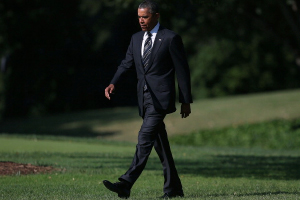
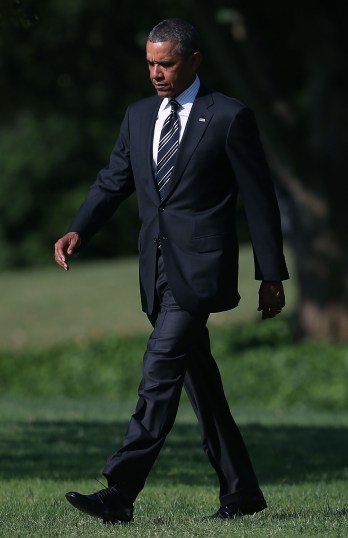
This is the (tongue-in-cheek) 12-dimensional chess interpretation of the Obama administration’s Syria strategy. Boxed in by red-line rhetoric and the Sunday show warriors, the Obama administration needed to somehow mobilize the opposition to war in Syria. It did that by “fumbling” the roll-out terribly. …
The Obama administration’s strategy to cool the country on this war without expressly backing away from the president’s red lines has been brilliant, Hill aides say (just look at the polls showing overwhelmingopposition!). If they are going to go to war, their efforts to goad Congress into writing a punitively narrow authorization of force that sharply limits any potential for escalation have worked beautifully.
Believing anything else — like this is how the administration is actually leading the United States into conflict — is too unsettling.
Yes, it is. We elected Obama over McCain and yet Obama is now ceding foreign policy to that discredited blowhard. We believed Obama was a realist, and yet we hear the most abstract and unreconstructed poems to liberal interventionism from his secretary of state. I certainly was led to believe – from a ridiculously high-level source – that intervening in Syria was the very last thing the president wanted to do. And yet here we are. He seems genuine.
Is this some brilliant strategic design? Force the House to acknowledge that there is no public support for war against Syria … and move fast and unilaterally first to force the UN to become more aggressive, and even get Putin’s possible assent to future action if more inspections prove Assad’s use of CWs to be deliberate and undeniable?
I wish I could believe it. The sheer weakness of the case for war is so obvious perhaps Obama is waiting for us to make him pull back before it’s too late. The delay could put more pressure on Putin ahead of the G-20. There are many twists and turns possible. But I am afraid I don’t believe it. Occam’s razor is the best bet here. Obama made a foolish pledge to go to war if chemical weapons are used and now his bluff has been called by Assad.
It may soon be called by Tehran too. And what then, Mr president, what then? Do you have the fortitude to stand down and truly transform American foreign policy? Or, when push comes to shove, are you actually weaker than McCain and Clinton – and your legacy will be not doomed wars in Iraq and Afghanistan but doomed wars in Syria and Iran?
“I accept that Britain can’t be part, and won’t be part, of any military action on that front but we must not in any degree give up our utter revulsion at the chemical weapons attacks that we have seen and we must press this point in every forum that we are a member,” – British prime minister, David Cameron, up-ended by something called democracy.
For me, the administration hasn’t even begin to present a coherent, let alone a persuasive argument. The congressional debate is absolutely the best forum for this debate to take place – just as the House of Commons was in Britain. If the Congress votes no – which, given the current arguments, it obviously should – then the president should accede to the wishes of the American people as voiced by their representatives. If he were to do that, the kind of transformation Obama promised in America’s foreign policy would be given a huge boost.
Perhaps I am giving too much credit to our president, but for a while I have been wondering if that wasn’t his endgame all along. He is marching well in step with his predecessor, jumping through every hoop to plead the case for war. However, he is doing it in such a way as to fail to convince a war-weary public of its necessity, rightness, goals and likelihood of success. Could it be that he is seeking an end result in which (a) the U.S. does NOT get involved in another quagmire, (b) the power of the presidency to wage war at will is curtailed, and (c) both (a) and (b) are accomplished without any accusations of “weakness” from the right wing?
If so, meep meep.
If so … And I sure hope that’s the case. What I fear is Obama’s liberal interventionist side (see above), enabled by aides like Samantha Power and Susan Rice and John Kerry. Hagel, who was supposed to push back against these utopians, seems neutered by them. But, yes, it’s always good to look at the longer term view with Obama. If the House turns him down, it seems to me he will be saved from his own predicament. He may even try to go to the UN, especially now that Putin has signaled some readiness to consider a resolution using force. Another reader sees another sign of a possible long game:
You’re missing a meep-meep moment. A few days ago the media generally, and the right-wing media especially, were crowing that this showed how weak Obama was. Now he has the Republican leadership lining up behind him, giving him cover.
Yep, it was a great bait-and-switch. But I just don’t believe that Obama is that sneaky. From all I can tell, he has been simply flailing, and a Congressional vote merely offers him some time to come to his senses. Another doesn’t buy the long-game argument at all:
I guess I’m not surprised, but your editorial fails to highlight the degree to which Obama dragged us into this mess. I find myself incapable of agreeing with either side – I can’t fathom how we could possibly intervene for the better, and I can’t fathom how we could possibly sit this out – but I am stunned and embarrassed by how Obama has handled this.
He seems to have confirmed every single Fox Newsy critique of his foreign policy in one fell swoop: by flip-flopping, he comes across as indecisive; by setting a red line, then letting Assad march right across it with no consequence to date, he has weakened the United States in a way I never thought imaginable. He has done so by hanging Kerry out to dry; by letting this decision be made by a Congress he knows will do anything it can to undermine him; by sending a signal to Israel, Turkey and Jordan that the US can’t/won’t act even when it promises it would; by allowing Cameron to fail so spectacularly, and, a decade after Bush, having once again only one single military ally, this time France, he makes us look like a smack-talking weakling.
And this is all coming from someone who not only enormously respects Obama, but also agrees with him policy-wise, almost down the line, and certainly in this arena. Had Obama made a strong case for intervention and decisively taken out Assad’s air force, which, by the way, seems like a very capable goal and a very effective one vis a vis the way in which he is terrorizing his population – I would have been on board. Had Obama decided that it wasn’t worth the risk, the capital, whatever, I could have been convinced. I really see no good options, and therefore no incorrect ones.
But this weak, dithering refusal to make a real decision – again, I am stunned. He has punted this decision to the fools in Congress – something I totally could support had he not suddenly decided to do this at the last minute, after being smeared in Britain – and has walked back his own self-imposed red line. He has sent a message to Assad (and Iran) that, hey, do what you want, and we’ll try to maybe figure something out, but we don’t really have the will. Its just a fucking disaster – and so out of character with who I thought this man was. I didn’t think it would be possible for him to piss off Samantha Power, John McCain, the irresponsible pacifists and the right-wing military crowd, all at the same time – but lo and behold, here we are.
And if you don’t think, however this plays out, that this won’t be one of the main talking points in November 2014 when the Republicans up their numbers in Congress, you are out of your mind. The only winner here: Hillary Clinton and her team, who had been itching to get into Syria months ago, and who now have the distance they need from Obama to win back the neo-connish Dems and turn her policy rightward.
What a fucking mess.
I guess I was lucky not to have watched this fucking mess unspool while I was on vacation. The last thing it suggests is any coherent strategy from the president. Maybe it will shake out for the better – but Obama should have the balls to insist that we cannot stop WMD use in Syria or nuclear development in Iran just as we could not repair Iraq’s sectarian conflict. Another criticizes Obama on a different front:
I’m in much agreement with your post “Marching As To War?” – with one caveat. While I certainly agree with you on the importance, if action is to be taken, of Obama getting congressional approval, I am extremely concerned with something Obama isn’t doing: taking any steps towards an international consensus.
Even Bush got a first UN resolution, a confirmation that everyone agreed that if Iraq had WMDs, they had to give them up. Even Bush established a “coalition of the willing” to demonstrate it wasn’t just the US. (Though the “coalition of the willing” still set a dangerous precedent on the use of force against a country that was not really threatening the security of other countries.) The whole development of international law norms has been to deter countries from doing exactly what Obama is doing.
Somehow I don’t see the US doing this if, say, Russia committed atrocities in Chechnya or China gasses some dissidents. But this is a terrible precedent to hand to the likes of Putin or a Third World dictator. If the US attacks Syria, I completely expect that to be the comeback given when a friendly government and friendly oil concessions are installed in some African nation by Russia or a neighbour after, say, a massacre they can vaguely plausibly claim involved war crimes or even genocide.
I hate to describe Obama as worse than Bush on anything, but he’s going that way on this issue and unfortunately it seems the congressional leadership is too terrified of being seen as soft on terrorism that they’ll back his play even though their constituents don’t.
One more reader:
I wanted to share with you a link to retired Lieutenant Colonel and former West Point instructor David Fitzpatrick’s recent post on Syria at “The Edge of the American West”, a history blog hosted by The Chronicle of Higher Education. I hope Fitzpatrick’s piece is read and circulated by those with the means to generate discussion and pressure for an official response, because the questions it raises are ones which must be answered not just with regard to Syria. Within them lies the specter of Rwanda and a debate about the application of the UN’s responsibility to protect a mandate. At the same time, Fitzpatrick’s questions also demand examining our response to other conflicts, conflicts like the still-ongoing genocide and war in Darfur, which had already claimed between 178,258 and 461,520 lives based on figures published in The Lancet three years ago.
The President has consistently demonstrated he feels the United States has a moral imperative to act in these situations. He said as much in his Nobel Peace Prize acceptance speech, and said as much with regard to Darfur as a candidate for President in 2007, as you can see in [the above video].
With his power as Commander in Chief, I don’t think he’s wrong to feel a moral responsibility to intervene if he believes intervention stands a chance of making a substantial positive difference. (I do disagree with him on whether he ought to act on this felt responsibility.) But, as an Iraq War veteran, I think he also has a responsibility – to his subordinates in the military who will carry out the mission, and to the nation itself – to answer questions like the ones Fitzpatrick raises, and to explain why situations like the ones in Syria or Libya demand forceful American intercession, and why that same America allows situations like the one in Darfur to persist and even worsen. Every member of Congress ought to ask one another the same questions as they prepare to vote on a Syria resolution, and every member of Congress ought to thoroughly explain their answers to their constituents.
One final remark. I left the Marine Corps in 2006. These days I am a graduate student who teaches history at the University of Wisconsin. Yesterday, as I listened to John Kerry equivocate in front of the Senate Foreign Relations Committee regarding an agreement to prohibit deploying troops on the ground in Syria, I have decided to share Fitzpatrick’s post with my students, who are just beginning a semester of immersion in the Vietnam War. In years past our conversations in class invariably include the enduring echoes of Vietnam in America, so Fitzpatrick’s post seems apt.
I also remember visiting my parents on my Iraq post-deployment leave in October 2004. While I was in home I voted absentee in that autumn’s election. With two years remaining on my enlistment and desperately hoping my commander-in-chief (and especially his cronies Cheney and Rumsfeld) would be voted out of office, I nonetheless couldn’t bring myself to cast a ballot for then-Senator Kerry. Despite the outcome of that election, I have never regretted that decision. Every so often, since the day he voted for the Iraq war, this Vietnam veteran has opened his mouth and reminded Americans why he had no business being elected President in 2004. Secretary Kerry seems to be the living embodiment of “Better to remain silent and be thought a fool than to speak out and remove all doubt,” for surely a fool is a man possessing Kerry’s wealth of experience and a dearth of comprehension of that same experience.
Patrick Cockburn reports that “Libya has almost entirely stopped producing oil as the government loses control of much of the country to militia fighters”:
As world attention focused on the coup in Egypt and the poison gas attack in Syria over the past two months, Libya has plunged unnoticed into its worst political and economic crisis since the defeat of Gaddafi two years ago. Government authority is disintegrating in all parts of the country putting in doubt claims by American, British and French politicians that Nato’s military action in Libya in 2011 was an outstanding example of a successful foreign military intervention which should be repeated in Syria.
Putting in doubt? It makes you want to cry. Ed Morrissey points out the obvious:
To call this a cautionary tale for Syria is to engage in artful understatement. This outcome should send up red flags, warning flares, and grab the focus of people around the world. Our last intervention turned Libya from a brutal dictatorship that at least cooperated with the West on some counter-terrorist efforts into a failed state where terrorists operate openly and oil revenue is up for grabs. That outcome in Syria would be an utter disaster for the Middle East, and eventually for Turkey and Europe.
Early risers take part in a Morning Glory ‘Rave Your Way Into The Day!’ morning dance experience at Village Underground on September 4, 2013 in Shoreditch, London, England. The new rave-club-style invigorating dance event, created by events producer Samantha Moyo and bodywork therapist Nico Thoemmes, is aimed at people looking for an alternative way to keep fit in the morning, with live DJs and massages taking the place of stereo-typical rave accompaniments drugs and alcohol. By Dan Kitwood/Getty Images.
Governor Christie called the use of chemical weapons by Syria “intolerable for civilized society” but would not give his opinion Tuesday about whether the United States should respond militarily. “I’m going to leave that to the people who represent us in Congress to make that decision, Christie said, adding he has great confidence that Sens. Robert Menendez and Jeffrey Chiesa and the rest of the state’s delegation will “do what they think is right for America.”
That’s the question that still nags at me. He was making progress against the rebels, and had used small amounts of poison gas in the conflict perhaps fourteen times before, according to British intelligence. UN inspectors were very close by. It simply makes no sense for Assad to have raised the stakes so massively – when it was in his interests to keep whatever CWs he used to small and isolated incidents far away from global attention.
The Obama administration hasn’t answered this question. No one has offered a persuasive answer. But German intelligence just might have:
Germany has followed France and the US in suggesting that chemical weapons had been used to intimidate the rebels and capture territory in a crucial battle for Damascus, especially to the east of the capital. There is a twist: “It could also be the case that errors were made in mixing the gas and it was much more potent than anticipated,” Gerhard Schindler, [the head of the BND external intelligence service], said.
The mistake may have been by some incompetent Hezbollah operator, or because Assad panicked, or both. The point is: we don’t know. Until we do, beyond any reasonable doubt, we should not go to war. You do not go to war because of your enemy’s mistake. You do not go to war because your enemy cannot admit such a mistake.
Remember Iraq? We went to war because of a mistake: we assumed Saddam’s WMD bluffs were true. They weren’t. Would it not have been prudent to wait until we knew everything? Does not a grave matter like this demand getting every single piece of evidence right? Or are we really back to 2003 all over again?
I knew the War On Weed was doomed two years ago when I attended a Hank Williams Jr. concert in red-state Oklahoma. In between lusty cheers every time Hank talked smack about Obama, the rednecks all around me created a virtual haze of marijuana smoke. I’ve been to more than 100 concerts, from Nine Inch Nails to Robert Plant to Merle Haggard. But never have I seen more pot use than at a Hank Jr. show. If obvious conservatives like those in the Sooner State are flouting pot laws, then you know legalization is not far away.
Another isn’t optimistic:
I wouldn’t get too far ahead of yourself. As a lifelong Alabamian, people here love to preach one way and do another. Most of the people I know smoke/have smoked pot, but they would never admit it. This is the same culture that gets trashed on a Saturday and then shows up to church on Sunday to pretend it never happened. It’s the same culture that rails against the federal government taking their hard-earned taxes but gladly takes more than its fair share of federal revenues. It’s the same culture that gave rise to Strom Thurmond, who railed against black rights but made sure to father a child with a black person on the side. Being hypocritical is ingrained in Southern culture.
Another Southerner agrees:
I was born, raised, and still live in a blood-red area of the South. But pot crosses all boundaries. I’ve smoked pot with liberals, staunch Republicans, hippies, factory workers, lawyers, bankers – you name it. Even though I don’t smoke anymore, in 15 minutes I could make two phone calls and get as much weed as I want. (A quarter of Mexican will run you between $30-$35 … $40 if things are dry. If you want some Kind Bud or something exotic, that’s gonna run you about $20 a gram – which is ridiculous, but I digress.)
One thing about pot in the South is that you don’t talk about it. It’s at both times everywhere and nowhere. It’s all winks and nods and visual cues and “let’s walk down to the woods” or “let’s go sit in the car.”
The odd thing is, I’m not sure many of these closet smokers want it to be legal, especially among the upper-class smokers. It’s almost like they are cool to smoke with their lessers, but if it is legal, they are equal. And God forbid a lawyer meets one of his clients in a weed store.
It reminds me of a joke a Methodist minister told me once: What’s the difference between a Methodist and a Baptist? A Methodist will speak to you if he runs into you at the liquor store.
One of the most astringent events of the last fortnight was the decision of prime minister David Cameron to allow a parliamentary vote on the possibility of a new war in the Middle East. He lost. He lost because the people of Britain absolutely, positively do not want another bank-breaking, inconclusive, morally fraught war in the Middle East. A new poll in the Independent this morning confirms the depth of the popular opposition:
Only 29 per cent agree that the US, without Britain, should launch air strikes against the Assad regime to deter it from using chemical weapons in future, while 57 per cent disagree. 80 per cent believe that any military strikes against Syria should first be sanctioned by the United Nations, while 15 per cent disagree with this statement.
So around 80 percent of the British people – the country closest to the US – oppose what Obama is now so foolishly proposing. 80 percent. How about Americans – those who actually pay for their president’s wars in money or blood or both? The WaPo-ABC poll reveals that
nearly six in 10 oppose missile strikes in light of the U.S. government’s determination that Syria used chemical weapons against its own people. Democrats and Republicans alike oppose strikes by double digit margins, and there is deep opposition among every political and demographic group in the survey. Political independents are among the most clearly opposed, with 66 percent saying they are against military action.
I cannot remember a war in which the public in the most affected countries is so opposed. And that opposition is not likely to melt in a week or so – certainly not if many people listened to John Kerry yesterday. And that poll is about the abstraction of “strikes” – and not about the open-ended war to depose Assad that the administration actually proposed in its own resolution. Mercifully, Americans are not as dumb as many think:
Only 32 percent said Obama had explained clearly why the U.S. should launch strikes. Back in March 2003, as the Iraq War started, 49 percent said that President George W. Bush had compellingly made his case for what was then at stake.
So Obama has much less domestic support than Bush, no backing from the Brits, open hostility by the UN for immediate war, and an obviously conflicted administration. This is a war even less likely to succeed than Iraq and even less popular. It is as if Obama decided to turn himself into Bush – and throw his second term down a rat-hole in the Middle East.
And yes, this is a proposal for an open-ended involvement in a sectarian civil war in the Middle East. Read it:
What we have here is a commitment to degrading the military resources of Assad and an utterly unenforceable attempt to limit that campaign only to prevent the use of chemical arms. If you have never seen a loophole that big before, gaze into it some more. It is so vast you could fit Iraq into it.
The prohibition on “boots on the ground” is also an obvious lie. Even the Senate can’t honestly echo the deceptive propaganda from the White House. So its formulation says:
The authority granted in section 2 does not authorize the use of the United States Armed Forces on the ground in Syria for the purpose of combat operations.
Another loophole you could drive a battalion through. They could be there for intelligence, for training the rebels, for arming them, for providing air cover, and for guiding them politically. So can we get real and admit that the US already has boots on the ground, and probably a lot? The president has already slipped and told us of the covert war he is already waging. This is part of the undemocratic madness of the military-industrial complex. It does what it wants to do. And every president, it seems, acquiesces. Even this one.
But the White House has given us a chance to make our voices heard. The Congress is the best place for such things, and the House is the most responsive to popular opinion. We can still stop this new war. But time is running out.
(Photo: U.S. Secretary of State John Kerry testifies before the Senate Foreign Relations Committee on the topic of ‘The Authorization of Use of Force in Syria’ September 3, 2013 in Washington, DC. By Win McNamee/Getty Images)
This is the (tongue-in-cheek) 12-dimensional chess interpretation of the Obama administration’s Syria strategy. Boxed in by red-line rhetoric and the Sunday show warriors, the Obama administration needed to somehow mobilize the opposition to war in Syria. It did that by “fumbling” the roll-out terribly. …
 letting Assad march right across it with no consequence to date, he has weakened the United States in a way I never thought imaginable. He has done so by hanging Kerry out to dry; by letting this decision be made by a Congress he knows will do anything it can to undermine him; by sending a signal to Israel, Turkey and Jordan that the US can’t/won’t act even when it promises it would; by allowing Cameron to fail so spectacularly, and, a decade after Bush, having once again only one single military ally, this time France, he makes us look like a smack-talking weakling.

 The Dish