Adventures In Vino

Smart Set Press has launched Planet of the Grapes, a new series of digital wine guides. Volume 1: Alternative Reds recommends carménère:

In 1993, no one believed carménère existed anymore. Until the late 1800s, carménère dish_grapes had been one of the prime grapes blended in Bordeaux. But it was thought to have mostly died off in the late 19th century, during the great epidemic of phylloxera (a devastating, sap-sucking insect) that killed off so many vineyards in France.

Then, in Chile in the early 1990s, winemakers got a hunch that much of their merlot might actually be carménère, and that eventually was verified through DNA testing by French viticulturalist Jean-Michel Boursiquot. How carménère got from France to Chile, and thrived, no one knows for sure. But for some reason, phylloxera has never threatened there.

Suddenly, Chile had its very own Bordeaux grape variety, just like neighboring Argentina with its malbec. As winemaking in Chile has improved carménère is really starting to come into its own. What I like about the best carménère is its distinctive pepper; spice; and deep, dark fruit character, more plum than berry. When it’s good, there’s really nothing like it.

(Photo by Carlos Varela)

Why Wall Street Is Weak On Its Home Turf

Alec Macgillis explains how the financial industry would wield much more influence in New York’s mayoral race if it weren’t for the city’s uncommon campaign-finance system:

The city caps individual contributions to mayoral candidates at $4,950. More significantly, the city is one of very few jurisdictions in the country with a public campaign financing regime. Each dollar that a donor gives to a candidate for city office, up to $175, is matched by six dollars in public funds. The obvious effect of this is to greatly magnify the role of small donors. If a candidate can get 20 people in his or her neighborhood to give just $100 each, that translates into a total of $14,000—far more than the candidate could get from getting one or two wealthy New Yorkers capable of writing a check at the maximum level.

And this is no mere hypothetical. The incentives of public financing have transformed campaign funding in New York into a much more egalitarian affair than we are used to in our political system (that is, at least in the years when one of the world’s richest men isn’t paying for his own campaign). A study by the Brennan Center at New York University found far higher participation in campaign giving to City Council candidates in New York than to candidates for state office, where matching does not apply.

What Makes A Father?

Rachel Lehmann-Haupt reconsiders the parental status of sperm donors as California’s legislature debates giving them legal recognition:

Men have often been viewed as reluctant and unwilling parents under the law; what happens if a new generation steps up and demands more involvement in the lives of their offspring—regardless of the method of conception? And what counts as sufficient commitment to win not just the moral right to be called dad, but the legal status to back it up? …

I’ve come to believe fatherhood is defined by the emotional connection, physical affection, advisements and daily consistency of a man in a child’s life whom he calls Daddy. I don’t believe this relationship has to be biological, and if it is biological then I don’t believe that a donor, even if he has a connection with the child, should automatically be able to claim parental rights. There needs to be strong evidence of deep commitment. That’s hard to define in bright line bill language and is probably best left to a factual case-by-case examination.

A Gold Rush For E-Textbooks

News Corp is betting big money on technology for the K-12 set:

The company plans to cash in on education with custom-made tablet computers and curricula, as American classrooms move ever closer to complete digital integration. It began by purchasing a company called Wireless Generation, rebranding it as Amplify and pouring in more than half a billion dollars. … News Corp.’s $540-million investment shouldn’t come as too much of a surprise. We seem to be on the precipice of one of the biggest changes education has seen since Socrates coined his method.

The Los Angeles Unified School District, the second largest school district in the country, just awarded Apple a $30-million contract. For $678 apiece, every student will have an iPad. Meanwhile, Florida is rushing to meet a new statewide standard requiring half of all classroom instruction to use digital materials, by fall 2015.

Textbook and curriculum creation is a $7.8-billion industry that, until now, Pearson, McGraw-Hill and Houghton Mifflin Harcourt have mostly controlled. But once 45 states adopted the Common Core State Standards Initiative, it opened the door for companies like News Corp. Common Core offers a countrywide set of mathematic and English language arts educational standards, effectively making curriculum creation easier. Instead of developing for each individual market, one size fits (almost) all. Potential financial boons like this don’t come around often.

Investors pumped $1.1 billion into the ed-tech market last year, roughly twice as much as they did in 2007.

What Will Going To Congress Accomplish?

Garance wonders whether congressional authorization will create “a more aggressive or protracted intervention than what we’d have seen had the president not sought Congress’s buy-in”:

[I]f Obama gets congressional approval, he’ll be getting it in what is likely to remain a fairly open-ended way, as part of a strategy with bigger aims, and owe his legislative success in part to the support of the most hawkish members of Congress. Is there any doubt they will continue to pressure him to act under the authorization they will have granted him, and that his White House requested? And that the forces gunning for intervention, once mobilized, will have a momentum of their own?

Chait argues that Congress voting against authorization might deter Assad from further use of chemical weapons:

Imagine that Congress votes not to authorize Obama’s plan. Then further imagine that Bashar al-Assad, emboldened, carries out another chemical attack. The media coverage would be far more intense. And members of Congress who voted no will have to answer for the carnage that will appear on television screens across the world. If the first vote lost by a relatively narrow margin, Obama would probably then call for a second vote and stand a good chance of winning.

The prospect of that happening may itself deter Assad. And when Republicans complain that Obama’s gambit of asking for a congressional vote is a way of shifting responsibility onto Congress, they are, in a sense, correct. Obama will own the consequences of action with or without Congress’s approval. But if it disapproves, Congress will own the consequences of inaction. And those might ultimately prove higher than it is willing to bear.

That Sickening Feeling

Bush Asks Congress For $74.7 Billion In War Aid

I’ve spent much of the day reading, reading and reading all I can about the events in Syria that I missed while on vacation. The more I read, the more opposed I became to what seems to me a potentially disastrous new war in the Middle East. And yet the more I absorbed the full incoherence of the argument for another utterly unpredictable war (you’ve probably read William Polk already but if not, do), and the more the arguments of John Kerry fell apart upon Senate inspection, and the more a look-back at the past two weeks revealed truly staggering policy confusion and doubt in the administration, the more it seemed that momentum was, incredibly, for another war.

And today’s media coverage felt like Iraq replayed as in a bad dream. The liberal internationalists, in an Ahmandownpour of self-righteousness, cannot wait to jump into another sectarian war we cannot control and would be unable to win. The neocons are still – staggeringly – being booked on television! Bret Stephens and Jennifer Rubin actually pulled out yet another Munich analogy  this week (seriously, it’s always Hitler with them) – only to be backed up by the blithering bore who is, alas, our current secretary of state.

The liberal elites are particularly amazing to behold. I watched Anderson Cooper tonight and I may have missed it, but I couldn’t find a single guest opposed to this war, even as most Americans emphatically oppose it. Even O’Reilly was more even-handed (I kept flicking back and forth). We got to listen to Ryan Crocker tell us that we have to intervene and at the same time that the potential replacement for Assad is probably just as foul as the dictator. And we got Fouad Ajami – another pro-Iraq war “expert” who was exposed as an eloquent bullshit artist during the Iraq fiasco – telling us – yes, he said this – to trust the “Syrian people”, as if they exist, as if the sectarian divides and hatreds are not re-fueling as we speak, as if he has no shame and no record. It really as if Iraq never happened, as if the US still had the resources to fight an0ther, brutal and scarring sectarian conflict in someone else’s country on someone else’s behalf who will eventually ally with our foes. It is as if the Bush-Cheney administration never happened. It is as if the “surge” worked.

Obama has long straddled the line between protecting the interests of the American people against Jihadists and extricating the country from two disastrous, budget-breaking, morally crippling wars that all but exhausted America’s deterrent power. This is not an easy balance, and he deserves a break in a truly vexing period of eroding US prestige and power. And Obama hasn’t squandered American soft power, whatever the neocons think. They did that by executing those very failed wars in utterly failed states. Having used our military might to no avail, we now threaten it and are somehow surprised we aren’t taken seriously. This, in other words, is not Obama’s real gamble. His real gamble was in stating he would prevent chemical weapons use in Syria in the first place, when he cannot without endorsing another Iraq-style occupation.

So now we are treated to the argument from “credibility”. Enough with the arguments about credibility! The United States would benefit by nothing more than accepting the fact that we do not have the power to control that region and shouldn’t die trying. Our credibility is threatened not when we stay out of other people’s civil wars, but when we make threats we cannot enforce. I am emphatically not dismissing the Rubicon of chemical weapons, and am as appalled by their use as anyone. But if we cannot resolve the question without entering another full-scale, open-ended war on the basis of murky intelligence about WMDs, then we should resign ourselves to not resolving the question. Repeat after me: American power is much more limited than our elites still want to believe.

Our choice right now is between enabling Assad to stay in power and murder and gas more innocents or entering an unknowable conflict with no clear goals and no vital national interest at stake. If we do the latter, we will prove either that we bombed Assad and he survived or that we bombed Assad and we got al Nusra in charge of the chemical arsenal. If we are truly worried about the spread of Assad’s chemical weapons, we should ensure he keeps a tight lid on them and prevails in the civil war. That’s the goddawful truth we want to avoid and Obama thinks he can elide. He cannot. Get your Niebuhr back out, Mr President.

It is, of course, a vast tragedy that innocent Syrians – men, women and children – are being slaughtered and shelled and now gassed in a deep, sectarian conflict that feeds on cycles of revenge. I understand the moral impulse to try to stop it. I am not blind to the evil in Assad’s mafia family, just as I wasn’t blind to the foul stench of mass murder among the Saddam clan. I also understand the prudential reasons for trying to live up to the red line Obama so foolishly drew. But I learned from Iraq that establishing the evil of a foreign dictator does not mean we should go to war with him. Assad has already massacred 120,000 people in the region we call Syria, and we are not, we are told, going to act decisively enough to remove him from power. Either we lose face by choice or we lose face by walking backward into inevitable defeat. Better to lose face now by choice.

As for Obama? I wish I understood better. But the point of Obama’s entire presidency – something bigger than just him – was to resist the impulse toward what Obama once called “dumb wars.” Dumb wars are often acts of hubris; and when a country has the kind of massive military power the US now wields, every problem looks tempting. Everything the president has said and done has suggested he understands this. And yet in Libya, he gave in to the hysteria because of an alleged, planned massacre that never happened. Has it occurred to the president that someone might have noticed how you trap the US in yet another debilitating, bankrupting quagmire? As for the intelligence, show us. All of it. Prove that the rebels could never have done this. Give a reason why Assad would have suddenly raised the stakes this high in a war he was winning. I’m not interested in educated guesses. Unless this case is proved beyond the slightest reasonable doubt, the Congress has a duty to say no. After Iraq, America deserves no less.

And when you come at this fresh, one thing strikes you. The very notion that a great power like the United States should be involved in any way in resolving the differences between Shia Alawites and Sunni Muslims in the eastern Mediterranean is simply an absurdity. Maybe Obama has realized that too late and is now seeking Congressional support. But if he gets it, it won’t last. It will be followed by a thousand “Benghazis” on Fox News and elsewhere. If and when the civil war makes the dispersion of chemical weapons a threat to us, we can intervene to protect ourselves. Until then, Obama needs a steely form of resistance to the siren call of understandable moral concern. That’s what statesmanship sometimes requires in weighing the long-term interests of this country and its people against the immediate moral necessity of preventing evil. It requires seeing the evil you cannot end more clearly than the evil you can.

I learned that in the brutal decade after 2000. Did anyone else in Washington?

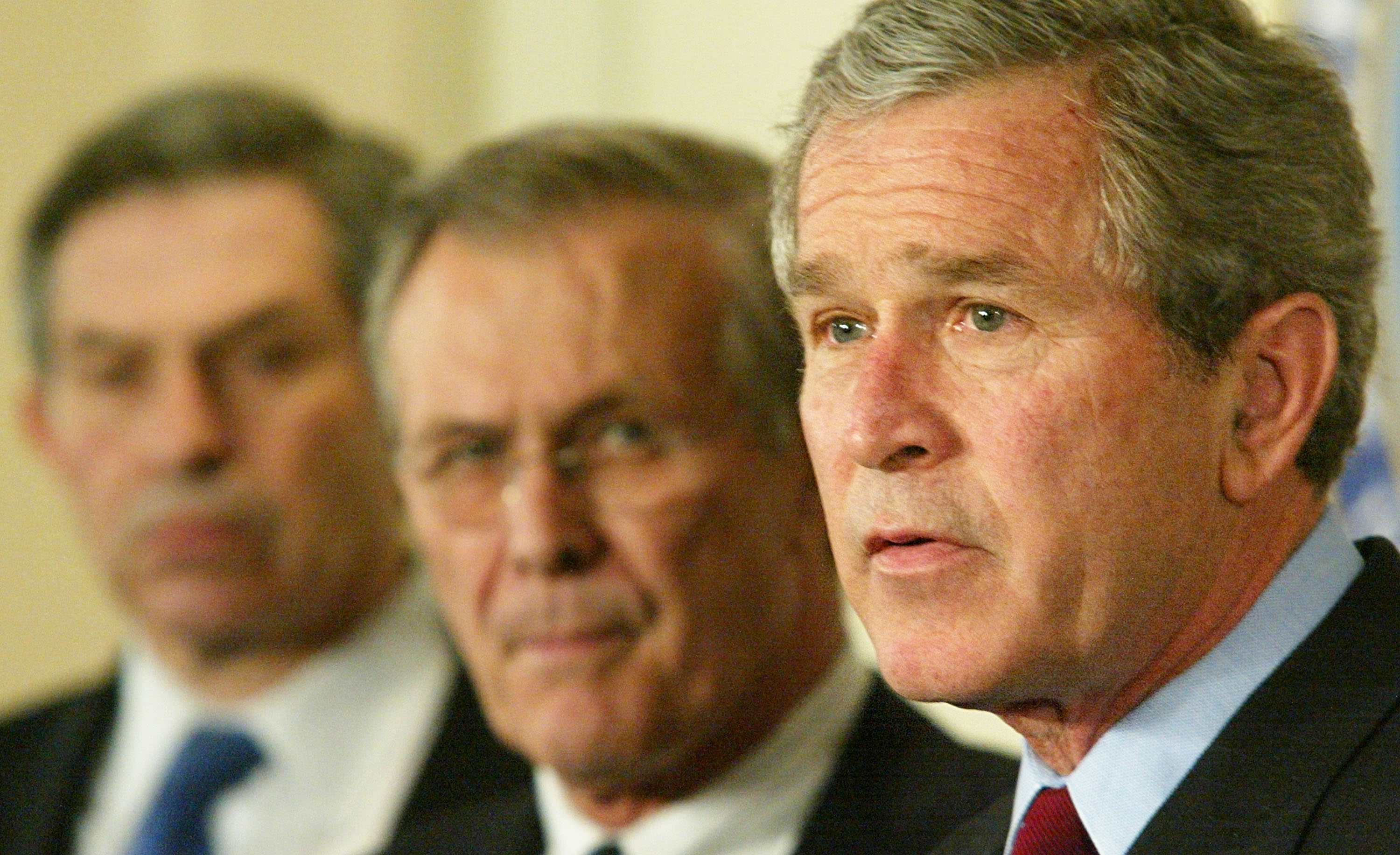
(Photo: U.S. President George W. Bush (R) speaks next to Defense Secretary Donald Rumsfeld (C) and Deputy Defense Secretary Paul Wolfowitz (L) during a visit at the Pentagon March 25, 2003 in Arlington, Virginia. Bush asked Congress for a wartime supplemental appropriations of $74.7 billion to fund needs directly arising from the war in Iraq and the global war against terror. By Alex Wong/Getty Images.)

Capturing The World’s Brutality

http://youtu.be/858V4S_w_xI

Fisher passes along the above interview with war photographer Goran Tomasevic:

Tomasevic, who is Serbian, began working for Reuters in 1996, covering political instability in his native Belgrade. He has since become one of the best-known war photographers currently working. If you’re in the Washington, D.C., area, you can see some of his photos at the Corcoran Gallery, which is hosting a wonderful war photography exhibit through the end of September.

The Reader’s Compass

Ian Buruma selects five books about the relationship between the East and West, including Graham Greene’s The Quiet American:

The Quiet American is much more about America than it is about Indo-China. The titular character is an idealistic young man in Indo-China, probably working for the CIA, whose well-meaning actions cause havoc. That is a sort of microcosm for what has actually happened in various parts of the world because of American intervention.

The Dutch and the British colonial enterprise was largely a commercial one, or in both cases it certainly began as a commercial enterprise, by traders. But the American attitude towards the non-Western world, from the late 19th century onwards, has been of a different kind. The Americans of course see themselves as being on the side of the anti-imperialists, as they fought an anti-colonial war themselves with Britain. So they couldn’t think of themselves as imperialists, even if they were – specifically in the Philipinnes, which they ran as their own colony. But there has been a strong sense of misguided idealism. This is something to do with the missionary spirit, and the Americans have been very active in that sense. But it’s also to do with the way in which Americans see themselves as having a mission to bring their concept of freedom, equality and democracy to the rest of the world. That’s rather akin to France, and both are Western democracies born from revolution.

Graham Greene should not be seen in the way that [Louis] Couperus and [E.M.] Forster were, of being fundamentally out of sympathy with colonialism. He was a Francophile. And in The Quiet American you get a very strong impression that the French, with their superior wisdom and their rich European sense of history, really understood the oriental mind, as people still put it in those days – whereas the brash, superficial Americans with their naïve idealism had no idea what they were doing, and caused great problems.

America Has Little Appetite For War

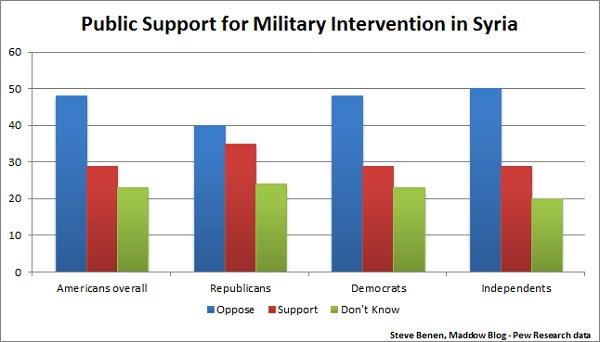
Pew finds that Americans fear another quagmire. Benen breaks down the numbers by political affiliation:

Oppose intervention

Larison comments:

Democrats are not rallying behind a president from their party on this issue. This is not what happened when Clinton ordered military interventions in the ’90s, but it is consistent with the reaction of Democrats to Obama’s wars in Afghanistan and Libya. Most Republicans might be expected to support hawkish measures, but Syria they have been almost as reluctant to intervene in Syria as everyone else.

Drum thinks the president “has a helluva sales job ahead of him.” Cohn believes support could go up:

As recently as five months ago, polls showed that a plurality or majority of Americans would support strikes on Syria if Assad used chemical weapons. It’s unclear whether even the most effective public campaign could lead a majority of the public to support an upcoming attack on Syria. But prior support, even if only in theory, suggests that the public might become substantially more supportive if they’re more aware of Syrian behavior and the Obama administration’s limited objectives.