Executive Dress

Simon Doonan contemplates fashion and politics:

I think when people write about politicians’ clothes they’re really scraping the barrel, dish_disraeli especially when they write about men’s clothes. They do this analysis of like, a red tie. They all wear red ties, for God’s sake. Talk about looking for love in all the wrong places. The politicians in history who have worn remarkable clothes are few and far between. You have to go back to Benjamin Disraeli, who was an outrageous dandy who wore velvet, yellow velvet waistcoats and knickers and he wore a lot of perfume and jewelry. He was extremely camp and over the top. Any politician who’s smart in this day and age is going to dress so as to be unremarkable, but somehow other writers feel it incumbent on themselves to remark on the unremarkable. I don’t know how they do it. “Oh look, he’s wearing an anorak.” And you can get columns out of it, and I think, really? An anorak?

Doonan particularly dislikes fashion talk about Michelle Obama:

The reality is, Mrs. Obama is quite chic, but not sort of in a vain, self-involved way. I guess I was getting sick of people talking about her appearance all the time, and I thought it was very unfair to her and borderline insulting. To me, it’s quite clear that what makes her a great First Lady is her intelligence and her strength and her warmth. Think about Nancy Reagan, think about Laura Bush, think about Hillary Clinton. You don’t get all those three in any of those women, warmth, strength, and intelligence. I thought it was unfair to her and unfair to her legacy to keep focusing on her clothing.

Update from a reader:

Just curious. Which quality do you think Simon Doonan was referring to regarding Laura Bush?

Think about Nancy Reagan, think about Laura Bush, think about Hillary Clinton. You don’t get all those three in any of those women, warmth, strength, and intelligence.

I can’t imagine it’s warmth, because she’s always come across that way to me, and I can’t imagine he’s calling her dumb. So I’m assuming he’s thinking “strength,” because she doesn’t have an in-your-face personality. But that’s not my definition of strength. I don’t know how anyone could survive being First Lady for 8 years without being strong. She’s also publicly disagreed with her husband’s stance on gay marriage and reproductive choice – that doesn’t require strength?

I’m a die-hard Democrat, but I think Laura Bush exhibits all those qualities in droves (her only intelligence blip being whom she chose to marry – but, you know, love yada yada yada).

(Image of Disraeli via Wikimedia Commons)

What, Exactly, Will Congress Authorize?

Jack Goldsmith analyzes the administration’s proposed Authorization for Use of Military Force (AUMF):

The proposed AUMF focuses on Syrian WMD but is otherwise very broad.  It authorizes the President to use any element of the U.S. Armed Forces and any method of force.  It does not contain specific limits on targets – either in terms of the identity of the targets (e.g. the Syrian government, Syrian rebels, Hezbollah, Iran) or the geography of the targets.  Its main limit comes on the purposes for which force can be used.  Four points are worth making about these purposes.

First, the proposed AUMF authorizes the President to use force “in connection with” the use of WMD in the Syrian civil war. (It does not limit the President’s use force to the territory of Syria, but rather says that the use of force must have a connection to the use of WMD in the Syrian conflict.  Activities outside Syria can and certainly do have a connection to the use of WMD in the Syrian civil war.).  Second, the use of force must be designed to “prevent or deter the use or proliferation” of WMDs “within, to or from Syria” or (broader yet) to “protect the United States and its allies and partners against the threat posed by such weapons.”  Third, the proposed AUMF gives the President final interpretive authority to determine when these criteria are satisfied (“as he determines to be necessary and appropriate”).  Fourth, the proposed AUMF contemplates no procedural restrictions on the President’s powers (such as a time limit).

Jeez. No wonder Larison thinks the authorization is too broad:

As it is currently written, the resolution likely wouldn’t pass because it requests authorization for what could potentially be much more than a few “limited” strikes. If this resolution passed, Congress would be effectively signing off on U.S. strikes against targets both in and outside of Syria for as long as the war in Syria lasts. That isn’t what the administration claims that it wants to do, but why would anyone take their word for it?

Daniel Nexon argues that broad authorizations are necessary:

In fact, successful compellence against Syria almost certainly requires a credible threat of escalation. The biggest threat posed by potential US intervention? That it directly or indirectly leads to the overthrow of the current regime. Crafting an AUMF that undercuts that threat will almost certainly be counterproductive when it comes to the Administration’s preferred outcome in Syria: forcing the regime to accept a negotiated settlement with the rebels.

The Senate is already revising the administration’s AUMF to make it more limited. Goldsmith believes that this will prove difficult. With any luck, this could be the sticking point – or the way toward a deal.

How Solid Is Our WMD Intelligence On Syria? Ctd

David Kenner reviews some newly declassified intelligence from the French, who support a strike on Syria:

While U.S. officials have conceded that they don’t know if Assad himself ordered the use of chemical weapons, the French assessment rebuts claims that the Aug. 21 attack could have been the work of a rogue officer. France traces Syria’s chemical weapons program to “Branch 450” of the innocuously named Center of Scientific Studies and Research, which Israel bombed in May. Only Assad and top members of his regime, the report says, have authority to order the branch to employ its deadly weapons. Nor does the report give credence to the idea of a rogue element within Branch 450 itself: The unit, it says, is “composed solely of Alawite military personnel … [and] distinguished by a high level of loyalty to the regime.”

Kenner also reviews the possible logic behind such a brazen attack:

While some analyses suggested the rebels were making gains in Damascus, the conventional wisdom was that Assad was making military progress without the use of chemical weapons. The French report, however, suggests that Assad’s position in the capital was weaker than had been supposed: “Our information confirms that the regime feared a large-scale opposition attack in Damascus,” the assessment reads. The attack, it says, was intended to “secure strategic sites” that would allow Assad to control the capital, such as the Mezze military airport.

The French also insist that Assad launched an additional assault to destroy the evidence. Meanwhile, Matthias Gebauer reports on a phone call intercepted by Germany’s foreign intelligence agency:

[Bundesnachrichtendienst (BND) head Gerhard Schindler] said that the [agency] listened in on a conversation between a high-ranking member of the Lebanese militia Hezbollah, which supports Assad and provides his regime with military assistance, and the Iranian Embassy. The Hezbollah functionary, Schindler reported, seems to have admitted that poison gas was used. He said that Assad lost his nerves and made a big mistake by ordering the chemical weapons attack.

The new information from the BND could become important in the coming days. Thus far the US has only noted that after the attack, intelligence agencies had intercepted internal government communications indicating concern about a possible UN inspection of the site. The telephone conversation intercepted by the BND could be an important piece in the puzzle currently being assembled by Western intelligence experts.

Earlier Dish on the intel question here.

Will The Anti-War Movement Return?

Antiwar Protests

Joe Weisenthal explains why it fizzled out:

In 2011, Professors Michael T. Heaney and Fabio Rojas published a study titled: The Partisan Dynamics of Contention: Demobilization Of The Antiwar Movement In The United States 2007-2009 which looked at nearly 6,000 surveys of anti-war demonstrators between January 2007 and December 2009.

This one chart [above] basically tells the whole story. The percentage of Democrats attending anti-war protests collapsed at the end of 2008, and in early 2009. As Democrats are the biggest block of any of these groups, this desertion of the Democratic party was the major blow.

Garance thinks Democrats may oppose Obama:

Obama never has to stand for election again, but the jockeying for 2016 is well under way. It’s possible Obama’s intervention in Libya would have earned louder opposition from Democrats and liberals if the president had not also still faced reelection, which doubtless tempered some voices. That he won’t again opens up the floodgates of criticism from people who expect to be standing on the political stage long after he is gone, as well as by some who hope to take his chair.

Pareene, on the other hand, doubts that Democrats will take a stand:

[A] Syria campaign probably won’t create the conditions for a future Obama to stake out an opportunistic left-wing position and ride it to the presidential nomination in 2016. Americans won’t be dying by the hundreds and we won’t be committing ourselves to a drawn-out and bloody occupation. (Well, let’s hope we won’t be, I guess.) We’re going to launch missiles for a few days and then quit, according to the latest plans. That’s not quite a war you can hang a presidential campaign on. Probably not even a congressional campaign.

Right now liberals (and the political press) are letting people like Rand Paul meet the demand for America to have a less “muscular” foreign presence. (This isn’t really surprising: Liberal antiwar voices are pretty much always marginalized in the United States, by both hawkish Democrats and the press,) The right-wing interventionists are terrified at how much his position resonates with people. But I’d put money on the next presidential election involving two supporters of military action against Syria

Did Obama Need To Go To Congress?

Marty Lederman thinks “that President Obama’s decision to ask Congress for authorization for the use of force in Syria is to be commended, and welcomed”:

Presidents will certainly continue to assert the power to act unilaterally, subject to statutory and international law constraints.  But if and when a President wishes to act for a reason that has not previously been the basis for unilateral action (such as to degrade another nation’s ability to use certain weapons), and/or in a manner that violates a U.S. treaty obligation, past practice will support obtaining congressional authorization, even as the question of the President’s unilateral authority in such circumstances remains untested and unresolved.

I agree – and in fact, think this move could make this moment in US history a possibly pivotal one. Jack Goldsmith weighs in:

The constitutional problem with pure humanitarian interventions – and especially ones (like Kosovo and Syria) that lack Security Council cover, and thus that do not implicate the supportive Korean War precedent – is that Presidents cannot easily articulate a national interest to trigger the Commander in Chief’s authority that is not at the same time boundless.  President Obama, like President Clinton before him in Kosovo, had a hard time making that legal argument because it is in fact a hard argument to make.  That is one reason (among many others) why I think it was a good idea, from a domestic constitutional perspective, for the President in this context to seek congressional approval.

Andrew Rudalevige notes that, since the 1973 War Powers Resolution (WPR), “actions where prior congressional authority was not sought have some characteristics in common not present in the Syrian case”:

First, they have a rationale in self-defense, even imaginatively defined. In the WPR, presidents are given authority to use force when there is (1) a declaration of war; (2) a specific statutory authorization; or (3) ”a national emergency created by attack upon the United States, its territories or possessions, or its armed forces.” Obviously options (1) and (2) can be based on any rationale, or none; but they do not – yet – apply to the Syrian situation. So one question facing Obama was whether (3) would cover sufficient ground. Some cases are easy, as with the (failed) rescue attempt of the American hostages in Iran in 1980 or the 1998 missile strikes after the African embassy bombings. In other cases presidents have been very generous in their interpretation of “attack upon the United States.”  The 1989 invasion of Panama was explained by President Bush as a response to General Manuel Noriega’s “reckless threats and attacks upon Americans in Panama [which] created an imminent danger to the 35,000 American citizens” there. The 1983 invasion of Grenada was publicly justified by President Reagan along similar lines: “first, and of overriding importance, to protect innocent lives,” and not just any lives: “American lives are at stake.” Still, it’s hard to stretch to this from the Syrian rationale, sold before today largely as punishment for the violation of international norms.

Second – in addition or instead—they had multilateral support, a cause of action endorsed by the international community, normally with a humanitarian component. Even Reagan in Grenada was careful to stress that the US had been invited to respond, that it was doing so in concert with other nations in the region (whose battleship inventory was perhaps a bit thin), and that ”this collective action has been forced on us by events that have no precedent in the eastern Caribbean and no place in any civilized society.” Likewise in Somalia (1992), Kosovo (1999), and Libya (2011), one could cite both humanitarian concerns, and treaty obligations (e.g. with the United Nations, NATO, or both). The WPR specifically rules out inferring authority to use force from such obligations (see Section 8(a)(2).)  Nonetheless, they muddy the legal waters.

In Syria, Obama has neither of these covering contexts to justify action.

Drum wishes that Obama had gotten authorization on all of his interventions abroad:

The real reason I’m disappointed is that Obama had a chance to set a new precedent in foreign policy and didn’t take it. Whatever else we liberals might think about George Bush’s military acumen, he left office having explicitly asked Congress to authorize both of his major military actions before he undertook them. If Obama had acknowledged the War Powers Act as good law, acknowledged Congress’s constitutional role in warmaking, and then voluntarily asked Congress for authorization of his proposed military operations in both Libya and Syria without being pressured into it, there’s a good chance that future presidents would feel bound to do the same. This is the way norms become settled, and this is a norm that would have truly changed Washington DC for the better.

But he didn’t do that, despite his apparent belief in 2007 that it was the right thing to do. It was a missed chance, and a disappointing one. I had hoped for better.

Me too. But that doesn’t mean sacrificing the opportunity now.

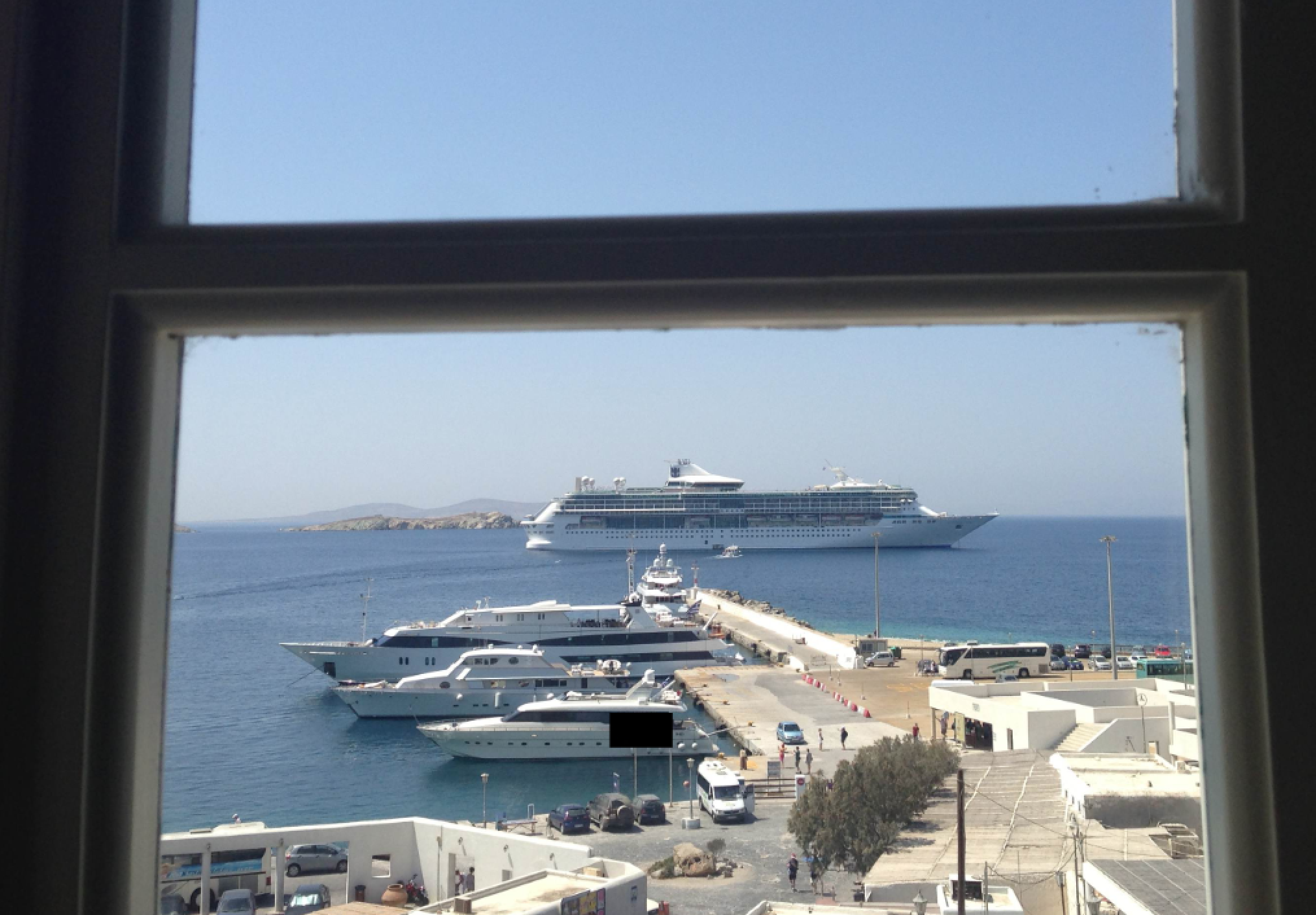
The View From Your Window Contest: Winner #169

Screen Shot 2013-08-31 at 11.27.12 AM

A reader writes:

Looks Mediterranean. One yacht has a Greek flag. Cars approaching the parking lot are driving on the lefthand side of the road. Based on Google maps it looks as though Larnaca, Cyprus has a bay with a view of the Turkish side of the island like this.

Another guess:

Marseille, France? This looks like the pier that was under construction the when I was visiting a friend there in 2011. It’s hard to tell because I haven’t been back since. The cars are European. Are those Les Îles in the background?

Another is more confident:

This view is from the hills above the dock for boats coming across the Gibraltar Strait to Tangier, Morocco. It is actually about a 45-minute taxi ride from the city itself. The buildings to the right are Customs.

Another:

I got as far as identifying the ship in the background (a Royal Caribbean vessel) and figuring out where it had been lately, but couldn’t for the life of me determine which of the many ports it had visited had yielded this photo. I’m going to go with Split, Croatia (though it could be Naples, or anywhere in that general area, really).

Another gets the right country:

My first impression was Caribbean, but then I thought, “What if it’s not?” – and my brain went straight to Greece. Now to settle in to the real work. I’m pretty confident that the cruise ship is the Splendour of the Seas (and wasn’t that a fun exercise, all on its own), which seems to run from Venice, Italy, to Croatia and to a few stops in Greece. I’ve given up searching the Greek islands for a pier that looks like this one. It’s a holiday, and I’m not going to spend it all on the search. I’m just going with Corfu.

Another island:

That is a RCCL Cruise ship and as they are using the tender, obviously a very small port. I couldn’t read the ship’s name so went on to cruise ship tracker and saw that the Serenade of the Seas was in port in Fira on the island of Kritko Pelegos, Greece earlier today.

Another:

It’s been years since I was there, and the harbor looks like it’s grown, but it has a familiar feel to it. It would be the quay below the town of Phira facing the caldera of the ancient volcano that erupted in the 15th century BCE. Phira is the capital of the Greek island of Santorini, also known as Thera. The view is toward one of the islets that emerged in the 20th century CE, perhaps Therasia.

Another gets the right island in Greece:

This must be an easy one because I think I actually got it. It’s a view of the Old Port in Mykonos, Greece.  I even found a very similar photo here. However, I cannot determine the name of the building I think it was taken from.

Another goes for the right building:

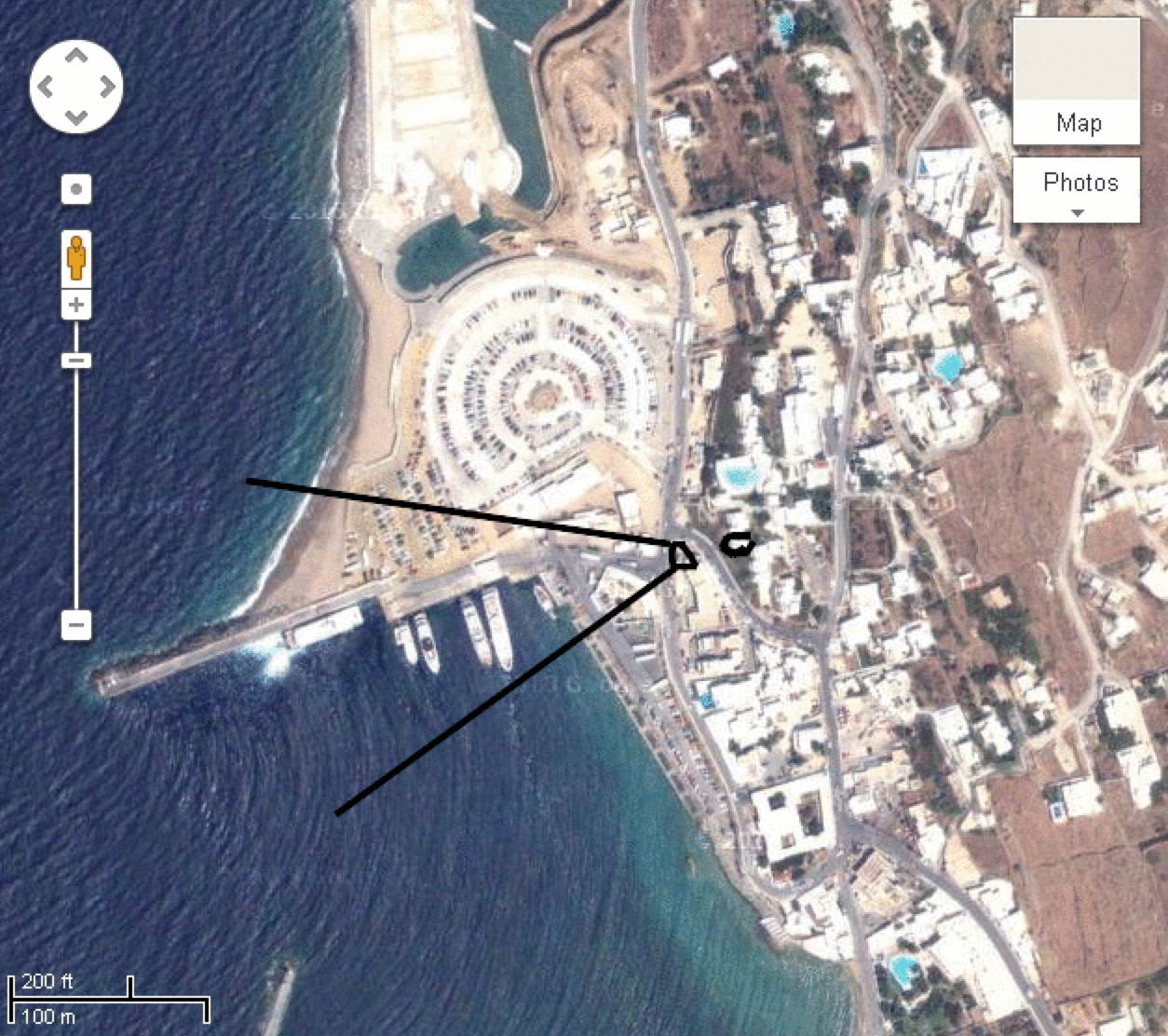
This week’s picture is taken from a window near the cruise berth in Mykonos. I could not find what I think is the building, but for the sake of guessing I’ll say it’s the Harmony Boutique Hotel. I’ve attached a photo circling two places I think it could be taken from, though it’s hard to tell without street view/pictures:
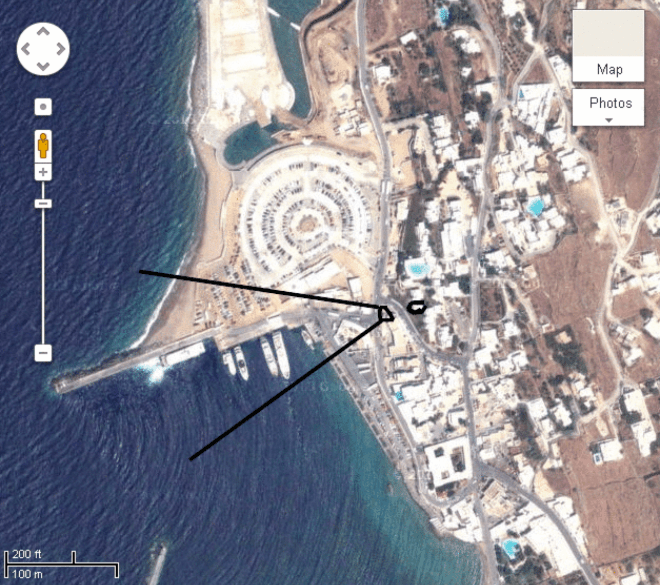
Screen Shot 2013-09-03 at 12.20.52 PM

I found the location because of the cruise ship. The emblem on the smoke tower, or whatever one calls that, is Royal Caribbean. With the help of my mom (who knows cruise ships better than I do), we figured it was an older one cruising through the Eastern Mediterranean. And right we were. Not sure if it’s the Splendour or the Legend of the Seas, but both are older and run cruises through Mykonos.

Another zooms in further:

I used to enter this contest a dozen times and never got any where (with the exception of Boston, my hometown – but so did a million other people).  I once correctly guessed Hastings-On-Hudson without having been there, but never entered the contest.  I’m pretty convinced about this one: Mykonos Greece. I’ve added a Google maps satellite picture with all the elements in place; the open air enclosure; the trees along the street; the dive that zigs at the end of the wharf; the small rocky island of MPAOS; and the larger island of Rinea behind it:

VFYW_083113_Mykonos

Another:

I was just in Mykonos not a month ago. The tricky part with this week’s challenge, not unlike the planning of my trip, is that there is no Google street view on that island, so it’s hard for me to pinpoint the precise location. I’ve included my best guess at a location, which I guess would be at the following coordinates: 37.451196,25.328979. Location is SSE of the Bank of Cyprus Building and NNE of the Harmony Boutique Hotel (and might in fact actually be taken from that location).

Another gets the right hotel:

I did the best geometry I could and I think I can identify the building. My best guess is that the it’s part of the Porto Mykonos Hotel complex, which is certainly on the other side of the little road, with the tower and the pool.  Since Frommers says “be sure not to get the back rooms, as they look into a parking lot” when describing the Porto Mykonos, and the bulk of it is right next door, and it has weathered white pane windows in some rooms, and they most certainly are not bragging about that view on their website, I’ll give it that guess.

Details from the submitter:

It was taken last week in Mykonos, Greece from my window at Porto Mykonos Hotel. The hotel is made up of scattered structures on a hill, so they’re like townhouses. My room was Room 137, which is a 1st floor room (not ground floor). And I was there on holiday. My room had excellent views of the sea, especially at sunset, but the passing cruise ship caught my attention while I was getting dressed for the beach. Let me know if you need more info. This is so exciting! I’ve had three VFYW pics posted before, but never for a contest!!

No one guessed the exact room number, but out of all the previous correct guessers who haven’t won a contest yet, three guessed the right floor. One of them writes:

The view is of the Old Port above what looks to be the bus and boat terminal.  A little google-fu tells me this is the Porto Mykonos Hotel.  This picture from Room 128 seems pretty close:
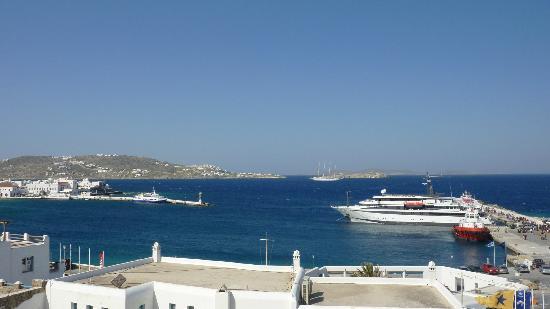
filename-p1040261-jpg

Just a note to add that my family and I, though separated by hundreds of miles, love playing the contest every week.

That reader has only entered two contests overall, but the following two readers have each entered nine:

I have a feeling you’ll get a lot of correct responses on this one. The picture was taken from the Porto Mykonos Hotel in Mykonos Town, Greece. Given the photographer’s position relative to the ferry pier, I think the room number is somewhere between 120 and 126. The Royal Caribbean cruise ship passing by is the Splendour of the Seas. The ship underwent structural modifications in the fall of 2011, and the picture was taken after those were completed.

The other reader is much more detailed, so we are going to award the razor-thin tiebreaker to him this week:

This is a view from a guest room window of the hotel Porto Mykonos, in Mykonos, Greece.  My guess is room number 124, since a view I found from room 128 was slightly to the south.  I attached two fuzzy pictures with first a sighting line, then an arrow pointing to the probable hotel room.  Also attached is the view I found from room 128 on TripAdvisor:

VFYW_Mykonos_TA

As usual, I think I only get these when they are easy.  My initial take on the view was that it was somewhere in the Mediterranean, based on the olive trees, the calmness and color of the water, the appearance of the islands, and the EU appearing license plates on the cars.  Since the cruise ship was anchored out, the cars were all small, and the shadows indicated a western view, my first guess was a country in the eastern Adriatic.

Before trying to find it by scanning with Google maps (especially since my internet is so slow), further research was in order.   The cruise ship seemed like a good place to start.  Aha, there seems to be a logo on the ship’s funnel.  It took me awhile to find the company, probably because it seems improbable that Royal Caribbean has ships in the Mediterranean.   Then I tried to figure out which of their ships it was.  This was not made easy, since the ships pictured on their site seem to be intentionally poor, missing or consisting of only representative sketches.  I then looked for their Med itineraries, and worked backward from there.  It turns out to be the Splendour of the Seas.  It’s interesting that most images I found of this ship do not match the one in the window view; it turns out that updates have been made recently to add a whole row of balconies to one level.

Then I just walked through the itineraries for this ship and looked for a west pointing pier with two islands off its end. Et voila!

(Archive)

Quote For The Day

“The consummate interventionist Robert Kagan wrote in his recent book that the American military “remains unmatched.” It’s unmatched in the sense that the only guy in town with a tennis racket isn’t going to be playing a lot of tennis matches. But the object of war, in Liddell Hart’s famous distillation, is not to destroy the enemy’s tanks (or Russian helicopters) but his will. And on that front America loses, always. The “unmatched” superpower cannot impose its will on Kabul kleptocrats, Pashtun goatherds, Egyptian generals, or Benghazi militia. There is no reason to believe Syria would be an exception to this rule. America’s inability to win ought to be a burning national question, but it’s not even being asked,” – Mark Steyn.

Well, we’ve been asking it here at the Dish – ever since Iraq revealed what an anachronism American global power actually is. If you cannot break your enemies’ will, it matters not how much weaponry you have. The 20th Century is over.

Beyond Good And Evil … Smugness

How does a personally decent and intellectually alert human being become responsible for the US embracing torture techniques from the Communist Chinese and launching a war against Iraq with no planning for the aftermath? Since I’ve known Rummy for a long while, and liked him until the evidence that he is a war criminal became overwhelming, it’s a question that fascinates me. So it’s good news that Errol Morris has interviewed Donald Rumsfeld for 35 hours for his new documentary, The Unknown Known. Sharan Shetty introduces the teaser seen above:

Rumsfeld was notorious for his “snowflakes” – the thousands of memos he sent during his time in Congress and the Pentagon, and as secretary of defense – which often employed a sort of bureaucratic poetry. (A particularly abstract briefing provided the title for Morris’ film.) In this brief clip, Morris explores the rationale behind these memos, many of which provided the foundation for the Bush administration’s decision to invade Iraq.

Scott Feinberg thinks the film lacks the emotional force of Morris’ 2003 documentary, The Fog of War: Eleven Lessons from the Life of Robert S. McNamara, in part because Rumsfeld, unlike McNamara, refuses to admit any mistakes. Still, Feinberg finds The Unknown Known compelling:

The most striking and, in some ways, disturbing thing about the doc is that Rumsfeld, even under the microscope of Morris’ Interrotron camera (which enables a viewer to almost see into the soul of an interview subject), actually comes across as smart, charming and mostly likable – save for a few creepy instances when he holds a smile for a little too long. … [I]t’s worth the price of admission to watch Morris, one of the world’s great minds and interrogators – who told the New York Times years ago that he has an “endless fascination” with the extent to which “people who engage in evil believe in some real sense that they are doing good” – put Rumsfeld in the hot seat. When Morris asks his last question, the subject’s face and response are priceless.

Can’t wait. Update from a reader:

That smile that Rumsfeld gives Morris and/or the camera at the end of the clip is beyond disturbing. It’s a knowing smile, a bullshitter’s smile. It’s enough to plunge me back into a deep outrage at the things that Rumsfeld and his old friend from the Ford administration Cheney did during those years. Who knows if they even really know it anymore; they’ve existed so long in denial that I know it must seem like the truth to them (I’ve had the experience, too). But I’m quite sure that in from 2001 to the start of the invasion in 2003, they knew exactly what they were doing.

Which was this: they parlayed the sense of shock, trauma, a need to trust in the government-as-protector, and a need for revenge on the part of the American public following the 9/11 attacks into an orchestrated campaign to walk the country into their preferred Iraq policy – regime change. It had long been their dream, and it dovetailed perfectly with their other national security pet projects – for Cheney, it was the “unitary executive” concept and total presidential power, for Rumsfeld, it was a “lighter” military lowering the threshold for more involvement worldwide and dominating the Defense vs. State department rivalry. Whether they knew the intelligence was faulty, they acted in bad faith by taking only those intelligence reports that supported their views and denigrating the intelligence (and those connected to it, such as Joe Wilson and Valerie Plame) that questioned their views. They willfully acted contrary to the administration’s stated policies and blamed the rank-and-file soldiers and bureaucrats when found out.

But most galling of all, they acted with clear disregard for the safety and well-being of the service men and women they sent into Iraq and came close to breaking the whole goddamn Army (close enough that someone can make a convincing argument that they actually did), and in doing so thought that they were right about everything all along (smugness). I don’t know how someone like Colin Powell or Lawrence Wilkerson can restrain themselves from beating the shit out of either of Rumsfeld and Cheney whenever they see them because I wouldn’t be able to if I were them.