The Covert War Already Under Way In Syria

We get a glimpse of it in the NYT today:

Officials said that in the same conversation, which included Senator Lindsey Graham, Republican of South Carolina, Mr. Obama indicated that a covert effort by the United States to arm and train Syrian rebels was beginning to yield results: the first 50-man cell of fighters, who have been trained by the C.I.A., was beginning to sneak into Syria.

“Beginning to sneak”? What the fuck does that mean? And how has this covert war affected Assad’s calculation with respect to WMDs? We don’t know – which, of course, is the point of covert wars. But we absolutely have a right to know. Until the Obama administration tells us about the war it is currently waging in Syria, we should refuse any further authorization for them to expand it.

How Solid Is Our WMD Intelligence On Syria?

US-SYRIA-CONFLICT-CONGRESS

Gregory Djerejian rightly requests “hard confirmation” on who used chemicals weapons in Syria:

[W]e require conclusive proof of the origins of the attack, beyond horrific footage of the grisly aftermath. After all, this speaks only to something horrible having happened, as did reports by respected NGOs like Doctors Without Borders (MSF), but it does not firmly evidence regime culpability. Similarly, sarin samples obtained from first responders proves the existence of said neurotoxic agent on the scene, but not necessarily who delivered it, precisely how, and exactly where.

After the Iraq fiasco, we need to ensure that we do not simply “trust” the guarantees of our democratic leaders and the security state that is feeding them intelligence:

[W]e have no choice but to reckon that we labor under the legacy of the terrible blunder that was the ginned-up intelligence that caused trillions of dollars wasted, hundreds of thousands of Iraqi lives, thousands of American ones, the epic disgraces of Abu Ghraib, and such grievous harm dealt the United States’ global repute. We must recall all this was premised on lies. So, like it or not, evidentiary hurdles moving forward must be higher.

Amen.

(Photo: A photo of alleged chemical weapons victims in Syria is seen before a hearing of the Senate Foreign Relations Committee on Capitol Hill on September 3, 2013. US Secretary of State John Kerry, Chairman of the Joint Chiefs of Staff Gen. Martin Dempsey, and Defense Secretary Chuck Hagel appeared before the committee to present the Obama Administration’s views on Congressional authorization for the use of military force in Syria. By Brendan Smialowski/AFP/Getty Images)

Marching As To War?

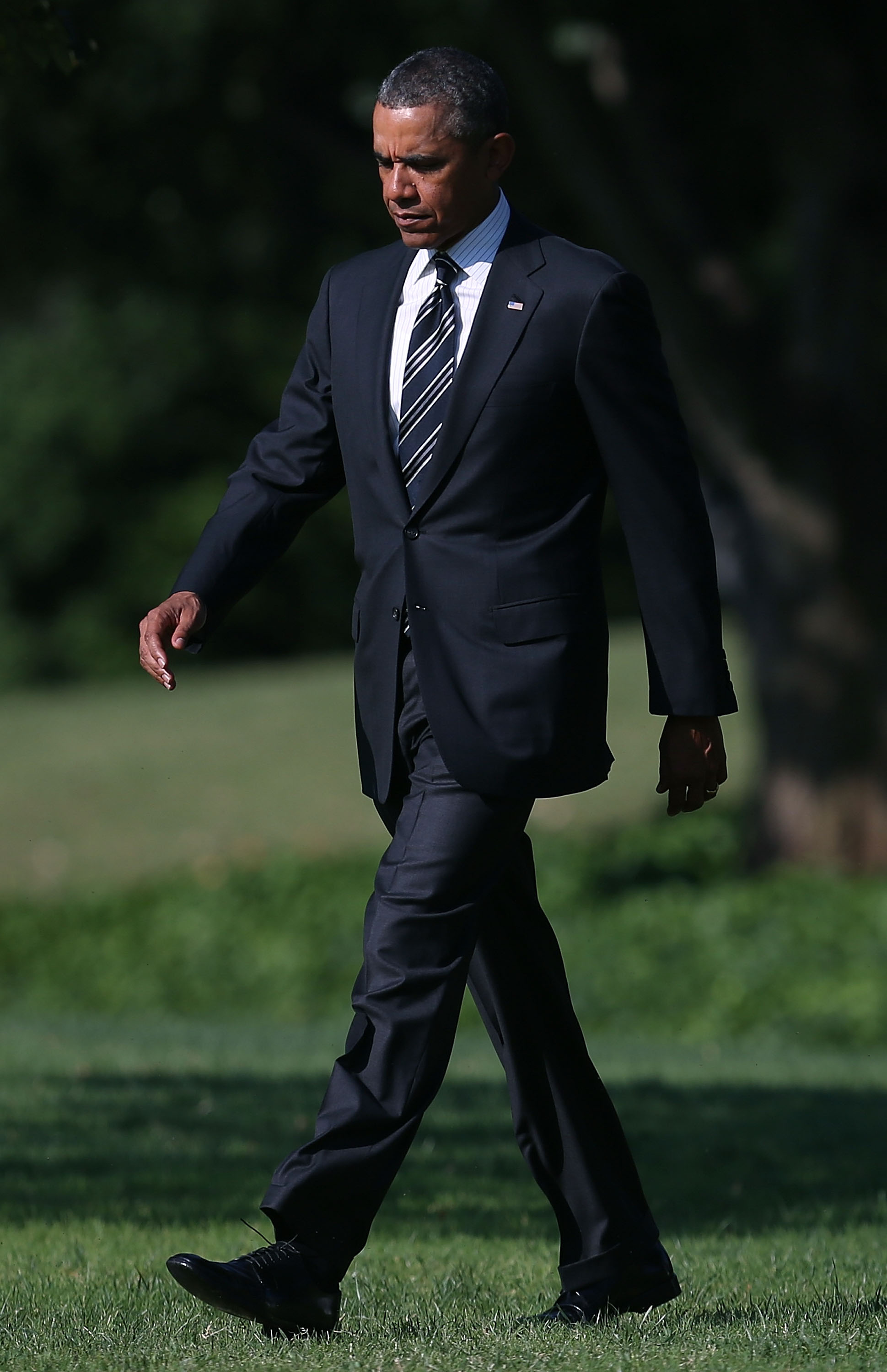
President Obama Departs The White House

This morning, I finally watched the visual evidence of the Assad regime’s chemical attack on hundreds of children. There is a reason, these awful videos prove, behind our fear of these kinds of weapons, even if they follow over 100,000 far bloodier deaths. They kill silently in the dark. Heavier than air, poison gas can sink into the basements and cellars civilians use for protection during wartime. The crippling efficacy of such weapons, once used to propel the mass extermination of European Jews, should draw us all short. It is not that the victims of chemical attacks are any more dead or crippled than the 120,000 or so other victims of the sectarian bloodbath in Syria. It is that the use of such weapons signals that the regime is now prepared to use this final trump card, if it suits its purposes. The Alawites have always had the power to kill their sectarian foes (Hafez al Assad committed a mass murder of 10,000 civilians); but now we know they also have the will to use the most silently lethal chemicals at their disposal. There’s a reason so many millions are now fleeing. The prospect of a sectarian Holocaust from the skies is no longer a dystopian illusion. It is an historical fact.

This makes Obama’s shift explicable, whatever the debating points scored at various junctures in the Syria debate in the last few years. I don’t buy the criticism that he should have intervened much earlier in Syria (there would have been zero public support); and the principle of forbidding chemical weapons use against civilians and rebel fighters is a vital one for the future of civilization. To do or say nothing now would have given Assad a green light to exterminate more people without any cost. So the core question really emerges: what would doing something look like?

Obama has proposed doing something and nothing at the same time. And, sure, a military strike on Syria will exact a cost for Assad for his sectarian extermination program. But it is highly unlikely to bring him down or, unless I am mistaken about the situation on the ground, shift the course of the war. After the dust settles, a US strike may even give Assad more lee-way to use his poison gases against his foes, and enable him to portray himself as a victim of Western intervention. If he got away with it once, and gained ground in the war, why not again and again? And what then?

The McCain faction is obviously right about one thing: the only option that would ensure Assad’s ouster would be a full scale war and invasion conducted by some kind of alliance between the US and the rebel groups. And they are obviously wrong, it seems to me, on one thing as well: there is no way on earth that this country or its armed forces should jump into such a brutal, sectarian vortex of violence, with only the goal of deposing a dictator. Have we learned nothing from Iraq? Our core interests are not affected by the result of the Syrian civil war, and we have simply no assurance that the replacement for Assad would be less monstrous than he is. If our concern is the security of chemical weapons stockpiles – and Syria has the third most in the world – then it seems to me that our cold interests actually lie with Assad’s victory. At this point, his faltering regime is more stable than the opposition and less allied with Sunni Jihadists.

But here, it seems to me, is where we should stop, and demand more clarity and transparency from the president. The Congressional debate – in my view, a constitutionally indispensable procedure – is a great opportunity for this. We all get the gravity of chemical weapons use – and Kerry can stop embarrassing himself by calling his former dining companion another Hitler. What we don’t yet fully know is what the Obama administration has already been doing in Syria and what it hopes specifically to achieve now – by militarily joining one side in Syria’s sectarian meltdown.

I want, first up, a better explanation for this quantum leap in the use of chemical weapons by Assad. My impression is that he was winning this brutal war slowly. Why play your trump card then – with all the risks associated with it? More to the point, why do it when UN inspectors are close by? Yes, Assad is evil – but he has long been that and the Ghouta mass murder has scrambled the situation in ways that indicate reckless, even desperate, stake-raising. So, first up, what I’d want first of all is a clear statement that the US has not been engaged in a covert war in Syria that might in any way have prompted this horror. I would like a clear, emphatic and truthful refutation of the reporting in Le Figaro that implies that a new anti-Assad offensive was launched at the start of last month, as part of a covert war, headed up by the US’s covert war machine. Is this paranoid? Maybe. But I remember Iraq and, forgive me, I have learned the value of deep skepticism about various US administrations’ accounts of reality.

Second, I want a clear explanation of what the goals are of this proposed strike.

If it is merely a symbolic act, then we should understand that we are risking American lives, money and values for moral optics, with no clear goal. If it is an attempt to shift the direction of the civil war, then we should know how the US attempts to win this sectarian struggle in the Middle East, when it could not impose sectarian peace in a country it occupied with over 100,000 troops for a decade (and where the sectarian murderousness endures and thrives). If we “win”, are we sure this isn’t just another move in an eternal cycle of sectarian vengeance? Look at Libya – the other place Obama decided to intervene. Obama’s reward? The attack on the Benghazi CIA facility and a fractured non-state that has allowed al Qaeda to regroup in north Africa. You can more easily see how a rebel victory on Syria could turn into a worse nightmare. If Jihadist nutcases end up in control of the third largest chemical weapons stockpile in the world, the first step toward that result would be this war against Assad.

I’m not denying the moral atrocity. I’m not denying the gravity of this breach of international norms. But military intervention in Syria? For me, the administration hasn’t even begin to present a coherent, let alone a persuasive argument. The congressional debate is absolutely the best forum for this debate to take place – just as the House of Commons was in Britain. If the Congress votes no – which, given the current arguments, it obviously should – then the president should accede to the wishes of the American people as voiced by their representatives. If he were to do that, the kind of transformation Obama promised in America’s foreign policy would be given a huge boost. This would be a president who brought Congress back into the key decisions of war and peace as the ultimate authority on them, as the Founders intended. It would be seen by history as the first key step away from the imperial presidency and the beginning of democratic accountability for the permanent war machine.

This could, in other words, be the dawn of a new, realist and constitutional age. Or the final death-throes of an empire that won’t quit until it bankrupts us both fiscally and morally. That’s why next week’s debate is so critical. And why Obama can still come out ahead on this, even as the conventional Washington wisdom will surely be all about his humiliation in a zero-sum narrative whose attention span is the next five minutes. If he defers to Congress on a new war in the Middle East, we are definitively in a new era.

It’s called 21st Century democracy. And not a minute too soon.

(Photo by Mark Wilson/Getty Images)

When Speaking Is Revealing

Alan Jacobs relays what he learned from reading aloud an essay he was working on:

As I was reading, as my mind was processing words and sending them along to my lips and larynx, a word pricked my conscience; I scanned my word-hoard for alternatives, and managed to retrieve one, to my relief. But it’s not always so easy. A few minutes later in the same lecture I came across a whole phrase that, even as it was about to emerge into the public air for the first time, was revealed to me as fundamentally uncharitable — but because it was a whole phrase I did not have time to construct an alternative. I was therefore forced to utter words even as I was renouncing them, to be convicted out of my own mouth of a lack of generosity. I was made to own, by speaking them, words I wished I had not written.

His broader point about the ethics of writing:

[M]any have been my idle words over the years. I wonder how much harm they have done to others, and even to me. I did not publish my first book until I was nearly 40, and while I used to regret that late start, I now am thankful that I didn’t get the chance earlier in life to pour forth yet more sentences to spend my latter years regretting.

A handful of times over the years I have drafted essays only to realize, before submitting them, that I did not want to say what I had written there; and a few other times I have had cause to thank editors for rejecting pieces that, had they been published, would have brought me embarrassment later.

In some cases the embarrassment would have been because of arguments badly made or paragraphs awkwardly formed; but in others because of a simple lack of charity or grace. An essay begins with an idea, but an idea begins with a certain orientation of the mind and will — with a mood, if you please. We have only the ideas that our mood of the moment prepares us to have, and while our moods may be connected to the truth of things, they are normally connected only to some truths, some highly partial facet of reality. Out of that mood we think; out of those thoughts we write. And it may be that only in speaking those thoughts do we discern the mood from which they arose. “Out of the abundance of the heart the mouth speaks” — a terrifying judgment, when you think of it.

Who’s Got Talent?

Grammy-winning violinist Joshua Bell plays in the DC Metro:

Meg Wolitzer draws a distinction between talent and success:

Soon the 1980s morphed into the 1990s, and somewhere along the way God gave us the internet, which promised to connect previously undiscovered talent with the world at large. Sure, there are the occasional phenomena, those YouTube sensations who burst out of nowhere and reach millions of viewers, or who gather “hits” – an appropriate word, since the image of a hand lazily slapping at a keyboard seems a good way to describe how we choose our cultural intake. But the problem with the rise of internet culture, along with the 24-hour news cycle, is that the furnace constantly needed to be stoked. There had to be a constant stream of people, faces, personalities standing by to fill up all that time. And so individuals who ordinarily wouldn’t have been in the public eye were suddenly drafted for the job. “Celebrity chef”, “brilliant hairstylist”, the terminology reflecting an aching wish, or need, for widespread specialness – acknowledged, of course, by fame. Even at home, my kids would demand, “Mom, can you make your famous mac and cheese?” How easy then to become a star, an expert, a source of acclaim. Everyone had talent.

In fact, though, very few actually do. …

It’s not talent that’s brought to the fore most often these days, but success. Whether it’s Joshua Bell playing masterfully to a swirl of indifferent commuters, or a brilliant film that gets a bad review and barely makes a dent in anyone’s consciousness, talent in its pure, beautiful form can be overlooked or misunderstood. Meanwhile, success – which by nature is bottomless, fathomless, and therefore keeps even successful people constantly on the hunt for it – keeps getting the attention. The two continue to be spoken of interchangeably, when in truth the first is the real deal, and the latter is simply the fairy dust that sometimes gets sprinkled on the real deal, and other times gets puzzlingly sprinkled on the mediocre, or the fraudulent, or the happened-to-be-there-at-the-right-time.

Platitudes Aplenty

“There are too many standard formulations in our language,” writes Teju Cole. “They stand in place of thought, but we proclaim them each time—due to laziness, prejudice, or hypocrisy—as though they were fresh insight”:

Flaubert’s “Dictionary [of Received Ideas]” inspired me to try something similar, over the course of a few hours, on Twitter. I think, also, there was the influence of Ambrose Bierce and his cynical “Devil’s Dictionary,” Samuel Johnson’s mostly serious but occasionally coruscating “Dictionary of the English Language,” and Gelett Burgess’s now-forgotten send-up of platitudes, “Are You a Bromide?” What the entries in these books have in common, in addition to compression and wit, is an intolerance of stupidity. As I wrote my modern cognates, I was struck at how close some of them came to the uninterrogated platitudes in my own head. Stupidity stalks us all.

Many more tweets from Cole:

When Children Weren’t Cherished

Alex Mayyasi leafs through Viviana Zelizer’s Pricing the Priceless Child:

Zelizer writes that in 18th century Europe, “the death of an infant or a young child was a minor event, met with a mixture of indifference and resignation.” She quotes a French philosopher of the time who wrote, “I have lost two or three children in infancy, not without regret, but without great sorrow.”

Historians find, for example, no evidence during the period that the English wore or displayed symbols of mourning when young children died and that the French commonly buried young children in the backyard like Americans bury pets today. Colonial Americans called newborns “it” or “the little stranger.” While the death of young children was greeted with sorrow, the next born child often took the name of its departed sibling.

Today that seems shocking, and Zelizer shows how reverence for young life developed in the 1800s. The deaths of young children became a great tragedy, inspiring memorials for young victims, movements focused on child mortality and health, and literature for parents on how to cope with the unbearable loss of a young child. Attitudes reflected this as childhood became the coddled, special time that we consider it today.

Putting Your Prose On A Diet

The novelist James McBride explains why he begins his novels by writing with a pencil and yellow legal pad:

When you handwrite, you edit. The first thirty to fifty pages of all my books are handwritten, and I do that because if you work on a computer, you end up going forwards and backwards and end up inserting entire chapters. Writing by hand forces you to edit before you edit – the act of moving a pen or a pencil across the page is a form of editing that cuts the fat from your work. It makes you a lean writer, and you really have to be lean in our time. Nowadays, writing is just covered in fat and icing. Everyone is a blogger writing in the first person, twittering about going to the store — I wouldn’t do that if my life depended on it.

So handwriting, especially today, is precious, and forces you to edit your work immediately. It moves you to clean your characters and content, it pushes your story forward, and it makes you identify what is important right away. Typing at a computer is like going to an all-you-can-eat restaurant. It’s too much. Stay lean.

Previous Dish on the topic here.

Deaf Architecture

Gallaudet University’s new dorm was designed according to the principles of the DeafSpace Project, “an initiative that sought to develop architectural guidelines to improve how deaf people interact with their built surroundings”:

The tiny design details that are the mark of DeafSpace begin with the building’s entrance. As students near the building, a set of clear glass paneled doors slide open, allowing people to continue their conversation uninterrupted. Most students who attend Gallaudet communicate through ASL [American Sign Language], meaning they need space, and most importantly, eye contact to communicate efficiently. For the hearing impaired, a door that requires the physical act of opening and closing is akin to a booming announcement over intercom speakers for a hearing person—anything that stops students in their tracks or interrupts the flow of conversation is a bad thing. Which is why every detail–from the topography of the floor-plan to the colors on the wall–are taken into consideration with DeafSpace.

[Architect David] Lewis points out that the ground floor’s community room has a subtle amphitheater-like slope that when viewed through the wall of windows, is clearly in line with the natural incline of the campus’ landscape. “Someone walking on the sidewalk on the outside is actually parallel to someone walking on the inside and can communicate across that glass through sign language in a way that literally makes the building transparent,” he explains.

Another building on campus is featured in the above video and it follows many of the same principles as the new dorm. Update from a reader:

I was surprised to see that the video didn’t contain any subtitles to ensure that the Gallaudet community could actually understand what was being said about their campus and their culture.

And I was amused that the camera person often seemed to zoom in on the person’s hands, perhaps thinking they were signing (when in fact it was just hearing person gesturing). Ironic videography and disappointing to see, in both cases. Perhaps it was the case that the video was not made or intended for deaf or hard of hearing people, which leads me to my central question of why do you think our non-film American media culture has not yet fully recognized the need for or embraced the addition of subtitles (even as an option) to their videos in order to ensure equal access of information to those who are hard of hearing or cannot hear?

I recently started dating a deaf person and very rarely think about her as being deaf except for when I watch online videos. Watching online videos, especially ones that I want to share with Katie, remind me that I have unlimited access to anything auditory, whereas most of the information in auditory videos is not directly accessible to deaf or hard of hearing people. Netflix seems to do wonders with its option for subtitles; Katie and I have indulged in watching Orange is the New Black together :o)

Another reader adds:

Out here on the West Coast, your post on “deaf architecture” has an analogy in Berkeley’s Ed Roberts Campus, designed by Leddy Maytum Stacy Architects and completed a few years ago as the headquarters for a consortium of disability right and service organizations.  The interior is organized around a spiral ramp that gives those who can’t climb stairs the primacy in moving through the building, and the rest of the structure – from bathroom design, to decor – stresses universal accessibility and usefulness.

Previous Dish on Gallaudet and deaf culture here.