A Box That Will Blow Your Mind

This isn’t CGI:

The creators explain:

“Box” explores the synthesis of real and digital space through projection-mapping on moving surfaces. The short film documents a live performance, captured entirely in camera. Bot & Dolly produced this work to serve as both an artistic statement and technical demonstration. It is the culmination of multiple technologies, including large scale robotics, projection mapping, and software engineering. We believe this methodology has tremendous potential to radically transform theatrical presentations, and define new genres of expression.

(Hat tip: Flowing Data)

“Comments Can Be Bad For Science”

Due to concerns that rowdy comments are skewing readers’ perceptions of science reporting, Popular Science has shut down its comment section. Derek Thompson approves the move:

Like a narrow Supreme Court opinion, PopSci‘s defense was case-specific, without presuming to tell other sites they should follow along. Comments “erode the popular consensus” on scientifically validated topics, LaBarre wrote, such as climate change and evolution. It’s perfectly legal to wonder aloud on your Facebook page whether dinosaur bones are real or placed there by a spiritual entity to test our faith. But it’s not quite the discussion a site like PopSci wants to cultivate under a column by a world-renowned paleontologist. “The cynical work of undermining bedrock scientific doctrine is now being done beneath our own stories within a website devoted to championing science,” LaBarre wrote eloquently.

Will Oremus objects:

[T]he magazine seems a bit too ready to enshrine scientific findings as gospel rather than thinking critically about their implications.

In one of the two studies, subjects exposed to a comments section studded with ad hominem attacks came away with “a more polarized understanding” of nanotechnology than those who read polite comments. But does that prove that readers would be better off with no comments section at all? I don’t see how it could, given that the researchers didn’t even address that question.

I happen to know that only because I clicked through to the New York Times op-ed cited by Popular Science, which in turn linked to the study in question. Incredibly, Popular Science itself didn’t see fit to link directly to either of the studies it cited as justification for its anti-comments stance. And for the second of the two studies, it provided no link at all, nor did it mention the title, the authors, or the name of the publication—no way, in short, for readers to examine the source material and draw their own conclusions. I guess Popular Science doesn’t trust its readers with original sources, either.

The reasoning behind the Dish’s own lack of a comments section is here.

The Theocon Panic, Ctd

Pope Francis Visits Sardinia

At first, we got denial. Theocon Matthew Schmitz at First Things even tried to argue that there is no difference between the vestments of the Liberace pope and his modest successor. A Vatican source relayed to me, in contrast, the words that Francis spoke as he was presented with Benedict’s wardrobe before going out for the first time on the balcony of St Peter’s: “Il carnevale è finito.” Then there was the attempt to argue that because Francis excommunicated a rogue Australian priest for violating the eucharist, heresy and misrepresenting the faith, he is no different than Benedict! You can read the details here. Money quote:

The letter, a copy of which NCR obtained and translated, accuses Reynolds of heresy (Canon 751) and determined he incurred latae sententiae excommunication for throwing away the consecrated host or retaining it “for a sacrilegious purpose” (Canon 1367). It also referenced Canon 1369 (speaking publicly against church teaching) in its review of the case.

I don’t know anyone who believed that Francis had just junked canon law, or had somehow come to believe that violating the Eucharist was something the Church should ever tolerate. I have never written or believed that. What I have written is that it is impossible to read the America interview without seeing it as a blunt repudiation of the last thirty reactionary, legalistic, and failed years of the church hierarchy.

And after the initial denial, some theocons are adjusting. Their adjustment is a form of revolt. In a splenetic tirade against today’s Jesuits, George Neumayr argues that Francis must be corrected:

For the good of the faith, laity, clergy, bishops, and particularly powerful cardinals should start playing Paul to Francis’s Peter, as his culturally conditioned liberalism threatens to undermine the unity and orthodoxy of the faith.

Peter snapped out of his pandering phase; let’s hope Francis does the same. Even if given the most charitable reading, Pope Francis’s recent interview with Jesuit publications was alarming in its spirit-of-Vatican II liberalism … It is not petty, disrespectful, or un-Catholic to object to the liberal parts of his agenda. Indeed, the need for a St. Paul to correct him grows with each passing week as his pontificate emboldens the Church’s enemies and undercuts her friends and most loyal members.

Bingo! The reactionaries determined to fuse Catholicism with the Republican right are rightly rattled. But note the pivot. They were only recently the relentless advocates of total obedience to papal authority. Now they’re calling for a mutiny among “laity, clergy, bishops, and particularly powerful cardinals” against the Pope. Well, at least their denial is wearing off, I suppose.

(Photo: Pope Francis greets sick people as he arrives at the Marian Shrine of Bonaria on September 22, 2013 in Cagliari, Italy. By Vatican Pool/Getty.)

Shamed Into Writing

Karl Ove Knausgård talks to The Believer about how shame influenced the writing of his six-volume autobiographical series My Struggle:

BLVR: I’m thinking that shame has a function for you: it pushes you to write.

Knausgård: Well, that’s really interesting: what shame is and what it does to me. It’s constructed for social purposes, to protect us and make us behave well to others. But for me, the shame has become a bit extreme. However, if you take for example my mother, you’ll see that she’s driven by moral values – meaning that you should behave and shouldn’t behave in certain ways, and not trespass any limits. If you go back further, to my grandmother, you’ll see that she’s even more like that: driven by shame and the thought that you shouldn’t think you’re someone special… but now, society has become almost shameless. That’s actually good since it gives a kind of freedom. We consider the old, functionless shame destructive. Today, if you have a strong sense of shame you also have a strong desire to overcome it. And that’s when you can write.

BLVR: Maybe you must overcome your sense of shame to be able to be individual and personal.

Knausgård: Yes, I think so. Shame tells you when you’ve gone too far. Then you try if it’s okay to go too far. And it might be so that shame was right. You can never, never know that.

Previous Dish on Knausgård here.

Missing: Wired Women

Internet Gap

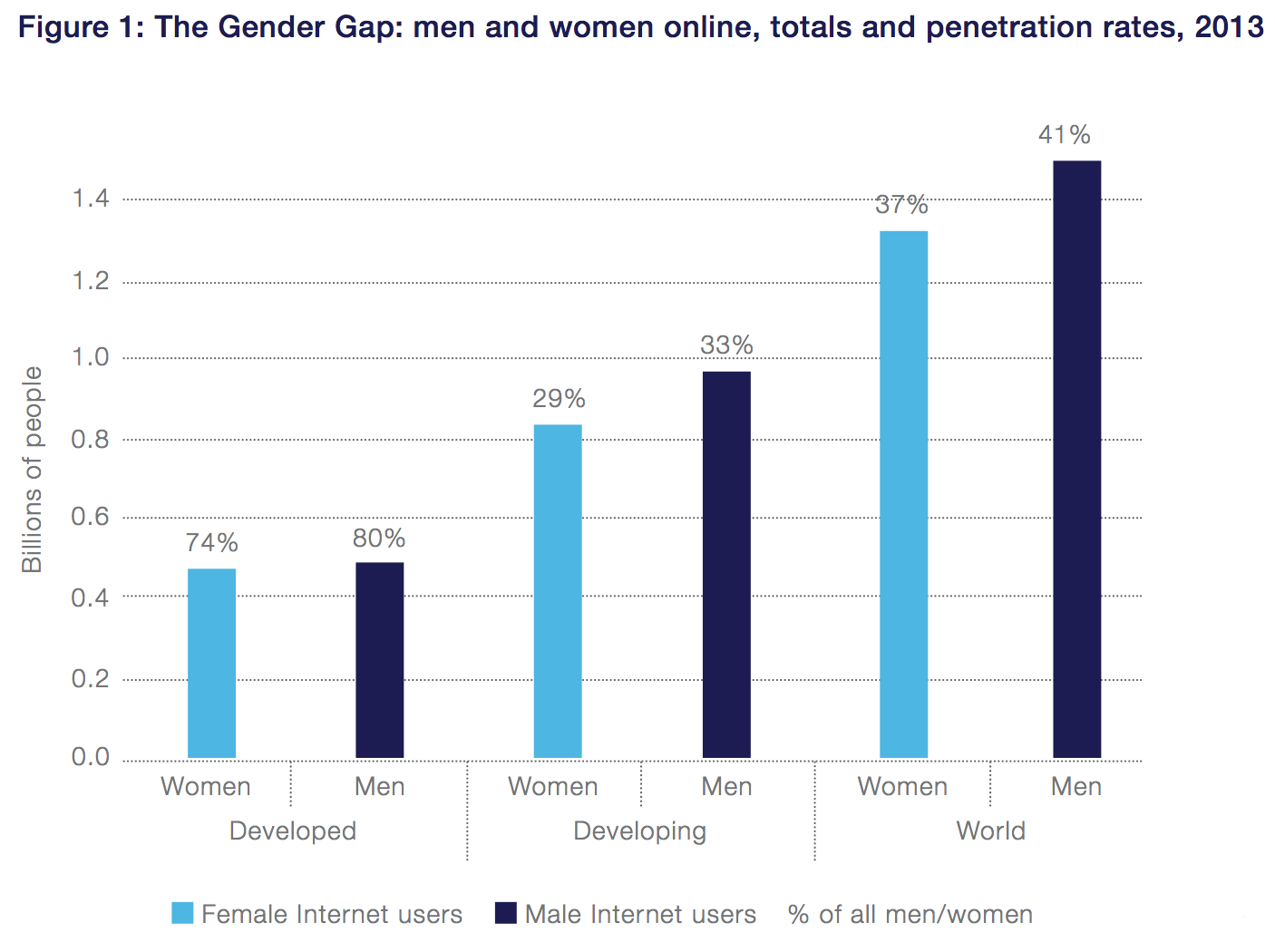
Meghan Neal points to a new UN-backed report indicating “there’s a major online gender gap that needs closing, quick”:

Worldwide, 200 million fewer women have access to the internet than men, and that’s expected to widen to 350 million if nothing’s done to change it. In today’s information economy, that puts women at a socioeconomic disadvantage right out the digital gate – not to mention it creates an unbalanced economy that’s not doing society any favors. In fact, according to the report, if the world were to add 600 million female internet users, it would boost the global GDP by up to $18 billion.

Tim Sampson delves into the report:

In some regions extremely hostile gender politics are what keep women offline. In certain Arab countries, women are discouraged or outright banned from online activities, leading to the biggest gender imbalances in countries where Internet is relatively accessible. In Saudi Arabia for instance, nearly two-thirds of men with Internet access were engaging in e-commerce, compared to less than 50 percent of female Web users. Similarly, smartphone usage in that country has a 4:1 male to female ratio.

But even in the Western world there is a gender gap, albeit a smaller one. In this instance, the gap is blamed on more subtle hostility toward female Internet users. “[T]he U.S. access gap is entirely the product of socioeconomic differences between men and women, while the use gap is the product of both socioeconomic differences and underlying, gender-specific effects,” the report states.

What’s The Plan To Avoid A Shutdown?

Collender asks:

At this very late point in the debate, it’s hard to discern even a hint of a strategy among House Republicans about what to do and how to get it done. The GOP plan that seemed to be emerging to vote this week on a debt ceiling extension that included tea party legislative priorities and punt on the CR was abandoned yesterday when the leadership realized it didn’t have the votes from its own caucus to pass that bill.

Here is a gif-summary of the GOP’s current strategy.

Republicans Reject The Romney Agenda

The insane demands of Republicans to avoid a government shutdown aren’t insane enough for some Republican Congressmen:

The House proposal (at least as originally conceived) is a grab bag of GOP goodies, most of which were bullet points in Mitt Romney’s presidential campaign platform. But it lacks the most controversial elements of the GOP agenda — Medicare privatization, Medicaid devolution — and as such doesn’t cut enough spending for some of the most hardline conservatives in the House Republican conference. It also doesn’t include any abortion restrictions.

As such, Boehner and his leadership team can’t whip up 217 Republicans (the current threshold for passage) to back it, and since zero Democrats will support their crazy plan, it’s dead. At least as currently written.

Chait thinks that there is a perverse logic to this turn of events:

Why would the most conservative Republicans settle for forcing Obama to implement Mitt Romney’s platform? They thought Romney’s platform was too timid in the first place! They were willing to vote for figures like Rick Santorum and Newt Gingrich, not to mention Herman Cain and Michele Bachmann, as an expression of their dismay with Romney.

Now, it may seem a little silly to insist that Obama accept an agenda that was too extreme to prevail in a Republican primary. But if you’re already insisting that Obama accede to an agenda that was too right wing to win a general election last November, at this point, what’s the difference?