A Poem For Monday

by Alice Quinn

This embed is invalid

“A Drink of Water” by Seamus Heaney:

She came every morning to draw water
Like an old bat staggering up the field:
The pump’s whooping cough, the bucket’s clatter
And slow diminuendo as it filled,
Announced her. I recall
Her grey apron, the pocked white enamel
Of the brimming bucket, and the treble
Creak of her voice like the pump’s handle.
Nights when a full moon lifted past her gable
It fell back through her window and would lie
Into the water set out on the table.
Where I have dipped to drink again, to be
Faithful to the admonishment on her cup,
Remember the Giver fading off the lip.

(From Selected Poems: 1966-1987 © 1987 by Seamus Heaney. Used by kind permission of Farrar, Straus & Giroux)

Remembering What We Read

by Jessie Roberts

Nicholas Carr points out the advantages of reading the physical page:

The differences between page and screen go beyond the simple tactile pleasures of good paper stock. To the human mind, a sequence of pages bound together into a physical object is very different from a flat screen that displays only a single “page” of information at a time. The physical presence of the printed pages, and the ability to flip back and forth through them, turns out to be important to the mind’s ability to navigate written works, particularly lengthy and complicated ones. We quickly develop a mental map of the contents of a printed text, as if its argument or story were a voyage unfolding through space. If you’ve ever picked up a book that you read long ago and discovered that your hands were able to locate a particular passage quickly, you’ve experienced this phenomenon. When we hold a physical publication in our hands, we also hold its contents in our mind.

The spatial memories seem to translate into more immersive reading and stronger comprehension. A recent experiment conducted with young readers in Norway found that, with both expository and narrative works, people who read from a printed page understand a text better than those who read the same material on a screen. The findings are consistent with a series of other studies on the process of reading. “We know from empirical and theoretical research that having a good spatial mental representation of the physical layout of the text supports reading comprehension,” wrote the Norwegian researchers. They suggested that the ability of print readers to “see as well as tactilely feel the spatial extension and physical dimensions” of an entire text likely played a role in their superior comprehension.

Previous Dish on reading and e-reading here, here, and here.

How Not To Write About The Balkans

by Jessie Roberts

dish_mostar

In the spirit of Granta‘s “How to Write about Africa,” Balkanist presents “How to Write about the Balkans”:

Make sure to place yourself, the Western journalist, at the very center of the story. Include anecdotes about being strapped into the seat of some godforsaken regional airline as it makes a bumpy landing on a narrow strip of runway. Detail the sheer terror you feel in the company of your wild-eyed driver, who careens recklessly around the blind curves of deadly mountain roads. Admit that you find yourself uneasily calculating the age of every local male you meet, nervously wondering if he ever carried a weapon in Bosnia and Herzegovina, Croatia, or Kosovo.

In contrast, the locals will appear fearless and serene, perfectly satisfied in their poverty. At this point, you should describe the smiling peasants offering plastic cups filled with raspberries on the roadside, or the women in headscarves dutifully carrying heavy buckets of sir up the hill to sell at the market. You might describe hospitable villagers who ply you with homemade rakija (“a type of brandy made from distilled fruit”, you’ll explain), or in the cities, enthusiastic university students who, despite the astronomical unemployment rate, enter “secret, smoky clubs” and dance ‘til dawn in a city you might deem “the new Berlin”.

Next, you should mention that this “friendly” and “vibrant” atmosphere makes it difficult to imagine that so much “barbarity” or “bloodshed” was visited upon the region so recently.

(Photo by Flickr user tagacayak)

Novel Isolation

by Jessie Roberts

Diane Mehta describes “reader’s block,” or the inability to read the work of others while she was writing her own book:

It’s difficult to read while immersed in writing a novel. If you’re stuck to your book as purposefully as you’re supposed to be stuck to it, it makes no sense to commit yourself to someone else’s book. It’s distracting. You have your own characters to consider. (At least, that’s what we tell ourselves, glumly.) I became sure of this when I tried Philip Roth and found he just turned my writing into bitterness and dense frenzy, which I liked, but which I quickly realized would harm my sentences. His, so calculated, would strong-arm mine and I would be the loser, with flaccid sentences that tried to be hard. Roth stayed on the shelf.

In Defense Of Poor Grammar

by Jessie Roberts

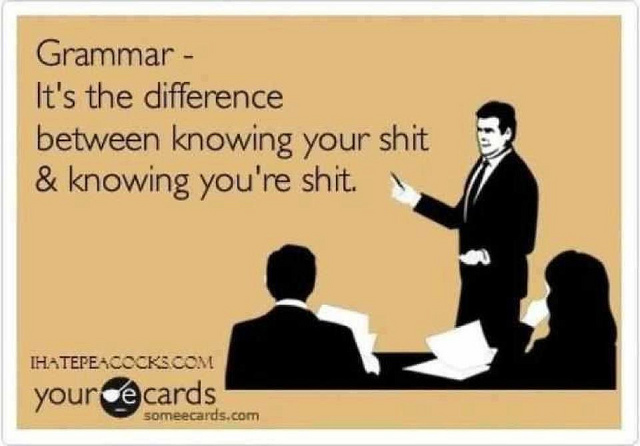
dish_grammar
A self-described “recovering grammar snob” explains why she overcame her rigor:

[T]here are two schools of thought when it comes to how we should use language. One is “prescriptive” and it’s backed by grammar snobs and the kind of people who froth at the mouth over the decline of “the King’s English”. The other is “descriptive” and it’s more about accepting that how people use language is how language works. A prescriptivist believes in the idea of standard English and sees mistakes everywhere. A descriptivist sees many englishes, and none of them are standard. …

The way people speak and write is based on a lot of factors. Geography, for one.

The various communities you belong to are also a big influence. Most of us belong to several communities and speak a little differently in the context of each one, whether that community is found at work, on a sports team, in a particular ethnic group, or in a religious community. We’re all fluent in more than one english, for example the language of our peer group and the language of our parents’ generation.

And then there are the two factors that have possibly the biggest impact on how we use language: education and socioeconomic status. When you judge people for what you consider to be poor grammar, you’re judging them for not being as good as you at something that might be a challenge because they didn’t have the advantages or experience you did. Maybe they haven’t had the luxury of worrying about their grammar. Maybe their use of language is right in line with their community. Maybe you’re just being a pedantic, prescriptivist jerk.

(Photo by Flickr user dullhunk)

The Sloppiness Of Studying The Self

by Matt Sitman

In a lengthy critique of psychologist Barbara Fredricksen’s Positivity – including news that a recent study found serious problems with the math underlying her work – Will Wilkinson hones in on a perennial problem with happiness research:

[M]ost work in the psychological and social sciences suffers from a lack of conceptual rigor. It’s a bit sloppy around the edges, and in the middle, too. For example, “happiness research” is a booming field, but the titans of the subdiscipline disagree sharply about what happiness actually is. No experiment or regression will settle it. It’s a philosophical question. Nevertheless, they work like the dickens to measure it, whatever it is—life satisfaction, “flourishing,” pleasure minus pain—and to correlate it to other, more easily quantified things with as much statistical rigor as deemed necessary to appear authoritative. It’s as if the precision of the statistical analysis is supposed somehow to compensate for, or help us forget, the imprecision of thought at the foundation of the enterprise.

It’s interesting that Fredrickson in Positivity avoids the term “happiness,” because she feels “it’s murky and overused.” One may say the same of “positivity.” There is definitely murk. According to Fredrickson, the constituents of positivity are joy, gratitude, serenity, interest, hope, pride, amusement, inspiration, awe, and love. But why these emotions? Why not others? As an inventory of positivity, this seems arbitrary.

Tania Lombrozo responds by defending the messiness of psychological research:

There’s a natural back and forth: we think about things a particular way, which motivates experiments, which in turn provide data, which leads us to refine and revise the way we conceptualize phenomena and theoretical entities. This dance between theory and experimentation is common to all science.

In the case of psychology, it is a particularly young field. It’s early days for the empirical study of many core psychological phenomena, including happiness.

So I agree with Wilkinson that psychological theorizing is often imprecise, and I share a craving for conceptual rigor. But some conceptual sloppiness may simply be a sign of immaturity, of psychology’s adolescent state. It’s an unavoidable step in achieving scientific progress, not the mark of a failed or floundering science.

Previous Dish on Fredrickson’s work here and here.

Beauty In Physics

by Jessie Roberts

dish_covariance1

Particle physicist Ben Still collaborated with artist Lyndall Phelps on Covariance, the installation for the Superposition project seen above:

The pair were introduced by the Institute [of Physics] and given the brief of creating a physics installation for public display. Rather than focusing on one particular area of physics, they decided instead to look at the machines that make the science happen — particle physics detectors.

“These [are] massive machines used to see the smallest bits of nature,” Still tells Wired.co.uk. The installation aims to show the way in which the detectors build up a picture of how these tiny particles interact with each other on a larger scale, as well as reflecting the way the electronic data collected by the detectors is then used to create plots on computers. …

“I showed [Phelps] some of the plots I was making for an analysis I was developing and again she was quite struck by how we took data from this massive machine and made these colourful plots to try and extract information,” [says Still]. The colour running through the installation, says Still represents “the way in which the data is presented finally”.

Here’s a close-up of the work, which consists of 28,000 glass beads arranged into 20 different designs:

dish_covariance2

Covariance is on display in the former ice wells of London’s Canal Museum through October 20th.

(Photos by Richard Davies, whose most recent photography and book project is Wooden Churches)

Visiting Your Favorite Film

by Brendan James

Troy Patterson studies what keeps us coming back to amusement parks, after “a record-setting year for the business”:

Projection is what the amusement park is all about—the projection of eager ideas of innocent fun, of nostalgia for things that haven’t even happened yet, of vomit on the X2 at Magic Mountain. The latest and last word in amusement-park projection concerns our disappearance into virtual reality by way of film—meaning, for one thing, the continued trend toward attractions such as Transformers: The Ride 3D at Universal Studios.

Enthusiasts are already anticipating what 2014 will bring, naturally enough, ardent anticipation being among the defining qualities of the amusement-park experience: In Florida, Hogwarts wannabes will thrill to the expansion of The Wizarding World of Harry Potter. In Italy, Cinecitta World will open on the grounds of the venerable movie studio, a development that has some cineastes up in arms but is okay with me so long as they include an Anita Ekberg water slide.

There is a difference in kind between the straightforward pop-entertainment experiences pioneered by Disneyland and those exemplified by Transformers: The Ride (the purpose of which is “blurring the line between fiction and reality”). If we may take a brief ride of the Jean Baudrillard Reverse Bungee, we may theorize that while the old Disneyland model of escapism involves a flight from adult reality into its infantile simulacrum, the new line-blurring Transformers-style escapism represents the next generation of the ethos of Walt Disney Worldand EPCOT Center, with their designs on reshaping reality.

PEDs And Writing

by Jessie Roberts

In light of recent controversies over performance enhancing drugs (PEDs) in sports, Brian Michael Murphy considers the role of drugs in literature:

All of my writing heroes used PEDs. I still respect them; I would still shake their hands; dish_absinthe I would never boo them as they took the podium to read, just returned from a stint in rehab or a drunk tank. I’m thinking of Allen Ginsburg’s acid. Baudelaire’s absinthe. Alice Walker’s magic mushrooms. Graham Greene’s Benzedrine. Legend has it that Gabriel García Márquez smoked up to 10 packs of cigarettes a day while holed up in his writing room for a year and a half like José Arcadio Buendía with his astrolabe and crucible. I once read that Balzac drank 50 cups of coffee daily and died of heart failure; another account said his personal record was 200 cups in a day, and that he died of a perforated ulcer.

I don’t use PEDs myself, aside from a demitasse of espresso here and there. Perhaps the impurity in me is not the caffeine, however. Perhaps it’s that very desire to be the best writer, to outshine my peers and gather accolades from people I don’t know, the willingness to sacrifice my time, energy, and relationships in order to accomplish it. Real life–a game of racquetball with my best friend, sharing a meal with my wife and daughter, teaching–tempers this impure ambition and keeps me connected to reality.

(Image: Portrait of Angel Fernández de Soto, or The Absinthe Drinker, by Picasso, via Wikipedia)