When Dinosaur Rockers Go Extinct

by Brendan James

http://www.youtube.com/watch?v=b3LfdRQ9iEA

E.J. Dickson worries that Springsteen’s music, unappreciated by millennials, won’t survive longer after his death:

[H]ere’s the thing about Bruce’s fan base: It may be huge, and it may be rabidly loyal, but it is old. Like, Peter, Paul and Mary fan old, to the point where David Brooks, in a recent New York Times editorial, referred to American Springsteen fans as “hitting their AARP years, or deep into them” (in Europe, where Springsteen’s fans are arguably even more fervent than their U.S. counterparts, the crowds tend to skew much younger). …

That feeling of restlessness and exhilaration that Bruce speaks to in his songs will be around forever. But Bruce won’t be. Dude is pushing 65. He can’t go smashing his balls into cameramen forever. And if this trend continues – if his music is listened to by progressively fewer and fewer members of younger generations – his fans won’t be around for much longer, either. He won’t reach the level of Zeppelin or Dylan or Kurt Cobain or Neil Young, artists who are still popular among those born decades after the pinnacle of their popularity. In 20 years, he will be a dinosaur, a Glenn Miller, duly respected in record books and Rolling Stone but virtually ignored by people born from 1995 onward. He will be known as the guy who sucked because he was old, or the guy who was old because he sucked.

I’ll make a tentative prediction that Springsteen’s quieter albums like Nebraska and Tom Joad will resurface in the future generations with every obligatory 10-year folk revival. Those records drop the gaudy, heartland grandeur that turns off younger listeners with no interest in cars or crumbling textile mills.

Previous Dish on the Boss here, here, here and here.

This Is Your Brain On Buzzfeed

by Matt Sitman

In a brilliant, depressing examination of lists and listicles, Mark O’Connell finds their deeper meaning:

In an interview with The Paris Review twenty years ago, Don DeLillo mentioned that “lists are a form of cultural hysteria.” From the vantage point of today, you wonder how much anyone—even someone as routinely prescient as DeLillo—could possibly have identified list-based hysteria in 1993. DeLillo’s statement also hints at something crucial about the list as a form: the tension between its gesturing toward order and its acknowledgement of order’s impossibility. The list—or, more specifically, the listicle—extends a promise of the definitive while necessarily revealing that no such promise could ever be fulfilled. It arises out of a desire to impose order on a life, a culture, a society, a difficult matter, a vast and teeming panorama of cat adorability and nineties nostalgia. Umberto Eco put it dramatically: “The list is the origin of culture. It’s part of the history of art and literature. What does culture want? To make infinity comprehensible. It also wants to create order.”

His take on why they’re the epitome of a culture actively arrayed against our attention spans: 

In an essay about Internet addiction in The Dublin Review last year, the Irish novelist and short-story writer Kevin Barry wrote about how the rapid depletion of his powers of attention affected the way he composes a piece of writing: “Lately, I note, most of the essays and stories I write tend to be broken up into very short, numbered sections, because I can no longer replicate on the page the impression or sensation of consecutive, concentrated thought, because I don’t really do that anymore.” Of course, essayists have been using the list as a way to structure thought for a long time. (Sontag’s “Notes on ‘Camp,’” to point to a famous example, takes the form of a list of fifty-eight numbered fragments.) But the list is a way of writing that anticipates, and addresses itself to, a certain capriciousness in the reader. By not only allowing partial and fleeting engagement but by actively encouraging it, the list becomes the form which accommodates itself most smoothly to the way a lot of us read now, a lot of the time. It’s the house style of a distracted culture.

Curating The Intangible

by Jessie Roberts

This embed is invalid

The iPad app Planetary, as visualized above, “turns exploring your music collection into a sci-fi adventure — albums are turned into planets, which orbit around suns representing artists.”  The Smithsonian’s National Design Museum, Cooper-Hewitt, recently acquired the app as well as its source code, marking “the museum’s first foray into intangible items”:

“The impetus for the acquisition,” says Sebastian Chan, Cooper-Hewitt’s director of digital and emerging media, “is that software has become one of the most significant arenas of design.” Code, the underpinning of any app, may be digital and insubstantial; you can’t touch it. Yet we interact with apps daily and their design affects our behavior.  …

Cooper-Hewitt curators plan to create a new version of Planetary containing information on the museum’s 217,000 artifacts. A majority of the holdings are in storage, about half of which are viewable as images on the museum’s website. Chan foresees Planetary as a tool allowing visitors virtual access to the entire collection.

Andrew Webster elaborates:

This is the first time the museum has acquired a piece of code, and it has also worked with the original creators to make the source code available to everyone, in an attempt to preserve software as if it was a living thing. … The museum hopes that the decision to add both the software and the code to its collection will not only help with issues of preservation, but also potentially change the way similar institutions view software in general. “We liken this situation to that of a specimen in a zoo,” says Chan. “Open sourcing the code is akin to a panda-breeding program.”

Why We Read

by Jessie Roberts

Adam Gopnik contemplates the role of readers in society:

So: Why should English majors exist? Well, there really are no whys to such things, anymore than there are to why we wear clothes or paint good pictures or live in more than hovels and huts or send flowers to our beloved on their birthday. No sane person proposes or has ever proposed an entirely utilitarian, production-oriented view of human purpose. We cannot merely produce goods and services as efficiently as we can, sell them to each other as cheaply as possible, and die. Some idea of symbolic purpose, of pleasure-seeking rather than rent seeking, of Doing Something Else, is essential to human existence. That’s why we pass out tax breaks to churches, zoning remissions to parks, subsidize new ballparks and point to the density of theatres and galleries as signs of urban life, to be encouraged if at all possible. When a man makes a few billion dollars, he still starts looking around for a museum to build a gallery for or a newspaper to buy. No civilization we think worth studying, or whose relics we think worth visiting, existed without what amounts to an English department—texts that mattered, people who argued about them as if they mattered, and a sense of shame among the wealthy if they couldn’t talk about them, at least a little, too. It’s what we call civilization.

Even if we read books and talk about them for four years, and then do something else more obviously remunerative, it won’t be time wasted. We need the humanities not because they will produce shrewder entrepreneurs or kinder C.E.O.s but because, as that first professor said, they help us enjoy life more and endure it better. The reason we need the humanities is because we’re human. That’s enough.

Previous Dish on English majors here.

Face Of The Day

by Jessie Roberts

Lorraine

For her photo series “Suburban Dreams,” photographer Beth Yarnelle Edwards documented family life in the suburbs of Silicon Valley:

“I think of my images as being like genre paintings because they’re intended to depict a typical event in the home rather than a decisive moment,” Edwards explained via email. “And like genre paintings, I strive to include as much information about the people and the place as possible.”

The images are the result of collaboration between Edwards and the families she photographs. She interviews them, takes a tour of their home, and then recreates events from the family’s daily life. Rather than pose them, she sets up improvisations. “When I see a gesture or action that rings true, I’ll ask the person to freeze because my shutter speeds are fairly slow; this leads to a slightly frozen look, which I love,” Edwards said. …

“I call my series and monograph Suburban Dreams because it depicts a way of life that many Americans live and even more aspire to,” she said. “To me personally, the American Dreams means the freedom to believe and act as one wishes as long as that doesn’t impinge on the rights of others.”

(Photo by Beth Yarnelle EdwardsSuburban Dreams was recently exhibited at The Oakland Museum of California. The series is available as a monograph.)

The Sight Of Music

by Matt Sitman

Peter Reuell explains a study offering insight into the visual side of music:

In a study by Chia-Jung Tsay, who last year earned a Ph.D. in organizational behavior with a secondary Ph.D. field in music, nearly all participants — including highly trained musicians — were better able to identify the winners of competitions by watching silent video clips than by listening to audio recordings. The work was described in a paper published this month in the Proceedings of the National Academy of Sciences.

“It’s a very counterintuitive finding — there have been some interesting reactions from musicians,” Tsay said. “What this suggests is that there may be a way that visual information is prioritized over information from other modalities. In this case, it suggests that the visual trumps the audio, even in a setting where audio information should matter much more.”

Alva Noē meditates on the way music is more than just “sound art”:

When we listen to music we listen to a performance, in the literal sense. We pay attention to what someone, or a group of people, is doing before us. Music is action.

This has has been obscured somewhat by recording, whose advent has influenced how we think about music. The idea that music is about sound, peeled off from its inherence in the tapping, plucking, smacking, stroking, blowing, fingering and vocal actions of real people, or, divorced from the thoughts, feelings and ideas of performers, seems somehow plausible in an era where you buy pieces of plastic, or download digital files, to get at music. In addition, electronic music has seemed, to some, to be the final blow to what may now come to seem a quaint idea: that music is an art of the body, an art of the analog transduction of physical energies.

And so we easily lose sight of the fact that what we care about, when we care about music, is not sound, but musicians and their use of movement, the body, and material instruments, to articulate significance.

Quote For The Day

by Matt Sitman

“I hate when art becomes a religion. I feel the opposite. When you start putting a higher value on works of art than people, you’re forfeiting your humanity. There’s a tendency to feel the artist has special privileges, and that anything’s okay if it’s in the service of art. I tried to get into that in Interiors. I always feel the artist is much too revered–—it’s not fair and it’s cruel. It’s a nice but fortuitous gift—like a nice voice or being left-handed. That you can create is a kind of nice accident. It happens to have high value in society, but it’s not as noble an attribute as courage. I find funny and silly the pompous kind of self-important talk about the artist who takes risks. Artistic risks are like show-business risks—laughable. Like casting against type, wow, what danger! Risks are where your life is on the line. The people who took risks against the Nazis or some of the Russian poets who stood up against the state—those people are courageous and brave, and that’s really an achievement. To be an artist is also an achievement, but you have to keep it in perspective. I’m not trying to undersell art. I think it’s valuable, but I think it’s overly revered. It is a valuable thing, but no more valuable than being a good schoolteacher, or being a good doctor,” – Woody Allen.

Must Biographers Admire Their Subject?

by Matt Sitman

Hermione Lee answers the perennial question:

I start from a position of profound admiration for the work. But it’s a mistake, in my view, to be sentimental. Writing a biography is not a love affair. It’s not a marriage. It’s a job, it’s a piece of work. You always get asked, Did you like them? Did you love them? The involvement with me always starts with the work, with a deep fascination about what kind of person and what kind of circumstances produced that work. You’re not writing about yourself, you’re not writing about a friend.

When I was trying to work out how to write the biography of Virginia Woolf, I wrote an essay, in a book called The Art of Literary Biography, called “Virginia Woolf and Offense.” It asked how you write about all the horrible things that are part of her character and her life story—racism, snobbery, spite, unkindness. There are some unpleasant things, too, in Edith Wharton’s behavior. You can’t pretend they’re not there. You can’t be defensive. Actually, I admired Wharton more and more, as a person and as a writer, as I wrote that biography. Whereas I found Cather increasingly unsympathetic as I wrote about her. I think she’s a great, great writer, but I found her an unappealing personality by the time I’d finished.

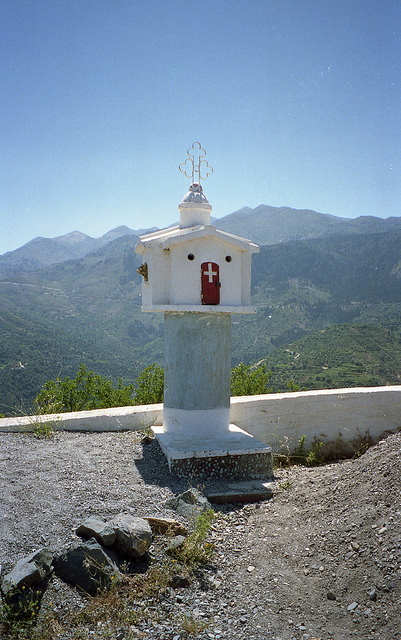
The Tiny Shrines Of Greece

by Jessie Roberts

MessyNessy provides a virtual tour of the miniature roadside chapels of Greece:

Some are elaborate little things made of terracotta or even marble, plonked in the dish_tinyshrine middle of nowhere, high up in the mountains; no village or houses for miles, and yet impossibly, most of them are faithfully maintained with a candle always burning inside.

There’s a number of reasons for these heartfelt shrines, some as old as the roads themselves. Placed by the roadside, an initial assumption is that they’re built to remember a victim of a traffic accident victim, and sometimes this is exactly the case. But just as often, shrines will be built by survivors of accidents, thanking a saint at the location of their ordeal. While each one might tell a different story, they all share the same purpose– to ultimately provide a passing traveler with a moment of rest and spiritual reflection.

(Photo by Bob Linsdell)

Writing In The Gray

by Matt Sitman

In an interview about her debut novel, The Love Affairs of Nathaniel P., Adelle Waldman describes how she approached developing the book’s central character, a 30-ish male writer living in Brooklyn named Nate:

I tried to come up with a plausible psychology for him because Nate, and some of the men I’ve dated and that my friends have dated don’t hurt other people for fun, but nor do they feel that the chance of hurting someone is so horrible that they should run the other direction. They must be torn between feeling bad but feeling also tempted to keep doing the things that lead, eventually, to heartbreak. I think it’s a predicament; there’s not exactly an answer. I don’t feel like I can say, “This is what’s wrong with Nate.” Human relationships are hard…

[H]is concern is justifying himself in his own eyes. That’s not quite the right concern; [the right concern] is the effect on other people. I wanted the book to reflect what life is like, and that there are ways in which people are not at all villains or in possession of some very obvious character flaw that makes them difficult to deal with in life. I wanted Nate to be more self-justifying than empathetic; it seems more true to the experience I’ve had in that you don’t come across that many people who are just really bad. I wanted to write in that gray area of life.

Sasha Weiss elaborates on the predicament Waldman’s exploring:

The pleasures of this novel—its lucidity and wry humor—are mixed with the sting of recognizing the essential unfairness of the sexual mores of our moment: after years of liberated fun, many women begin to feel terribly lonely when realize they want a commitment; men, who seem to have all the power to choose, are also stuck with an unasked-for power to inflict hurt. We’ll have to keep searching for an arrangement that works better, and monogamous coupledom may not be it, Waldman suggests. But she offers no balm, no solution—and tacitly resists a culture that offers sunny advice and reassurance to women.

Marc Tracy expands on the point:

[Nate] must resolve the contradiction between having his pick of women (and having a part of himself that would like to exploit this privilege) and knowing that if he just blithely sleeps with every one available to him, his values dictate that he must hate himself in the morning. “Men in New York—far outnumbered by women, and with time on their side—sometimes seem to hold all the cards,” is how The New Yorker’s Sasha Weiss describes Nate’s situation. To some extent, that is an unchangeable truism—indeed, as with all those 19th-century girls in trouble, it is partly rooted in biology itself, including gender-specific fertility clocks set at two different speeds. And it collides with the feminist mores of a liberal 21st-century city and, much more dramatically, with the feminist beliefs of this liberal 21st-century city-dweller.

What makes this predicament particularly tricky is its extremely personal nature. While bien-pensant liberals are horrified when the privileges men enjoy over women—or white people enjoy over people of color, or wealthy people enjoy over poor people—are abused in the aggregate, everyone tends to be a little more tolerant at the individual level, where the stakes are more personal, the power is more diffuse, and the rules are unwritten.