A reader writes:
One of the repeating themes in your commentary about the mess that is the GOP is that the region most responsible is the South. I’ve always thought you significantly overplayed that theme. My concern isn’t to defend the South, but to see the problem as it is, rather than through historical assumptions.
You posted this map a few weeks ago, showing the districts of the 80 Republican congressmen who signed a letter asking Boehner to defund Obamacare by threatening to shut down the government:
You can see that this nonsense isn’t just a regionalized phenomenon. It has hotbeds scattered all over the country, from Arizona to Pennsylvania, and Florida to Idaho, with more support in Michigan, Indiana, and western Ohio than in Alabama, Mississippi, and western Tennessee. Insofar as any region stands out at all, it’s Appalachia, not the former Confederacy. Even to say it’s Appalachian, though, is misleading. There’s more Tea Party support in Kansas than there is in West Virginia, for example. A more accurate description might be that Tea Party support generally tracks cultural Appalachia, but even that would have major exceptions.
On the whole, like racism, Tea Party support is ultimately much more age- and class-based than it is regional. Your emphasis on the old Confederacy confuses more than it clarifies.
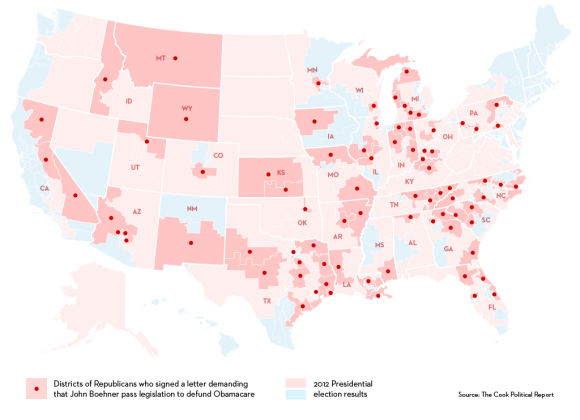
I’d say it may confuse as well as clarify. I was too lazily reductionist and apologize for the confusion part. Nonetheless, even though the subculture may have spread beyond the South to much of rural, white America, you can still see the themes of nullification, secession, and states’ rights throughout the Obama opposition. They have a history. Another reader is much more blunt:
I believe “The Tea Party As A Religion” is a very intemperate and inflammatory piece. If your goal is sensationalism to fire up your readership and improve your commercial success, then I believe it’s probably well done. If your goal is dialogue that tries to get at the truth of things and advance our common interest, then it is rather poorly done. You, for one, blast charges of racism against anyone that opposes Obama’s policies, with absolutely zero evidence for racism. It’s an incredible non-sequitur. Obama is black, I oppose Obama’s policies, therefore I am a racist. This is the worst kind of political arguing, gets us nowhere, and only leads to more enmity.
Indeed it is. But that is not what I wrote. The analysis in the post of the Tea Party deals with middle-class economic stagnation, bewildering changes in the culture (from a future majority-minority country to gay marriage), the decline of mainline Protestantism, the rise of modern fundamentalism, and the psychological need for total certainty in very unsettling times. It’s a very complex analysis, and it is elaborated at length in The Conservative Soul without any reference to race at all.
But to leave race out of it seems equally wrong to me.
Of course, opposition to Obama’s policies is not reducible to racism. But the fervor of the opposition, the personal contempt for and condescension toward the president, the rhetoric about his “otherness”, the refusal to believe he was born in America and is a Christian: these are all driven by some racial attitudes. They are part of the very complex mix. My goal is to try to capture reality – even if that might offend some of those I need to persuade. But for me, as a writer, I’ve long put understanding things as they are above any regard for my own influence. That doesn’t mean I haven’t gotten things very wrong. It just means that I’m trying to get things right. From the too-easy narrative about Matthew Shepard to the genetic aspects of race, from insisting on the fact of American torture to the reality of future crippling debt, I try to get things right.
Race in America still matters in complex ways. When Tea Party protestors wave the Confederate flag outside a White House occupied by an African-American, I’d be negligent for not addressing it.
 The Dish