A new paper by Scott Wallsten attempts to find out:
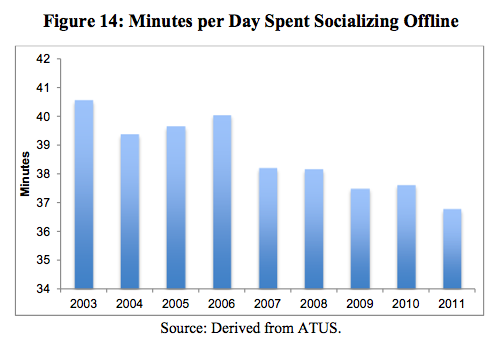
I find that, on the margin, each minute of online leisure time is correlated with 0.29 fewer minutes on all other types of leisure, with about half of that coming from time spent watching TV and video, 0.05 minutes from (offline) socializing, 0.04 minutes from relaxing and thinking, and the balance from time spent at parties, attending cultural events, and listening to the radio. Each minute of online leisure is also correlated with 0.27 fewer minutes working, 0.12 fewer minutes sleeping, 0.10 fewer minutes in travel time, 0.07 fewer minutes in household activities, and 0.06 fewer minutes in educational activities.
When your work is entirely online, the social isolation can even intensify further. One reason I cherish my time in Ptown every summer is that it forces me to have much more physical and personal interaction. Walking down Commercial Street is impossible without bumping into friends, new and old, all the time. And they tend to be on vacation so are more prone to stopping and chatting. It re-humanizes me after so much typing alone onto a screen. The rest of the year, I engage with far more people virtually than I do physically. And that can rob life of its essence. If you’re not careful you begin to live online.
Ben Richmond ponders the effect on socializing:
Even though the segment of time most affected is the biggest—watching TV—Wallsten also points out that there’s a visible social shift.
“Other offline leisure activities that involve interacting with other people are crowded out by online leisure: attending parties and attending cultural events and going to museums are all negatively correlated with online leisure,” he writes. “In short, these results based on ATUS data suggest that a cost of online activity is less time spent with other people.”
Of course, the most popular activity for online leisure is social networking, so worries that we’re all becoming hermits should… tempered, I guess. The nebulous nature of the internet is exactly what makes quantifying if what happens online comes at the expense of something else, because “being online” is terribly descriptive of what you’re doing.
Simone Foxman chips in her two cents:
Although Wallsten can’t prove that more computer time causes less sleep, for instance, he concludes, “that online activities, even when free from monetary transactions, are not free from opportunity cost.” This trend is particularly strong among young people. For example, every minute 15- to 19-year-olds spend online leads to 18 fewer seconds doing educational activities. For Americans 20-24 years old, however, the same minute of online leisure is only associated with losing about seven seconds of educational activity. For older Americans, the impact is even smaller. This data suggests—though does not definitely prove—that teenagers are more likely to devote time that would otherwise be devoted to educational activity to surfing the web or instant messaging than do slightly older young adults.
 The Dish