The cost of cancer drugs has skyrocketed:
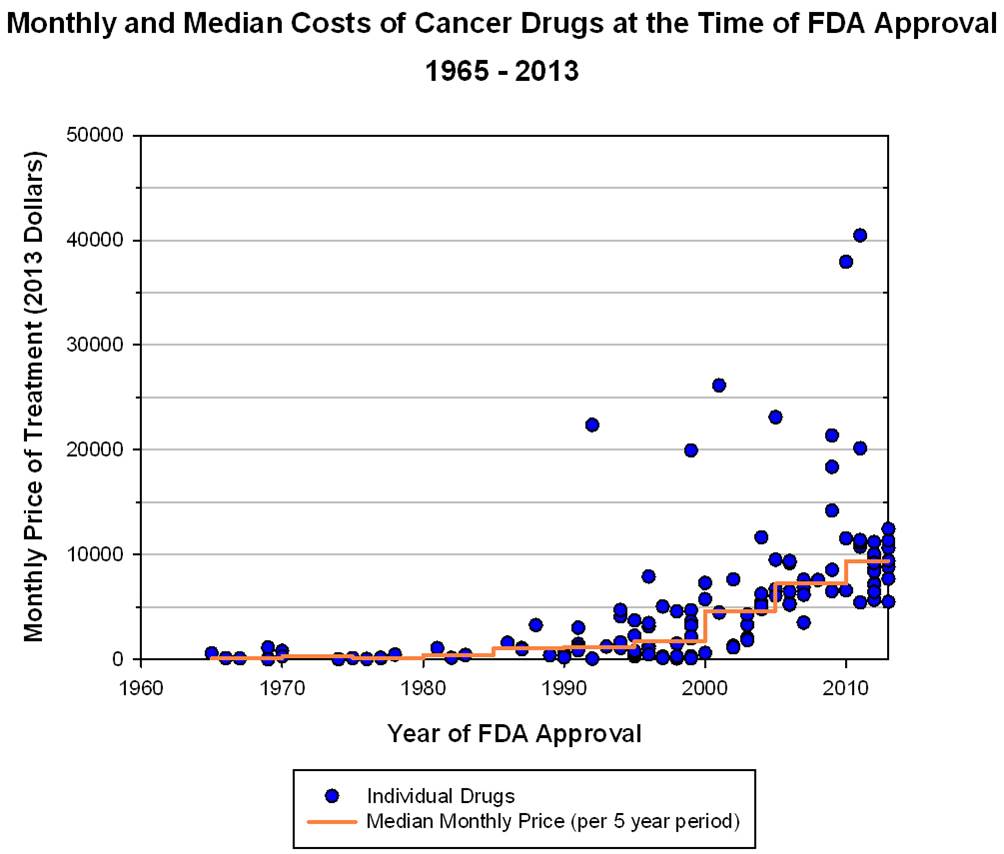
Stephen S. Hall covers the phenomenon:
What is sobering about this booming business is that, as a group of oncologists wrote earlier this year, “most anti-cancer drugs provide minor survival benefits, if at all.” They often (but not always) reduce the size of inoperable tumors, but they rarely eradicate the disease.
For relatively uncommon malignancies like testicular cancer, some forms of leukemia, and lymphoma, drugs effectively cure the disease; for the common “solid tumor” cancers (lung, breast, colon, prostate, and so on), which account for the vast majority of annual cases, drugs buy some time—precious time, to be sure, but time usually measured in weeks and months rather than years. And even though many of the newer drugs are less toxic, they often still have to be given with older drugs whose side effects include nausea, hair loss, fatigue, and decreasing blood counts. One anti-cancer drug produces a skin rash so severe and disturbing, according to [Leonard] Saltz [head of the gastrointestinal oncology group at Memorial Sloan-Kettering Cancer Center], that some patients have been asked by employers not to come to work. …
In 1994, the median survival rate for someone with advanced colon cancer was eleven months, according to Saltz, and the lifetime costs of the drugs used to treat the average patient would be about $500 at today’s prices. By 2004, the median survival rate had increased twofold, to 22 months, but Saltz says the drug costs had increased hundreds of times for that extra eleven months.
 The Dish