The Real Split In The GOP

Mitt Romney Finishes His Four Day Bus Tour In Ohio

Class:

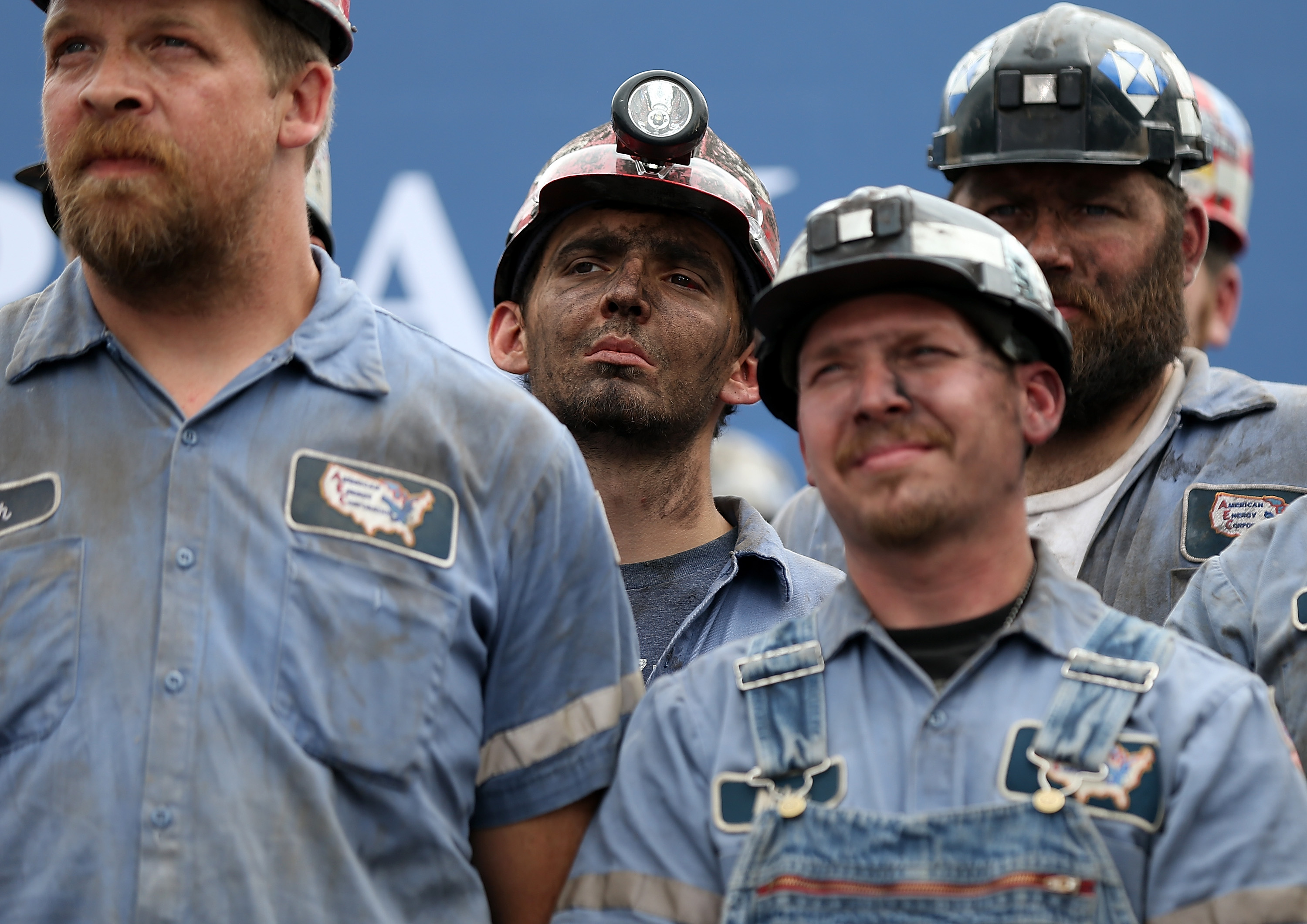
At the grassroots, the key divide in today’s Republican Party isn’t between downscale Tea Partiers and affluent pro-business moderates. It’s between relatively affluent Tea Partiers, who want government radically downsized, and working-class conservatives who want government to help them get ahead, the people Ross Douhat and Reihan Salam called “Sam’s Club” Republicans.

In the Obama era, these downscale whites have streamed into the GOP. In 2004, notes Pew, whites with a high school education or less leaned Republican by six points. By 2012, they leaned Republican by 16 points. In 2004, Democrats enjoyed a nine point advantage among whites who earned less than $30,000. By 2012, that margin was down to two points. You can see this shift in West Virginia, a low-education, low-income, historically Democratic state where Barack Obama in 2012 lost every single county.

Pew calls these white working class migrants into the GOP “disaffecteds.” Like Tea Partiers, they’re religious, oppose gun control, want tougher enforcement of America’s borders and take a dim view of the federal government. But unlike Tea Partiers, they’re not angry at the federal government because they see it as a leviathan crushing their economic freedom. They’re angry because it’s not an effective ally in their economic struggles. Ninety-six percent of “staunch conservatives” favor a smaller government that provides fewer services over a larger one that provides more services. But among “disaffecteds,” there’s an almost even split. Among “staunch conservatives,” the deficit represents the biggest economic worry, by far. Among “disaffecteds,” it’s rising prices and the lack of jobs.

(Photo: Coal miners look on as Republican presidential candidate Mitt Romney speaks during a campaign rally at American Energy Corportation on August 14, 2012 in Beallsville, Ohio, near the border of West Virginia. By Justin Sullivan/Getty Images)

The Saudis’ Temper Tantrum

Totten – seconded by Roger Cohenwarns that “American-Saudi alliance is in danger of collapsing”:

Foreign Policy 101 dictates that you reward your friends and punish your enemies. Attempts to get cute and reverse the traditional formula always lead to disaster. Yet Barack Obama thinks if he stiffs his friends, his enemies will become a little less hostile. That’s not how it works, but the Saudis have figured out what Obama is doing and are acting accordingly. …

The Saudi regime is in a dimension beyond distasteful. It’s an absolute monarchy wedded to absolute theocracy. It’s worse than merely medieval. Human rights don’t exist. The regime—and, frankly, the culture—offends every moral and political sensibility I have in my being. I’d love to live in a world where junking our “friendship” with Riyadh would be the right call.

But the United States and Saudi Arabia are—or at least were until recently—on the same page geopolitically. For decades we have provided the Saudis with security in exchange for oil and stability, and we’ve backed them and the rest of the Gulf Arabs against our mutual enemies, Iran’s Islamic Republic regime and its allies.

The alliance isn’t deep. It’s transactional.

But the possible deal with Iran would upset all that – for good reasons, from the American point of view, it seems t0 me. If the US were to develop a transactional relationship with Iran on the lines of the Saudi relationship, it would transform the regional dynamics that the Saudis have used to promote their Sunni brand of Islamism. It would give the US a more balanced relationship with both Sunni and Shiite strands of Islamism, and enlarge our spectrum of policy choices. It could also give us more leverage over Israel’s destabilizing right-wing, and potentially unleash democracy over the long run, as Iranians, many of whom despise their regime, slowly develop more of a prosperous middle class, empowered by new media and eager to join the world of the West. The Saudi temper tantrum seems to me a sign of a monarchy that views the Shi’a as inferior, and sees Persians a threat to Arabs. I can see why they see things that way. But why should we?

Kaplan, unlike Totten, doubts that the Saudis are going to walk:

First, they have nowhere else to go.

The Saudi army and air force are structured along the lines of the American military, which provides them with tremendous amounts of weaponry, support, and training. The French and Russians could offer some assistance, but not nearly as much—and their political interests and alliances wouldn’t align so neatly with the Saudis’ either.

In fact, Bandar’s stratagem may reflect a growing awareness of Saudi weakness.Figures released earlier this month reveal that the United States has overtaken Saudi Arabia as the world’s biggest supplier of petroleum. To put it another way: The Saudis need our arms more than we need their oil.

Walt’s perspective on America’s relationship with Saudi Arabia, Iran, and Israel:

[T]he United States is not about to abandon its current allies or entirely reverse its long-standing regional commitments, and widening our circle of contacts won’t immediately force others to leap to do our bidding. Nor do I think it should. But a bit more distance from Tel Aviv and Riyadh, and an open channel of communication between Washington and Tehran would maximize U.S. influence and leverage over time. It’s also a useful hedge against unpredictable events: when you become too strongly committed to any particular ally (as the U.S. was once committed to the Shah of Iran), you suffer more damage if anything happens to them.

Because the United States is not a Middle Eastern power — a geographic reality we sometimes forget — and because its primary goal is the preservation of a regional balance of power, it has the luxury of playing “hard to get.” That’s why it’s not such a bad thing if our present regional allies are a bit miffed at U.S. these days. Remember: they are weaker than the United States is and they face more urgent threats than we do. And if they want to keep getting U.S. protection and support and they are concerned that our attention might be waning a wee bit, they might start doing more to keep U.S. happy.
Thatcher From The Inside

Artist Joe Black Large Scale Murals Of World Leaders Past And Present

Reviewing Jonathan Aitken’s new posthumous biography, Margaret Thatcher: Power And Personality, Glen Newey is surprised to read such a scathing account of the woman the author calls a close friend:

Over 700-plus pages she is described as ‘abnormal’, ‘petty’, ‘overindulgent’ (to [son] Mark), ‘deplorable’, ‘hubristic’, ‘hysterical’, ‘embarrassing’ and ‘ursine’, which is a bit hard on bears. Thatcher’s astounding amour-propre is a constant. Aged nine, she tells a teacher who congratulates her on winning a poetry recital competition that ‘I deserved it’; at her father’s funeral in Grantham, she moans to Muriel, ‘They don’t know how to treat a cabinet minister, do they?’ and is told: ‘This service isn’t about you’. As Aitken says, ‘the few knew perfectly well’ that Thatcher ‘showed remarkably little interest or sympathy for the deprived.’ One for whom Thatcher does show sympathy is the ex-con who comes to pay court on his release from Ford open prison.

She was certainly not one to worry about pleasing people. And power corrupted her to higher and higher levels of self-regard. But perhaps that kind of personal immunity to empathy also helped her make decisions – many necessary – that hurt many at the time but helped countless in later ears. Simon Hoggart echoes the sentiment, but points out that Aitken is “overall, a huge admirer”. And yet Aitken’s judgment of Thatcher’s domestic policies is pretty damning:

He believes she was sound and brave on most foreign affairs: the Falklands, the ending of the cold war, the liberation of Kuwait, and the euro (though he suggests that she rewrote history when declaring she was always against our membership of the ERM).

Her judgment was less reliable in domestic affairs. Aitken points out that she could not distinguish between the striking miners and Arthur Scargill, regarding them all as members of the enemy within. That contempt for the working-class people of the north and the Midlands brought a cost that the Conservative party is still paying. The poll tax: surely the product of a disordered mind? She began to treat the people closest to her with evident contempt, most of all Geoffrey Howe who received a bollocking in cabinet that no schoolteacher would be allowed to administer today.

When the “stalking donkey”, Anthony Meyer, stood against her in 1989, she had a good campaign team in place, but the whips warned her that on top of the handful of votes Meyer got, there were all the abstentions, spoiled ballots and dozens of MPs who had to be arm-twisted into supporting her. The situation was therefore far more dangerous than it appeared. She brushed their fears aside as the hobgoblins of lesser minds, and a year later insouciantly cleared off to Paris for a ceremonial summit, which she could easily have skipped. But she loved mingling with world leaders, and telling them where they were wrong.

(Photo: A woman admires an artwork by Joe Black of Margaret Thatcher entitled, ‘Broken Britain’, which is made from thousands of hand-painted nuts and bolts, in the Opera Gallery on October 14, 2013 in London, England. By Oli Scarff/Getty Images.)

The DNA Of Human Society?

Ed Yong ponders the ramifications of human DNA when compared to chimps and bonobos:

We might think that people from different corners of the world look very different, but our genomes tell a story of unusual uniformity. You can find are more genetic differences between chimps living in the same troop, than among all living humans. …

Less varied genomes mean that people (and children or neighbours in particular) become more similar, in both their physical traits and behaviour. In a population like that, “a cultural innovation like art or language might be more likely to persist,” says Gage. “If you have a unique event, like say a Picasso invents cubism, and you introduce it into the pack, it has a greater chance of being assimilated into the culture.”

This is all speculation for now.

The Many Meanings Of “Dude”

J.J. Gould contends that dictionaries aren’t enough:

Dude may be the most Mandarin Chinese word in American English. In Mandarin, depending on how I intone the single syllable ma, I could be saying “mother” (), or I could be saying something as radically distinct as “horse” (). Dude has a comparable quality. Just think of the last time you did something awesome in the presence of a friend who affirmed your awesomeness with the exclamation Duuude! Or the last time you said something objectionable to someone who began setting you straight with a firm and sober Dude. There may not be any obvious difference in denotation between these cases, but the difference in connotation is, you’ll appreciate from experience, pretty major.

Update from a reader:

This may be the first instance in the history of the Internet that someone has email-forwarded the work of Rob Schneider, but he unpacked the varied meanings of dude back in the late-’80s:

And there’s this classic beer commercial:

Selling A Piece Of Your Future

Surowiecki profiles Upstart, a website that gives you cash in exchange for a small percentage of your earnings over the next five to ten years:

Upstart is still an experiment; fewer than a hundred people have completed funding so far. Critics argue that the idea is inherently flawed—that borrowers will hide their income or just take the money and slack off. And to some the concept seems uncomfortably close to indentured servitude. As Girouard puts it, “There is that gut reaction that says, Ugh, I don’t know about this.” It’s an understandable reaction, but the analogy is flawed: a share of your earnings isn’t a share of yourself. And you could say that young people are already indentured—to their student loans and to credit-card companies. There are precedents, too: Muhammad Ali’s early boxing career was funded by a syndicate of backers who paid for his training in exchange for a share of his winnings. Tournament poker players are regularly staked by investors. Creative work is often funded in a similar way. Publishers advance authors sums of money and take the vast majority of the profit until the advance is recouped.

Hot Houses

In the wake of Mt. Etna’s most recent eruption over the weekend, designer Kieren Jones suggests channelling lava flows into architectural molds:

At present, the method for mitigating the destruction of lava flows is to place large concrete blocks in the predicted path of the flowing lava and spraying it with sea water in order to try and cool this molten material. … Instead of placing large concrete blocks in its path, I propose to create large casting beds into which the lava can flow, creating building blocks for future shelters. Not only would these casting beds protect the population at the base of the volcanoes but they will also provide them with a constructive material in which to aid the recovery of a community post-eruption.

Ian Steadman appreciates the idea but doubts its feasibility:

Using volcanic rock as construction materials isn’t new, of course. The communities that live beneath volcanoes take full advantage of all that hard, pretty granite and basalt lying around everywhere in large brick-sized chunks, using it to build their homes. What’s different here is reversing the process – instead of carving out the shape you want from the rock after it cools, you make the shape first and then dig it out of the ground. … There’s beauty in the thought of turning this destructive force into something creative. However, as the Etna example shows, volcanoes are dangerous, difficult things to try and control.

Invading Our Space

As of October 28, the newly discovered asteroid 2013 TV135 – which now occupies the top slot on NASA’s near-earth object watch list – has a 1-in-28,000 chance of striking Earth. While Eric Holthaus assures us that “we are almost assuredly safe from this errant geological space wanderer,” he nevertheless wonders what a direct hit would look like:

According to the Earth Impacts Effects Program, a joint project of Imperial College London and Purdue University, 2013 TV135 would carry the energy of about 3,300 megatons of TNT if it were to strike. That’s roughly equivalent to 60 percent of the world’s remaining nuclear weapons detonated at the same time, in the same place. The result would surely be impressive:

The crater would be about twice the width of Manhattan, and about as deep as the newly constructed Freedom Tower in New York is tall. More than one hundred million cubic meters of rock would be instantly vaporized on impact. The shaking produced would be equivalent of a 7.0 earthquake. If you were standing about 60 miles (100 km) from the impact site, within two minutes you’d be pelted with debris up to about two inches in size. Within five minutes, the air blast generated by the heat of the impact would create hurricane force winds, shattering your windows. If you were standing within about 20 miles away (30 km) – for reference, New York City is roughly 20 miles wide – the effects would be much more serious. The average fragment size headed your way would be about the size of a dishwasher, and within 90 seconds wind speeds would top 500 miles per hour.

The good news:

Thankfully, in the very unlikely case that NASA can’t rule out this kind of a strike in 2032, we’ll have nearly two decades to deflect 2013 TV135 onto a safer course. Scientists have been investigating ramming dangerous objects with spacecraft, among other tactics. If it comes to that, let’s just hope world governments can agree more quickly about exactly what to do than they have on the much more real threat of climate change.

Fukushima Isn’t Over

William Pesek reports on this weekend’s 7.3-magnitude earthquake:

As Tokyo shook early Saturday morning and loud shrieks from mobile-phone earthquake-warning alarms filled bedrooms around the city, one word immediately sprung to mind: Fukushima. Those who don’t reside 135 miles away from the worst nuclear crisis since Chernobyl won’t understand this reaction. But the first thing most of Tokyo’s 13 million residents do once things stop wobbling is check if all’s well at the Fukushima Daiichi plant still leaking radiation into the atmosphere and the Pacific Ocean. Worse, a fresh spate of accidents there make some wonder if the Marx Brothers are in charge. …

It’s been almost three months since Prime Minister Shinzo Abe pledged to step in to help the hapless Tokyo Electric Power Co. end the crisis. It’s been two months since his office went even further, saying it was laying out “emergency measures” to take control of the disaster recovery. It’s been seven weeks since Abe told the International Olympic Committee not to worry about that little nuclear situation up north to secure the 2020 Games. And, well, we’re still waiting for and worrying that the next quake will cause a fresh meltdown.

Update from a reader:

I just wanted to point you to this counterpoint to all the media frenzy over Fukushima.

It is worth repeating the author: while 18,500 people died from the earthquake and tsunami, not a single person has died from radiation poisoning. Of the 110,000 cleanup workers, less than 0.1% have developed cancer. Especially interesting to me (as an engineer) is the NYT use of “quadrillions of becquerels” because it sounds like an enormous quantity of radiation. If you do the conversion (I’ll spare you) this converts to a brick of radioactive material that would fit inside a 1 gallon paint can.

The most dangerous radioactive substance released from Fukushima was Iodine-115, which had a half-life of 8 days … which means it has long since become a non-issue. Nuclear reactors continue to be incredibly safe, and the media does us a disservice by over-stating the dangers; nuclear power plants should be part of a clean energy portfolio.

Another reader:

As your reader who wrote in, I’m also an engineer. I also have a friend who is getting his PhD in nuclear engineering at Purdue and have regularly picked his brain on this topic. I’ve also worked with radioactive materials in labs during the course of my undergraduate work and professional life.

All this adds up to me being continually irritated with the media when they talk about radiation. My biggest contention is that it’s phrased as general radiation and the type is not included. The type of radiation is quite important. From Health Canada: “The becquerel (Bq) is named after the French physicist A.H. Becquerel. This unit measures radioactivity in a substance. It doesn’t consider the type of radiation emitted or what its effects may be. One becquerel equals one nuclear disintegration per second. This is a very small unit, so multiples are often used.”

Telling me something has x number of becquerels is meaningless unless I know what type of radiation it is. A more useful unit is a sievert (Sv), which incorporates the effect of ionizing radiation. Further, within ionizing radiation, there are three main types of emitters: alpha, beta, and gamma.

Alpha particles cannot penetrate dead skin or clothes, so they’re most dangerous to the eyes and ingestion/inhalation. Plutonium-235 and Uranium-238 are alpha emitters. Beta particles are more dangerous and are more of a chronic problem than acute and are worst when ingested/inhaled. Carbon-14 and Iodine-131 are beta emitters. Gamma rays are generally the worst of the bunch as they can travel much further than alphas or betas. Cobalt-60 and Cesium-137 are gamma emitters.

Then we also must consider the half-life of the particle, as noted by your previous reader. A compound that has high potency but breaks down quickly is not as dangerous as a compound with half the strength but lingers for years to centuries.

So, you have to put it all together to know whether it’s bad for you. I guess that’s too difficult for the media to understand and it’s much simpler to quote a huge number that seems made up. As your previous reader said, nuclear energy is extremely safe and should be part of the green movement to cleaner energy. Also, coal plants can emit more C-14 than nuclear plants, so if you’re near a coal plant you’re getting hit with more beta particles more than someone who works in a nuclear plant.