Why The Green Monster Takes More Of Your Money

Bill Bradley investigates why tickets to the World Series cost 81 percent more in Boston than in St. Louis:

Some people might point to the respective team’s stadium capacity: Busch Stadium in St. Louis holds 46,861 while Fenway Park in Boston clocks in at 37,400. There are fewer tickets in Boston, therefore the tickets are more expensive. Supply and demand, it’s simple economics. But take a closer look at the two metro regions, and it becomes quite clear – to borrow a phrase from noted St. Louis luminary Nelly – that it must be the money.

“Personal income in Boston per person is $55,000 annually in the metro area,” Brian Goff, distinguished professor of economics at Western Kentucky University, told me. “For St. Louis, it’s $43,000.” St. Louis, Goff said, has a total personal income of $117 billion annually. Boston’s more than doubles that, with $250 billion. There’s just more money to go around in Beantown. As Tim McLaughlin wrote at Reuters earlier this week, someone earning $100,000 after taxes in Boston is equal to $65,000 in St. Louis.

The Boston metro area boasts 4.5 million people and St. Louis, 2.6 million. They are equally crazed baseball cities with rabid fan bases. That means a pool of two million more people who might want tickets to the fall classic out East. (This doesn’t even include the Red Sox fans scattered all over New England outside the Boston metro region.)

Update from a reader:

I think there’s an added wrinkle here: you’re not necessarily looking at the population as a whole, but at the upper part of the population.

Yes, there are a lot of die-hard Sox fans here (myself included). Back in 2004, a lot of us would have paid nearly anything to go to Game 6 of the Series (which the Sox swept in 4). But I think the average guy making $60K or even 100k is not going to blow 2% of his annual income on three hours at the ballpark.

For a segment of the population, however, $2000 is a margin of error. Hotshot lawyer? Tech millionaire? Loaded undergrad? These are the types who are going to throw thousands of dollars at a playoff ticket. And I’d imagine that there are a lot more of these types in Boston than Saint Louis. Plus, in Boston, season ticket holders snap up most of the playoff tickets, so there are even fewer seats to go around.

So, yes, while partly supply and demand (and who the supply and demand is). If this were a larger market, then there would be more supply and prices would be lower. If this was a commodity (like, say, a regular season ticket, which are plentiful), there would be no reason to push up the price exorbitantly. But because of the scarcity and the nature of the goods, there is only enough supply to satisfy the very top of the market. And that very top is willing to pay a lot of money.

A Revolution In Biology

Laurie Garrett provides a primer on the rapidly developing field of synthetic biology, or synbio:

To understand how the field of synthetic biology works now, it helps to use a practical example. Imagine a legitimate public health problem — say, how to detect arsenic in drinking water in areas where ground-water supplies have been contaminated. Now imagine that a solution might be to create harmless bacteria that could be deposited in a water sample and would start to glow brightly in the presence of arsenic. No such creature exists in nature, but there are indeed creatures that glow (fireflies and some fish). In some cases, these creatures glow only when they are mating or feel threatened, so there are biological on-off switches. There are other microorganisms that can sense the presence of arsenic. And there are countless types of bacteria that are harmless to humans and easy to work with in the lab.

To combine these elements in your lab, you need to install an appropriate software program on your laptop and search the databases of relevant companies to locate and purchase the proper DNA units that code for luminescence, on-off switches, and arsenic sensing. Then, you need to purchase a supply of some sort of harmless bacteria. At that point, you just have to put the DNA components in a sensible sequence, insert the resulting DNA code into the bacterial DNA, and test to see if the bacteria are healthy and capable of replicating themselves. To test the results, all you have to do is drop some arsenic in a bottle of water, add some of your man-made bacteria, and shake: if the water starts to glow, bingo.

How To Block Bigotry

dish_discrimination

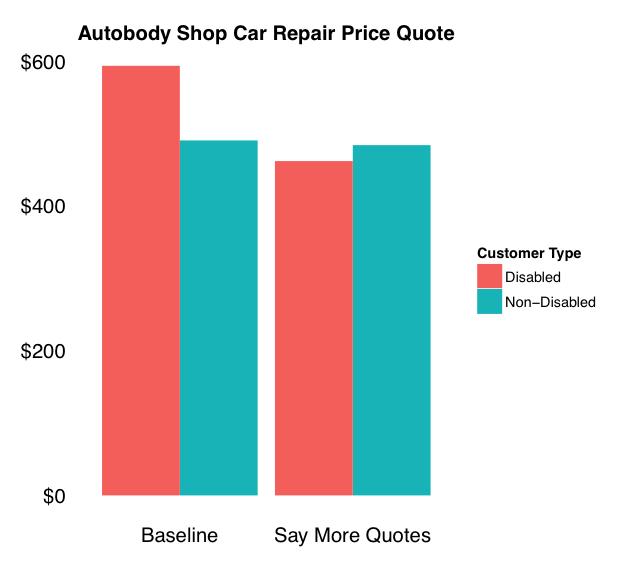
John List and Uri Gneezy conducted a series of experiments to evaluate discrimination against disabled people seeking car repairs:

[W]e recruited several men between the ages of twenty-nine and forty-five to act as our secret agents. Half these men used wheelchairs and drove specially equipped vehicles. The other half were non-disabled, but in all cases the individuals hopped into a specially equipped vehicle for the disabled with a fresh ding on the side and headed to Chicago-area repair shops.

When our secret agents got to an auto repair shop they simply asked for a price quote to fix their car. What we found initially was shocking. The disabled were given quotes 30 percent higher than the quotes given to non-disabled for the exact same repair!

Curious about the extent to which car repairman were motivated by hatred or just profit motive, though, we did one run of the experiment where both types of our secret agents got a quote and told the repairman that they were, “getting three price quotes today.” What did this extra sentence do? Well the figure shows that for the able-bodied subjects, their price quotes didn’t change at all, but for the disabled they plummeted. Furthermore, the difference in prices for the disabled and abled disappeared.

Beard Is The Warmest Color

15. Leonardo_Three Views of a Bearded Man

On the facial hair front, a few news items: some slow, sensuous, mutual beard caressing from the Red Sox last night; and a new exhibit at the Morgan Library in New York of Leonardo’s drawings, many of which are from the Biblioteca Reale in Turin. A reader also sent me a video of bears in the wild that, for some unaccountable reason, I hadn’t yet seen.

The Serendipity In Online Dating

Several readers take the thread on subculture dating in a different direction:

The Internet creates efficiencies in the market for everything, people looking for dates included. I stuck with online dating for a long time because my experiences with offline dating were no better. After 75-plus online dates and several relationships with women I met online, I finally met my wife – and it was her first online date. We’ve now been married for nearly a year and have a 7-week-old baby.

Another:

My husband and I met on Match.com in late 2001 and discovered within two rounds of emails that we had attended the same church in the early ’80s and undoubtedly met. We married our exes in that church the same year. We knew several people in common, including his former boss, who confirmed to me his employment and good character. Our connections went back to the 1950s when a member of his extended family knew my parents. My husband grew up in a Boston suburb where his mother bought his first pair of hard-soled shoes. More than 30 years later I lived in that same suburb and bought my son’s first pair of hard-soled shoes in the same store. My husband, who is white, recalls having a crush on a Black woman in the choir, who we established was me. I did not see white men as potential romantic partners and have no recollection of the man to whom I’m now married.

Both of our marriages had ended and eventually each of us decided to look for companionship online. I was looking for about a year, met seven intelligent, attractive men in person without establishing a significant bond with any of them, so I decided to take down my profile in one week. My husband joined the site two days after my decision. Less than an hour after he posted his profile, I saw it and got in touch – having decided to include white men in my dating search. Before meeting in person we had numerous phone conversations and suspected we might get married one day. The moment we laid eyes on each other – three weeks after meeting online – we knew we’d spend the rest of our lives together. We lived in separate cities. I moved with my son seven months after the online meeting. It is very fortunate that I had lived in that same city for years and was delighted to move back. We married one year after our initial online encounter.

My husband and I are atheists – more evidence of our compatibility – and don’t ascribe to the idea that we were “meant to be together”, implying that a supernatural force controls human experiences. But serendipitous things happen and some transcend rational explanation. I see it as life-altering good luck.

A male reader:

I’m very excited to be writing to you as a brand new (five minutes ago) Dish subscriber! I have to weigh in on the serendipity thread. My husband and I met in an AOL chat room.

We were both looking for “the one” and had been single long enough, and had dated enough, to have developed fairly keen selection and rejection abilities. We lived about 90 minutes from each other in NJ at the time, had exhausted our respective local dating pools, and had recently expanded into more GU (geographically undesirable) potential mates.

Our first date was to the NY Auto Show at the Javits Center (how’s that for breaking stereotypes?). Feeling the electricity crackling between us, neither of us could focus on the show, so we left after about an hour, heading to Greenwich Village to find something more intimate to do. Despite having worked in Lower Manhattan for nearly 10 years, and knowing it like the back of my hand, I was so distracted driving down the West Side Highway, I suddenly realized we were at Battery Park, having driven right past the Village.

We went to see a movie we had heard about: It’s My Party about a man dying of AIDS (great first date stuff, huh?!). We held hands and cried together. After the movie, we found a romantic little restaurant, held hands on the candlelit table and stared into each others eyes throughout the meal. We were utterly oblivious to our surroundings, each other’s faces cameoed in focus with everything else around us a blur.

Despite the late hour, we simply could not bear to part and decided to drive the 90 minutes to my house, even though my date had to be home early the next morning for a family function. We made love the rest of the night (okay… we don’t break every gay sterotype. Guys can indeed be guys). As I drove him home, bleary-eyed the next morning, I said “I love you” while still on our first date, which by then had run 22 hours. The only reason he didn’t respond in kind until that evening was because he didn’t want to say “Me too!”

He moved in with me less than two months later. We bought a home together and merged our finances after 9 months. That was over 17 years ago. We’ve spent the past 10-plus years full-time RVing around North America, living and working together, side-by-side 24/7, in about 400 square feet. When people openly wonder how we can live and work together in such a small space without killing each other, it makes us realize that we must have about the best relationship in the world.

If that isn’t serendipity, I don’t know what is.

Another reader’s story:

Serendipity is a weird and fickle mistress. After I finished my grad degree in the UK, I returned to the states and, due to the economic downturn, was only able to find temp work. My first day, I found a girl who was absolutely perfect – a certain type of Manic Pixie Dream Girl. She had been in the UK exactly when I had. She and I shared a love of the same music (the Smiths chief among them), We enjoyed walks in the forest, smoking pot over drinking, and debating politics. It was, to a large extent, love at first sight, and it seemed like this was just exactly the kind of conventional meeting that would lead to the ultimate relationship.

At the same time, I’d been maintaining a profile on the free dating site OKCupid. I’d had some success getting laid from the site, and I’d had a few three- to four-month-long relationships from it, but nothing had ever been lasting. While I was (non-exclusively) seeing the woman described above, I met another woman who didn’t have much in common with me. I mean, we both liked music, but she was definitely not my “type.” However, as our relationship progressed over a period of a few months, it became clear that whatever we lacked “in common,” we got along brilliantly. I mean, it was uncanny how much we just liked each other.

To many, the first woman would seem like the best match. We hadn’t “had” to meet online; we’d met through far more conventional means. However, that relationship went up in flames; it was an awful match. We ended up loathing each other because our personalities, for whatever reason, didn’t mesh.

However, the second woman and I continued to see each other. And continued. And four weeks ago tonight, we were married, after four years of dating. I have never met someone that I simply clicked with so well – and someone who was willing to put up with my rather massive amounts of shit.

As I said, serendipity is a weird and fickle mistress. Had I listened to serendipity, I would have been broken by the fact that the first woman and I had not worked out. But thanks to online dating, I found someone who matched me perfectly – we don’t have everything in common, but we click. THAT is what love is all about: you find someone who makes you feel good and who you can make feel good. Far more important than the “old school” ideas of how one is supposed to meet his or her mate. I got married thanks to online dating. And I couldn’t be prouder of that.
Why Does Sebelius Still Have A Job? Ctd

Health And Human Services Chief Sebelius Visits Phoenix Health Center

A reader writes:

Part of my job is to do performance testing and analysis (mostly analysis) for clients running large web applications, some of whom are government agencies. Most of the time, projects are appointed some generic “Project Manager” throughout the whole development lifecycle (from design to  production). The project manager’s sole value is to push people and process through bottlenecks to deliver the application on time and under budget. The good project managers understand the complexities of the application and what new data points mean to the project dependencies. They will build dynamic deadlines and breathing room into the project plan.

The bad ones will tune out info and march on to the deadline despite mitigating information. They fear not being able to achieve on time delivery, and will therefore deliver at any cost, hoping that things just work. They see stubbornness and pushiness as “what it takes to get the job done”. They create a culture where devs are afraid to speak up about needing more time to do things right. This is likely the personality assigned to Healthcare.gov. A dead giveaway of this situation is in this article, which states testing was done for two weeks! Our company demands that the project plan includes minimum six weeks for performance testing and analysis (which includes script building, dummy data population, testing accounts, fully integrated production simulation, and code and traffic instrumentation). In addition, any bottlenecks identified identified during testing will have to be addressed by the devs, and tested again.

Is Sebelius culpable? I really don’t think so. This really is squarely in the hands of the CIO at CMS (and everyone downstream to the project manager).

This is pointing at a bigger problem that affects almost all large institutions, and the way they role out new apps. The CIO is suppose to understand the way this works.

1) You have to phase rollouts for something this big and complex. The comparison to Facebook, Amazon, and Google is apt with respect to scale, but not process. And for good reason. Those three companies do not push out major updates and features to everyone at once. You phase it in, precisely to work out the bugs.

2) To help with above, you have to get away from “waterfall” process approaches to SLDC (software development lifecycle). The newer frameworks allow for a tighter integration btwn development and operations to fix problems faster, test changes, and do more intelligent delivery rollouts (phased).

3) I guarantee this was built on old (early 2000s) technology (IBM websphere, MS IIS, Oracle, SoftwareAG WM Integration). These older products were never meant to scale to the size of this app. The newer platforms (Apache Openstack, etc) are much more easily scaled than the static platforms mentioned above. But the govt and legacy enterprises never seem to grasp this. Apps in “the cloud” are mostly run on newer software platforms. But IBM, CGI, and all the other big outsourcing groups only develop on these older platforms, mostly using mediocre dev/engineering talent that relies on crappy certs more than real engineering talent.

I just don’t see Sebelius being responsible for this screw up. There is a lot that DHHS does outside of this – NIH, FDA, Medicare, Medicaid. If Sebelius goes, she is far enough removed from the location of the actual problem, that her departure would mean absolutely nothing. And the actual problems would persist.

And please keep in mind, nobody is dying here. This is a web application having issues, that will eventually get resolved, as more data becomes visible.

So we have the impossibility of getting a successor confirmed and the fact that she is not directly responsible for the clusterfuck. So who is the CIO at CMS? Update from a reader:

Seriously? 30 seconds on the google: “Tony Trenkle is the Chief Information Officer (CIO) and the Director of the Office of Information Services (OIS) in the Centers for Medicare and Medicaid Services (CMS)”

Rubio Retreats

He is backing off from his previous support for comprehensive immigration reform. Issac Chotiner sees this as proof of Rubio’s “political cluelessness”:

This leads to the larger question of what exactly Rubio was thinking when he decided to support the Senate bill in the first place. I have argued previouslythat it was political suicide for him to get behind the comprehensive approach: if such a bill had passed, Rubio would have been tarred as the most visible supporter of Obama’s biggest second term achievement. (Good luck running on that). And if it fails, as now appears likely, what did he gain by pissing off a bunch of the voters he will need for 2016?

Chotiner expects no movement on immigration reform before the midterms:

Pretend you are a House Republican, and thus in almost all cases are from a very conservative district. What is your incentive to pass an immigration bill before November 2014? Not only would it make you vulnerable to a primary challenge, but it isn’t even obvious that it would strengthen your position in the general election, especially considering the way House districts are drawn, and that non-presidential election years tend to have older and whiter electorates.

Chait, meanwhile, tries to make sense of the GOP’s latest immigration reform spin.

Revving Up The Fight For Equal Rights

Max Fisher covers a renewed push among Saudi women for expanded civil rights:

Saudi Arabian women are subject to some of the most severe legal restrictions in the world, of which the de facto driving ban is perhaps the best-known — and it has become the focus of a campaign by Saudi women for broader rights. The campaign has grown dramatically since it began, in May 2011, with a single drive. A 32-year-old information technology consultant named Manal al-Sharif was filmed by women’s rights activist Wajeha al-Huwaider driving around and reeling off arguments for dropping the ban. The two posted the video to YouTube, and police arrested Sharif the next day, charging her with disturbing public order. Sharif was released after a week in prison, but that video, and her passionate message, had already spread among the country’s increasingly well-educated and well-connected women.

Juan Cole rips the country after political pressure forced many women to abandon their driving protests, which were scheduled for Saturday:

It is about the most pitiful thing one can imagine– a state that disallows protest altogether as a means of enforcing a brutal patriarchal order that deprives women of the basic right of mobility. Inability to drive limits women’s ability to pursue not just their careers (Saudi women have high rates of literacy and education) but even just hobbies. Wealthy women have chauffeurs, but contrary to stereotypes not all Saudi families are rich or can afford to hire drivers. Supportive Saudi husbands sometimes have to spend a lot of their time driving family members around.

Saudi comedian Hisham Fageeh made the video above to coincide with the protests:

While the video has a light-hearted vibe, the ironic satire is sharp, and because the reasons given by ultra-conservative Saudis for keeping women away from the driver’s seat are so surreal, they do make easy targets. There’s the claim, for instance, that driving might damage women’s reproductive organs. “Ovaries, so safe and well,” Fageeh intones, “so you can make lots and lots of babies.”

“Your feet is your only carriage, but only inside the house. And when I say it I mean it,” Fageeh sings in another line, addressing Saudi Arabia’s male guardianship law which strictly limits a woman’s ability to travel, work, open a bank account, marry, or undergo certain medical procedures without the consent of a male guardian. In some cases, this guardian could be a young son.

And, finally, Caitlin Dewey reminds us that Saudi Arabia is just one of a number of countries that maintain severe restrictions on women’s rights:

According to one measurement, though, there are actually several countries that rank lower on women’s rights than Saudi Arabia. The World Economic Forum, which publishes the preeminent ranking on gender gap issues, ranked Saudi Arabia 10th from the bottom in its 2013 report – ahead of Mali, Morocco, Iran, Cote d’Ivoire, Mauritania, Syria, Chad, Pakistan and Yemen. Women’s rights abuses are by no means limited to North Africa, West Africa or the Middle East, though that’s where we tend to hear such stories most frequently.