“Music-Loving Muses”

A trailer for the 1970 film Groupie Girl:

Joe Daly interviews Pamela Des Barres, author of I’m with the Band: Confessions of a Groupie:

You’ve met on a very personal, and occasionally intimate level, the biggest of the big in modern music. How did you do that?

I was in the right place at the right time with the right look and the right taste. Mick Jagger came up to Miss Mercy at a Burritos gig and said, “Please introduce me to your pretty friend.” That’s how I met Mick. Jimmy Page’s road manager came up to me at a Bo Diddley gig and handed me his phone number and said, “He’s waiting for you in room 605.”

I didn’t have to go after these people. I was in the GTOs, I had an all-girl group, I was hanging out with Zappa, and I was in the thick of everything in Hollywood. People wanted to meet us. Early on, of course, I chased the Beatles, I tried to meet the Stones—and I did meet a couple of them when I was with Captain Beefheart—but I was just in the right place at the right time, but with the right attitude and the right love of the music, and my appreciation of what these people were doing was completely sincere. …

Before your book the word “groupie” conjured an opportunistic…

It still does. I’m still trying to retrieve that word. My most recent book, Let’s Spend the Night Together, was about a bunch of other groupies. I’m still trying to set that word straight, because all it means is just a music lover who wants to be near the band. Period. That’s all it means, in whatever capacity. Sexual? Sometimes yes, but also friends, helpers, assistants, guides… we wanted to uplift and enhance these people who moved us so much. That’s all that a groupie is. They are music-loving muses.
The Underemployed Porn Star

Lux Alptraum profiles James Darling, who “isn’t like most up-and-coming porn performers”:

As it happens, he’s a trans man (meaning he’s a man who was born in a female body), and that greatly limits the amount of work he can get. Trans women looking to perform sex work have numerous options, but for trans men, it’s a different story. Unlike “t-girls” and “shemales,” who’ve long been pornographic staples, trans men didn’t enter the porn world’s awareness until the early 2000s, when pioneering porn performer Buck Angel debuted as “the man with a pussy.” To this date, Buck is the only trans man to ever have been recognized by any of the major porn awards shows.

More than six years after Buck took home the award for Transsexual Performer of the Year, the number of porn studios willing to work with trans men is still in the single digits. Major porn studios don’t know how to market transmale content, which appeals to an audience not targeted by more traditional genres of porn. The filmmakers who pick up the slack tend to be members of the queer community who are looking to create the content they’re personally interested in seeing. Most, if not all, of those studios are indie ventures with small budgets and infrequent shoots, making it hard for Darling to pick up regular work. If he shoots once a year for the handful of companies that are trans man-friendly, that’s about four or five scenes—enough to establish a porn presence, but not nearly enough to make a living.

In the meantime, Darling’s day job? Pizza delivery man.

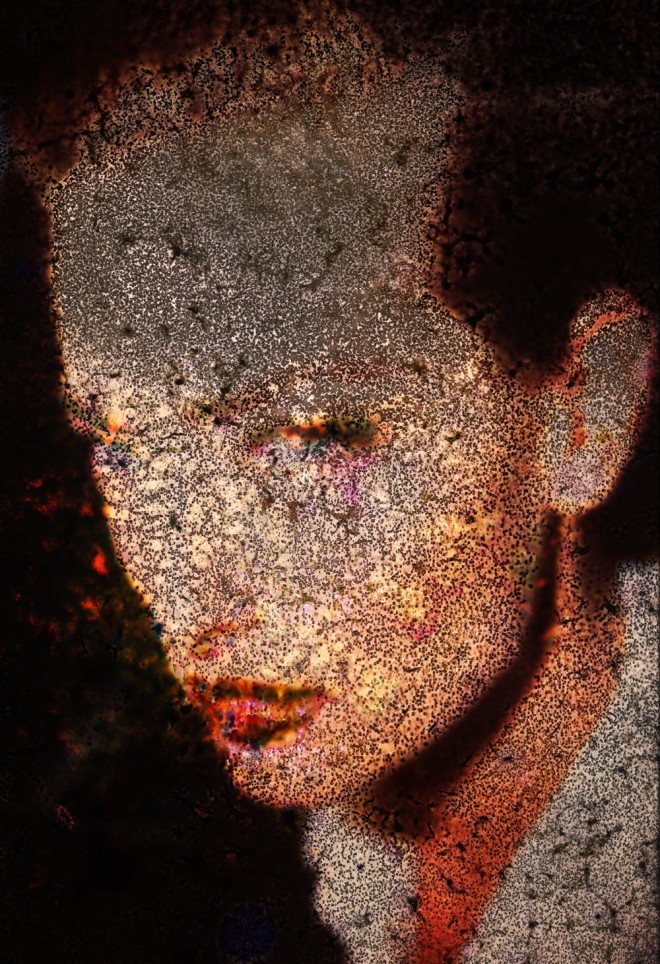
Face Of The Day

dr.mad_-660x9641

Doug Beirend explains the “hauntingly distressed images from Dutch photographer Rohn Meijer“:

The idea for the project came after Meijer discovered a batch of slides in his basement that had been exposed to moisture for 15 years. Most people might have tossed them, but Meijer saw that the moisture had created a pleasing crystallized effect, so he decided to experiment. He began developing a cocktail of water and other chemicals — a formula he prefers to keep secret — that would interact with the silver nitrate on the back of the negative and enhance the crystallization. To keep the negatives as saturated as possible, he built a homemade, hermetically sealed container for them to stew in.

Details on Meijer’s upcoming exhibition here.

Risky Days Are Here Again

Now that investors can put their money in athletes, bitcoin, and “motifs“, Kevin Roose declares, “the age of bullshit investments is back”:

Some of these bad ideas spring from the normal irrational exuberance that comes with an economic bounce-back, and the fact that many investors are more willing to jump into murky waters than they were in 2008. But there are other factors in play, too. The JOBS Act, for one, was a post-crisis law that was meant to make it easier for companies to raise money. … Thanks to the JOBS Act, there are now crowd-funding bazaars that make gambling in the markets as easy as picking a Spotify playlist. There’s also the newest West Coast fund-raising trend, the venture capital syndicate, which makes it possible for average shmoes with little to no market expertise to enter into highly risky investments with early stage start-ups, and which has put the sentence “Miley Cyrus could be the next big tech investor” within the realm of the possible.

Meanwhile, as Florida’s economy shows signs of recovery, Wendell Cox explains what made the state so vulnerable to the real estate crash:

Florida’s restrictive land-use policies (better known as “smart growth” or “urban containment”) helped inflate its property bubble to massive size, making its bursting all the more economically painful. Such growth policies limit urban expansion, prohibiting new housing except in small sections of already dense metropolitan areas. As Brookings Institution economist Anthony Downs argues, these policies can destroy the competitive supply of land, driving land prices up (other things being equal) as demand rises sharply in relation to supply. These higher prices get passed along to prospective homeowners in higher home costs—often made even pricier by various other regulations and fees. The rapidly escalating housing prices, in turn, create the potential for extraordinary profits for speculators—or property “flippers”—who, jumping into the real-estate market in considerable numbers, increase the excess of demand over supply, driving prices higher still, until a bubble begins to expand. It’s no surprise that markets with more restrictive land-use policies have much greater housing-price volatility, as research by economists Edward Glaeser and Joseph Gyourko has shown.

Inspired To Write

Popova points to insights on the life of writer from Dani Shapiro, author of Still Writing: The Pleasures and Perils of a Creative Life. On how ordinary life informs creativity:

If I dismiss the ordinary — waiting for the special, the extreme, the extraordinary to happen — I may just miss my life. … To allow ourselves to spend afternoons watching dancers rehearse, or sit on a stone wall and watch the sunset, or spend the whole weekend rereading Chekhov stories—to know that we are doing what we’re supposed to be doing — is the deepest form of permission in our creative lives. The British author and psychologist Adam Phillips has noted, “When we are inspired, rather like when we are in love, we can feel both unintelligible to ourselves and most truly ourselves.” This is the feeling I think we all yearn for, a kind of hyperreal dream state. We read Emily Dickinson. We watch the dancers. We research a little known piece of history obsessively. We fall in love. We don’t know why, and yet these moments form the source from which all our words will spring.

On what makes writing “as necessary as breathing”:

It is in the thousands of days of trying, failing, sitting, thinking, resisting, dreaming, raveling, unraveling that we are at our most engaged, alert, and alive. Time slips away. The body becomes irrelevant. We are as close to consciousness itself as we will ever be. This begins in the darkness. Beneath the frozen ground, buried deep below anything we can see, something may be taking root. Stay there, if you can. Don’t resist. Don’t force it, but don’t run away. Endure. Be patient. The rewards cannot be measured. Not now. But whatever happens, any writer will tell you: This is the best part.

Morrissey By Morrissey

John Harris determines that the Smiths’ frontman’s Autobiography – the first page sung above, by voice artist Peter Serafinowicz – is strongest when it focuses on the singer’s upbringing and musical journey, rather than personal rivalries and legal battles:

For its first 150 pages, Autobiography comes close to being a triumph. “Naturally my birth almost kills my mother, for my head is too big,” he writes, and off we go – into the Irish diaspora in the inner-city Manchester of the 1960s, where packs of boys playfully stone rats to death, and “no one we know is on the electoral roll”. In some of the writing, you can almost taste his environment: “Nannie bricks together the traditional Christmas for all to gather and disagree … Rita now works at Seventh Avenue in Piccadilly and buys expensive Planters cashew nuts. Mary works at a Granada showroom, but is ready to leave it all behind.” And when pop music enters the story, he excels. … And then [musician] Johnny Marr pays him a visit, and his life takes off – while, in keeping with an unwritten rule of celebrity memoir, Autobiography takes a serious turn for the worse.

Boyd Tonkin calls the 450-page memoir a self-pitying screed, and ridicules Penguin for publishing it as a part of their “Classics” series:

The droning narcissism of the later stages – enlivened by the occasional flick-knife twist of character sketch, or character assassination (watch out, Julie Burchill) – may harm his name a little. It ruins that of his publisher. For the stretches in which in his brooding, vulnerable, stricken voice uncoils, particularly across his Mancunian youth, Morrissey will survive his unearned elevation. I doubt that the reputation of Penguin Classics will.

Mostly agreeing, Jessica Winter nonetheless sees moments of genuine insight:

Autobiography is at times so relentlessly whiny and misanthropic that it’s startling when Morrissey shares a flash of sober self-awareness. “Undernourished and growing out of the wrong soil,” he writes of himself circa 1984, “I knew at this time that a lot of people found me hard to take, and for the most part I understood why. Although a passably human creature on the outside, the swirling soul within seemed to speak up for the most awkward people on the planet.” That was once true—exhilaratingly true, true enough to save a life. But Autobiography only speaks up for its author, and never more than in his next line. “Somewhere deep within,” he confesses, “my only pleasure was to out-endure people’s patience.”

Oliver Lyttelton rounds up the “most Morrissey-y” passages. John Crace delivers a CliffsNotes version:

At school, I am the futile pupil brutalised by neo-fascist inquisitors who do not understand the subtleties of sublime rhyme. My only valent talent is for athletics, my event the 20-kilometre walk on water. Blood laced with disgrace flows from my hands, feet and side. “Oh, Steven,” says my Mother Mary. “What have you done to yourself now?” I feel forlorn in my crown of thorns. Death death death unbreath is all around me. Nancy laughs, her wild smile frozen for ever as a bus loses control on a pothole and crushes her against the grimey cor blimey door of the Rover’s Return. Gloria Gaynor sings I Won’t Survive. Life is thus.

The “Anti-Gatsby”

Tim Kreider praises John Williams’s Stoner as “a great, chronically underappreciated American novel”:

“Stoner” is undeniably a great book, but I can also understand why it isn’t a sentimental favorite in its native land. You could almost describe it as an anti-“Gatsby.” … Gatsby’s a success story: he makes a ton of money, looks like a million bucks, owns a mansion, throws great parties, and even gets his dream girl, for a little while, at least. “Stoner”‘s protagonist [William Stoner] is an unglamorous, hardworking academic who marries badly, is estranged from his child, drudges away in a dead-end career, dies, and is forgotten: a failure. The book is set not in the city of dreams but back in the dusty heartland. It’s ostensibly an academic novel, a genre historically of interest exclusively to academics. Its values seem old-fashioned, prewar (which may be one reason it’s set a generation before it was written), holding up conscientious slogging as life’s greatest virtue and reward. And its prose, compared to Fitzgerald’s ecstatic art-nouveau lyricism, is austere, restrained, and precise; its polish is the less flashy, more enduring glow of burnished hardwood; its construction is invisibly flawless, like the kind of house they don’t know how to build anymore.

“Part of Stoner’s greatness is that it sees life whole and as it is, without delusion yet without despair,” continues Kreider:

Stoner realizes at the last that he found what he sought at the university not in books but in his love and study of them, not in some obscure scholarly Grail but in its pursuit. His life has not been squandered in mediocrity and obscurity; his undistinguished career has not been mulish labor but an act of devotion. He has been a priest of literature, and given himself as fully as he could to the thing he loved. The book’s conclusion, such as it is—I don’t know whether to call it a consolation or a warning—is that there is nothing better in this life. The line, “It hardly mattered to him that the book was forgotten and served no use; and the question of its worth at any time seemed almost trivial,” is like the novel’s own epitaph. Its last image is of the book falling from lifeless fingers into silence.

The Zeitgeist Of Kids’ Books

In a review of the New York Public Library’s exhibit The ABC of It: Why Children’s Books Matter, Paula Marantz Cohen ponders the capacity of children’s literature to defy social expectations:

There are … examples of pedagogy in support of civic causes — children’s books from the 465px-Cendrillon_story Russian Revolution and the Chinese Cultural Revolution, books associated with Irish Independence that makes use of fairy tales, a beautifully illustrated Hebrew alphabet book to teach children the language of a not-yet-created Jewish state. There are samples from W.E.B. Dubois’s monthly magazine for African-American children, The Brownies’ Book, published from 1920 to 1921, to teach black children pride in their identity.

Yet it is noteworthy that some of our most beloved children’s books don’t teach anything and can’t be linked to an agenda of any kind. It is also interesting to see those that caused a stir in their day for failing to toe a line of one sort or another. A recessed space contains books that have been controversial or censored: Pippi Longstocking, for its character’s rebelliousness, The Diary of Anne Frank for its narrator’s sexual explicitness, A Wrinkle in Time for overstepping the bounds of secularism when first published and for being unconventionally spiritual more recently. There is a copy of Garth Williams’ 1948 A Rabbits’ Wedding, castigated in its time for representing the marriage of a white rabbit and a black one. What looks like iconoclasm or perversity in one era can become unobjectionable and even desirable to teach in another — and vice versa. My reflex is to think that children are the best arbiters, being naturally drawn to what is good and true, but I may be indulging in a Rousseau-ist idealism here. After all, children are also fascinated by the sadistic and the gross — all those disturbing Grimm’s fairy tales, not to mention Jon Scieszka’s Stinky Cheese Man.

Recent Dish on children’s lit here, here, and here.

(Image: book cover of Cendrillon, c. 1930, via Wikimedia Commons)

The DSM-5 As Dystopian Novel

That’s how Sam Kriss interprets the latest edition of the American Psychiatric Association’s signature publication:

This is a story without any of the elements that are traditionally held to constitute a setting or a plot. A few characters make an appearance, but they are nameless, spectral shapes, ones that wander in and out of view as the story progresses, briefly embodying their various illnesses before vanishing as quickly as they came – figures comparable to the cacophony of voices in The Waste Land or the anonymously universal figures of Jose Saramago’s Blindness. A sufferer of major depression and of hyperchondriasis might eventually be revealed to be the same person, but for the most part the boundaries between diagnoses keep the characters apart from one another, and there are only flashes. On one page we meet a hoarder, on the next a trichotillomaniac; he builds enormous “stacks of worthless objects,” she idly pulls out her pubic hairs while watching television. But the two are never allowed to meet and see if they can work through their problems together.

This is not to say that there is no setting, no plot, and no characterization. These elements are woven into the encyclopedia-form with extraordinary subtlety. The setting of the novel isn’t a physical landscape but a conceptual one. Unusually for what purports to be a dictionary of madness, the story proper begins with a discussion of neurological impairments: autism, Rett’s disorder, “intellectual disability”. The scene this prologue sets is one of a profoundly bleak view of human beings; one in which we hobble across an empty field, crippled by blind and mechanical forces whose workings are entirely beyond any understanding. This vision of humanity’s predicament has echoes of Samuel Beckett at some of his more nihilistic moments – except that Beckett allows his tramps to speak for themselves, and when they do they’re often quite cheerful. The sufferers of DSM-5, meanwhile, have no voice; they’re only interrogated by a pitiless system of categorizations with no ability to speak back. As you read, you slowly grow aware that the book’s real object of fascination isn’t the various sicknesses described in its pages, but the sickness inherent in their arrangement.