Global Warming Groupthink

Judith Shulevitz psychoanalyzes climate change deniers:

Risk assessment by groupthink is reasonable, if not rational, because, at the personal level, it costs nothing. If you misconstrue the nature of a global threat, your mistake won’t hurt you much, because you can’t save yourself anyway. But if you contradict your friends or powerful members of your group—that could cost you dearly. (Incidentally, Kahan sees evidence of scientific groupthink on both sides of the ideological spectrum.) [Yale psychology professor Dan] Kahan’s most provocative finding, though, is that people better at “cognitive reflection,” or slow, probing thought, are actually more likely to arrive at predetermined conclusions about risk, not less. The urge to maintain status within one’s social network is so powerful, Kahan told me, that well-educated people will use their information-gathering and computational skills to marshal a more impressive body of evidence in support of whatever identity it is (freethinking skeptic, caring mother hen) that earns them brownie points in their troop. On his blog, he once called these strong in-group effects “tapeworms of cognitive illiberalism” and a dispiriting omen for democracy.

Europe’s Anti-Roma Racism

Roma children laugh in front of the came

Joshua Keating zooms in on Europe’s sudden wave of anti-Roma sentiment:

The biggest international story is that of “Maria,” the blond, blue-eyed girl removed by police from a couple during a raid on a camp in Greece when they became suspicious that she looked nothing like her darker-skinned parents. DNA tests confirmed that the child was not related to the couple, sparking a continentwide search for her biological parents. The couple say the girl was not abducted, that it was “an adoption that was not exactly legal but took place with the mother’s consent.” This could be plausible, though further investigations have shown that the couple had used multiple names to register 14 children in three different cities, perhaps as part of a government benefits scam. Greek authorities have ordered an investigation of thousands of birth certificates issued in the last five years, and three more Roma have already been arrested in a similar case case on the island of Lesbos.

While it certainly seems like something not-quite-aboveboard was going on here, the case has raised fears that the case of the “blonde angel,” as she has been called in the Greek media, could reignite old myths of Gypsies kidnapping white children. When ancient prejudices combine with the tabloid media’s fixation on missing blond children, it’s hard to imagine anything good coming from it.

A backlash against Roma appears to be taking hold, with a blonde Roma girl in Ireland separated from her parents until DNA tests proved her to be their biological daughter. Filip Borev points out that the mixed heritage of Roma can produce fair skin and hair, and that the panic speaks to something deeper:

Don’t get me wrong, blond hair is somewhat a rarity among Roma populations. What is rarer, however, is the “pure blood” or tatcho Romany. Indeed, there is nothing more the Romany like to do than fight among themselves over who is the purest Gypsy, but one only needs to take a glance at Britain’s Romany community to realise there has undoubtedly been a great deal of intermarriage. My genes would best be described as a melting pot – my mother is part Bulgarian Roma, part Romanichal (English Romany), and my dad is part Romanichal, part Irish Traveller – thus, it was hardly surprising when I was born a blue-eyed milk bottle.

The notion of the baby-snatching Gypsy is an old racist stereotype. Since I was born it has been a running joke within my family that I was stolen. My mum’s engagement to a Roma man resulted in three considerably darker-skinned siblings. Among my Roma family I couldn’t have stood out more, but lucky for me I can now hand down the “stolen baby” joke to my younger brother who was born with strikingly blonde hair. In the current environment, however, I must ask just how funny this joke is.

Okasana Marafioti bemoans the long history of discrimination against Roma in Europe:

The stereotype of Gypsies as child snatchers is centuries old, but ask anyone if they can give you a specific incident, and they will scratch their heads. More disturbing historical facts have survived, including records of more than 133 anti-Gypsy laws enacted in the Holy Roman Empire at around 1551, which made being a Gypsy punishable by death, and authorities systematically took Romany kids from their parents and placed them in “proper” homes, a trend that continued well into the first half of the 19th century.

Rachel Shukert adds:

One doesn’t like to descend into comment sections, but a perusal of those on these latest stories is like peering into something out of the Malleus Maleficarum, or Borat. Americans, who for the most part see gypsies as something you dress up as on Halloween when your mom forgot to get you a real costume, express utter bafflement, while Europeans, who never tire of calling Americans out on their racism, insist on the toxicity of these people—their essential, unchanging, criminal nature; it’s who they are, they insist. It’s their culture. They can’t be changed, so they have to—somehow—be gotten rid of. (My favorite thread managed to both laud Hitler for killing the Roma along with the Jews, while blaming the Jews for the Roma not getting any credit for the Holocaust. And also, did you know we’re both capitalists and Bolsheviks? Blah blah blah.)

(Photo: Roma children laugh in front of the camera in a camp on the outskirts of Rome on September 8, 2010. By Christophe Simon/AFP/Getty Images)

Black History Sans White Saviors

Wesley Morris reviews 12 Years A Slave. How the film upends the racial dynamics of Hollywood:

There is a kind of audacity in something like Lincoln, in which important white men get discursive about the moral quandary in which slavery mires the country. That debate required men to search their souls and vote accordingly. But after enough of these movies, you’re just hot with insult. You have to stop accepting apologies, accepting, say, The Help, and start demanding correctives, films that don’t glorify whiteness and pity blackness, movies — serious ones — that avoid leading an audience to believe that black stories are nothing without a white voice to tell them that black people can’t live without the aid of white ones.

[Director Steve] McQueen and [screenwriter John] Ridley turn that dynamic inside out. Their movie presents the privilege of whiteness, the systematic abuse of its powers, and black people’s struggles to get out from beneath it. A different movie might have taken this story and turned it into a battle between Epps and the white men who feel a duty to free Northrup. That’s what we’re used to. There have been complaints that the movie is too violent, that it depicts too many lashings, too many cruelties, too much interracial abuse, that all the gashes on all the backs (what Toni Morrison poetically described as chokecherry trees) are just too much. But that’s a privileged concern.

Peter Malamud Smith is troubled with Northrup representing the institution of slavery as a whole:

12 Years a Slave is constructed as a story of a man trying to return to his family, offering every viewer a way into empathizing with its protagonist. Maybe we need a story framed on that individual scale in order to understand it. But it has a distorting effect all the same. We’re more invested in one hero than in millions of victims; if we’re forced to imagine ourselves enslaved, we want to imagine ourselves as Northup, a special person who miraculously escaped the system that attempted to crush him.

Isaac Chotiner counters:

[I]f Hollywood ever did make a movie called 200 Years, Millions of Slaves, how much would you wager that writers like Smith would be denouncing Hollywood for de-personalizing slavery? Doesn’t Hollywood realize that actual individuals suffered? Doesn’t Hollywood grasp that the evils of slavery went beyond statistics? Secondly, 200 Years, Millions of Slaves is not a movie. Movies focus on individuals or groups of individuals. How would one even conceive of Smith’s project? Smith even seems to backhandedly acknowledge as much, writing, “Maybe we need a story framed on that individual scale in order to understand it.” Maybe we do! In the meantime, we should evaluate 12 Years a Slave on its own terms.

Healthcare Needs The Healthy

Health Status By Age

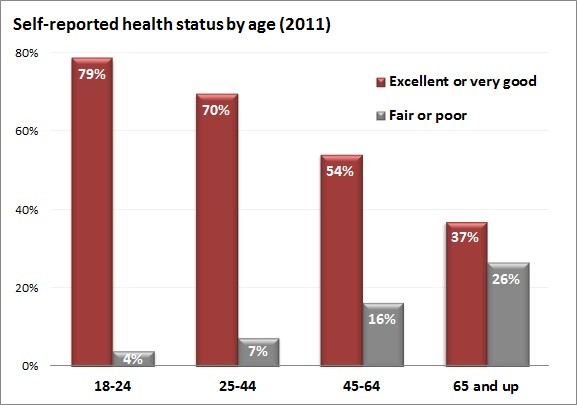
Waldman illustrates why the young must sign up for Obamacare for it to succeed:

The truth is that while we talk about the importance of young people being in the risk pool, what matters isn’t their age but their health. On average, young people will be healthier longer, but every year the system needs plenty of healthy people of whatever age they might be. When you ask them, the young are much more likely to report being healthy, with self-reported health declining the older you get.

Emma Roller covers efforts to get the young to enroll:

Mothers make the health care decisions in 80 percent of families, and they’re the most effective “messengers” to persuade their kids to sign up for health care. Anne Filipic, who leads the nonprofit group Enroll America, says men may be the ultimate target for groups promoting the exchanges—they are more skeptical of health insurance and tend to visit the doctor less—but they’re focusing on women because of their decision-making role. “The messenger matters a lot,” Filipic says. “The most effective thing we can do is get moms and women the information, so in their day-to-day conversations they can be spreading the word.”

Enroll America surveyed young people and asked who they were most likely to trust talking to them about health care. For young women, “someone like me” was the most persuasive messenger. For young men, it was their mom, followed by their spouse or girlfriend. That’s why the Obama administration has promoted the exchanges on mom-friendly media like allrecipes.com, Good Morning America, and Elle magazine.

Free To Hate

While discussing the Ender’s Game controversy, Rauch argues that hate speech is necessary for social progress:

To make social learning possible, we need to criticize our adversaries, of course. But no less do we need them to criticize us. … Some of the things [Orson Scott Card] has said are execrable. He wrote in 2004 that when gay marriage is allowed, “society will bend all its efforts to seize upon any hint of homosexuality in our young people and encourage it.” That was not quite a flat reiteration of the ancient lie that homosexuals seduce and recruit children—the homophobic equivalent of the anti-Semitic blood libel—but it is about as close as anyone dares to come today.

Fortunately, Card’s claim is false. Better still, it is preposterous. Most fair-minded people who read his screeds will see that they are not proper arguments at all, but merely ill-tempered reflexes. When Card puts his stuff out there, he makes us look good by comparison. The more he talks, and the more we talk, the better we sound.

Why he hopes the Ender’s Game boycott will fail:

I can think of quite a few reasons why boycotting Ender’s Game is a bad idea. It looks like intimidation, which plays into the right’s “gay bullies” narrative, in which intolerant homosexuals are purportedly driving conservatives from the public square. It would have little or no effect on Card while punishing the many other people who worked on the movie, most of whom, Hollywood being Hollywood, probably are not anti-gay (and many of whom almost certainly are gay). It would undercut the real raison d’être of the gay-rights movement: not to win equality just for gay Americans but to advance the freedom of all Americans to live as who they really are and say what they really think. Even if they are Orson Scott Card.

Above all, the boycott should fizzle, and I expect it will fizzle, because gay people know we owe our progress to freedom of speech and freedom of thought.

How Much Is A Little More Life Worth?

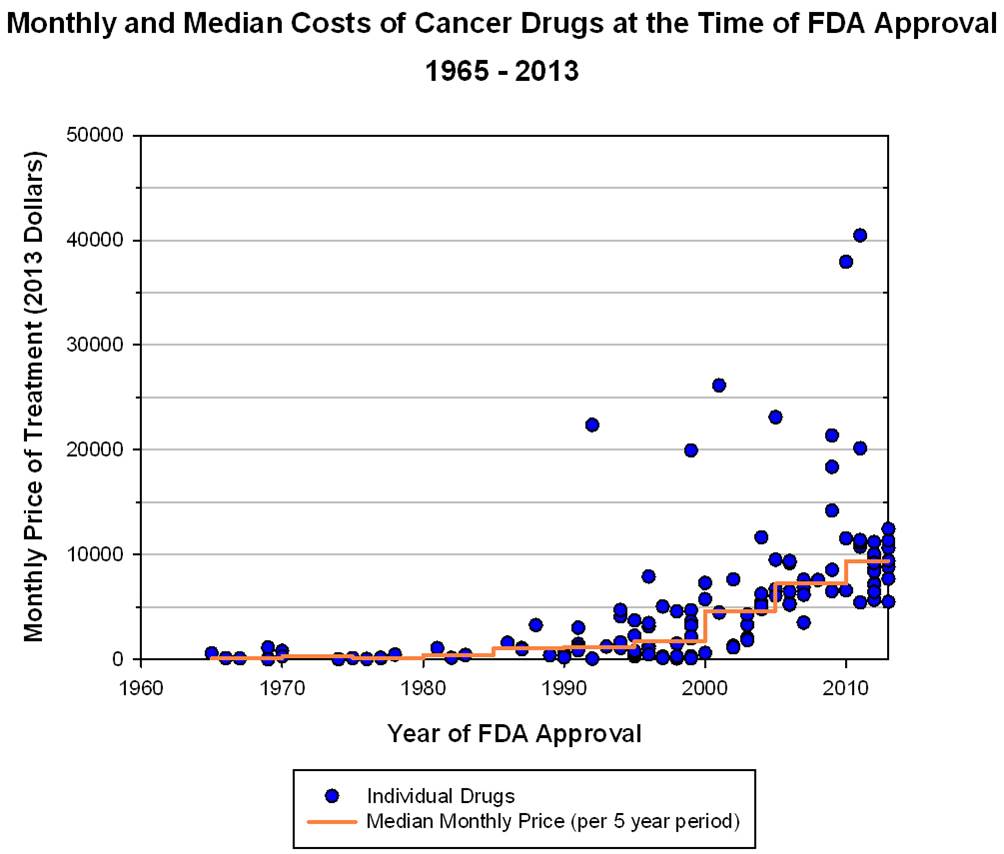
The cost of cancer drugs has skyrocketed:

Cancer Drugs

Stephen S. Hall covers the phenomenon:

What is sobering about this booming business is that, as a group of oncologists wrote earlier this year, “most anti-cancer drugs provide minor survival benefits, if at all.” They often (but not always) reduce the size of inoperable tumors, but they rarely eradicate the disease.

For relatively uncommon malignancies like testicular cancer, some forms of leukemia, and lymphoma, drugs effectively cure the disease; for the common “solid tumor” cancers (lung, breast, colon, prostate, and so on), which account for the vast majority of annual cases, drugs buy some time—precious time, to be sure, but time usually measured in weeks and months rather than years. And even though many of the newer drugs are less toxic, they often still have to be given with older drugs whose side effects include nausea, hair loss, fatigue, and decreasing blood counts. One anti-cancer drug produces a skin rash so severe and disturbing, according to [Leonard] Saltz [head of the gastrointestinal oncology group at Memorial Sloan-Kettering Cancer Center], that some patients have been asked by employers not to come to work. …

In 1994, the median survival rate for someone with advanced colon cancer was eleven months, according to Saltz, and the lifetime costs of the drugs used to treat the average patient would be about $500 at today’s prices. By 2004, the median survival rate had increased twofold, to 22 months, but Saltz says the drug costs had increased hundreds of times for that extra eleven months.

How Many Wiki Editors Do We Need?

Tom Simonite sees the online encyclopedia getting sclerotic:

The volunteer workforce that built the project’s flagship, the English-language Wikipedia – and must defend it against vandalism, hoaxes, and manipulation – as shrunk by more than a third since 2007 and is still shrinking. Those participants left seem incapable of fixing the flaws that keep Wikipedia from becoming a high-quality encyclopedia by any standard, including the project’s own. … The main source of those problems is not mysterious. The loose collective running the site today, estimated to be 90 percent male, operates a crushing bureaucracy with an often abrasive atmosphere that deters newcomers who might increase participation in Wikipedia and broaden its coverage.

But he acknowledges that the decline of participation is largely due to the anti-vandalism measures introduced in 2007, when high-profile hoaxes seemed to pose an existential threat to the project:

The project’s most active volunteers introduced a raft of new editing tools and bureaucratic procedures intended to combat the bad edits. They created software that allowed fellow editors to quickly survey recent changes and reject them or admonish their authors with a single mouse click. They set loose automated “bots” that could reverse any incorrectly formatted changes or those that were likely to be vandalism and dispatch warning messages to the offending editors.

The tough new measures worked. Vandalism was brought under control, and hoaxes and scandals became less common. … But those tougher rules and the more suspicious atmosphere that came along with them had an unintended consequence. Newcomers to Wikipedia making their first, tentative edits – and the inevitable mistakes – became less likely to stick around. Being steamrollered by the newly efficient, impersonal editing machine was no fun. The number of active editors on the English-language Wikipedia peaked in 2007 at more than 51,000 and has been declining ever since as the supply of new ones got choked off. This past summer, only 31,000 people could be considered active editors.

The Classical Remix

A portion of Max Richter’s dazzling take on Vivaldi’s The Four Seasons:

In a wide-ranging essay that connects Kanye West to Beethoven, Michael Markham discusses the similarities between classical music and today’s popular genres:

Vivaldi’s generation reveled, without embarrassment, in instant emotional gratification. Its most popular form of music, Opera seria, was not like later Romantic opera. It did not present a deep unified story in the Wagnerian sense, and instead provided little more than a series of 40 or so fragmented emotional moments, each represented by a static aria that crystallized a single mood.

Baroque-era audiences treated the productions as live “best of” concerts, wandering in and out of the theater, choosing to listen only to the excerpts that touched the right mood for them that night. Baroque composers were trained to enhance such evocative mood-experiences even when writing instrumental concertos. The constant nervous pulse (that for much of the 20th century led to Baroque music being called “sewing machine” music) invigorates in the same way modern rock or hip-hop does; the cascading sequences and recurring fragments of melody produce a pop-like repetition that pulls the listener back again and again to the same emotional starting point. …

The form of the Vivaldian concerto is based on the idea of the reoccurring “hook.” It is similar in this way to the verse-chorus-verse-chorus progression of our own pop songs. [Composer Max] Richter’s own comments on his music reveal this connection to today’s composition: “I was pleased to discover that Vivaldi’s music is very modular. It’s pattern music.” So is Richter’s, as well as that of many of the most prominent composers of both “classical” and “pop” minimalism (not to mention trance, hip-hop, dance, house, etc.) of the last 20 years — from Brian Eno and Meredith Monk to Kanye West, Gotye, Nico Muhly, and John Luther Adams.

Is Layaway Worth It?

Alex Tabarrok is perplexed by the popularity of the purchasing plan:

The typical layaway plan requires a deposit of 10 to 15 percent of the price of the good, say a new TV. If the consumer pays the balance over the following 10 to 12 weeks (i.e., by Christmas) they can pick up the good. If the consumer doesn’t pay the balance, they get a refund of payments made less a service fee. Walmart and Kmart advertise their layaway plans heavily. I am shocked, however, that so-called consumer advocates also have good things to say about poor people lending big corporations money:

Consumer advocates say layaway is a great way to manage a major purchase and stick to a budget, allowing consumers to spread the cost of an item over a number of payments without running up a lot of costly debt. …“The fees, if any, are generally nominal and probably much lower than the interest you’d pay if you purchased those things with a credit card and didn’t pay off the bill for several months,” said Tod Marks, senior editor and shopping expert at Consumer Reports.

Stop the insanity! The relevant comparison is not to buying on credit but to saving. Instead of lending Walmart money, get yourself an old-fashioned piggy bank and avoid the cancellation fee and the hassle of going to the store to make the periodic payments.

Erik Loomis defends layaway with a real-world example:

Let’s imagine a situation for layaway. You are 11 years old. It’s July. Your family doesn’t have much money. Getting new school clothes is a big deal because you don’t get very many new clothes in a year and you want to wear them on the first day of school. Your parents are really worried about this. They want to buy you the new clothes. They also know that they will have a really hard time actually saving the money to purchase them all at once. So they put them on layaway at the Target or Walmart and make the payments, hoping to have them all paid off before school starts.

How would I come up with this scenario? Because I was that 10 or 11 year old and my parents used layaway to get me those new clothes I wanted. In fact, in the scenario I am recalling, they actually couldn’t make all the payments and I really wanted those clothes and somehow we talked the store into giving us some of the clothes up front and breaking up the layaway, which probably only worked because I was there and nearly hysterical that I would have to wear old clothes on the first day of school. In a so-called rational economic world, layaway might not make sense. In the real world that actually people live and operate in it makes a ton of sense, even if it is bad economics.

Meanwhile, Drum contends that “the economic case against layaway is thinner than it seems”:

Suppose you put a $300 item on layaway for four months. What’s the opportunity cost? Roughly speaking, it’s the interest you could have earned on that money, which for most of us is around 2 percent or less these days. That’s a grand total of one dollar over the course of four months. Frankly, if layaway really does provide a psychological prod to make the payments, it’s not a bad deal at all.