Orange Suit, White Collar

A finding that may surprise you:

In the forthcoming December 2013 issue of Justice Quarterly, Michael Benson and his co-researchers argue that white-collar offenders adapt to prison just as well as other types of offenders, and in some categories, do even better.

One reason they adapt:

“Prisons are bureaucracies that have rules and regulations,” Benson says. “People from middle-class and white-collar backgrounds understand rules and bureaucracies. I did an interview for my dissertations where I talked to a small number of white collar offenders. Before they went they were scared to death. They imagined all these bad things happening. Once they get there, after the initial shock passed, they realized it’s just a big organization. Follow the rules, be polite to people, don’t go outside your space, and you’ll be fine.”

This Guy Again!

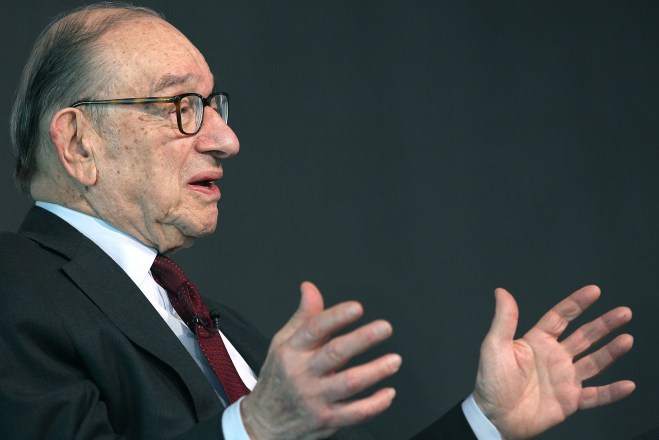
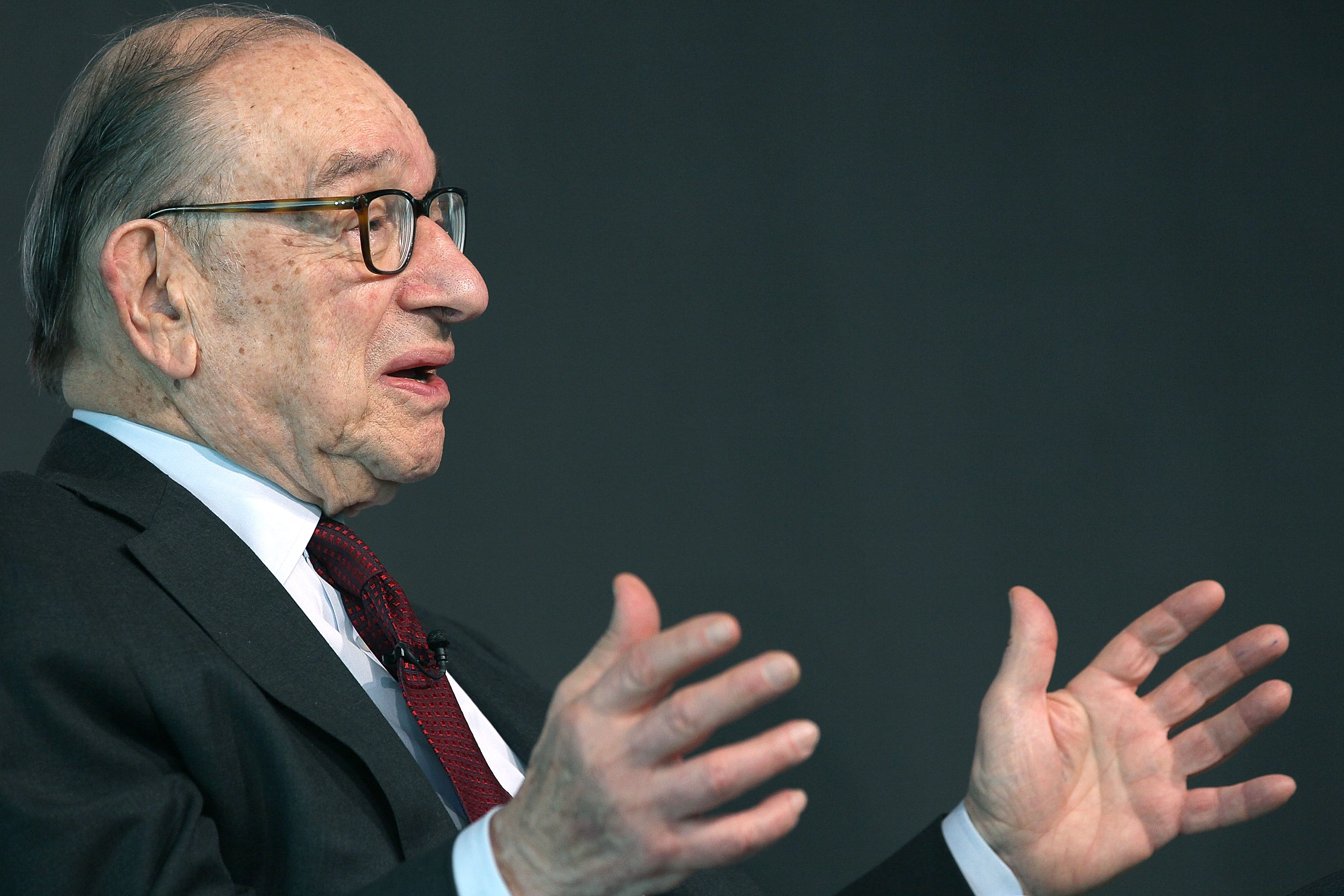
Former Federal Reserve Chair Alan Greenspan Speaks At Bloomberg News Economic Summit

Alan Greenspan is making the TV rounds in support of his new book, and Daniel Dayen is baffled by his warm reception:

So far [on his media tour], he’s gone virtually unchallenged. He has said the 2008 financial crisis “was the first time ever that markets were broken and could not fix themselves” (ever hear of the Depression?), and that he “could have caught a number of different crises” during his tenure at the Fed (which begs the question of why he didn’t). Journalists have asked such penetrating questions as, “You were knighted. Does that come with a title or anything?” …

[A]nyone who’s paid attention to the economy the past few years knows how ridiculous it is to fete Greenspan, the main architect of the policies that led to the Great Recession. If we lived in a just world, we would put him on trial, not on television. And his penalty should be to scrounge up the funds to pay JPMorgan Chase’s $13 billion fine with the Justice Department. After all, that fine penalizes JPMorgan Chase for duping investors into purchasing mortgage-backed securities it knew were stuffed with garbage loans. And nobody in America duped more people – investors, homeowners, you name it – into buying bad loans than Alan Greenspan.

That’s a little too harsh, it seems to me. Greenspan has, after all, admitted his own errors – which is more than most on the right have done. He has been extremely candid about his intellectual blindspot. He is in some degree responsible for the economic collapse, but not in the same way as those bankers who knowingly deceived their customers, and took on risks no one should ever dream of taking on. There is a difference between sins of omission and commission.

And besides, writers have been more critical: Yglesias calls Dayen “too soft” on Greenspan, while Krugman describes The Map and the Territory as “a really terrible book on multiple levels.” Plus, the NYT and WaPo reviews have hardly been complimentary. In some ways, I think going out there with a book is an act of minor courage. Better then refusing to concede error, and throwing spitballs at others dealing with the mess.

(Photo by Mark Wilson/Getty)
Will The GOP Overplay Its Hand?

Drum wonders whether Republicans can capitalize on the Obamacare fiasco:

There’s plenty of meat available in an investigation of the Obamacare rollout. But a good investigation will go slowly, taking pains not to drown officials in a blizzard of subpoenas while they’re in the middle of fighting a fire. A good investigation will also focus a lot of its effort on real issues of procurement and how the federal government handles IT projects. It won’t be just a fishing expedition for emails that might be embarrassing to Obama staffers. …

Can Issa restrain his attack dog personality enough to understand that? Will the tea party caucus allow it? Or will the whole thing quickly devolve into a barrage of subpoenas that are so obviously politically motivated that no one takes them seriously anymore? We’ll see, but I’d put my money on the latter right now.

Waldman places the same bet:

If you’re a Republican member of Congress, this is coming at a critical time, because it’s around now when your potential primary opponents are deciding whether they want to run against you in next year’s election. That gives you an incentive to prove to the folks back home that you’re as conservative as the nuttiest Tea Partier. It isn’t hard to do, really—all that’s necessary is to go on television and tell the Fox News host that you’re deeply concerned that Healthcare.gov was intentionally made to work improperly as a pretext for the socialist Obama administration to collect all our DNA to facilitate herding us into FEMA concentration camps (or something like that). Which helps make your primary challenge less likely, but doesn’t serve the party’s larger purpose of convincing the American public that the GOP is not, in fact, a party of extremists who don’t care about governing.

Quote For The Day

“Our side is winning on gay marriage for a very simple reason, which is that millions of mothers think, ‘I didn’t choose for my kid to be gay, but since he is, I hope he settles down with the right person.’ I have never, ever heard a mother say ‘I didn’t choose for my kid to want multiple mates, but since he does, I hope he settles down with the right three or four women.” Isn’t it time writers like [Mona] Charen and [Ryan] Anderson dropped this trope?” – Wally Olson.

Hewitt Award Nominee

“Someone had posted something with a picture of Barack Obama and across it said ‘traitor.’ And, you know, I don’t always agree with the guy, I certainly didn’t vote for him but I gotta defend him on this one. I just don’t think it’s right at all to call Barack Obama a traitor. There’s a lot of things he’s done wrong but he is not a traitor. Not as far as I can tell. I haven’t come across any evidence yet that he has done one thing to harm Kenya,” – Larry Pittman, North Carolina state representative.

Will Democrats Campaign On Cannabis? Ctd

Like Bernstein and Yglesias, Nate Cohn suspects so:

Marijuana legalization may be increasingly popular, but it’s not clearly an electoral bonanza. Support for legalization isn’t very far above 50 percent, if it is in fact, and there are potential downsides. National surveys show that a third of Democrats still oppose marijuana legalization. Seniors, who turnout in high numbers in off year elections, are also opposed. Altogether, it’s very conceivable that there are more votes to be lost than won by supporting marijuana. After all, marijuana legalization underperformed President Obama in Washington State.

Even so, Democratic voters will eventually prevail over cautious politicians, most likely through the primary process. Any liberal rival to Hillary Clinton in 2016 will have every incentive to support marijuana legalization.

But David Harsanyi sees few signs that legalization is becoming the new marriage equality:

Where you stand on gay marriage has become something of a bellwether in Beltway circles, indicative not only of your cultural awareness and political IQ, but your prospects. Either you get 21st century America or you don’t.

Well, what about the Drug War?

As far as I can tell, not a single elected official in Washington actively supports marijuana legalization. Not a single governor. Not a single Senator. And, moreover, few of them have been asked, much less seriously pressed, to explain where they stand on the issue. Some unlikely counterintuitive voices pop up here and there – Tom Tancredo, former congressman, anti-immigration activist and candidate for governor of Colorado and Sen. John McCain are to examples of politician who, to varying degrees, have been open to marijuana legalization – but, despite the growing popularity of the position generally, it’s basically a non issue.

Jonathan Bernstein adds:

Politicians “evolving” on marriage were only worried, really, about current opinion. I’m pretty sure they didn’t worry about a backlash if marriage equality was enacted, and certainly not that if marriage equality took place that newspapers might start running gay marriage horror stories … But politicians will worry that if they support legalization that they could be held responsible for any weed horror stories that emerge — and everyone knows that the press is capable for concocting those, true or not.

Dog Doppelgängers

There’s some science to the old adage that pets look like their owners:

119939095_b88a06e3cc_bResearchers around the world have repeatedly found that strangers can match photos of dogs with photos of their owners at a rate well above chance. Perhaps people are drawn to animals that look like them. In a study of female college students, those with longer hair judged flop-eared dogs—spaniels, beagles—to be more attractive, friendly, and intelligent than dogs with pointy ears; women with shorter hair concluded the opposite. And the apparent affinity between owners and pets is more than fur-deep: One analysis found self-described “dog people” to be less neurotic than “cat people,” who were more curious. Another study, which cross-referenced personality-test scores and breed preferences, noted that disagreeable people favored aggressive dogs.

While the Law of Attraction—like attracts like, or in this case, adopts like—might explain some of these similarities, there’s reason to think pets also emulate their owners.

A 2011 study found that dogs tasked with opening a door preferred whichever of two methods of door-opening they had just observed their owners use (head or hands/paws), even when offered a treat for the opposite choice. Researchers concluded that dogs possess an “automatic imitation” instinct that can override both natural behavior and self-interest. Dogs are also more susceptible to yawn contagion (an indicator of social attachment) when it’s their master, rather than a stranger, doing the yawning.

Wouldn’t you like to meet the owner of this pup?

1383959_10151948957644508_1092920932_n

(Bottom photo from Carli Davidson‘s Shake, a new coffee-table book you can order here. Live-action book preview here. Top photo from Flickr user Anjuli)

Spying Isn’t Always In Our Interests

Rothkopf is in the camp that feels the NSA’s snooping has gone too far:

Yes, many governments spy. But so too do all countries have armies, police forces, and tax codes. In each instance, the question is not whether to pursue the activity — it is how to do it, how to limit it, and what values should underpin it. Our spying has overreached. We took risks we shouldn’t have for rewards that were too limited. Even when there were perceived threats that seemed to warrant these activities (and that cannot be the case in some of the recent examples we have encountered of spying against friends and companies), many of those threats may themselves not have been so great to warrant the risks associated with spying. What if the NSA scandals result in a more fragmented global Internet? What if they are used as an excuse by repressive regimes to violate their own citizens’ privacy? What if they are used as an excuse to deny U.S. companies access to their markets? What if they are used as an excuse to justify similar actions against the United States?

Keating doesn’t think we can brush off the NSA’s wiretaps as spying as usual:

Even if allied governments assumed this type of spying was going on, the scale of these programs, the targets involved, and the newness of the type of spying mean the governments involved have to come up with some sort of political response. Those who brush this off as no big deal should also think about how we would react if the situation were reversed. Yes, we know that there are foreign spies, including those from friendly governments, operating within the United States. But if credible reports emerged that the Mexican government was tapping Barack Obama’s BlackBerry or that France was monitoring thousands of American phone calls, do we really think American news outlets and politicians would just brush it off as the price of doing business? (Also, someone should ask Jonathan Pollard if a little espionage between friends is no big deal.)

At this point, it also seems highly doubtful that Brazil, Mexico, and Germany would be the only governments the U.S.  is conducting this type of surveillance on. We’re likely to see more shoes dropping and a lot more diplomatic impact.

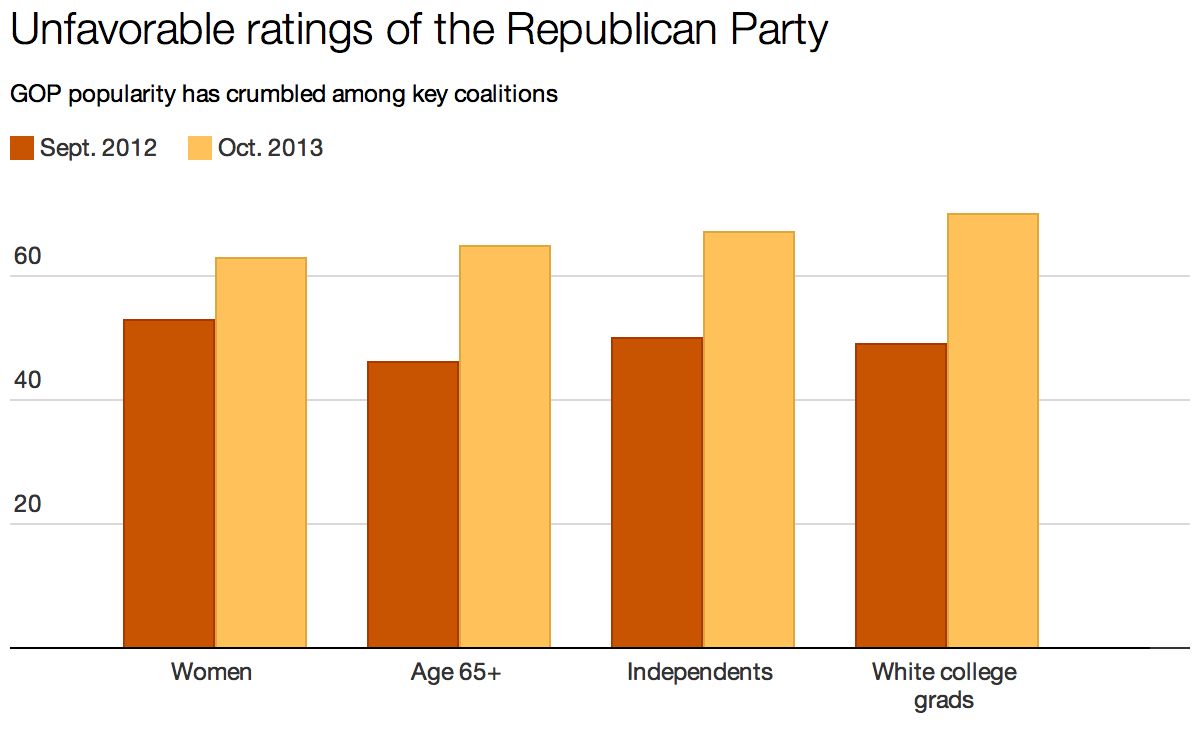
Chart Of The Day

GOP Brand

Sargent breaks down the Republican party’s unpopularity:

Polling released this week by the Washington Post and ABC News found the GOP’s unfavorability ratings among Americans at an all-time high of 63 percent. But a closer look at the numbers reveals that this has been accompanied by a massive collapse in 2013 of the GOP brand among core constituencies important in midterm elections: Independents, women, and seniors. The crack Post polling team has produced a new chart demonstrating that in the last year — since just before the 2012 election – there’s been a truly astonishing spike in the GOP’s unfavorable ratings among these core groups

The Crystal Ball has put out new House rankings:

To sum it up, the race for the House is getting more interesting by the day.

Republicans remain favored to retain control — call it Likely Republican in the parlance of our ratings — but the shutdown has shaken things up. At this point, we’re now expecting a small Democratic gain, instead of the small Republican gain we were forecasting earlier in the cycle. That prognostication is likely to change once Congress tackles the same old fiscal deadlock in January and February. Have Republicans learned anything from their October debacle? We shall see.

Nate Cohn remains cautious:

If there’s anything I could get people to understand about the next election, it’s this: Even a 2006 or 2010-esque tsunami might not give Democrats control of the House. That might seem shocking. In 2006, Democrats won 31 seats; Republicans won 63 in 2010. Today, Democrats only need 17 seats—which might not sound like much. But the fact is that Republicans just aren’t exposed. To turn the “tsunami” into an extended metaphor, an unprecedented share of the Republican caucus has evacuated to high ground.