Coverage You Can’t Keep

Over the past few days, there have been several stories like this one:

CareFirst BlueCross BlueShield is being forced to cancel plans that currently cover 76,000 individuals in Virginia, Maryland, and Washington, D.C., due to changes made by President Obama’s health care law, the company told the Washington Examiner today. That represents more than 40 percent of the 177,000 individuals covered by CareFirst in those states.

More examples:

Florida Blue … is terminating about 300,000 policies, about 80 percent of its individual policies in the state. Kaiser Permanente in California has sent notices to 160,000 people – about half of its individual business in the state.  Insurer Highmark in Pittsburgh is dropping about 20 percent of its individual market customers, while Independence Blue Cross, the major insurer in Philadelphia, is dropping about 45 percent.

Last week, Bob Laszewski explained what’s happening:

The U.S. individual health insurance market currently totals about 19 million people. Because the Obama administration’s regulations on grandfathering existing plans were so stringent about 85% of those, 16 million, are not grandfathered and must comply with Obamacare at their next renewal. The rules are very complex. For example, if you had an individual plan in March of 2010 when the law was passed and you only increased the deductible from $1,000 to $1,500 in the years since, your plan has lost its grandfather status and it will no longer be available to you when it would have renewed in 2014.

These 16 million people are now receiving letters from their carriers saying they are losing their current coverage and must re-enroll in order to avoid a break in coverage and comply with the new health law’s benefit mandates––the vast majority by January 1. Most of these will be seeing some pretty big rate increases.


Level With Us, Mr. President

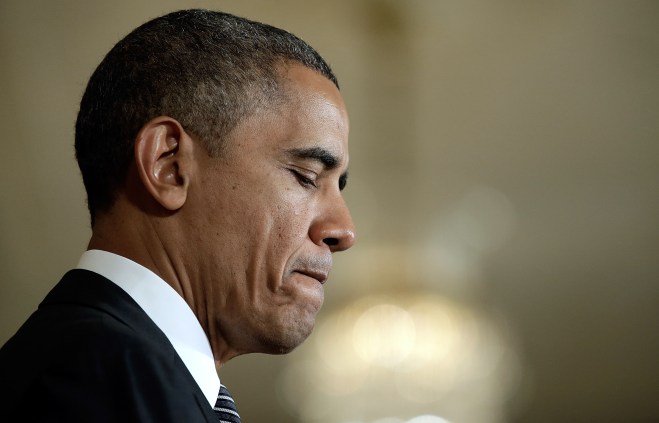
President Obama Discusses Immigration Reform At The White House

Barro wants some straight talk:

The administration is still behaving like it is trying to get Obamacare enacted, and therefore its top public relations task is to bury negative stories about the law and emphasize the upside, like heavy consumer interest. But this is a mistake. Obamacare is already the law, and its long term political success is going to be determined by its substantive policy success — including whether consumers are able to sign up and get the health coverage they want.

There’s no reason not to level with the public right now, unless the truth is so horrible and the website is so un-fixable that Obama administration officials can’t bring themselves to discuss the matter publicly. I suspect that’s not the case. But I’d feel better if they stopped trying to sell the line that the issue here is basically a great product whose website is getting overwhelmed by intense interest, and started speaking frankly about what’s wrong and how they’re fixing it.

Couldn’t put it better myself. Charlie Cook also has a typically shrewd take – even as Captain Hindsight. From the get-go, there has been what you might call a defensive-aggressive approach to the ACA. By defensive-aggressive, I mean a classic Democratic trait which is to believe that you are more enlightened than the country at large and must therefore govern with both relentlessness and some degree of stealth. The Republican refusal to engage constructively on the question made this much worse, of course. But the blame lies, in the end, with the president. He should have been far more proactive and forthright about the desperate need for reform, and never stopped making those core points. He was admirably persistent in pushing this reform through, but so far from persistent in making the case for it.

Yes, he got universal healthcare through an American polity usually incapable of producing such major policy shifts – besting Nixon and Clinton. But he did so by maneuvering deftly through the system, rather than making it a constant refrain in his public appearances. He has made some great speeches on this, but if it is your core domestic initiative, you have to be much more relentless in your explanation and persuasion. I know the presidency is a tough job, and God knows he has had a lot on his plate – but he’s the one who insisted (rightly) that a president must be able to walk and chew gum at the same time.

Perhaps spooked by the 2010 Congressional elections, the president pocketed his controversial domestic win and then laid low. Healthcare was not one of his rallying cries in the election – because it was not the most popular part of his agenda. But over the long haul, legitimizing his healthcare law and reminding us of its core gains – lower costs, no bar on pre-existing conditions, and an end to free-riding – was more important than simply securing re-election the least difficult way. Then, too defensively, the Obama team waited until the website roll-out to make their case – hoping, presumably, to capitalize on what they imagined would be a great online experience. Then came the mismanaged disaster, followed by ever more defensive – and somewhat opaque – public statements. Kathleen Sebelius’s appearance on the Daily Show (a key demographic for the law) was one of the worst performances I’ve ever seen of a public official defending her own work. It was a textbook case in how not to talk to the public. It has gone downhill from there, including the president’s super-lame Rose Garden mix of ebullience and defensiveness.

What we need is candor. We need the president first of all to take personal responsibility for this failure. He needs to apologize to the country for what was either terrible executive branch management or negligence. And he needs to fire those responsible as a simple matter of accountability. If he had no clue of the train-wreck, his administration is not functioning correctly.  The problems were foreseen as long ago as this spring by Max Baucus. He wasn’t clairvoyant about the website, but he presciently warned of a looming train-wreck because the exchanges would not be ready on time and because the administration had done such a piss-poor job of communicating the core provisions to the public. He was in constant touch with Sebelius, and regarded their exchanges as futile.

This is not about the concept of the ACA – although its complexity, a function in part of the political Rubik’s Cube any healthcare form needs to solve in America, is an obvious weakness (Ross Douthat’s examinations of that are enlighteningly fair-minded). This is about competence and confidence. If the federal government were a business, and the ACA were a new product, its stocks would be in the toilet right now. If Apple made an iPhone that experienced massive failures on the consumer end from the start, it would be withdrawn. But, of course, the government is not a business, and the ACA is not just a product but a law. But competence still matters a huge amount.

I’m sure many are working furiously to fix the website problems. Things may work out in the end, as they did in Massachusetts and with Medicare D, after early choppy waters. But competence also requires confidence. Confidence requires extreme candor from the top. Stop trying to sell a product people cannot easily buy. Explain why this happened, and who has taken responsibility. Fire them. Apologize. Be totally forthright about everything you know. Explain the plan to fix it – clearly. Reiterate the core goals of the law – with an emphasis on its many popular aspects. If some kind of delay is needed, say so now. Don’t stumble back into it later. Or do it in embarrassing half-ass stages.

This is basic public relations. It should be reflexive for a president who told us he would admit error when he has screwed up, unlike his predecessor. Instead, we have defensive acknowledgments of the bleeding obvious, and a drip-drip-drip of bad news leaking from congressional hearings and reporters. At this point, the president is behind the ball. He needs to get ahead of it – and fast. Or he will begin to look like George W Bush spinning his Iraq fiasco. Unlike Bush, Obama has many supporters prepared to confront and criticize him publicly, which is a help. The president now needs to rise to this occasion or have his own singular policy choice, like Bush’s, become a synonym for government incompetence. Confess, Mr President. Americans forgive failures explained forthrightly. They rightly never forgive those who cannot plainly and clearly admit error and take responsibility.

(Photo by Win McNamee/Getty)
Hypocrisy As A “Key Strategic Resource”

Henry Farrell and Martha Finnemore assert that “the deeper threat that leakers such as Manning and Snowden pose is more subtle than a direct assault on US national security: They undermine Washington’s ability to act hypocritically and get away with it”:

Of course, the United States is far from the only hypocrite in international politics. But the United States’ hypocrisy matters more than that of other countries. That’s because most of the world today lives within an order that the United States built, one that is both underwritten by US power and legitimated by liberal ideas. … This system needs the lubricating oil of hypocrisy to keep its gears turning. To ensure that the world order continues to be seen as legitimate, US officials must regularly promote and claim fealty to its core liberal principles; the United States cannot impose its hegemony through force alone. But as the recent leaks have shown, Washington is also unable to consistently abide by the values that it trumpets. This disconnect creates the risk that other states might decide that the US-led order is fundamentally illegitimate.

Agreed. And this is one of liberalism’s great weak spots. It cannot abide hypocrisy while never fully understanding how, in a fallen world, it is a key lubricant for almost all human society. As someone once wrote, hypocrisy is the tribute vice pays to virtue. It reflects the simple fact that we cannot live up to the ideals we often have. So they keep some things on the down-low. This is true of all of us, including governments. Most marriages, for example, could not survive total transparency. The manifold husbands staying up late to jack off on the computer downstairs do not want to tell their wives, because it would hurt the marriage they actually want to keep. But they cannot help their sex drive, the power of novelty in sexual attraction, or the astonishingly easy access to porn morning, noon and night. So discretion in these cases – which can be a form of hypocrisy – is the norm.

In other words, hypocrisy – of the mildest kind – makes marriage possible. It makes any relationship – business or otherwise – possible. It makes statecraft particularly possible in ways Glenn Greenwald, I’m afraid, has not fully accepted. I’m not defending unnecessary secrecy or lack of democratic accountability and a certain degree of transparency. I’m defending a more pragmatic approach to how we actually live our lives in society and how some level of hypocrisy makes that possible. Hypocrisy is also a two-way street. Are we supposed to believe that the aggrieved Angela Merkel does not have her own espionage capacities, does not spy on other countries, does not scoop up intelligence? Of course not. Yet we respect her complaints as a necessary form of hypocrisy.

Because fully exposing that hypocrisy, however noble and exhilarating, takes a toll on how the world is governed, and how countries are defended. Writing elsewhere, Farrell notes that American leaks are also putting foreign governments, such as Brazil’s, in a tight spot:

Leaked documents from Manning, Snowden and others are making it much harder for other states to pretend that they don’t know what the US is doing. The US is less able to hypocritically pretend that it’s not doing stuff that it is doing, while other states are less able to hypocritically ignore what the US is doing. The result is that systematized hypocrisy is becoming a lot more costly for the US  than it used to be.

Joshua Foust is troubled:

Seen this way, you could envision all of these disclosures from Snowden not to be a defense of civil liberties  –  the documents moved past that a while ago. And it is important to remember: the NSA is legally obligated to surveil foreign communications — that is its explicit purpose as constructed by US law. Rather, they are an attack on the very existence and behavior of the US intelligence community. That may be something some of the most ardent anti-NSA activists, such as Glenn Greenwald, are comfortable doing. But it should raise all sorts of uncomfortable questions among those who merely want reform. Putting the US at a stark disadvantage compared to its most active rivals and competitors  – neither Russia nor China face nearly as much scrutiny in their intelligence activities, for example  – is difficult to see as anything other than an attack on the US, not a defense of anyone’s rights.

Farrell disagrees:

This seems to me to be basically mistaken. If Snowden, or Greenwald, were looking simply to ‘attack’ the US, they would be behaving in very different ways. It is pretty clear that they are (or, in Snowden’s case, were) sitting on a hoard of material, some of which is potentially far more damaging to US intelligence (by revealing methodologies, etc.) than anything they have revealed. What they have chosen to reveal is embarrassing, and revelatory of US hypocrisy, rather than striking at the heart of NSA methodologies. You may like this, or dislike this, depending on your political druthers. But it is far closer to the kinds of actions that human rights NGOs engage in than the kinds of action that spies do.

NGOs are under few illusions about governments’ profound commitment to human rights, civil liberties and so on – most governments, much of the time, are prepared to water these commitments down where it is expedient, when they do not abandon them altogether. So what NGOs do is to play the politics of hypocrisy against states, strategically revealing hypocritical behavior so as to embarrass governments into behaving better. Snowden’s and Greenwald’s actions seem to fit very well into this framework.

Drezner adds:

Going forward, it will be interesting to see whether the Obama administration adopts new policies and rhetoric designed to reduce the exposed levels of hypocrisy. So far, administration officials have veered in the opposite direction – the mantra of “we’re only using this super-high-powered surveillance stuff on foreigners, not Americans” has tarnished America’s image abroad even more.  Unless the US government changes its tune, then we’re about to get a good empirical test of what happens when the hegemon’s “lubricating oil of hypocrisy” evaporates.

That would not be pretty.

Streaming The Small Screen

Netflix Subscribers

Alyssa sees Netflix focusing more and more on television instead of movies, noting that subscribers are more likely to stick around for a longer series, and that the TV format allows for the production of more content for less:

Netflix can spend $100 million on 26 hours of House of Cards programming, where if it wanted to compete and film blockbusters, $100 million might only buy the company 90 minutes of programming. And the investments Netflix makes in sets for television shows can amortize over years of production if a show is successful. The question of syndication costs is trickier, but the basic equation remains the same–Netflix needs a huge volume of content, and a larger overall investment in a television show may be much more worthwhile for Netflix if the cost per hour is lower. It’s true that on the call with investors, [Chief Content Officer Ted] Sarandos suggested he’d be interested in documentaries–which come with a much, much smaller price tag–and movies that Netflix might be able to have first runs on. But he’s not going to get into the hugely expensive sports market. And I’d imagine that whatever movies the company does pursue will have price tags in keeping with their value to the company.

Derek Thompson comments on the remarkable growth of Netflix’s subscriber base:

[M]ore Netflix consumers are clearly good news for Netflix consumers. If Netflix can get one to two million more people to pay $7.99 for its service each quarter, it doesn’t have to raise prices on existing customers. Indeed, Netflix hasn’t changed its monthly fee ($7.99) for the last two years, which means streaming TV is actually getting cheaper each year in inflation-adjusted terms. That’s amazing. Even more amazing is Hastings spending hundreds of millions of dollars (amortized over who-knows-how-long) on new contracts with Disney and exclusive rights to shows like “House of Cards” and “Orange Is the New Black.” If it needs 1-2 million more customers each quarter to keep revenue and net income targets, then so far, so good …

(Chart from Zachary Seward.)

How Much Carbon Must We Remove?

Scott K. Johnson spotlights a recent study by Andrew MacDougall on what is would take to return to a pre-industrial climate:

Because warming causes additional carbon to be released into the atmosphere, such as is the case with thawing permafrost, we’ll actually have to remove significantly more CO2 from the atmosphere than we put there by burning fossil fuels. In fact, we’d have to remove roughly 40 percent more in the model simulations. … The study concludes, “These results suggest that even with monumental effort to remove CO2 from the atmosphere, humanity will be living with the consequences of fossil fuel emissions for a very long time.” Solutions that limit the amount of CO2 we end up emitting this century are investments. Not only do they obviously pay off in terms of warming avoided, but they also lessen the burden on future generations should they try to clean up the atmosphere they inherit.

Kids Keep It Real

Reviewing MasterChef Junior, Willa Paskin concludes that regular kids are ideally suited for reality TV:

Like all engaging reality TV stars, the junior chefs are unburdened by self-consciousness, but because they are preteens, this is age-appropriate and not a manifestation of narcissistic personality disorder. They have endearing personalities without all the triangulation and effort that goes into being a “personality.” Jack is a 10-year-old from the Rockaways, an old man stuck in a little boy’s body, with a kind, conciliatory spirit, a tendency to collapse on the floor with relief, a collection of Hawaiian shirts, and an old-school New Yawk accent. Sarah, blond and 9, is scared of nothing but clowns. Troy hides a bossy streak and preternatural skills under SoCal bangs and intonations: “Is it going to be duck, chicken, or horse?” he asks the camera. “You never know, man.”

And compared with adults, they’re remarkably gracious in defeat:

The contestants don’t always take [losing] well, but they take it so much better than just about every grown-up I’ve ever seen getting eliminated from a reality show. They lose, they tear up, they wipe off their tears and then say how much fun they had, and how great they feel to have gone this far. For grown-ups, a competition show is a referendum on their life’s work or dreams. But the kids on MasterChef get to go back to full lives – school, family, hobbies, friends, and yes, cooking – having gotten to spend time in a place as cool as the MasterChef test kitchen, their life’s work still ahead of them.

Your Spouse Makes You Take Seconds

Brian Palmer investigates why married people are more susceptible to obesity:

The nature of the connection between marriage and weight gain is a matter of conjecture. One plausible explanation is the “marriage market hypothesis”: Single people remain thin for no other reason than to attract a mate. Once you’ve legally obligated someone to stick with you through sickness and health, there’s no compelling reason to eat right and exercise.

But that theory flies in the face of the overall marriage protection hypothesis. If people quit smoking, wear sunscreen, and eschew suicide for the sake of their families, why would they allow themselves to become obese? (It’s important to note that mere age is not the explanation for the link between obesity and marriage. Researchers control for our tendency to gain weight as we get older, and the correlation is still easily detectable.)

There may be a simple explanation: People eat more when they’re together.

Update from a reader:

Here’s another reason, which I’m surprised I didn’t see in the post: if I don’t go back for seconds, my wife doesn’t think I like what she cooked.

Another:

It’s funny for me that you bring this up. Last night my wife said to me, “I’ve lost 7 lbs. I think this ‘having no food in the house’ thing might be working.”

Now it’s true that we’re scraping by these days, but our house is by no means empty of food. Our refrigerator is stuffed full. What she means, whether she fully realizes or not, is that scraping by means going without all the hyper-processed, junk-food extras that are often in abundant supply in our house.

As that last comment probably indicates, the two of us differ in our opinion of food and how to shop for it. I’m the cook in the house, so I shop for preparing meals. When my wife goes shopping, she buys to eat. Her grocery bill is often 50% – 100% more than mine because I tend to buy the basics, while she buys whatever grabs her fancy.

How is this relevant? Because if it’s in the house, I’ll eat it too. I know I will. That’s why I don’t buy it. Still, I’m struggling with my weight because if I have it in my mind to prepare the chicken I bought for this week, but come home to find my wife about to stick a frozen pizza in the oven, I’ll cave. Rather than stop her and insist I prep the chicken breast, I tell myself that we’ll have it tomorrow night.

Being married means I have my own enabler.

Another:

Yes, married people are heavier over time than non-married people. But the two factors not mentioned in the post are that married women are more likely to have children than single women (which typically increases weight, thereby skewing the average), and more importantly the greater likelihood of the presence of children contributes to physical and psychological exhaustion for both men and women. And study after study shows that we eat more when we are less rested.

The Pitfalls Of Rape Prevention, Ctd

A reader writes:

I cannot believe we’re still having this debate. As always, people who should know better like to combine and muddy issues that should be clear.

1) Of course the fault of rape lies with the rapist. Entirely and totally.

2) Talking about how to avoid rape isn’t about fault. It’s about how to deal with a flawed, screwed-up world. Given the fact there are people (mostly men) who rape, how do you deal with that?

I mean, who ever thought you could stop murders by telling murderers to stop? Or robbers to stop robbing? The world is full of bad people who commit all manners of crimes. Trying to prevent those crimes has nothing to do with making the victims at fault. But it is still practical and important. I don’t understand why so many people cannot handle the simple explanation: “If you get really drunk, you put yourself at risk of a large range of crimes from bad people. Rape isn’t the only one, but it is a major one. It’s not your fault, but it is a danger.”

As always, it’s the “should” that kills people. No one should go hungry. No one should be raped. The world should be more fair and equitable. Yes, but so what? “Should” is small comfort for those who’ve discovered that the world is built on what “shouldn’t”, not “should.”

Another suggests:

Here’s a proposal for how we can give gender-neutral advice to people new to drinking: the buddy system.

Like swimming, drinking is an activity where everyone should have a buddy: Nobody should drink alone, nobody should go home without knowing that their buddy is safe for the night. This holds for both men and women – anyone who is up for a night of serious drinking is at risk of making stupid decisions. Run these decisions by your buddy first, that’s all we’re saying. And if two drunken people do want to hook up, their buddies can at least check that both participants are conscious enough to discuss condoms.

This is not the same as a designated driver – your buddy can drink too. But it’s someone who will come check on you if you vanish into a back room, or if you start walking down the middle of the highway, or fall asleep in a puddle of puke. And someone to remind you (and someone you will remind) that you agreed not to do shots that night.

Another reader:

The controversy surrounding Emily Yoffe’s warning reminds me of my days as a resident adviser back in the mid-1980s. In our RA training, alcohol consumption got a lot of attention, and one point I particularly remember was that drunkenness made people more likely to commit crimes and more likely to be the victims of crime. The advice was directed equally at women and men.

But something else came up the year I was an RA, and the double standard got to me. At an RA meeting, some male RAs brought up the fact that they had seen some female residents asleep in their rooms while their doors were open. The male RAs’ concern stemmed from fears that a wayward male might take that situation as an invitation. It had happened; there had been reports at our campus of young men just walking into dorm rooms and getting into bed with women they hadn’t met.

On the one hand, I could understand the concern. On the other hand, I didn’t like the tone. I remember a statement to the effect of, “Someone needs to talk to those girls and tell them they’re really asking for trouble.” The thing is, Andrew, if a guy fell asleep while his door was open, nobody would have thought twice about that. Maybe he didn’t face the same risk as a female, but to doze off in an open room was (so far as I could tell) unconsciously assumed to be a male student’s right and a female student’s poor judgment.