Cybersquatting At .онлайн

Now that there are Arabic, Chinese, and Russian alternatives to “.com”, Leo Mirani predicts a “digital land rush”:

Until yesterday, there were only 22 gTLDs [generic top-level domains], all in the Roman script. Now there are 26, and .website, .fish, .discount and .lawyer are also on their way. The four new domains are .онлайн and .сайт (Russian for “online” and “site”), .شبكة (Arabic for “web”) and .游戏 (Chinese for “game”). The new gTLDs present a huge opportunity for speculators – sometimes uncharitably referred to as domain squatters – who register hundreds of domains in the hope that someone, someday, will pay big money for them.

ICANN has taken steps to prevent the most egregious of such cases.

To begin with, 629 words and phrases are off limits entirely. These include addresses that could be used for the International Committee of the Red Cross, the International Olympics Committee and dozens of obscure intergovernmental bodies such as the International Olive Oil Council. Moreover, registrations for the new gTLDs will open to the public only after a “sunrise period” of at least 30 days, which is reserved for trademark holders to register their domains on new gTLDs. … There is no restriction on common nouns, however. That means the Arabic, Russian and Chinese Internet are about to create a few new millionaires, if past experience is anything to go by.

Beard Of The Week

Meanwhile, Salon gets all paranoid:

“Duck Dynasty’s” bearded male stars offer a symbolic reaffirmation of traditional values onto which many Americans threatened by social change can latch.

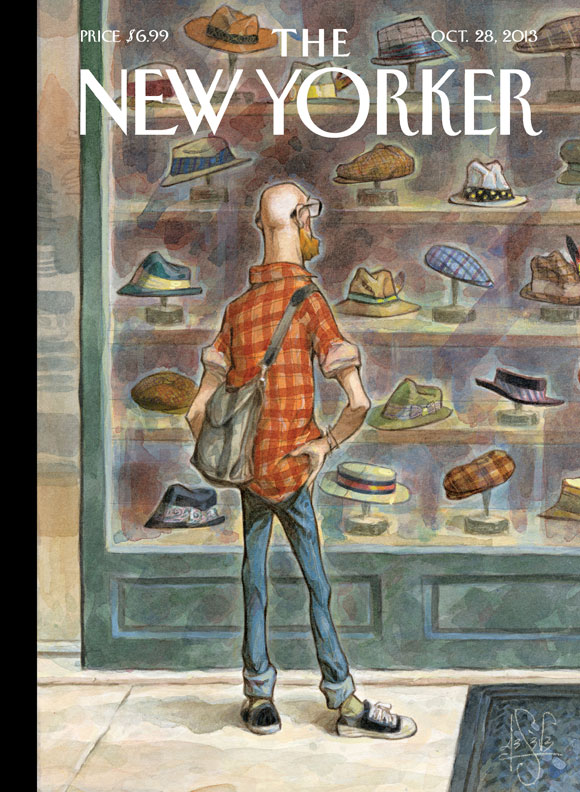
So where are all the big-bearded Republican candidates? And, er, how do you account for Brooklyn? Meanwhile, a runner-up for Beard of the Week:

CVC_TNY_10_28_13_580px

The Mandate Gets Delayed, A Little

Late yesterday, the administration announced a six-week individual mandate delay. Originally, even though open enrollment lasts through the end of March, individuals would have needed to buy health insurance by February 15th in order avoid a penalty. Sarah Kliff reported the news:

They are allowing anyone who purchases coverage during open enrollment (up through March 31) to not face a tax penalty for those three months they spent uncovered. This is only true for people who buy coverage through the marketplace.

How much this change had to do with HealthCare.gov’s technical problems isn’t totally clear. On the one hand, it certainly helps alleviate some of the time pressures on the administration if it can give shoppers six additional weeks to purchase coverage. On the other, it’s easy to see this change getting made in any situation. It’s confusing to have two separate deadlines, one when the individual mandate kicks in and another when shopping ends. Either way, now those two dates are the same. The mandate kicks in and open enrollment ends for exchange shoppers on March 31.

Chait bets that “the two deadlines for enrollment and avoiding a penalty, probably would have happened even if HealthCare.gov wasn’t a glitchy mess.” Drum isn’t so sure:

I’m a little surprised the administration is taking this action so soon. After all, if the Obamacare website is up and running by mid-November, that should still leave plenty of time for everyone to meet the old deadline. This suggests that the White House has already concluded that fixing the online application process is going to be a long slog.

Meanwhile, Democratic Senator Joe Manchin will submit legislation to delay the individual mandate by a full year. Chait unpacks the politics of this move:

It’s a pure political maneuver by vulnerable Democrats to insulate themselves from an unpopular national story. And as political theater, it’s a fairly clever maneuver. President Obama could simply veto a legislative delay if it passes. It would have been harder for him to veto a bill delaying the individual mandate if it were tied to reopening the federal government or lifting the debt ceiling. The individual mandate lets red state Democrats engage in some relatively harmless distancing rituals.

Pierce piles on:

If Manchin wants to delay the mandate because he doesn’t like it, he should say so, and he should admit [that] he doesn’t like the law, period, because, otherwise, he’s saying he likes the law, but not the parts that make it work, and that would be a really dumb thing to argue.

Happy Birthday, Brain Pickings!

newsletter_new

Yesterday, friend-of-the-Dish Maria Popova’s wonderfully curated website and newsletter, Brain Pickings, turned seven. There’s really nothing quite like it on the web – a labor of love that consistently turns up the most enriching literary and cultural artifacts, from the daily routines of famous writers to the 100 ideas that changed graphic design. When I look around the web for sites that really do value intelligent content over page-view whoring and advertizing-disguised-as-editorial, Maria’s singular blog perches head and shoulders above the rest.

I’m in awe of her intellectual range and boundless capacity for reading, reading, reading. She is a walking rebuttal to the idea that new media cannot sustain and further deep reading and writing. I see that as the great challenge editorially online – finding a way to harness the energy and curiosity of the web to lead away from ADD listicles and GIFs and toward more long-form reading, complicated thought and intelligent, informed conversation.

Here’s how Maria describes the remarkable growth of her venture:

On October 23, 2006, I sent a short email to a few friends at work — one of the four jobs I held while paying my way through college — with the subject line “brain pickings,” announcing my intention to start a weekly digest featuring five stimulating things to learn about each week, from a breakthrough in neuroscience to a timeless piece of poetry. “It should take no more than 4 minutes (hopefully much less) to read,” I promised.

This was the inception of Brain Pickings. At the time, I neither planned nor anticipated that this tiny experiment would one day be included in the Library of Congress digital archive of “materials of historical importance” and the few friends would become millions of monthly readers all over the world, ranging from the Dutch high school student who wrote to me this morning to my 77-year-old grandmother in Bulgaria to the person in Wisconsin who mailed me strudel last week. (Thank you!)

Later in the post, she offers seven lessons she’s learned from seven years of writing. One of them? “Allow yourself the uncomfortable luxury of changing your mind”:

Cultivate that capacity for “negative capability.” We live in a culture where one of the greatest social disgraces is not having an opinion, so we often form our “opinions” based on superficial impressions or the borrowed ideas of others, without investing the time and thought that cultivating true conviction necessitates. We then go around asserting these donned opinions and clinging to them as anchors to our own reality. It’s enormously disorienting to simply say, “I don’t know.” But it’s infinitely more rewarding to understand than to be right — even if that means changing your mind about a topic, an ideology, or, above all, yourself.

Maria gets both the perils and the promise of web journalism. She seems instinctively to understand what I was forced to learn by daily blogging for a decade and more: a mind is a wonderful thing to change.

Yes, It’s A Parody …

… but, like all the best parodies, it’s thisclose to the truth:

In an interview with Fox and Friends this morning, the former Alaska governor promoted her new book about the left’s “war on 51ltBbhsl7L._SX258_BO1,204,203,200_Christmas” and argued that all Christian holidays should return to the traditional versions practiced by Jesus.

“It makes me so gosh darn angry,” Palin explained. “The liberal left in this country has targeted Christian holidays and is trying to secularize them right out of existence. When Jesus celebrated Easter with his disciples there were no Easter bunnies or egg hunts. There were no Easter sales at department stores or parades in the street. Easter was a special time of prayer and Christian activism. Jesus would gather all the townspeople around and would listen to their stories about the meaning of Easter in their lives. Then he would teach them how to love one another, how to protest Roman abortion clinics and how to properly convert homosexuals.”

I know this counts as a relapse, but I just. couldn’t. resist.

A 60-40 Majority For Marijuana Legalization! Ctd

Enten – always a downer – suspects that Gallup’s latest poll is an outlier:

Of the three other polls taken this year, only Pew’s found a majority who believe use of marijuana should be made legal.

Pew’s 52% was far less than Gallup’s 58%, and it, at least, followed the more linear trend of support building slowly over a few years that one might expect. The other two polls conducted in 2013 actually found that more people than not wanted recreational use of marijuana to stay illegal. A survey conducted by Fox News had the number in favor of legalization only at 46%, with 49% opposed. And a Public Religion Research Institute* survey matched the Fox News poll, with 45% in favor of marijuana legalization and 49% opposed

But:

That said, it seems to me that we’re likely heading towards a society in which marijuana will be legal. All pollsters have support for marijuana legalization jumping by about 20 points over the past 20 years. A few more polls that look like the ones from Gallup and Pew will convince me that a majority favor marijuana legalization now.

Just kidding about the downer part. He’s right to focus on all the polls, and not just one, and to see the deeper long-term shifts as the real news here.

Ted Cruz’s Taxpayer-Subsidized Health Insurance

government shutdown debt ceiling

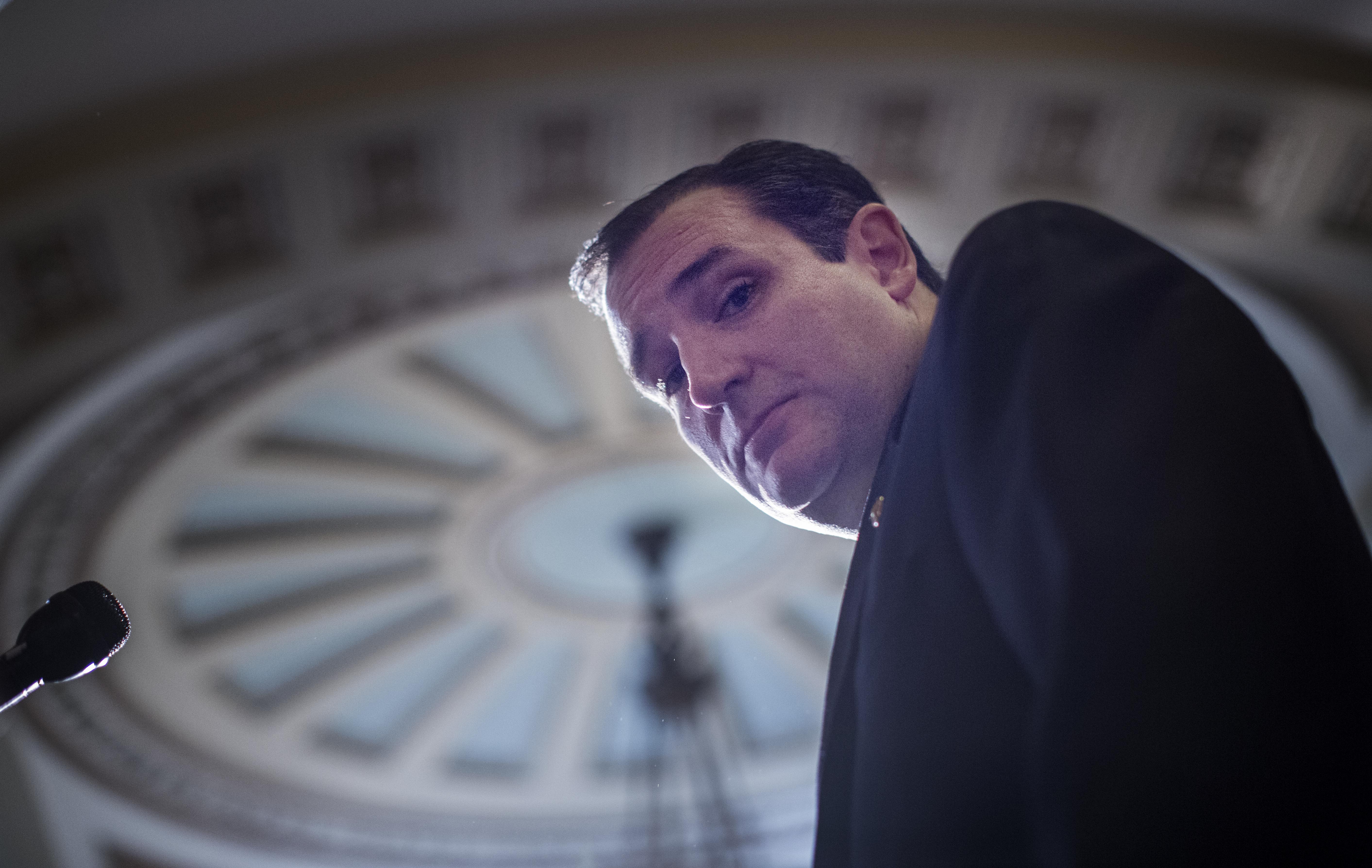
He gets his coverage from his wife’s Goldman insurance policy, which, like all employer-sponsored insurance, is given a juicy tax break. His office does not seem to grasp this elementary fact:

“Ted is on my health care plan,” said Mrs. Cruz, who has worked in Goldman’s investment management division for eight years. Catherine Frazier, a spokeswoman for the senator, confirmed the coverage, which Goldman said was worth at least $20,000 a year. “The senator is on his wife’s plan, which comes at no cost to the taxpayer and reflects a personal decision about what works best for their family,” she said.

No cost to the taxpayer? Nuh-huh:

In fact, the Senator and Mrs. Cruz are probably* getting a bigger tax break than the cost of coverage of a typical, non-elderly Medicaid beneficiary, or even two … (* I don’t know the Cruz’s income with certainty. I think it’s safe to assume it puts them in one of the higher marginal tax rate brackets. A Senator’s salary is $174,000. Ms. Cruz is a managing director at Goldman Sachs.)

Having put the knife in, Austin Frakt wiggles it a bit. Read the whole thing.

Update from a reader:

Ted Cruz released his tax returns during his Senate primary campaign. In 2010, his wife made $360,290 working for Goldman Sachs. Ted made well over $1 million as a partner in his Houston law firm.

So he’s almost certainly costing the taxpayers more than a typical Medicaid beneficiary. Worth knowing.

(Photo by Melina Mara/The Washington Post via Getty Images)

The Decline And Fall Of Christianism, Ctd

The invaluable McKay Coppins – that rare political reporter who understands people of faith – homes in on another aspect of the phenomenon I noted yesterday: the impact of Pope Francis on the evangelical religious right. They’re not happy:

Bryan Fischer, a senior analyst at the American Family Association and devout Christian, said he was “disappointed and alarmed at some of the things the pope said” — a sentiment shared by many of the protestant culture warriors on America’s religious right. “It raises questions in our mind because the Catholic Church has always been a faithful shoulder-to-shoulder ally to social conservatives in the fight to protect unborn human life” and the sanctity of marriage, Fischer said. “We simply have questions of whether we’ll be able to count on the Catholic Church to be comrades-in-arms to continue to fight these battles.”

Fischer is way out there, of course, a near-pathological opponent of homosexual civil equality. But Coppins finds some nervousness among more careful spokespeople like Russell Moore of the Southern Baptists and Tony Perkins. Beneath their statements you can see a clear fissure developing along the ancient Catholic-Protestant fault-line, especially as it relates to politics. Francis is blunt on that:

I say that politics is the most important of the civil activities and has its own field of action, which is not that of religion. Political institutions are secular by definition and operate in independent spheres.

That re-statement of Christianity – as opposed to Christianism – along with Francis’ reframing of evangelization – “Proselytism is nonsense” – could almost be designed to infuriate Protestant Christianists. McKay finds a large fish in a small barrel:

Away from the gaggle of reporters, Tracy Pyland, a born again Christian and Maryland mother of five who came to the conference with her husband and two youngest children, was less diplomatic when asked about the pope’s recent comments. “That’s infuriating. That man needs to read his Bible,” she said.

She hastened to add, “I don’t mean any disrespect, but that man garners a lot respect and he should earn that respect. He should not have done that… He’s not doing the job he was given, which is to represent Christ in a positive light.”

For Christianist Protestants, Francis has not cast the positive light on Christianity the way, er, Bryan Fischer and Tony Perkins and Brian Brown have. That’s not a slight disagreement with most American Catholics. It’s a chasm of difference.

Update from a reader:

I’m very glad you have singled out my fellow Mormon McKay Coppins as a very smart political reporter with lots to say concerning faith and people of faith.  I’ve been a fan of his since he began to work at Buzzfeed – Ben Smith certainly knew what he was doing when he hired him from the Washington Times.

I’m sure Ben knew that Mr Coppins’ shared Mormon heritage would be a valuable asset on the Romney campaign trail, helping to explain, debunk or affirm Romney’s beliefs by someone who really knows his Mormon theology. He was also invaluable in deciphering Mormonism’s distinct (and at times quirky) culture, and that was just as important in my opinion. And his journalism seemed to stay very much in the center of the facts, he did it with a sensitivity to his own faith, as well as those of other Republicans in the race. How much of this perfect meshing of reporter and  was part of the Ben Smith/Buzzfeed plan and how much of it was serendipity I don’t know, but it really was the most consistently solid reporting on the Romney campaign that I read.Screen Shot 2012-11-28 at 10.29.47 AM

I wondered how he would fair after the election without a prominent Mormon to have to explain to a still wary nation, but I shouldn’t have. He’s been excellent since then as well, and has become a standard in my rotation.

I would like to think that part of his success speaking to and about people of faith has something to do with his Mormon upbringing (hell, he’s named after Mormon prophet David O. McKay, for crying out loud) and I want to recognize that there’s a strain of Mormon youth that are very much in the same mold as McKay, one that’s willing to talk up an often criticized biography of the Prophet Joseph Smith and to encourage other Mormons to be open to receiving criticism of their faith while searching diligently for truth, serving their fellow man and embracing the real stories of Mormons of the past and the new stores of today.

The fact that he looks like Truman Capote is a bonus.
Handyüberwachung!

I’m indebted to Roger Cohen for the new German word. It means spying on other people’s cell-phones, and it’s now overwhelmingly associated with the United States (even though Piers Morgan and other Brit tabloid machers pioneered it).  In light of complaints from France and Germany, Ambers defends the agency:

Make no mistake: For the NSA, giving the U.S. president valuable information to the exclusion of every other country and leader in the world is not a morally ambiguous goal. It’s THE goal. It’s not controversial.

In order to map out out the geopolitical space within which the president will act, he needs to have solid intelligence, a good guesstimate, on what other countries are going to do and how they will respond to whatever he decides to do. The president wages war, conducts diplomacy negotiates economic treaties, imposes sanctions, and works to promote U.S. interests abroad. Strategic intelligence should inform all of these decisions, not simply those that involve the military.

So why the uproar? I think it’s partly because of a cultural gap between Europe and the US. Privacy is much more sacrosanct on the European continent than in the US or Britain – and in Germany undergirded by the memory of the Stasi’s surveillance. Merkel grew up in that climate in East Germany and to find the US doing what the Soviet client state once did is, well, almost as stunning as seeing the US use Soviet military installations to torture prisoners using Communist torture techniques.

But it’s less the principle of maximizing the president’s intelligence here than the specific method: wire-tapping. Beinart wishes America would consider foreigners’ perspectives:

American foreign policy has been most successful when the U.S. has been more, rather than less, sensitive to other countries’ pride. A good example is the Marshall Plan, which the United States funded but let the nations of Western Europe design, even though they organized their postwar economies in ways that looked socialistic to American eyes. Another is NATO, which at least in theory meant that the U.S. had obligations to smaller, weaker European nations, not just the other way around.

In the unipolar era that followed the Soviet Union’s demise, the U.S. didn’t show this kind of deference very often. Many conservatives, and some liberals, thought it didn’t need to. But that unipolar era is ending. In a world where other countries have more power relative to the U.S., it’s increasingly dangerous to believe we can do things to them we would never tolerate them doing to us.

Cohen has some great reporting from the German side of things:

Even before this furor, Germany was incensed by what it has perceived as a dismissive U.S. attitude. A senior official close to Merkel recently took me through the “very painful” saga of the Obama administration’s response to Syrian use of chemical weapons. It began with Susan Rice, the national security adviser, telling the Chancellery on Aug. 24 that the United States had the intelligence proving President Bashar al-Assad’s use of chemical weapons, that it would have to intervene and that it would be a matter of days. German pleas to wait for a United Nations report and to remember Iraq fell on deaf ears. Six days later, on Friday Aug. 30, Germany heard from France that the military strike on Syria was on and would happen that weekend — only for Obama to change tack the next day and say he would go to Congress.

I hear very similar complaints from my British Tory friends. For all Obama’s re-positioning of the US as a partner, not a hegemon, in practice, the disdain for allies’ particular interests can seem as dismissive as Rumsfeld or Cheney. I’m not sure how to fix this substantively, unless the Congress reins in the NSA. But a little more respect for our European allies would surely help.