Will Democrats Campaign On Cannabis?

https://twitter.com/mattyglesias/status/392726776914640896

 
Bernstein feels that there is “now a very good chance that a fair number of ambitious Democratic politicians are going to sign up for full legalization as a way to differentiate themselves in Democratic primaries”:

Matt Yglesias suggests that Hillary Clinton will be among them. I think that’s perhaps premature, but maybe not. The way this probably will unfold is that a fair number of candidates will take a legalization position, and some may even try to run hard on it, in 2014 elections and especially Democratic primaries. If it’s perceived to be successful, then expect Clinton’s competitors for 2016 to flirt with or perhaps even embrace the position. Only after that — or at least, only after it’s clear that it will happen — would I expect Clinton to go along. As a strong front-runner (and assuming she’s running), expect Clinton to avoid positions that she perceives as dangerous in a general election, but also expect her to match Democrats who embrace issues that could divide the party.

On the Hillary Clinton question, I just want what Matt’s smoking. Clinton is such a cautious, establishment figure I doubt she’d ever be able to back such a clear stance. But newly minted senator Cory Booker has already said  he wants to work with Rand Paul on drug reform. Steinglass sees the liberaltarian “relationship between Mr Booker and Mr Paul [as] a template for how the legalisation movement is likely to play out at the level of partisan politics”:

Mr Booker has endorsed medical marijuana and ultimately wants to “go beyond that” to decriminalise marijuana use entirely. As a Republican, Mr Paul has had to tread a much more careful line; he has said he opposes legalising marijuana, even for medical use, but wants to eliminate prison terms for users, and to leave other questions up to the states. The bill he introduced in March, along with Pat Leahy, the Democratic senator from Vermont, is pretty modest. It would give courts a “safety valve” to waive federal minimum sentences for non-violent offenders in cases where the punishment would be unreasonable.

Due to the residual strength of anti-drug sentiments in the GOP, it may be difficult for Mr Paul to go much further than that. Mr Booker, meanwhile, just won an election on a platform of legalisation. Given the partisan divide among voters, and the potential to exploit legalisation as a wedge issue dividing Republican libertarians from traditional conservatives, Democrats are likely to make this issue a battleground over the next few years.
The Bully Pulpit Is Overrated

Dan Hopkins thinks most political messaging typically falls on deaf, partisan ears:

In part, the myth of messaging relies on the idea that there are lots of voters who are at once engaged with politics and without strong party loyalties. But as John Sides has pointed out, such voters are few and far between, since it is the strong partisans whose rooting interest keeps them tuned into C-SPAN. Just as you don’t find a lot of people at football games who will root for whichever team plays the better game, the core audience for contemporary politics doesn’t have many attentive, neutral voters who are simply listening for the best argument. Instead, the voters who follow the ins and outs of politics most closely are those with a strong commitment to a party, making them very unlikely to abandon that party at the turn of a phrase.

Jonathan Bernstein calls out political staffers for exaggerating the power of political messaging:

Within those candidacies/offices, there are a number of people — the communications operation, probably polling, media, maybe more) who have a direct interest in believing that the words that politicians say have a direct effect on public opinion in a way that really matters.

What Web Surfing Has Replaced

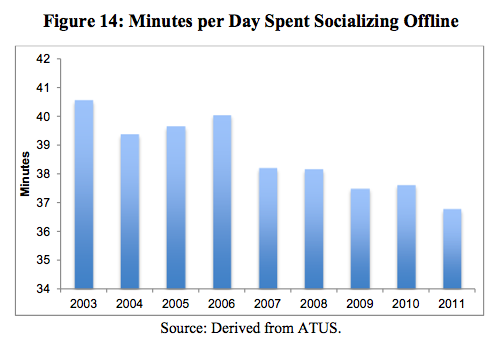
Minutes Socializing

A new paper by Scott Wallsten attempts to find out:

I find that, on the margin, each minute of online leisure time is correlated with 0.29 fewer minutes on all other types of leisure, with about half of that coming from time spent watching TV and video, 0.05 minutes from (offline) socializing, 0.04 minutes from relaxing and thinking, and the balance from time spent at parties, attending cultural events, and listening to the radio. Each minute of online leisure is also correlated with 0.27 fewer minutes working, 0.12 fewer minutes sleeping, 0.10 fewer minutes in travel time, 0.07 fewer minutes in household activities, and 0.06 fewer minutes in educational activities.

When your work is entirely online, the social isolation can even intensify further. One reason I cherish my time in Ptown every summer is that it forces me to have much more physical and personal interaction. Walking down Commercial Street is impossible without bumping into friends, new and old, all the time. And they tend to be on vacation so are more prone to stopping and chatting. It re-humanizes me after so much typing alone onto a screen. The rest of the year, I engage with far more people virtually than I do physically. And that can rob life of its essence. If you’re not careful you begin to live online.

Ben Richmond ponders the effect on socializing:

Even though the segment of time most affected is the biggest—watching TV—Wallsten also points out that there’s a visible social shift.

“Other offline leisure activities that involve interacting with other people are crowded out by online leisure: attending parties and attending cultural events and going to museums are all negatively correlated with online leisure,” he writes. “In short, these results based on ATUS data suggest that a cost of online activity is less time spent with other people.”

Of course, the most popular activity for online leisure is social networking, so worries that we’re all becoming hermits should… tempered, I guess. The nebulous nature of the internet is exactly what makes quantifying if what happens online comes at the expense of something else, because “being online” is terribly descriptive of what you’re doing.

Simone Foxman chips in her two cents:

Although Wallsten can’t prove that more computer time causes less sleep, for instance, he concludes, “that online activities, even when free from monetary transactions, are not free from opportunity cost.” This trend is particularly strong among young people. For example, every minute 15- to 19-year-olds spend online leads to 18 fewer seconds doing educational activities. For Americans 20-24 years old, however, the same minute of online leisure is only associated with losing about seven seconds of educational activity. For older Americans, the impact is even smaller. This data suggests—though does not definitely prove—that teenagers are more likely to devote time that would otherwise be devoted to educational activity to surfing the web or instant messaging than do slightly older young adults.

What’s The Problem With Political Ignorance?

Ilya Somin’s new book argues that such ignorance among Americans makes small government preferable. Sean Trende prefers to look on the bright side:

[A] relatively low-information electorate has helped produce one of the most prosperous, most free societies in world history. This country has adopted many policies that economists seem to deem beneficial: tax rates have fallen, deductions have been reduced, and global trade has grown. We’ve become more tolerant with regard to racial, gender, ethnic, and sexual minorities. Sometimes this has come with a push from the courts (but see Gerald Rosenberg’s The Hollow Hope), but there’s no doubt that the will of the people has played a key role as well. I might hope for a more educated populace, but at the end of the day, I’m not sure American electorate is so broken that it demands the sort of fix that Ilya suggests.

Somin defends himself:

In calling the United States successful, we have to ask, “relative to what?” The answer, of course, is relative to other nations, nearly all of which are either democracies that also suffer from problems caused by political ignorance, or dictatorships.

I do not deny that dictatorships are, on average, much worse than democracies. But the relative superiority of the United States compared to dictatorships and most other democracies is not relevant to the issue I raise in the book: whether democracies would suffer less damage from political ignorance if they limited and decentralized their governments more than they do at present.

During most of its history, the U.S. government was both more limited and more decentralized than most other democracies. The large size, limited central government, and numerous diverse jurisdictions of the United States gave Americans numerous opportunities to vote with their feet. And the informational superiority of foot voting over ballot box voting is, of course, a central thesis of my book. Extensive opportunities for foot voting, rather than ballot box voting, historically made the United States unusual.

Earlier Dish on Somin’s book here.

The New Wild West

Oil Boom Shifts The Landscape Of Rural North Dakota

Mike Riggs examines how North Dakota’s Bakken region – home of America’s fastest-growing regional economy – is struggling to police itself:

In 2005, the Williston Police Department in Williston, North Dakota, received 3,796 calls for service. By 2009, the number of yearly calls had almost doubled, to 6,089. In 2011, the most recent year for which data is available, the Williston P.D. received 15,954 calls for service. … And Williston hasn’t even seen the worst of it. The police department in nearby Watford City received 41 service calls in 2006. In 2011 they received 3,938. That’s life in an energy boomtown.

“Policing the Patch, a new study issued by the Department of Criminal Justice & Political Science at North Dakota State University, sheds new light on the problems faced in these boomtowns. Between October 2012 and March 2013, professor Carol A. Archbold and her team interviewed 101 law enforcement officers from eight agencies about how the in-migration of oil workers to the Bakken region has changed the way they do their jobs. The team’s findings tell us a lot about the problems created when cities and towns grow at an explosive rate.

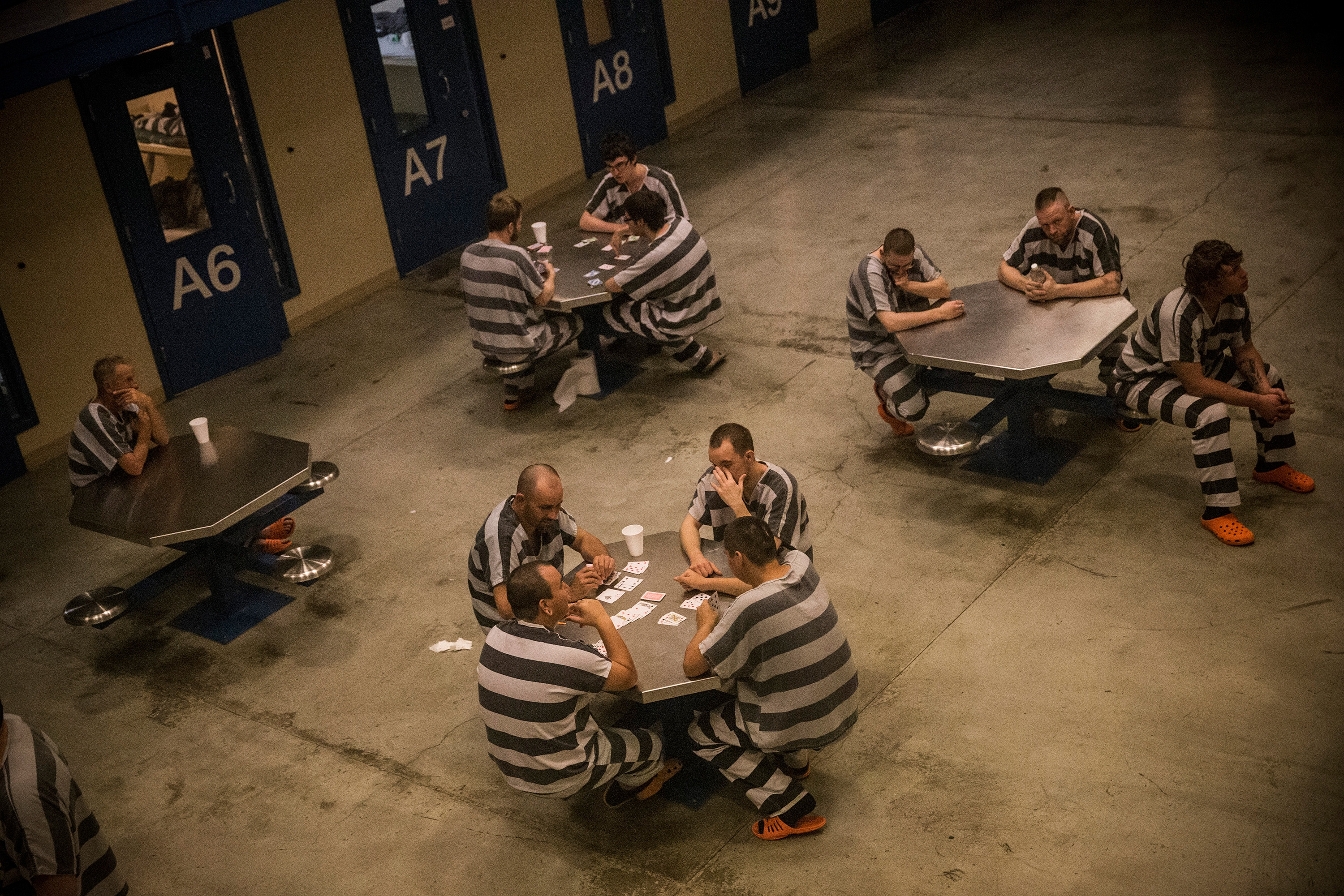
(Photo: Inmates sit in the county jail on July 26, 2013 in Williston, North Dakota. The state has seen a rise in crime, automobile accidents and drug usage recently, due in part to the oil boom which has brought tens of thousands of jobs to the region, lowering state unemployment and bringing a surplus to the state budget. By Andrew Burton/Getty Images)

Could Big Pharma End The Death Penalty?

Clare Algar thinks it’s possible:

Thirty-two states retain the death penalty in the U.S., but a new obstacle is making it increasingly difficult for them to carry it out. Pharmaceutical companies are taking a moral stand. The manufacturers of the drugs required by state departments of corrections for executions are saying they will not allow their products to be employed in this way. Manufacturers in the UK, US, Denmark, Israel, Switzerland, Germany, Austria, and India have taken steps to prevent their drugs being used in executions.

This has had an astonishing effect. Shortages of lethal injection drugs and attendant litigation have resulted in moratoria—an official halting of executions—in Arkansas, California, Kentucky, Louisiana, Maryland, Missouri, Montana, Nebraska, North Carolina, Oregon, and Tennessee.

Update from a reader:

The article you link to is intriguing, but Oregon’s moratorium was put in place for a different reason, a very conscious and deliberate choice on the part of our governor. In 2011, he placed a moratorium on all executions:

“In my mind, it is a perversion of justice,” Kitzhaber said at a crowded news conference, his voice strained and uncharacteristically quavering at times. “I refuse to be a part of this compromised and inequitable system any longer and I will not allow further executions while I am governor.”

A very principled and brave stance (and one I wholeheartedly support), but it will be interesting to see what happens when his time comes to step down.

The Instagram Loophole

The photo-sharing site is home to a thriving gun market:

guns-4Users of Instagram, which has no explicit policy prohibiting the sale of firearms, can easily find a chrome-plated antique Colt, a custom MK12-inspired AR-15 tricked-out with “all best of the best parts possible,” and an HK416D .22LR rifle by simply combining terms like #rifle or #ar15 with #forsale. These are handguns, shotguns, assault rifles, and everything in between being sold in an open, pseudo-anonymous online marketplace. With no federal law banning online sales and differing, loophole-ridden state laws, many gun control advocates are concerned about the public safety consequences of this unregulated market.

Miles Klee raises his eyebrows:

That black market operators are behaving so brazenly on social media doesn’t mean they’ll always get away with it, of course. Rapper Matthew Best brought about the largest NYPD gun bust in history, with 254 firearms seized, when he bragged about his firepower on YouTube and Instagram. But what’s one bust when the web is facilitating so many other potentially illegal sales and absolving itself of such trafficking in the process?

(Screenshot from Best’s Instagram account)

Gridlock Around The Globe

Divided government is getting more common:

Democracies everywhere—from the oldest and most mature, to the youngest and least institutionalized—are showing a surprising common feature: It is increasingly rare that a presidential candidate trounces his opponent. Elections won by a landslide are endangered species. They still happen occasionally, but the prevalent trend is that wherever free and fair elections take place, the margins of victory are shrinking. Increasingly, elections are won by a hair.

Today, polarized and fragmented electorates are the norm, and their votes offer no clear mandate or dominant position to any party or candidate. This is why so many countries are governed by complex, cumbersome, and unstable coalitions formed by political groups whose members often have little in common and in some extreme cases are even bitter rivals.

As I have noted elsewhere, in 2012, among the 34 members of the “rich nations club,” the Organization for Economic Co-operation and Development, only four featured a government that also had an absolute majority in parliament. In India, 35 parties shared seats in the 2009 election; no party has won an absolute majority since 1984. In fact, absolute majorities are globally on the wane. In electoral democracies, minority parties have won on average more than 50 percent of the seats in parliament throughout the postwar period; in 2008, minority parties controlled 55 percent of seats on average. But even in countries that are not deemed democracies, minority parties are increasing their clout. In those countries, minority parties held fewer than 10 percent of seats three decades ago; now their average share has risen to nearly 30 percent.