When The Shelves Run Dry

8159652005_b23a554396_o

Siddhartha Mahanta warns that New York City is increasingly ill-prepared for food shortages following a natural disaster:

Until relatively recently, most of the food that wound up in New Yorkers’ stomachs came from the farms of upstate New York, Connecticut, and New Jersey. Even Brooklyn and Queens helped out, for a long while registering as the nation’s two biggest vegetable-producing counties. When that locally grown food got to New York, it tended to stay around longer, sitting in warehouses for perhaps weeks at a time.

Now, New Yorkers rely chiefly on food from across the country, or the other side of the world.

And to complicate matters, in recent decades the big companies that run these systems have radically altered how they manage the flow of this food through their supply chains. Most of the private companies that now dominate the distribution of food in America, like Walmart and Sysco, keep much smaller inventories than in years past, sized to meet immediate demand under stable conditions – a strategy known as “just-in-time.”

Analysts, in fact, expect Sysco – a major presence in the New York region – to continue cutting down an already super-lean supply chain operation. In other words, the food on New York’s shelves flows through supply lines that stretch much further than ever before. And there’s a lot less of it along the way.

(Photo of a post-Sandy supermarket in Edgewater, New Jersey, by Flickr user Bee Collins)

Detail-Obsessed Authors

Morgan Meis spotlights them, from Pliny the Elder to the recently deceased Tom Clancy:

[David Foster Wallace] considered [The Sum of All Fears] by Tom Clancy serious enough reading put it on a top ten list of all-time favorites. We’re challenged to figure out why. The writer D.T. Max recently wrote a biography of DFW called Every Love Story Is A Ghost Story: A Life of David Foster Wallace. Max has claimed (in a New Yorker article) that DFW “admired the novels of Tom Clancy for their ability to pack in facts.” It is not, on the face of it, a very revealing comment. What exactly does it mean to “pack in facts,” anyway?

But on second thought, it is revealing. DFW loved to pack in facts with his own writing. He had real trouble deciding just how many facts to include. Hundreds of pages were ultimately cut from his first novel The Broom of the System, and from his magnum opus Infinite Jest. It was a desire to include many facts that led to one of DFW’s most loved (and most criticized) formal inventions, the footnote (or endnote). DFW could put a footnote in anything: a casual essay, a novel, a short story. DFW’s footnotes and endnotes sometimes take up more space than the main body of the text. …

DFW looked to the writing of Tom Clancy and found a similar obsession with information. Clancy also had a lot of things to say. He loved technical manuals and he loved to find out how things work — guns and big machines like aircraft carriers, yes, but also people and organizations. Here, for example, is a passage from a climatic scene at the end of Clancy’s Clear and Present Danger.

“Uh-oh,” the flight engineer said. “I think we have a P3 leak here. Possible pressure bleed leak, maybe a bad valve, number-two engine. I’m losing some Nf speed and some Ng, sir. T5 is coming up a little.” Ten feet over the engineer’s head, a spring had broken, opening a valve wider than it was supposed to be. It released bleed air supposed to recirculate within the turboshaft engine. That reduced combustion in the engine, and was manifested in reduced Nf or free-power turbine speed, also in Ng power from the gas-producer turbine, and finally the loss of air volume resulted in increased tailpipe temperature, called T5.

Now, most thriller writers would have taken care of this passage with the phrase, “the plane was in trouble.” But not Clancy. He loved all the details and he was damned if he was going to cut anything out. Clancy wrote like this all the time, in all of his books. Right in the middle of the action he would simply break off into laborious and overly technical explanations of the mechanical workings of a plane or the Byzantine hierarchical structure of the NSA.

The Placebo Effect Has Its Place

Physician Aidan O’Donnell draws a lesson from the rise of “cosmeceuticals“, or cosmetic products that purport to have medical benefits:

From my point of view as a doctor, [cosmeceutical treatments are] a deliberate use of the placebo effect. There is a lot of nonsense spoken about the placebo effect, so to avoid confusion, I consider the placebo effect to be the added satisfaction patients derive from a treatment, over and above its actual benefit. It is neither quackery nor witchcraft; nor is it closed to the orthodox tools of scientific inquiry. The crux of it is this: the placebo effect makes you feel better, even if it doesn’t make you get better. …

I can’t help wondering if [dismissing the placebo effect] misses something very important: Patients want the placebo effect. In fact, some of them are prepared to shun orthodox medicine and pay money to practitioners who can provide them with only the placebo effect. Worldwide, people spend over US$100 billion on complementary or alternative medicine. It seems that people are voting with their wallets, for treatments which don’t “work.”

To be clear, I do not consider such people to be credulous fools. Instead, I think they are looking for something which orthodox medicine doesn’t quite recognize the value of.

The Decline And Fall Of Christianism

.jpg

The fusion of politics and religion – most prominently the fusion of the evangelical movement and the Republican party – has been one of the most damaging developments in recent American history. It has made Republicanism not the creed of realists, pragmatists and compromise but of fundamentalists – on social and foreign policy, and even fiscal matters. And once maintaining inerrant doctrine becomes more important than, you know, governing a complicated, divided society, you end up with the extremism we saw in the debt ceiling crisis. When doctrine matters more than actually doing anything practical you end up with Cruz cray-cray. How does one disagree with a Taft:

Watching the Republican Party use the full faith and credit of the United States to try to roll back Obamacare, watching its members threaten not to raise the debt limit — which Warren Buffett rightly called a “political weapon of mass destruction” — to repeal a tax on medical devices, I so wanted to ask a similar question: “Have you no sense of responsibility? At long last, have you left no sense of responsibility?”

But there is some light on the horizon. The Catholic hierarchy has been knocked sideways by the emergence of Pope Francis and his eschewal of their fixation on homosexuality, contraception and abortion. That fixation – essentially a Christianist and de facto Republican alliance among Protestants and Catholic leaders – has now been rendered a far lower priority than, say, preaching the Gospel or serving the poor and the sick. Francis has also endorsed secularism as the proper modern context for religious faith:

I say that politics is the most important of the civil activities and has its own field of action, which is not that of religion. Political institutions are secular by definition and operate in independent spheres.

But perhaps a more powerful shift against Christianism is now taking place among evangelicals, especially the younger generation. Check out this terrific profile of the Southern Baptist Convention’s new public voice, Russell Moore. Money quote:

“We are involved in the political process, but we must always be wary of being co-opted by it,” Mr. Moore said in an interview in his Washington office, a short walk from Congress. “Christianity thrives when it is clearest about what distinguishes it from the outside culture.”

Moore, moreover, is not alone. At 42, he is more in touch with the next generation of evangelical Christians who do not share or support the harsh political agenda of their elders:

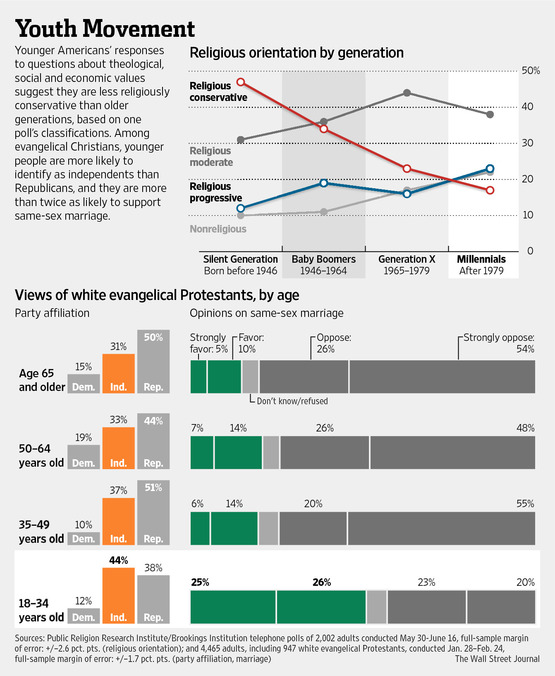
A March survey of nearly 1,000 white evangelicals by the Public Religion Research Institute, a nonpartisan polling organization, found half of those under 35 favored same-sex marriage, compared with just 15% of those over 65. The younger evangelicals were more likely to be independents over Republicans, while the opposite was true of their elders.

“The religious right was born on the theology of numerical expansion: the belief that conservative churches grow while liberal ones die. That conceit is gone now,” says David Key, director of Baptist Studies at Emory University’s Candler School of Theology.

And that conceit was very much behind the stance of a Catholic like Ross Douthat, who, despite his youth, sounds at times more like a theocon of the 1990s than a Millennial Catholic or evangelical. What Ross and others got wrong, I’d suggest, was being too utilitarian in a context where truth still matters. No one should support a church’s doctrine because it is more effective in the short run at putting bottoms on pews, as they P1-BN650_EVANGE_G_20131021185409say in England. A doctrine or moral position can only be defended as true, not useful. And the Christianist positions on gay people – they can be cured or should be required to be celibate their entire lives, without even masturbation – is so ludicrous as an example of what God would want for a small proportion of his Creation that it has rightly evaporated among the next generation.
Ditto the silly notion that contraception somehow violates the order of nature in ways so grave it must be outlawed. Evangelicals never had to deal with this transparent nonsense, but Catholics still labor under its staggering lack of persuasiveness. The idea that universal healthcare should be opposed because of a tiny detail about contraception coverage is as theologically ass-backwards as the notion that the church might shut down its services for abandoned children or the homeless for fear of employing one spouse of a married gay couple. Perhaps a strong dose of the old medicine could firm up the older generations – but clinging to arguments that no one under 40 finds even vaguely plausible, let alone humane, is not a long-term strategy for the health of Christianity.

The exception to this is abortion, where the moral arguments against it remain powerful and coherent, if impractical as a political project. So it’s no surprise that it’s that issue the younger generation have not shifted on. But the political program to criminalize it may not be as appealing to this generation as a prophetic call against abortion’s dehumanization of human life, and violence against the most vulnerable. To oppose contraception as well as abortion strikes many, rightly, as morally contemptible as a practical question.

And so the pendulum swings back. We do not yet know what a more apolitical, Gospel-centered, life-centered Christianity will achieve, how popular it may be, or whether it will lead to higher levels of commitment to God than at present. But I suspect even Pope Benedict finally realized it is the only way forward – hence his resignation in the face of his papacy’s near-total failure. What matters now and always is truth, not usefulness, faith, not politics. The next generation gets this.

Know hope.

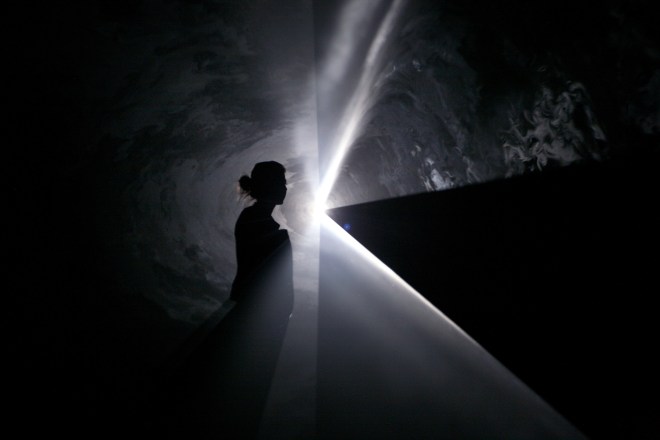
(Chart: from the WSJ. Photo: A visitor inspects a light installation by British-born artist Anthony McCall during a preview of the exhibition “Anthoy McCall. Five Minutes of Pure Sculpture” at the Hamburger Bahnhof museum in Berlin on April 19, 2012. By Stephanie Pilick/AFP/Getty Images.)


Redacted Drawings

dish_guantanamo

Janet Hamlin began working as a sketch artist at the Guantanamo Bay hearings in 2006. Her drawings – collected in a new book, Sketching Guantanamo: Court Sketches of the Military Tribunals 2006–2013 – form one of the only visual records of the trials, since cameras and video recorders were not permitted in court. An excerpt from the book:

Guantanamo tribunals differed from the other court drawings I’ve done. For instance, there were faces I was not allowed to draw, and each drawing could not leave the courtroom until a Pentagon official reviewed it. He would examine the art, occasionally have me erase some of the details, then sign and stamp the art once approved. Then I carried the sketches back, uploaded them to the media pool with descriptions, grabbed lunch, and got back for the afternoon session, going through three levels of security every time we entered or left the court area, always with an escort. Time is precious.

In a review of the book, Jillian Steinhauer emphasizes the unusual conditions under which Hamlin sketched:

When it comes to the larger of the two Guantanamo courtrooms, where Khalid Sheikh Mohammed and the other 9/11 conspirators are being tried, Hamlin isn’t even allowed inside.

She and other journalists must sit in a separate room at the back, separated from the proceedings by three panes of thick, soundproof glass. Not only that, but sound from the trial is broadcast into the room on a 40-second delay, to allow an officer who sits near the judge to censor classified material, if need be. In Hamlin’s words, “What we are seeing looks like a badly dubbed movie.”

Given these circumstances, Hamlin’s animated, colorful, and detailed sketches constitute a nearly heroic effort. The fact that she’s been able to give us thoughtful close-ups of everyone from Canadian Omar Khadr, the youngest convicted war criminal in modern history, to Khalid Sheikh Mohammed attests to her perseverance and skill as an artist. Her portraits and scenes breathe life — including that most familiar quality of human existence, tedium — into an operation shrouded in political secrecy. When Hamlin draws Khadr’s clenched, angular shoulders and his tired, weary face, he becomes a real person. Mohammed appears in the sketches alternately impassioned, disinterested, and, when he shows up one day in a camouflage vest, menacing — until we read the accompanying caption, in which Hamlin explains that the item “is a hunting vest and can be found at Sears.”

(Caption via NYRB: “Khalid Sheikh Mohammed wore a camouflage vest to court. Army Col. James L. Pohl, the judge, is shown in back with a court security officer at his left. Both Pohl and the security officer have buttons to mute, with white noise, testimony they suspect may be classified; the security officer also reviews my sketches before releasing them, October 17, 2012.” More drawings from Hamlin here.)

The Damage Done By Drones, Ctd

drones-2

Responding to two new reports on America’s drone war, Benjamin Wittes admits that “it is impossible for a modestly-moral person to read these reports without something approaching nausea” and that “they thus raise serious questions about the way at least those drone strikes they cover took place.” But he still criticizes various aspects of the reports:

[T]he reports—particularly the Amnesty report—have a way of conflating legitimate targeting which may produce civilian collateral damage with horrible errors that simply should not happen. The most glaring example of this is Amnesty’s treatment of the June 4, 2012 strike that killed Abu Yahya Al-Libi, a senior Al Qaeda leader. According to the Amnesty report, an initial drone strike killed five people and injured four others (the report does not say whether any were civilians). A group of 12 people, including both local residents and foreigners “whom villagers said were Arabs and Central Asians who were likely to be members of al-Qa’ida” showed up “to assist victims.” Al-Libi was “overseeing the rescue efforts” and was killed in the second strike, along with between 9 and 15 other people, including six local tribesman who “as far as Amnesty International could determine, had come only to assist victims.” In other words, six tribesman were killed working alongside a group of Al Qaeda operatives under a senior Al Qaeda official were killed.

Amnesty considers this strike a potential “war crime” both because it constituted an attack on civilian rescuers and, quite amazingly, because Al-Libi may not have been directly participating in hostilities at the time of the strike. (I’m really not making this up. See pp. 29-30.) In other words, Amnesty’s position is that it may be a war crime to target a senior Al Qaeda leader when he’s doing something other than plotting attacks—if, that is, it’s lawful to target him at all. There are many serious issues these reports raise; this kind of overreach undermines them all.

I agree. Unintended collateral civilian casualties are not war crimes, and never have been. But the moral equation shifts, it seems to me, when the belligerent stops truly seeing these casualties as morally deeply troubling. This is particularly true when it comes to the anti-septic feel of drone warfare, where human beings can be seen simply as distant statistics. There comes a point at which indifference to civilian casualties veers toward a war crime. That was my problem with the Israelis’ pulverization of Gaza in 2009. They did not seem particularly agonized by it at all, despite the huge imbalance of fatalities on each side of that conflict. With that kind of technological power, restraint is even more essential if we are not to lose our soul.

The way in which the Obama administration began to scale down drone warfare in the growing evidence of such casualties suggests to me a mindset attempting to avoid the worst aspects of such a war – not surrendering to it. But it’s a blurry line, and we need to remain extremely vigilant about it for moral and strategic reasons. Multiple civilian deaths do not, after all, help the case against al Qaeda in Pakistan.

(Photo by Getty)

The Hidden Homeless

Homeless Activists Group Release Report On New York City's Abandon Buildings

Ian Frazier reports on a troubling trend:

[T]here are far more homeless people in [New York City] today than there have been since “modern homelessness” (as experts refer to it) began, back in the nineteen-seventies. Most New Yorkers I talk to do not know this. They say they thought there were fewer homeless people than before, because they see fewer of them. In fact, during the twelve years of the Bloomberg administration, the number of homeless people has gone through the roof they do not have.

There are now two hundred and thirty-six homeless shelters in the city. Imagine Yankee Stadium almost four-fifths full of homeless families; about eighteen thousand adults in families in New York City were homeless as of January, 2013, and more than twenty-one thousand children. The [Coalition for the Homeless] says that during Bloomberg’s twelve years the number of homeless families went up by seventy-three per cent. One child out of every hundred children in the city is homeless.

The number of homeless single adults is up, too, but more of them are in programs than used to be, and some have taken to living underground, in subway tunnels and other places out of sight. Homeless individuals who do frequent the streets may have a philosophical streak they share with passersby, and of course they sometimes panhandle. Homeless families, by contrast, have fewer problems of mental illness and substance abuse, and they mostly stay off the street. If you are living on the street and you have children, they are more likely to be taken away and put in foster care. When homeless families are on the street or on public transportation, they are usually trying to get somewhere. If you see a young woman with big, wheeled suitcases and several children wearing backpacks on a train bound for some far subway stop, they could be homeless. Homeless families usually don’t engage with other passengers, and they seldom panhandle.

(Photo: An empty lot is viewed on January 25, 2012 in New York City. Homeless activist group Picture the Homeless will release findings from a new study conducted with Hunter College in which a count of vacant buildings and lots in 20 of NYC’s 59 community boards was conducted. The findings, which will be released tomorrow in full, found that vacant properties in New York City could house every homeless person and more. By Spencer Platt/Getty Images)

Ask Elyn Saks Anything

[Updated with many new questions submitted by readers]

From her Wiki:

Elyn Saks is an expert in mental health law and a Mac­Arthur Foundation Fellowship winner, which she used to create the Saks Institute for Mental Health Law, Policy, and Ethics. She is also Associate Dean and Orrin B. Evans Professor of Law, Psychology, and Psychiatry and the Behavioral Sciences at the University of Southern California Gould Law School. Saks lives with schizophrenia and has written about her experience with the illness in her award-winning, best-selling autobiography, The Center Cannot Hold: My Journey Through Madness, published by Hyperion Books in 2007.

You can also watch her TED Talk about living with mental illness here.

What should we ask Elyn? Let us know via the survey below (if you are reading on a mobile device, click here):


This embed is invalid