Fluent Fans

Na’vi, a language invented for the alien population of Pandora in the 2009 film Avatar, has really taken off:

The Na’vi tongue was invented by Paul Frommer, a clean-cut linguist and professor emeritus of management communication from California. Na’vi is melodious and fast flowing, composed of unusual syntax and consonant clusters that sound beautiful and exotic to an Anglophone ear. It is one of many so-called constructed languages, or conlangs: a man-made language authored for a purpose. From world peace, as in the case of perhaps the most widely-known conlang, Esperanto, to expanding our capacity for logic, like the unwieldy Loglan, constructed languages have captivated us for centuries.

Na’vi is a conlang subtype known as an artlang: It was created with a specific aesthetic goal, as an integral part of a piece of art. Like other famous artlangs (J.R.R. Tolkien’s Elvish, Star Trek’s Klingon, and the languages spoken in the HBO television series Game of Thrones, Dothraki and Valyrian) Na’vi was intended solely for fiction. … Moved to connect themselves in a more tangible way to the utopian world Avatar presented, [fans] had dived into the film and resurfaced with something no longer confined to fiction. Currently, Frommer estimates there are around 100 Na’vi speakers, though other researchers have said there are many more, and the language has grown to a vocabulary of approximately 2,000 words.

Previous Dish on Dothraki here and here, and Esperanto here. Below is a Klingon version of “Never Gonna Give You Up” that just emerged last week – if you can take the hathos (I was mesmerized):

The Silence Of St. Thomas, Ctd

In a review of Denys Turner’s Thomas Aquinas: A Portrait, James R. Kelly looks at the human behind the holy saint:

We learn that Thomas disappointed his ambitious parents when he joined the recently formed Gentile_da_Fabriano_052Dominicans, who sided with the era’s 99 percent with their off-putting vow of poverty and their street-preaching, that he did grow fat and balding, that he knew no Greek, that he unhesitatingly drew on Arabic sources of Aristotle, that his sermons were “mercifully short,” that he was not scintillating, that he had a plodding deadpan style, that he too thought of himself as a “dumb ox,” that he didn’t complete his Summa Theologiae and that this very incompletion was symptomatic of his non-self-promotional personal and professional style.

Thomas was the smartest person in the room, but he always took the last seat in the last row. So—how did Thomas the Unlikely become the founder of that periodically discarded only to be rediscovered philosophia perennis called Thomism? A deep Catholic sensibility is part of it. Thomas’s philosophy aces the F. Scott Fitzgerald criterion that “the test of a first-rate intelligence is the ability to hold two opposed ideas in the mind at the same time, and still retain the ability to function.” In his own little paradox, Turner characterizes Thomas’s thought as combining both the Protestant either-or and the Catholic both-and.

Nathaniel Peters notes Thomas’s intellectual humility in his final days:

Is Thomas a saint because he made good arguments, and if not, what is it that he did? Turner’s answer is simple: He fell silent. Thomas’ refusal to finish the Summa speaks volumes about the limits of theology and the magnitude of God. More than that, though, there is a holiness lying behind everything Thomas wrote, precisely in the fact that he lies behind it, not in front. Thomas’ writing is not about Thomas; it is about the truth. His holiness, Turner concludes, “is a theologian’s holiness, the holy teacher invisible otherwise than in the holy teaching itself.” In his writing as in his life, Thomas embraced poverty so that God might be preached all the more.

Previous Dish on Turner’s biography here.

(Detail from Gentile da Fabriano’s Valle Romita Polyptych, circa 1400, via Wikimedia Commons)

“The Best Thing Going For The GOP” Ctd

A reader takes exception with me calling the following quote from Christie on the shutdown “pitch-perfect“:

All you need to do is look about 200 miles south of here to see the mess that Republicans and Democrats have made of our national government and we should haul all their rear-ends to Camden today to see how bipartisanship works and government works together.

This is decidedly NOT pitch-perfect. Well, maybe it is to Republicans. Personally, all I see is more of the insidious false equivalence that allows Republicans to act like lunatics and then avoid accountability by yelling that Democrats are guilty, too. Democrats may be spineless and lame, as a general rule, but to accuse them of being culpable for our current morass anywhere near so much as the Republicans is wildly disingenuous and irresponsible. At best.

Give Christie credit for being more honest and sane than the rest of the Republicans. Yip de doo. But that doesn’t mean he’s doing what would really make him a hero true to his no bullshit-reputation: unequivocally calling out the Republicans for actively trying to destroy the American economy and the ability of the federal government to serve even the most basic functions. Once he does that, I’ll consider voting for him in 2016. Until then, being slightly less crazy than the rest of the GOP doesn’t make him presidential material.

Another reader:

Not one mention of Christie and Obama actually working together after Sandy?  Remember, the GOP primaries will be run by crazy people.  They will savage Christie for actually being friendly with the president.  This is all you will see:

Another elaborates:

The far-right base is sick of the establishment telling them who’s “electable.”  Even if they weren’t swooning over Ted Cruz (who got an 8-minute standing ovation from Republican women in Texas on Monday), 2016 is the year they’re adamant a “true conservative” will be the nominee. And while you may believe Christie is one, the base of the Republican party emphatically does not.  He’s the governor of a northeastern state, he welcomed Obama after Hurricane Sandy, and he just rolled over (in their perception) on marriage equality.  There is no way Christie will ever be the Republican nominee in 2016.

Another turns to Christie’s weight:

I don’t think he’s too fat to be elected president – I agree it augments his populist appeal – but he may well be too fat to successfully run for president. Eighteen months of (first) primary battles with Ted Cruz for the soul of the GOP and (second, if he wins the nomination) winner-take-all presidential campaigning in the late, sweltering summer of 2016 will require enormous physical stamina.  (Ever been in Richmond, Virginia, on Labor Day?  How about Tampa? It’s not pretty.)

Most of our recent candidates have been in tip-top shape for their age: Obama, Romney, Bush, Kerry.  The flabbiest of the last 20 years was probably Al Gore, who was a damn sight fitter than Christie, and, remember, he won the popular vote.  Contrary to the SNL image, Bill Clinton was 15 or 20 pounds overweight at his worst, and he was preternaturally durable mentally and physically.  Same with McCain, who seems to have a titanium constitution against his prisoner-of-war injuries.  Christie probably also has a deep well of energy despite his size, but since the emergence of the 24-hour electronic news cycle, nobody of his physique has attempted the most grueling task a politician can take on.

Another quotes me:

“The Jacksonian wing of the GOP – think Zell Miller or Dick Cheney – loves a fighter, cheers a brawler, and would swallow whatever disagreements they have with Christie on social issues because of his attitude.”

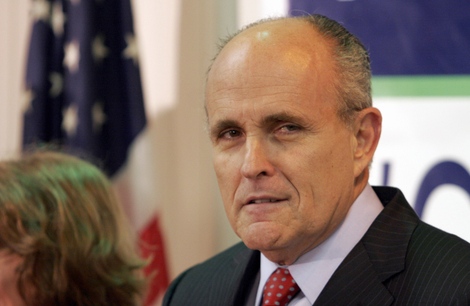
Like this guy?

giulianinicholasrobertsafp.jpg

Another goes local:

Here is what Chris Christie has done that should “render him unacceptable to a majority of the 2016 electorate”: he killed the proposed Trans-Hudson Passenger Rail Tunnel.

None of this can be reasonably disputed: New Jersey is highly dependent for its economic success on travel into New York.  There are terrible bottlenecks getting New Jersey commuters past the Hudson River.  It is inevitable that another bridge or tunnel has to be built on the Hudson.  The 2008 crash made the cost of building historically low.

Christie killed that project for no good reason other than to stick an ideological thumb in Obama’s eye during an economic crisis.  He said that it would be expensive, which is true, but given that that cost has to be incurred sooner or later it was foolish of him not to seize an unusually opportune moment to build.  Maintaining the Lincoln Tunnel is also very expensive, and presumably Christie would not suggest that New Jersey could save money by closing it.

Christie’s decision was horrifically stupid and destructive, and New Jersey will suffer for a generation as a result of it.  If that is what conservatives call bipartisanship, moderation, and “common sense governing,” thanks but no thanks.

(Photo by Nicholas Roberts/AFP/Getty Images)

What Can A Tech Surge Accomplish?

Over the weekend, the Obama administration announced a “tech surge” in order to fix Healthcare.gov. Timothy B. Lee doubts this will work:

Not only will more programmers not necessarily speed up the development process very much, it could actually make things worse. That’s because existing programmers will need to spend time training the new programmers, assigning them tasks, and coordinating their efforts with the new, larger development team. … [A]dding more people to the HealthCare.gov team may actually lengthen the time it takes to build the HealthCare.gov Web site.

This phenomenon, in which adding people to a late software project makes it later, is known as Brooks’s Law. In the mid-1960s, Fred Brooks managed the project to build OS/360, a complex IBM operating system for mainframes. In 1975, he wrote a famous book called “The Mythical Man Month” about the experience.

“When schedule slippage is recognized, the natural (and traditional) response is to add manpower.” Brooks wrote. “Like dousing a fire with gasoline, this makes matters worse, much worse.”

McArdle makes similar points:

While outsiders may be valuable for small, concrete tasks and a fresh take on particularly tough problems, they can’t just come in and fix everything. If the contractors and HHS managers who built the federal exchange can’t fix it in the next month, then it’s just not going to get fixed in the next month.

Yuval Levin identifies another reason why Silicon Valley’s tech mavens can’t save the site:

I think the idea that Silicon Valley types are going to rescue the bureaucracy confuses two kinds of technical mastery: experimental innovation and consolidated management. Each has its strengths and its weaknesses, but these two visions generally do not play well together. Successful technology firms do a huge amount of trial and error, avoid over-management, and create adaptive knowledge systems that work by learning and are constantly tested against competitors. The federal bureaucracy develops and enforces uniform rules meant to apply technical knowledge it (thinks it) already possesses to a complex and chaotic world to make it simpler and more orderly — to make it do the bidding of policymakers. As Max Weber put it, “bureaucratic administration means fundamentally domination through knowledge.” The maxim of the Internet age is closer to “liberation through knowledge.”

Our Memory (And Selves) Will Belong To The Cloud

cloud1

In a review of Permanent Present Tense by Suzanne Corkin, Steven Shapin reflects on the life of Corkin’s famous patient, Henry Molaison, whose ability to form new memories was destroyed by a brain operation when he was 27. How Molaison’s sense of memory relates to our own:

In everyday life, we don’t much care whether what we remember is contained between our ears or resides on a piece of paper. We rely on our partners, colleagues, and friends to remind us of obligations; we stick Post-its on computers and fridge doors to cue us to buy milk or have the car serviced; our cell phones ping to announce coming appointments and remember all our phone numbers for us. Increasingly, our memories are distributed across a landscape populated by things and other people, and, in that respect, it’s possible to see Molaison as standing merely at a pathological extreme of memory’s normalcy: after the operation, all of Molaison’s declarative memory lived outside his own body, while only some of ours does.

Shapin imagines a future in which “technology will banish forgetting”:

The Quantified Self movement encourages everyone to follow Silicon Valley utopians in forming a personal digital register of every item of food consumed and every measurable bodily state. A camera worn on the neck of a “lifelogger” records everything seen, and a digital recorder captures everything heard. It’s all there—nothing filtered, nothing lost, nothing distorted by the messiness of internal memory. Wearable computers like Google Glass hold out the promise of still more powerful modes of self-archiving. We shall be as gods, and about ourselves we shall know all things. Technology will banish forgetting, and the stores of undeformed memory will live forever in the cloud, retrievable at will. The name for our remaining problems will be “search”: all we’ll have to do is remember what we’re looking for, master a few tricks for finding it, and, finally, offload the initiation of search onto external prompts that will remind us to remember.

Last Saturday I spent a relatively harmless and hugely enjoyable few hours with some friends and the conversation got a little 3 am college dormy. My friend elaborated an epiphany about eternity.

As the years go by, and our lives are digitally recorded in more and more ways, he argued, there will be digital versions of ourselves – from selfies to web trails, from precise consumer preferences to social networks, from thousands of emails and texts to videos and Facebook likes – that will have more data embedded in them than even the most industrious biographer could have used on the most famous person in the past. We will also come, inevitably, to refer to these digital summaries of ourselves, to remind us of our past, to get digital proof of previous loves or ideas or events or friends. We will therefore need to remember less and less, even as the imprint we make on the world becomes more and more indelible and eternal. We can just look them up, the way we reach for Google when we cannot remember the answer to a trivia question or need to resolve an empirical debate.

Writing a blog every day for thirteen years and counting brings that home rather firmly. So many feelings, thoughts, asides, facts, wishes, errors, home-runs, and massive fails are all there for anyone to see and for me to flinch from. But just as surely, I do not need to remember much of my life any more. It is remembered for me and exists in something we call the cloud. The cloud is eternal. It reaches into the depths of the past and makes it instantly accessible to the present and to any non-apocalyptic future.

The concept of a personal trail that makes a life eternal isn’t new, of course. I think of Emily Dickinson’s vast trove of scribbles or Pascal’s unfinished scraps of paper we now know as the Pensees. But in the past, only a few managed to achieve anything like the record we are currently assembling of our own lives every day. For most, there was the Parish register or, if you were really lucky, a mention in government or church records. A gravestone here; a family genealogist there. Far, far more human beings ended their lives with no lasting memory of them remaining among those still living. We were almost all unknown soldiers once.

Now, we are all so known. And the key aspect of the cloud, it seems to me, is not just its powerful storage, but its instant accessibility to anyone with an Internet connection. Just like the seventeenth century poems we publish afresh here on the Dish alongside the written-a-few-minutes-ago blog-posts, the old and the new exist as equals, because they will increasingly become equally available to us. And so time itself disappears as an experience online. It truly is an eternal now, that connects past and future to a perpetual present.

And in some ways, our personal digital records are very much the summation of ourselves. Not our physical, intimate, human selves – the selves we eat with and run with and fall in love with – but our abstracted selves, the conglomeration of every detail, feeling, idea, thought, impulse, and friend that tells the story of me. Long after I am dead, will that not be the most accessible incarnation of me – alongside all the published words I have written in part to live past my physical expiration date? Will I not continue to exist in some form that is available to all of humankind for ever?

Ambitious types in the past performed all sorts of amazing and horrifying things to become immortal, to leave a legacy, to be remembered by history. But increasingly, that form of immortality is available to to more and more people in principle. In the future the scale of the recording – the Big Data Of Humanity – will only increase and deepen. In practice, of course, our lives will exist only in so far as others care to find us. And that is how it has always been. But now, more and more of us will never fully die. We will always be available for rebooting.

Is it a purely etymological accident that we call this collective memory a cloud?

Was it also purely by accident that for aeons, humankind looked up past the clouds to see Heaven?

Will A Death Spiral Destroy Obamacare?

McArdle worries that Obamacare is entering a “death spiral,” where young and healthy individuals don’t buy coverage and thereby drive up premiums:

[W]hat we have now is a situation where only the extremely persistent can successfully complete an application. And who is likely to be extremely persistent?

1. Very sick people.
2. People between 55 and 65, the age band at which insurance is quite expensive. (I was surprised to find out that turning 40 doesn’t increase your premiums that much; the big boosts are in the 50s and 60s.)
3. Very poor people, who will be shunted to Medicaid (if their state has expanded it) or will probably go without insurance.

Insurance that is only sold to these groups is going to be very, very expensive. Not the first year — President Barack Obama was in the Rose Garden just this morning, touting the fantastic cost savings available to the old and sick people whom Obamacare was already helping. But if those are the only people who sign up, insurers will lose a bunch of money on these policies. And then next year, they’ll ask for a lot more money.

Adrianna McIntyre, on the other hand, argues “delaying the individual mandate for a year wouldn’t provoke a full death spiral” because “there are deep-in-the-weeds protections baked into the Affordable Care Act” that “aid insurers if they wind up enrolling a population that is sicker and more expensive than projected” during Obamacare’s first few years:

Basically, today’s worst-case scenario is that HealthCare.gov takes months to fix and the mandate is delayed until 2015, resulting in widespread adverse selection. Insurers wouldn’t recoup all losses, but the risk corridor program provides their bottom line with a substantial buffer. Importantly, it doesn’t need to be budget neutral; if the math demands it, the government can pay out more than it collects through the program. This could be expensive—the CBO scored the health law as though risk corridors were budget neutral—but it could also be offset by foregone subsidies.

Insurers have a stake in Obamacare’s success; that doesn’t magically disappear if 2014 enrollment is rockier than anticipated. The the risk corridor program continues through 2016, which would allow plans to weather 2014′s uncertainty and probably keep the following year’s premiums relatively unchanged as the risk pool normalizes.

The real risk of delaying the individual mandate is long-term political fallout from Obamacare being labeled a “fiasco”, not the dreaded insurance death spiral.

Barro agrees that insurers will do everything in their power to avoid a death spiral:

Health insurers are eager to add tens of millions of new customers and have every reason to work to prevent a death spiral. Even if website problems that drag into 2014 cause the participant pool to be disproportionately sick, and insurers take a bath for one year, they will be motivated to price in a way that draws healthy participants in for 2015, so long as the website is working well by fall 2014, when 2015 enrollment starts. Still, it would be best to avoid the problem altogether.

TNR Already Did It!

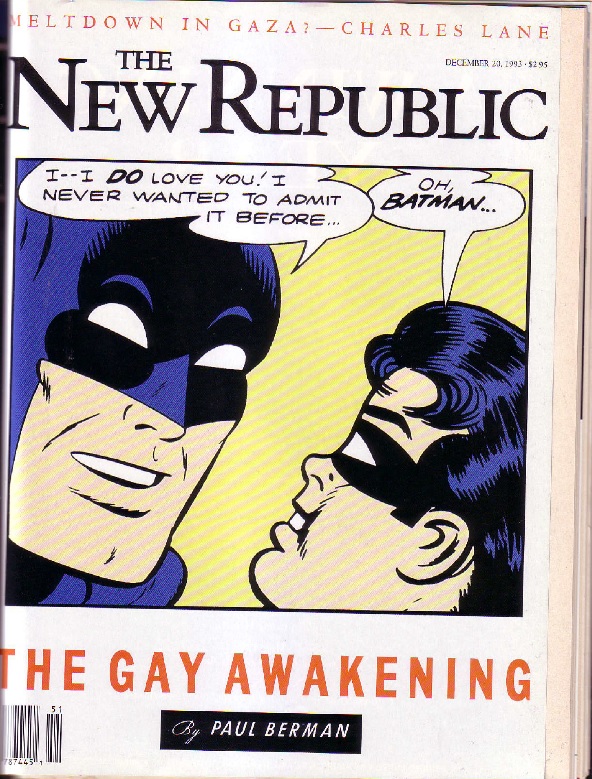
A small note. Jon Rauch’s excellent new essay on the tipping point for marriage equality appeared in American Review. It was titled “A Gay Awakening” and featured a wedding cake with Batman and Robin on top of it. But back in the day at TNR, we did one better. A superb review-essay by Paul Berman was put on the cover and I asked the legendary Chip Kidd if he’d design the image. The title? “The Gay Awakening.” The cover?

tnr_cover_gayawakening

1993 – twenty years before the American Review’s unintended homage.

Sometimes I forget just how out there I was two decades ago. I put it down to youth and inexperience.

Ending Prohibition Is Within Reach

That’s Kevin Drum’s reaction to Gallup’s latest:

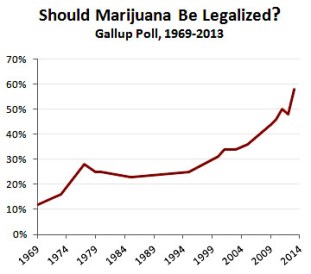
I have a rule of thumb that favorability ratings need to reach about 65 percent before you hit a tipping marijuana_legalpoint where a major social change starts getting codified into law nationwide. There’s nothing magic about this threshold. It’s just a general sense based on previous issues similar to this.

And as you can see, public opinion isn’t merely rising on marijuana legalization, it’s accelerating. The rate of increase has gone from about 0.5 points per year in the 90s to 1.5 points in the aughts to 4 points so far in the teens. If this keeps up, we’ll pass the 65 percent threshold by 2016 or so.

Mark Kleiman agrees that, unless the polling trend reverses, that federal legalization will happen in the near future:

If the question of whether to legalize now seems largely settled, that makes the much-less-debated question of how to legalize even more topical. Some of the smarter opponents of cannabis have figured this out, and are now looking for ways of limiting the increase in drug abuse likely to follow legal availability. However, career and ideological interests and group ties are likely to lead the majority of the active drug warriors to keep fighting what now seems like an unwinnable battle, telling one another that legalization is sure to be such a disaster that the public will demand re-prohibition. By doing so, the warriors will help to ensure that the legal system that eventually arises will be over-commercialized, under-regulated, and under-taxed.

This would simply repeat the mistake they made in opposing the medical use of cannabis. While the warriors kept chanting “Cheech and Chong medicine,” the pot advocates rolled right over them.

Mark also takes me to task for downplaying marijuana’s downsides:

Andrew Sullivan strikes a triumphal note. Hard to fault him for that. But goddammit, “less harmful than alcohol” and “not harmful to most of its users” do not add up to “harmless.” Adolescents spin out on cannabis and wreck their academic careers. People of all ages do stupid things while stoned, including driving their cars into trees and other cars. Cannabis now follows only alcohol as the primary drug of abuse reported by people voluntarily entering drug treatment.

Why take the perfectly reasonable case that cannabis should not be illegal and ruin it with the silly claim that the stuff is harmless?

Well, I was perhaps a bit too giddy last night to avoid stupid, simplistic adjectives. In The Cannabis Closet and this blog, we’ve long aired the harms that can attach to the plant. I think it should be kept from teenagers the same way we restrict alcohol (perhaps more so). What I was getting at is that there is no fatal overdose for marijuana – unlike alcohol and so many other drugs; and that almost everything is harmful in certain contexts and degrees: driving sober, for example; or skiing; or sex; or porn. My point is that in this broader context, pot is pretty harmless as these things go. But nuance eluded me last night, for which I apologize.

Krugman’s Dick Morris Award

Yes, Krugman got the Internet wrong. But Andrew Sprung rightly notes how much he has gotten right (at times to my chagrin):

He was right about the Euro. He was right about the Bush tax cuts. He was right about the Iraq war. He was right about the housing bubble. He was right about the size of the stimulus.  And, I just accidentally reminded myself, he was right about Obama’s dreams of postpartisanship. On Jan. 28, 2008, with the country in full flush of Obama fever, Krugman posted a warning that Obama ignored for the first 32-odd months of his presidency.