The Beverly Hills Divorcee Saint

Mary Clarke was raised by a very wealthy father in Beverly Hills, whose business she ran for a while after his death. She married twice and divorced twice, with eight children. Always interested in charity work, Clarke, then Brenner, started to help a priest minister to the hardcore inmates of Tijuana’s La Mesa prison. It changed her life. From her obituary this week:

Ms. Brenner began providing for inmates’ basic needs, giving them aspirin, blankets, toiletries and prescription eyeglasses. She sang in worship services. She received a prison contract to sell soda to prisoners and used the proceeds to bail out low-level offenders. If a prisoner died, of illness or in a gang fight, she prepared him for burial. Inmates told how Mother Antonia once walked into the middle of a prison riot while bullets flew and tear gas filled the air. When the inmates saw her, fearless in her habit, the fighting stopped. She never seemed to stop smiling.

In due course, she decided to move into the prison itself, in a 10′ by 10′ cell in the women’s section:

“It’s different to live among people than it is to visit them,” she told The Washington Post in 2002. “I have to be here with them in the middle of the night in case someone is stabbed, in case someone has an appendix [attack], in case someone dies.”

What makes her ministry even more remarkable is that as a twice-divorced woman, the church hierarchy could never accept her into a religious order. So she simply, like Saint Francis, invented her own. She made her own nun’s habit, and simply did what she believed was God’s work. In the end, the hierarchy – just as with Saint Francis – relented and blessed her new order, The Eudist Servants of the Eleventh Hour. If you are a mature woman and are interested in their work, check out this page. The criterion for joining them is simple:

Members must, in their hearts and in their lives, bear the pain of the poor, the imprisoned, the sick, the rejected, the forgotten and the abandoned children of God.

We have been used to reading such terrible things about religion – from the fanatics who murdered so many on that September morning to the death threats against young girls seeking an education and the burning of schools and massacring of sectarian enemies. No one should deny the unique power of religion turned into an instrument of earthly power and violence. But equally, the countless moments of mercy, tenderness, self-sacrifice and courage that occur every day and that spring from the same religious impulse must always be considered alongside the bad. It was a religious vision that propelled Mary Clarke and a priest called Anthony who inspired her to call herself Sister and then Mother Antonia:

She has said that in 1969 she had a dream that she was a prisoner at Calvary and about to be executed, when Jesus appeared to her and offered to take her place. She refused his offer, touched him on the cheek, and told him she would never leave him, no matter what happens to her.

No, Christopher, religion does not poison everything. It can be used in a poisonous way, but it can also be the most powerful force for human 51X2YX9WYSLsalvation – in the present moment – that we have at our disposal.

What I love about Mother Antonia, above all, however, is her demonstration of the power of women in creating a future for Christianity. She refused to let rules about such things as divorce prevent her from ministering to those she felt need ministry. She refused to let her gender limit her in any way. She – not the male hierarchy – is the church. And she reminds us of the appalling, morally crippling, un-Christian subjugation of women in the Catholic Church.

It must end as a matter or moral urgency, and when it does, the power of women as spiritual leaders and healers may shock and surprise many but elevate us all. In the words of Mother Antonia, from inside a prison where rapists, murderers, gang-lords and hit-men resided:

Pleasure depends on where you are, who you are with, what you are eating. Happiness is different. Happiness does not depend on where you are. I live in prison. And I have not had a day of depression in 25 years. I have been upset, angry. I have been sad. But never depressed. I have a reason for my being.

(Photograph: the biography of Mother Antonia, The Prison Angel, which can be bought here.)
Shutdowns Aren’t Accidents

That’s why Jonathan Bernstein is betting against a weeks-long shutdown in January:

All three extended shutdowns in recent American history—the two Newt Gingrich shutdowns in late 1995, and the Ted Cruz shutdown this month—were deliberately planned. In 1995, Gingrich foolishly believed that Bill Clinton was a weak man who would buckle if faced with the risks of an extended shutdown. This year, at least if you accept the surface explanation, radicals believed that a long fight would spark a wave of anger at Obamacare. It’s possible, of course, that Tea Partiers or some other group will decide another long shutdown is the right plan. But don’t expect prolonged shutdown (more than two or three days) to be the natural result of a normal budget stalemate. It doesn’t seem to happen.

Even if we avoid another shutdown, Collender has low expectations for the budget negotiations:

[W]hy does anyone think that the 2014 sequester that will occur on mid-January unless Congress and the White House agree on a deal to stop it will be enough to get everyone to compromise? Everyone also hated it the first time around but it was the best alternative compared to all of the others. Not only will that still be the case in January 2014, it will be even truer this winter with the primaries and general election being only months rather than years away.

That’s not to say that a budget deal can’t or won’t happen in December and January. But it does say that, if there is a deal, it will be much smaller and far more symbolic than significant. It will be the kind of deal where everyone declares victory and goes home.

Under The Cover Of Night

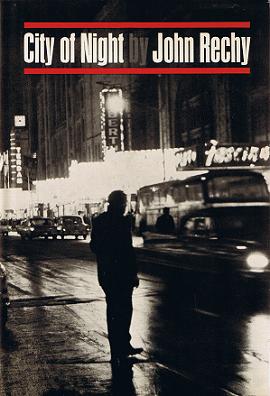
Charles Casillo profiles John Rechy, the gay hustler-turned-writer whose groundbreaking debut novel, City of Night, just turned 50:

“I want to be known as a writer with a unique life who has transformed that life into literature,” CityofNightRechyRechy says. With City of Night he succeeded. City of Night blends Rechy’s poetic vision with his journalistic eye for detail, and he makes his misfit characters yearnings, burnings, and alienation feel universal. The book documents its time, a time when homosexuality was illegal, and still described in medical books as a mental illness. It is one of the best firsthand accounts of what it was like to be gay in the mid-20th century — ostracized — separate from the mainstream world. It reveals, through its characters, how young men couldn’t admit, even to themselves, that they were what society deemed perverted. Rechy recalls. “I remember on a New York subway I saw a man reading a book; I could recognize it right away as City of Night although he had wrapped a different jacket around it.”

The essay also includes a revealing anecdote about Rechy:

“Theres just two ages anyway,” a character in City of Night observes, “youngman and oldman.” After its publication, Rechy, his age murkily sandwiched somewhere between those two extremes, led a bizarrely divided life. He continued hustling the streets and the parks even as he published a steady stream of books — fifteen to date. Simultaneously he became a respected teacher at UCLA and in private workshop classes he gave from his home. Sometimes his carefully compartmentalized worlds collided, as on the evening he was standing shirtless on Hollywood Boulevard, his muscular torso on full display, when one of his students happened to pass by. “Good evening, Professor Rechy,” the bemused student shouted, “Out for an evening stroll?”

(Image: First edition cover)

Reanimating Immigration Reform

Byron York thinks immigration reform can come back from the dead. Drum, on the other hand, can’t find a pulse:

[W]ould the business community like to see a comprehensive bill pass? Sure, probably. Is it a huge priority? No, not really. Are they willing to go along with the obvious reality that it can’t pass the House? It sure sounds like it.

Waldman wants Democrats to revive the immigration reform debate, even if it’s doomed:

The thing is, even if Obama were sure there was next to no chance of succeeding in passing reform, there are few things he could spend time talking about over the next few months that would do more damage to his opponents.

Think about it this way: What’s the GOP’s biggest problem right now? It’s the widespread perception that they’re a bunch of extremists who are willing to throw sand in the gears of the political system to fight anything Barack Obama wants to do, no matter the damage to everyone else, and even the sane people in the party don’t have the courage to stand up to Tea Party nuts. And what happens if we have a debate about immigration?

Well, you’d see a lot of establishment Republicans saying, “This is something we really should do.” And then you’d have a bunch of conservative Republicans saying, “No, no, no!” and making outlandish demands. And I’d rate the chances at somewhere around 99 percent that along the way some of those Tea Partiers will say some ugly things about immigrants that get lots of attention and cause Karl Rove and the rest of the national Republican establishment no end of agita.

Ezra chuckles at how, when it comes to tackling immigration reform, the GOP is “so scared that Obama is trying to destroy them that they’re destroying themselves”:

The unifying excuses for the GOP’s failure to move on immigration reform is that it’s all the Democrats’ fault. York quotes an unnamed Republican lawmaker saying, “Everyone has seen the bad faith exhibited by Obama and Reid during this fiscal fight and I can’t imagine anyone making the case that a final [immigration] product would reflect conservative principles in any fashion.” That’s similar, of course, to Labrador’s contention that Republicans should abandon immigration because Obama is trying to destroy the Republican Party.

The irony is that if you talk to White House officials, their belief has long been that immigration reform might be possible precisely because it would help the Republican Party politically and because the Senate was able to craft a bill that conservatives like Marco Rubio found ideologically congenial. They’ve even tried to keep Obama distant from the process so the Senate Republicans who participated would get much of the credit. If the price of immigration reform is a more competitive Republican Party in 2016, it’s a price the White House is happy to pay.

The Buggery Of Bugs

Up to 85 percent of many insects have same-sex sex. Scientists trying to figure out if this is due to the same evolutionary reasons for widespread homosexual behavior across many species have decided it’s just about confusion. The dudes think other dudes are chicks – yes, all ants look alike even to ants – and they fuck anything that moves and looks fuckable:

“Insects and spiders mate quick and dirty,” Dr. Scharf observes. “The cost of taking the time to identify the gender of mates or the cost of hesitation appears to be greater than the cost of making some mistakes.” … Almost 80 percent of the cases of homosexual behavior appeared to be the result of misidentification or belated identification of gender. In some cases, males carry around the scents of females they have just mated with, sending confusing signals to other males. In other cases, males and females look so similar to one another that males cannot tell if potential mates are female until after they have mounted them.

So many Justin Biebers, so little time. But species with high rates of homosexual sex also tend to be more generally horny, with a penchant for humping beer bottles and … well, basically anything. So you can put it down to bonobo-levels of sex. Or we may not understand it fully yet:

It is also possible, however, that sexual enthusiasm in bugs is related to other evolutionarily beneficial traits, the researchers say.” Homosexual behavior may be genomically linked to being more active, a better forager, or a better competitor,” says Dr. Schart. “So even though misidentifying mates isn’t a desirable trait, it’s part of a package of traits that leaves the insect better adapted overall.” To confirm their theory, the researchers plan to study the conditions that make homosexual behavior more or less likely in bugs. They also want to look more deeply into male resistance to homosexual mating.

Yeah: what about bug homophobia? At what point does the buggered bug turn around and say, “Hey, wait a minute …”?

Epistemic Openness Watch

Joan Walsh wants Obamacare supporters to hold their fire on the failures of Healthcare.gov. Beutler strongly disagrees:

Generally, I think Healthcare.gov’s early failures have provided the left an opportunity to prove that it is in better epistemological shape than the right, and the left has taken it. That’s good for liberalism, and good for the people who write about domestic politics from the left.

But the upshots aren’t entirely abstracted from the technocratic challenge of making Obamacare work. Liberals are contributing to the ongoing public relations fiasco, but that’s a good thing for the law. If the only people making noise about Healthcare.gov were its avowed enemies, decision makers in the administration would be much more likely to create false bases for denying the extent of the challenges. If Ezra Klein and Ryan Lizza say Healthcare.gov is a giant mess and the stakes for fixing it enormous, they’re likelier to listen, and respond as best they can.

Chait agrees that the “coverage of the Obamacare website debacle is a helpful illustration of the epistemic imbalance between left and right.” But he nevertheless thinks that this imbalance is distorting Americans’ impression of the ACA:

Only the negative liberal coverage has pierced the conservative information bubble, as evidence that even die-hard Obamacare lovers recognize the law is failing. … The imbalance in honesty has magnified the impact of bad Obamacare news and blunted the impact of good Obamacare news. And to date, the good Obamacare news seems to be much more significant. Rapidly falling medical inflation suggests that the law’s pay-for-quality reforms may work, perhaps much better than expected. The cost of insurance plans on the exchanges has also come in well under forecast, likewise implying positive things about the success of the markets. Those developments ultimately matter much, much more than the initial success of the website.

Of course they do. And of course it’s possible to bemoan the incompetence and mismanagement from the president on down, while also noting why healthcare reform was necessary in the first place. One thing I suspect we may be under-estimating: this debate inevitably features a couple of core issues. The first is how people with pre-existing conditions can keep insurance over a lifetime. The second is how you restrain costs without the ACA’s pay-for-quality reforms and market competition. You can emphasize both – because the reason for the frustration is because these hugely popular and valuable ideas are not getting the real-time experiment they deserve because of the president’s grotesquely negligent mismanagement of his most important domestic policy legacy.

I have faith in the judgment of Americans, and do not share the agitprop tendencies of Joan Walsh. What matters is the truth. What matters when things go wrong is transparency. What truly worries me is less the website’s failure than Obama’s defensive, secretive posture in response to it. Take the hit as hard as you can now. Explain the fail fully. And move relentlessly forward.

The View From Your Window Contest: Winner #176

vfyw_10-19

A reader writes:

The temple looks like something from Thailand or Cambodia, but since everyone will guess that I am going slightly further afield, to northern Borneo. Kuching, Malaysia? Total guess this week.

Another:

Manila, Philippines? That looks straight out of Apocalypse Now. I bet Kurtz is out there somewhere.

Another:

Mitt Romney’s deck from his secret condo at the Kali River Rapids ride, Animal Kingdom, Walt Disney World, Orlando, Florida. It includes a car elevator.

Who? Another gets the right island:

Somewhere in Bali. Best I can do this week; busy, busy. Spent a good part of Sunday afternoon touring Southeast Asia, but none of the architecture seemed to match. Temples in Bali looked like a perfect match, but in the “land of 10,000 temples,” I wasn’t able to nail down the right one.

Another tries to:

I haven’t submitted an entry recently and wanted to get back on the bandwagon. My bet is that you’ll get a lot of Bali guesses on this one, so I wanted to throw my hat in that ring. I’ve been to Bali a few times, so it seemed obvious to me, but I haven’t been able to pin the location down. This isn’t one of those really iconic spots on the island, so I’m going to guess at the Jagantha temple in Denpasar, Bali, Indonesia.

Another:

One of the more frustrating things about the VFYW contest is also its most fun: Every week I discover a million things that I didn’t know I didn’t know.

I was confident this was Thailand or maybe Cambodia. Browsing Google images, I assumed the architecture was Buddhist. But nothing looked quite right. At some point in my searching, I saw a building that looked very similar. Google’s header was “Hindu temple.” So, I don’t know if I should be ashamed of this or not but I had no idea that Hinduism spread that far south to the point of having so many shrines and temples. I was also struck to see how unique these Hindu structures in Bali were compared to those elsewhere in Indonesia.

I believe this week’s photo is a view of the Puri Saraswati temple in Ubud, Bali, Indonesia. If you use this image for reference, I think we’re looking at the left entryway, from a building behind the trees a bit to its right (our left). There’s a cafe there but this is an upper level and there’s a fabric curtain so I’m going to guess it’s one of the Puri Saraswati bungalows on site. I am having a helluva time finding a layout or picture of that corner and I’m hungry so that’s as far as I’m getting.

So anyway, thanks for the weekly lessons!

P.S. I just received the VFYW book from my Lviv win and while flipping through it spotted my submission from my parents’ living room. My dad is a longtime Dish reader, and the person who originally encouraged me to become one – I can’t wait to show him!

Another reader photo:

IMG_8214(1)

I started going through my photos of my Bali trip and stumbled on to photos of the same place that’s in your contest photo. The temple is conveniently right next to a Starbucks, where I was able to cool down in air conditioned comfort after trekking all over Ubud (a bit of relief after constantly saying “No, Thank You” to yelled offers of “Taxi, Madam?” from nearly every man I walked by!).

Another:

I’m looking forward to stories of aggressive Temple monkeys snatching glasses off a tourist’s face, pictures of manly men with bushy beards in sarongs at the Temple gates (required attire if you want to be respectful), and idyllic honeymoons spent in Losmen (guest houses) overlooking the temples and rice fields of this arty, scenic, and culturally diverse tourist destination.  Although I’ll be prepared to be depressed by the faux authenticity of it all.  Even on my first visit in 1984 this place was beginning to be overrun – they were just starting to realize the commercial possibilities of bussing tourists around to watch the spectacle of a Hindu cremation ceremony.  By my next visit a decade later, the hot ticket was three-fer tours with a puppet show, a fire dance, and a cremation in a four-hour package.

Still a lovely place, with a population that lives its religion daily, and well worth a visit.

A visual entry:

solution

More than 100 readers recognized the right temple, and close to a dozen guessed the exact room in the hotel, but the following reader guessed a difficult window in the past without winning, among a dozen total entries. So she’s the winner this week:

Pura Sarawiti Bungalows is the place.  And it has some upstairs rooms, which is important, since the view is clearly from the second floor.  And we are clearly looking at the roof of the bar and eating area on the blog.  BUT … the room number. So I’m figuring I need to choose a random room number likely for the 2nd floor, but I find on Travelocity that the rooms have names, not numbers.  Yudistira appears to be on the first floor, many of the rooms are on the street side (unfortunately for those guests), Arjuna gets mixed reviews, but is in back, Agung seems like a possibility.  Gatotkaca has the most beautiful view and overlooks the water palace and dance performances.  I’m going with that one (and guessing it’s the window on the far right in this picture.  Nothing is above it, and to the right is an outdoor area.)  If I needed back up names, I’d say Agung and Arjuna are the other possibilities, but I’m going with Gatotkaca.

From the submitter:

The hotel is the Puri Saraswati Bungalows right in the center of Ubud, about 30 meters east of the Museum Puri Lukisan where the exhibition I’ve curated is running. (By the way, puri means palace and pura means temple.) All the rooms are named for Mahabharata heroes. The photo was shot looking north from the easternmost window of Gatot Kaca, the second floor room of the bungalow that also has Yudistira on the ground floor. The gate is the side entrance to the Pura Taman Saraswati in the southwest corner. Saraswati is the god of science, culture, education, literature, arts and music. She’s a busy lady in Bali.

(Archive)

Just How Badly Did The GOP Lose The Shutdown?

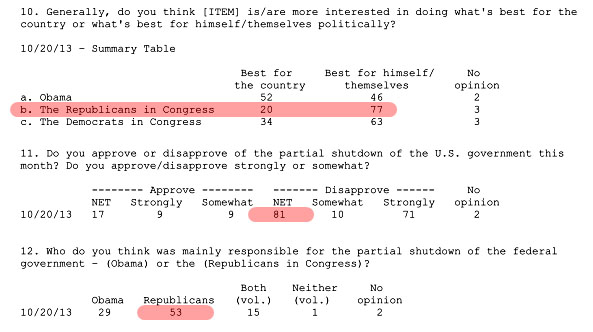
Drum highlights these numbers from a new ABC/WaPo poll:

abc_poll_shutdown

He adds:

Ted Cruz and his fellow tea partiers have done tremendous damage to the Republican Party brand. If I were sociopathic and didn’t care about my country, it would almost be enough to make me hope that they do it again a little closer to Election Day.

The question before the House, though, so to speak, is whether something shifted in the national psyche this past month. Did this stunt that brought the global economy to the brink of a catastrophic collapse deeply alter the public’s views of politics in ways that will last? My hope is yes, unless the Obama administration’s rank incompetence on its highest domestic priority might rescue the GOP from the oblivion it so richly deserves. What gives that hope some evidentiary clout are, to my mind, the following pieces of polling evidence: Independents now favor the Dems over the GOP by 46 – 35 percent; only one in five think Republicans are “interested in doing what’s best for the country,” while 77 percent think they’re “interested in what’s best for themselves politically.” As Sargent notes, among independents, that number is a staggering 14-83. Among moderates 18-81. Among seniors – yes, seniors – 24-74.

So you have a big majority blaming the GOP for the shutdown and near-default; and you have a massive majority (80 percent) believing the shutdown and near-default were bad for the country; and you have a massive majority believing that the GOP is a cynical exercize in partisanship as opposed to a party offering solutions to public problems in good faith.

Now, I’ve reluctantly come to believe all of this over the past ten years or so, but never has there been such an amen chorus. It could be that we just had an aha! moment about the degeneracy of the political right that could shape future politics the way the Gingrich shutdown did. For me, it makes backing Republicans next year unthinkable – and electing a Democratic House a win-win for the country and, perversely, for the cause of GOP reform in the long run. Could that judgment begin to entrench itself among the public as a whole?

Nate Cohn also analyzes the post-shutdown polling:

Last night, two surveys from CNN and ABC/Washington Post showed Democrats building an 8 point lead on the generic ballot; if Democrats could win the popular vote by such a wide margin, they would be well positioned to retake the House. But those 8 point leads might not be as strong as they look. These are polls of registered voters, not likely voters. And once the pollsters apply likely voter screens, the Democratic edge will narrow.

“The Best Thing Going For The GOP”

Hurricane Sandy New Jersey Relief Fund Press Conference

That’s what Ambers calls Chris Christie:

There is nothing he has done — not one thing — that would render him unacceptable to a majority of the 2016 electorate. (Yes, he’s against gay marriage. He’s made it clear, by his actions Monday, that he is not prepared to litigate the issue nationwide, that he understands his personal views are on the wrong side of history, and that he will not expend political capital on an ideological crusade in order to please the Republican base.) If the GOP primary sorts out into a Ted Cruz/Rand Paul revanchist wing and a common sense governing conservative wing, Christie can probably make it through the gauntlet of the GOP nomination contest. And about his size: it still marks him as a regular guy, and his surgery to reduce it is probably enough to satisfy any lingering concerns about his hardiness.

I agree. What makes Christie so potent a figure is his relative moderation compared with the GOP’s current fire-breathers and his Jacksonian, bullying persona. The latter is critical to winning over the South, which might otherwise be repelled by an urban Northeastern pragmatist. The Jacksonian wing of the GOP – think Zell Miller or Dick Cheney – loves a fighter, cheers a brawler, and would swallow whatever disagreements they have with Christie on social issues because of his attitude. And they would love that attitude delivered to the door of Hillary Clinton if she were the Democratic nominee. The real danger of that match-up, of course, would be the gender gap. One flash of the bullying, condescending alpha male in a debate – and I mean something much more inflammatory than “you’re likable enough” – and women voters could recoil, especially if he’s up against the first female candidate for president.

But his response to the shutdown and default crisis was pitch-perfect:

All you need to do is look about 200 miles south of here to see the mess that Republicans and Democrats have made of our national government and we should haul all their rear-ends to Camden today to see how bipartisanship works and government works together.

Weigel analyzes Christie’s decision to withdraw his appeal to New Jersey’s marriage equality ruling:

If marriage was hurting Christie, it wasn’t showing up in public polls. But anything that hurt his margin, and by extension his potential coattails for Republicans in legislative races, was more damaging to Christie’s future than a cave on gay marriage. The Republican primary votes who’ll meet the governor in 2015 will already assume he’s more moderate than they are.

Allahpundit thinks along the same lines:

Electability is, after all, 95 percent of Christie’s argument for the GOP nomination three years from now. It’s not enough to win reelection, which is a lock; he wants to run up the score to show national Republicans that he’s the only guy in the field who can make Hillary worry. Christie’s dream scenario (which he’d never admit to, of course) is that he wins by 25 points in Jersey while true conservative Ken Cuccinelli ends up getting blown out in purplish Virginia. That one-two punch will give a lot of conservatives who dislike Christie pause in ruling him out categorically for 2016.

(Photo: By Michael Loccisano/Getty Images)

Dick Morris Award Nominee

“The growth of the Internet will slow drastically [as it] becomes apparent [that] most people have nothing to say to each other…. By 2005 or so, it will become clear that the Internet’s impact on the economy has been no greater than the fax machine’s,” – Paul Krugman, 1998.