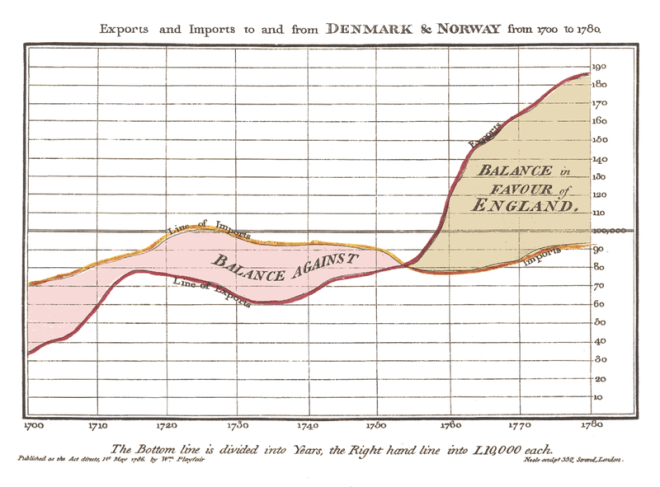
Scottish engineer William Playfair was the first to start designing charts in ways that illustrate clear visual patterns, rather than mere rows and columns:
In the decades after Playfair, Europe came alive with infographic innovation. In 1826, Charles Dupin created a so-called “thematic map” using shading to show the varying levels of illiteracy across France. The German geographer Heinrich Berghaus made this technique famous in the mid-nineteenth century with dozens of works depicting the planet’s climate, animal life, and anthropology. Later in the century, Charles Booth published a map that showed the stunning extent of poverty in London, helping to promote social reforms. Even Florence Nightingale, the mother of modern nursing, invented a new kind of chart to show seasonal changes in casualties during the Crimean War. Called a polar-area chart, it’s still used today.
(Image: William Playfair’s trade-balance time-series chart, published in his Commercial and Political Atlas, 1786, via Wikimedia Commons)
Bilge Ebiri outlinesKill Your Darlings, a new romantic thriller about the interlocking lives of Beat icons Allen Ginsberg, Lucien Carr, Jack Kerouac, and William Burroughs:
Together, the four of them begin to breathlessly explore the creation of a new creative movement, to be called the New Vision, which will rejuvenate American literature and tear down the stuffy, hidebound morality and culture all around them. The nation might think it’s fighting fascism abroad, but these guys are convinced the real fascists are here at home, hiding in the ironclad poetic rules of meter and rhyme, and in the sexual mores governing society. “Let’s make the patients come out and play,” they proclaim. “We need new words, new rhythms!”
What’s that you ask? Oh, right, the murder. While all this is happening, there’s also an older gentleman by the name of David Kammerer (Michael C. Hall), who expresses a bit too much fondness for Lu [Carr]. For all his sophistication, the man is clearly obsessed, pathetically, with this beautiful young boy. He also appears to have given Lu some of his bolder ideas, so the notion of said ideas now being shared with the likes of Ginsberg and Kerouac (all of whom Kammerer sees as potential romantic rivals) clearly drives him nuts. The film opens with Lu dropping Kammerer’s bleeding body into a river, so I’m not really spoiling anything when I say that the story builds up to the older man’s death. Is it a murder, or a blood sacrifice in the name of art? Is he the darling being killed, or is there something more symbolic going on here?
Andrew O’Hehir considersDarlings a solid entry in the recent wave of Beat Generation films, including 2010’s Howl, last year’s On The Road, and the upcoming Big Sur, which hits theaters next week:
One could argue that “Kill Your Darlings” could use a bit more unpredictable or hostile Ted Cruz energy, some sense of the threat the young Beats (who didn’t call themselves that until the ‘50s) posed to the social order. … But despite its unsure moments, “Kill Your Darlings” has considerable advantages over both Rob Epstein and Jeffrey Friedman’s “Howl” and Walter Salles’ ambitious, hit-and-miss adaptation of Kerouac’s iconic “On the Road,” which featured Sam Riley and Kristen Stewart. For one thing, it actually has a plot, a crisp, compact (and mostly true) narrative that unfolds during the latter years of World War II, when Ginsberg first came to New York and met Lucien Carr.
But Jordan Larson suggests that all of these films have missed the mark:
[W]hat’s most problematic about these films isn’t their artistry but their authenticity. … One could argue that these films are only trying to honor the spirit of the Beat Generation, but can you separate the “essence” of a story or a movement from what its progenitors really said and did, and at what point in their lives? Neal Cassady and Jack Kerouac were grown men who were also alcoholics, misogynists, and womanizers who killed themselves with substance abuse. Pretending Kerouac’s life was some sort of consequence-free dream not only does a disservice to viewers, but to the Beats, as well.
A.A. Dowd has mixed feelings about the new film but lauds the depiction of the young, brilliant lovers:
The saving grace of Kill Your Darlings is its sordid romantic angle, a narrative thread that pulls the film away from wink-wink allusions and into more serious emotional territory. At heart, this is a love triangle, one that drops a smitten Ginsberg between the charismatic Carr and the latter’s stalkerish benefactor, David Kammerer, similarly bewitched by the young, sexually ambiguous heartbreaker. Even before the scenario explodes into violence—culminating in a true-crime climax built from hard fact, hearsay, and invention— [director John] Krokidas has mined it for fine speculative melodrama.
It was another great day for marriage equality – with New Jersey expanding human freedom and dignity as of 12.01 am. Tocqueville predicted the sweep, and I insisted on the multiple truths of the Matthew Shepard story. The president failed to truly cop to the disastrous launch of the Affordable Care Act, while insisting he was mad as hell about it. (Joe Klein, who has long criticized Obama for not getting his hands dirty in running the executive branch, must be smiling ruefully somewhere.) As the deal to secure Syria’s WMDs appeared to be working, Israel’s possession of both nuclear and chemical weapons isolated it still further.
Maria Popova offers high praise for David K. Randall’s Dreamland: Adventures in the Strange Science of Sleep. Below is an excerpt from Randall detailing the work of psychology professor Calvin Hall, who began collecting records of people’s dreams in the 1950s:
By the time he died in 1985, Hall had synopses of more than fifty thousand dreams from people of all age groups and nationalities. From this large database, he created a coding system that essentially treated each dream like it was a short story. He recorded, among other things, the dream’s setting, its number of characters and their genders, any dialogue, and whether what happened in the dream was pleasant or frightening. He also noted basics about each dreamer as well, such as age, gender, and where the person lived.
Hall introduced the world of dream interpretation to the world of data. He pored through his dream collection, bringing numbers and statistical rigor into a field that had been split into two extremes. He tested what was the most likely outcome of, say, dreaming about work. Would the dreamer be happy? Angry? And would the story hew close to reality or would the people in the dream act strange and out of character? If there were predictable outcomes, then maybe dreams followed some kind of pattern. Maybe they even mattered.
Hall’s conclusion was the opposite [of] Freud’s:
far from being full of hidden symbols, most dreams were remarkably straightforward and predictable. Dream plots were consistent enough that, just by knowing the cast of characters in a dream, Hall could forecast what would happen with surprising accuracy. A dream featuring a man whom the dreamer doesn’t know in real life, for instance, almost always entails a plot in which the stranger is aggressive. Adults tend to dream of other people they know, while kids usually dream of animals. About three out of every four characters in a man’s dream will be other men, while women tend to encounter an equal number of males and females. Most dreams take place in the dreamers’ homes or offices and, if they have to go somewhere, they drive cars or walk there. And not surprisingly, college students dream about sex more often than middle-aged adults.
Now that we’ve entered the era of smartphones and big data, dream research looks more promising than ever. Taylor Beck describes a new campaign that aims to create “the world’s largest database of dreams”:
Shadow: Community of Dreamers is a mobile app, crowdfunded with $50,000 on Kickstarter, which will wake people, collect dream reports by typing or talking, anonymize them and beam them into a searchable, analyzable online set. … “We can measure how global events affect mankind’s unconscious,” says Shadow adviser and Spanish neuroscientist Umberto León Domínguez, PhD, a researcher in the sleep and circadian rhythms lab at the University of Madrid School of Medicine’s Psychiatry department. The wars in Iraq and Afghanistan, natural disasters, terrorist attacks, elections, and the World Cup are examples of events Domínguez thinks impact people’s dreaming. Data collected on Shadow will show scientists how events like births, deaths, celebrity marriages, and pop cultural breakthroughs like documentaries or marketing campaigns affect global dreaming, too.
“They would rather not see [marriage equality] on the table [in 2016]. They’re focused on economic issues and trying to win … I can see [Christie’s move] playing well to a great deal of them,” – a high-level GOP fundraiser, speaking of the party’s New York donors.
Over the last few weeks, it has demonstrated again that its intent is not to shake up the establishment but to burn down the village. As a Democrat, I disagree with its policy positions, but its policy positions alone are not what make the Tea Party so dangerous. What makes the Tea Party dangerous is its members’ willful disregard for the most basic tenets of American democracy. They do not believe in the legitimacy of our president. They do not believe in the legitimacy of decisions handed down by our Supreme Court. Unlike President Obama, Harry Reid, Mitch McConnell, John Boehner, or a host of other Democratic and Republican lawmakers who grasp the basic reality of politics, they have never, not once shown a willingness to compromise on anything. Merely uttering the word is enough to draw a primary challenge.
Jonathan Bernstein adds that once “resistance to compromise itself becomes an important principle, episodes such as the shutdown are hard to prevent”:
The key point to emphasize here is that the problem with the Republican Party, or at least the problem that causes shutdowns and other such disasters, isn’t that they’re “too conservative.” If that was all that was going on, they could still reach compromises with Democrats. The problem isn’t about ideology, at least not as we conventionally think of it; it’s about willingness to compromise and to work within the political system.
Finally, Jeff Shesol dismisses the idea that there is some kind of civil war happening inside the GOP:
The extremism of our own age—Tea Party extremism—“contaminates the whole Republican brand,” as David Frum has written. And he’s right. But Tea Party extremism is not, as this implies, a betrayal of the party’s belief system. It is, instead, a crystallization, a highly potent concentrate, of the party’s belief system. The free-market dogmatism, the tax-cut catechism, the abhorrence of nuance and science and government and fact—these did not bubble up during town-hall meetings in 2010 but flow from the same deep well from which establishment Republicans like Mitch McConnell (Goldwaterites, all) have long been drinking. Frum and other sensible conservatives yearn for a Tea Party exit—maybe even an expulsion—from the G.O.P. But it cannot be expelled, because in this case the parasite is a creation—in some ways a perfection—of the host organism itself.
Lots of blood boiled when the above video went viral last week, showing Utah Boy Scout leaders destroying an iconic rock formation in Goblin Valley State Park:
Despite their assertions that they were concerned for the safety of others in the park after watching a family with small children pass below, the lighthearted attitude of the film paints a different picture for many as the men cheer and high-five. Utah State Parks spokesman Eugene Swalberg said Thursday he found the video disturbing and has asked that possible criminal charges be considered in the case. … A spokesman for the Boy Scouts of America called the act by two leaders disappointing and reprehensible. “We teach our 2.6 million youth members and 1.1 million adult members … the principles of ‘leave no trace.’ These principles stress a commitment to maintaining the integrity and character of the outdoors and all living things,” according to a statement from the BSA.
Michael Byrne thinks the uproar reveals a split in American attitudes toward nature:
On the one hand are dudes like this, frequently found in the Utah desert piloting 4X4s around black-stained slickrock trails, and then there’s the crowd more into hiking and quietly being awed. You know, Coors versus Dales. Or whatever. I hate even acknowledging it, but every spot of public land in the U.S. will have some version of this user divide. It goes back to old definitions of “use” I suppose, exploitation vs. preservation. Ours vs. ours to protect. It’s not that easy, of course, and they bleed together probably as much as they separate, but it’s hard not to see a rift in values. It’s a rift that leads to things like this.
The president touted them in his speech today, but McArdle claims that “the computer systems at the call centers for states running the insurance exchanges are the same as the computer systems that consumers are having such a hard time with”:
A nice woman at a federal call center told me that (at least for the state of Florida, where my in-laws live) there is an alternate procedure: They can fill out a manual application in PDF format. But she also told me that it takes three weeks for that application to be mailed to your house. After you receive it, you check the application to ensure it’s accurate, and then mail it in. One to two weeks later, you will be notified of your subsidy eligibility. Then you can actually enroll in a plan, though she wasn’t quite clear on how that part would work — do you call back again?
This may work for older people who simply can’t figure out how to use computers, or for desperately ill people who have been rebuffed by the computer system . . . but so will repeatedly logging in until you finally get the system to work. It is unlikely to get loads of healthy, young, premium-paying folks to sign up for insurance and thereby make this whole thing financially viable. And by the time we’re ready to default to this option, it’s unlikely that there will be enough time to make it work.
Philip Klein ran into another, smaller problem with the call centers:
Obama encouraged Americans seeking insurance to sign up the old-fashioned way by calling 1-800-318-2596. But when I tried calling the number and followed the prompts in what I deemed the most logical manner, I got referred back to the website Healthcare.gov and its live web chat feature.
Suderman analyzes other aspects of today’s speech:
If President Obama was confident that the online exchange system was on track to be fixed in short order, that would have been the highlight of his message. It wasn’t. Indeed, much of his speech was devoted to arguing that Obamacare is more than just a website, and to explaining how people who want coverage can still enroll in coverage outside the exchanges.
There was no clear explanation of what was going wrong. There was no timetable for when it would be fixed. Obama repeatedly said that he was angry, but he sounded ebullient. In the end, though, Obama’s speech doesn’t matter. Either the Web site will be fixed in a reasonable time frame, and the law will work, or it won’t be fixed and the law will begin to fail. The Affordable Care Act is no longer a political abstraction. It’s the law, and it will be judged not on how well politicians message it, but how much it does to improve people’s lives.
In a review of The Fifth Estate, Bryan Bishop praises its “painfully underutilized” actors but feels overall that the film “fails to deliver”:
[The Fifth Estate] is clearly enthusiastic about the broader cause of exposing truth in the first place. The sequence when WikiLeaks hits its stride is a clear rallying cry: [Wikileaks spokesman Daniel] Domscheit-Berg knows that the site is changing the world for the better, and [director Bill] Condon establishes an energy that makes one want to be part of that movement. The rapid-fire phone calls and split-second decisions as editors of The New York Times, Der Spiegel, and The Guardian decide how to handle leaked documents take on the irresistible rhythm of the spy thriller — all the while the US government is portrayed as flat-footed and downright ignorant of the forces that WikiLeaks is harnessing. The thorny moral and ethical issues that develop — the tension between full transparency and the safety of intelligence agents in the field is the most prominent — are laid at the feet of Assange the man, rather than used to undercut the positive sentiment about the WikiLeaks mission itself.
In WikiLeaks’ own takedown of The Fifth Estate script, it describes the film as “irresponsible, counterproductive, and harmful.” In truth, it’s none of those things — if only for the reason that it would have to be a much more hard-nosed and effective film in order to have that profound of an effect. As it is, The Fifth Estate sits as mild, broadly accessible fare that should start a conversation amongst those that aren’t already familiar with the story — but won’t profoundly change the minds of anyone that’s been paying attention.
[Eva Gollinger]: Do you think [the film is] an attempt to discredit you and your organization?
JA: I don’t sort of look at the things that way. This film comes from Hollywood. I know the book that it was based on. The books were definitely an attempt to do precisely that. DreamWorks has picked the two most discredited libellous books out of dozens of books available for it to pick. But it’s coming out of a particular milieu about… within Hollywood and that constraints, it seems, what scripts can be written and what things would get distribution. I don’t know if that was the intent of the filmmakers. It’s certainly the result, but it’s been doing quite poorly in the reviews.
Indeed, its Rotten Tomatoes score is a dismal 39%. But contrary to Assange, Mark Kermode contends that Condon “goes out of his way to be balanced, perhaps overly so”:
Condon even gives his adversarial central character the last word, dismissing the film from the confines of the Ecuadorian embassy, telling viewers that it this is only one version of a far more complex story, urging them to find out more for themselves. While this may be philosophically admirable, it doesn’t make for great drama, and for all its simplifications and fictionalisations, The Fifth Estate feels strangely unfocused, uncertain of how to deal with its slippery enigma.
And Jessica Winter focuses on the film’s omission of the sexual assault charges against Assange:
Precisely because The Fifth Estate is not a hagiography — its takeaway is of a difficult, deeply flawed and damaged person who did good things and may continue to — it’s bizarre that the movie scrubs out the legal case that’s cast a shadow over him nearly as long as the world has known his name. In October 2010, Assange fled an interview with CNN’s Atika Shubert because she wanted to ask a perfectly reasonable question about how the sexual-assault allegations were affecting the work of WikiLeaks. “I will have to walk,” he said moments before removing his mike, “if you’re going to contaminate this extremely serious interview with questions about my personal life.” The Fifth Estate obliges Assange on this point, but the result is a film that’s not merely clean but sterile, sanitized, redacted — exactly the kind of history-making that WikiLeaks set out to dismantle.

 The Dish
