Its appeal, I think, comes from Lewis’s success in writing a theodicy of the everyday. Unlike Dante and Milton, he eschewed a grand theology of the cosmos, focussing instead on quotidian temptations of the common man. An epistolary novel, “The Screwtape Letters” features a senior demon called Screwtape writing thirty-one letters of advice and encouragement to his inexperienced nephew, Wormwood, who is trying to win the soul of a nameless young man. …
For believers, the letters are theology in reverse, teaching the love of God through the wiles of the Devil, but for all readers, regardless of belief, the letters frame human experience as a familiar sequence of trials, from how you take your tea and what parties you attend to the sort of person you choose for a partner and the sort of politics you espouse. As Justice Scalia said when he invoked “The Screwtape Letters,” “That’s a great book. It really is, just as a study of human nature.” The novel remains wildly popular because whether or not you agree with Lewis and Scalia that the Devil is real, the evils promoted by Screwtape—greed, gluttony, pride, envy, and violence—most certainly are.
I loved the book when I read it years ago. Its success is in telling a story about what sin means in a granular, graspable, middle-brow prose. Parts of Lewis can be clotted and a bit pretentious, but much of it is written in an English as accessible as Orwell’s and successful for similar reasons: readers love stories more than arguments. By embedding an argument in a story of secret correspondence, the Devil comes alive for modern Christians – not as a myth, but as a canny part of our own self-deception. That part reveals how small, trivial concessions to evil can slowly change one’s character altogether over the years. It illuminates not the banality of evil, but its disguises.
(Image: St. Michael Vanquishing Satan by Raphael, via Wikimedia Commons)
Beutler argues that the GOP’s allergy to any sort of tax increases makes it difficult:
In a real way, this was Grover Norquist’s shutdown. And now, Norquistism is the main obstacle to preventing another shutdown in January.
The bill that reopened the government precipitates official budget negotiations. Democrats have been demanding a House-Senate budget conference for six months, but Republicans forestalled it, largely because of Norquistism. And in the aftermath of the shutdown GOP leaders are still squashing any discussion of revenues before contemplating the merits.
Does that mean the government will shut down again unless Republicans have a tax epiphany, and agree to close some tax loopholes for rich people? No. But it means that they have already closed off the easiest and most obvious path to avoiding one.
Ezra suggests that Democrats shelve tax increases, for now:
The core question for the American economy isn’t taxes. Or spending. It’s growth. That’s true even if all you’re worried about is the deficit. As Larry Summers wrote, the Congressional Budget Office’s numbers suggest that “an increase of just 0.2 percent in annual growth would entirely eliminate the projected long-term budget gap.” The budget debate, in other words, should be a growth debate. And Democrats’ top priority shouldn’t be higher taxes. It should be growth — and, to be sure, the distribution of that growth.
He wants relief from the fiscal pinch of sequestration. Chait expects this to be a heavy lift:
The Republican Party now embraces sequestration even while sometimes still assailing it as horrible policy. The real appeal to the GOP is that Obama doesn’t like it. As McConnell candidly says, “Keeping the BCA [Budget Control Act] levels is a huge success, and I know because Democrats hate it.” Aside from any policy details, Republicans really want to stick it to Obama. Keeping in place policies Obama hates makes them happy, irrespective of the content of those policies.
Cohn tries to imagine a deal that Republicans and Democrats might agree to:
Democrats once hoped to reach an agreement that would replace all of the sequestration cuts, which are supposed to last for ten years. But that would require the kind of grand bargain Republicans have rejected. That’s why the best hope is probably for a much narrower deal—one that replaces a year or two of sequester cuts, while putting some money into Democratic priorities like transportation infrastructure and maybe a token investment in the president’s pre-kindergarten proposal. Such a deal might also include new revenue, but only a small amount, perhaps as a byproduct of tax reform or some kind of clearly dedicated user fee. (In other words, some kind of tax designated for a specific purpose, in the same way a gas tax is dedicated to transportation.) In exchange, Democrats could agree to a set of “mandatory spending” changes that didn’t touch Medicare and Social Security benefits—say, cuts to farm subsidies or federal retirement programs, or changes in the way Medicare pays for services. Some of these proposals are already in Obama’s 2014 budget proposal. Both the White House and congressional Democrats could go for this kind of deal—depending, of course, on the precise mix of components.
My main concern with unwinding sequestration is that it removes the only serious leverage against defense spending, the critical part of future fiscal health that no one wants to talk about. But frankly, any failure to act on the big issue of entitlements makes me less interested in any future budget that breaks out of the sequester. Perhaps the deal means adopting chained CPI in return for current infrastructure investment. That both boosts growth now while restraining costs later. The Democratic left would hate it. Obama should ignore them. If we’re going to have a small bargain, an adjustment to the sequester, keeping the defense cuts, increasing infrastructure investment and giving some relief to future generations strikes me as doable.
Today the president discussed the problems with Obamacare’s exchanges:
I have to say I found his remarks far less contrite than they should have been. Where is the unqualified apology? Where is the commitment to basic accountability for this clusterfuck? Instead, we have all these positive rationalizations and excuses in a confusing technical lecture. Ezra reports that the White House was blindsided by the Healthcare.gov problems:
The problem here isn’t just technological. It’s managerial. The White House’s senior staff — up to and including the president — was blindsided. Staffers deep in the process knew that HealthCare.gov wasn’t ready for primetime. But those frustrations were hidden from top-level managers. Somewhere along the chain the information was spun, softened, or just plain buried.
The result was that the White House didn’t know the truth about its own top initiative — and so they were unprepared for the disastrous launch. They didn’t even know they needed to be lowering expectations. In any normal corporation, heads would roll over a managerial failure of such magnitude and consequence.
And perhaps heads will roll. But for now, the White House is focused on trying to make HealthCare.gov work.
Not. Good. Enough.
Obama needs to get ahead of this, and stop being as defensive as he was this morning. He does not have the credibility to sell us on the ACA when he does not cop more aggressively to his own failure to stay on top of this most important domestic initiative. Sebelius is the person most obviously responsible for the managerial – not technical – problems that have plagued this new program’s rollout.
Until someone that high up is fired, I do not believe that no one is angrier about this failure than the president. I believe that’s true – but also spin. Meanwhile, W. James Antle III wonders whether Obamacare repealers and Obamacare fixers will work together if the exchanges require legislative fixes:
The reasons liberals should want to prevent their long-awaited victory on health care reform from being turned into defeat by the haphazard implementation of a poorly constructed law are obvious. But what’s in it for conservatives? Nothing would better vindicate their case against Obamacare than the “death spiral” that would follow young people fleeing exchanges that are being flooded with the old and sick.
Yet if Obamacare undermines the entire individual health insurance market, it will make it even more difficult—and perhaps impossible—to ever implement any free-market health care reforms. In fact, single payer may loom ever larger as the only viable remaining option to an employer-based system that both conservatives and liberals would like to substantially remodel.
But for Republicans, Obamacare is not and perhaps never has been a program to favor or oppose, to reform or to abandon. It has become a doctrinal issue of paramount importance. They have not acted rationally in shaping it, as they could easily have, or in reforming it, as they could now do. They will continue a policy of sabotage – and the possibility that we could all end up in single-payer as a result is not the kind of empirical thing they can compute. It requires an analysis of costs and benefits, which they are unable to do. All they do is proclaim eternal, political truths and purge any dissenters. That’s all they know. Because actually governing – rather than controlling – the country is of no interest to them.
In a later post, Ezra assesses the efforts to fix the ACA website:
HealthCare.gov is monstrously complex. The Times reports that there’s more than 500 million lines of code — of which more than 5 million lines may need to be rewritten. And that code is interfacing with computer systems (and computer code) at the Internal Revenue Service, the Social Security Administration, state Medicaid systems, insurers like Aetna, and more. Even the best programmers would have trouble figuring out what’s going on — much less what’s going wrong — quickly.
The truth is that the Obama administration is, to a much greater extent than it would like, dependent on the very people who built HealthCare.gov to fix it. They’re the only people who know what’s going on inside the system.
A reader sent me a recent column by the legendary William Pfaff syndicated in the international edition of the NYT. What he writes there would not, I bet, appear in the domestic NYT. Because what Pfaff does is debate the reality of the Middle East and weapons of mass destruction in ways almost never heard in mainstream American media – but ubiquitous abroad.
He posits two possible outcomes of recent developments. First off, he cites the so-far remarkably successful effort to find, secure and destroy the Assad regime’s chemical weapons stockpile. Incredibly as it seemed only a few months ago, we look as if we may be on the path to removing those hideous weapons from the world – a big advance in collective security. But imagine if the talks with Iran also conclude successfully – which may well happen, if they aren’t deliberately scuppered by the Christianist-AIPAC alliance in the US Congress. Then you’d have Iran’s nuclear program monitored as a civilian enterprise under the Non-Proliferation Treaty – and Obama would have helped remove WMDs from two Middle East powers, a big advance toward lowering the potential for an apocalypse in that part of the world.
But guess who that leaves as the sole WMD power in the region, with chemical and nuclear weapons not under any international supervision? Pfaff:
The conclusion of such a series of developments could be the regulation and legalization of the conventional weapon stocks possessed by Syria and Iran, leaving Israel as an outlaw not only because of its possession of weapons of mass destruction, but because of its aggressive expansion and apartheid policies with respect to the Palestinian territories and their populations.
If Syria and Iran give up their WMD potential – Israel is going to find itself extremely isolated in global opinion – even more so than today. The Israelis will not be able to argue that their WMDs are designed to deter other WMDs, since those other WMDs will have been neutralized. Israel will argue, understandably, that because of its uniquely despised existence in the region, it still requires a deterrent of huge magnitude. I’d be very sympathetic to that case. But it will be difficult to argue that and to argue that it will never give up the West Bank as well. Neither the US nor the European powers would be able to support both Israel’s retention of nuclear and chemical weapons and the continuing occupation and relentless de facto annexation of the West Bank and East Jerusalem.
I can even see a strategy where a successful conclusion to the Iran negotiations and to the Syrian chemical stockpile would increase the pressure on Israel to end its brutal occupation of the West Bank. What is Netanyahu’s strategy for dealing with that? Pfaff sees warfare against Iran as Netanyahu’s response to such advances – against US wishes. But I think that would intensify Israel’s isolation, especially if the Iranians were close to a deal – or even past one – with the West as a whole. Netanyahu is a Ted Cruz figure, but even he would not go there, I guess.
Is it therefore possible that developments in Syria and Iran could help advance a two-state solution in Israel/Palestine? Know hope.
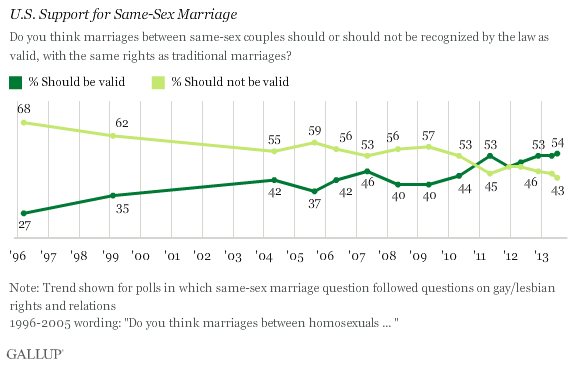
Reviewing the extraordinary progress of the marriage equality movement over the past two decades, Jonathan Rauch coins a term for how changes in public opinion tend to happen in America:
Alexis de Tocqueville, the Frenchman whose observations of America in the 1830s remain shrewdly relevant, famously remarked on Americans’ deference to majority opinion: “As long as the majority is still undecided, discussion is carried on; but as soon as its decision is irrevocably pronounced, everyone is silent, and the friends as well as the opponents of the measure unite in assenting to its propriety.” Although he exaggerates, the broad point remains true: the legitimising effect of public opinion is such that, other things being equal, majority support tends to amplify itself.
Even if I have doubts about gay marriage, the fact that most of my countrymen are on the other side weakens my resolve and impels me to acknowledge the legitimacy of their view. The difference between support at, say, 55 per cent versus 45 per cent — that is, the different between majority and minority standing — is one of kind, not merely of degree. That is not to say that opposition evaporates or crawls under a rock when it loses majority standing. But its power and relevance are greatly reduced.
Another word for this is the tipping point. But more generally, we are indeed much more susceptible to accepting things that a majority seems to have settled on. My biggest experience of this is living for part of the year in Provincetown.
It’s a small New England fishing village in outward aspect but any day-tripper there will encounter much higher levels of gay visibility than they’re used to, drag queens walking to get groceries, transgender people in front of you getting coffee, gay couples with children in strollers, and the occasional glimpse of an unexpected bare ass in leather. The day-trippers come from all-over – for whale watching, taffee-buying, dune touring or nightlife. They are predominantly heterosexual. And yet within a few minutes of awkwardness, they just accept it. Because no one is paying attention to the weirdness, you learn not to as well.
The place itself simply imposes acceptance by majority rule and the visitors immediately seem to sense that and adjust. They may feel differently if a drag queen were holding up the line at Starbucks in, say, Revere. But in the little town of widespread nonchalance toward otherness, the culture shifts almost at once. As usual, Tocqueville was onto something – long before Malcolm Gladwell.
(Polling from Gallup’s latest survey on the question.)
Ron Brownstein notes that leading gubernatorial candidate and long-time Clintonite Terry McAuliffe has tacked liberaltarian on social issues – a once unheard-of move for Democrats in the Old Dominion:
Virginia Democrats historically have sought a cautious middle ground on such questions, largely in hope of holding culturally conservative blue-collar, evangelical, and rural white voters long considered indispensable to statewide success. But McAuliffe has repeatedly adopted liberal social positions that ensure repeated conflicts with those voters—while providing fuel to energize the Democrats’ new ‘coalition of the ascendant’ centered on minorities, the millennial generation, and white-collar white voters, especially women. … That evolution suggests Virginia Democrats have increasingly decided that failing to motivate their ‘coalition of the ascendant’ is a greater electoral risk than alienating right-leaning whites.
Brownstein sees the same dynamic playing out in other states:
[P]urple-state Democrats, such as Sen. Kay Hagan of North Carolina and Colorado Gov. John Hickenlooper, have placed the same wager as McAuliffe and aligned with the social priorities of their new coalition, even at the price of goading conservatives. That has solidified Democratic unity on previously divisive issues such as gay marriage and immigration. Yet this consensus is likely to last only if it produces swing-state victories, starting with McAuliffe’s race next month.
Kilgore also underscores the national implications of a McAuliffe win:
As the Virginia race heads to its final days, it will often be noted that in the last nine gubernatorial elections there the party holding the White House has lost (Mills Godwin’s 1973 victory was the last win by the incumbent presidential party). As I argued in a long-lost FiveThirtyEight post four years ago, there are a lot of coincidences in that data point, and it probably has more to do with Virginia political rhythms than anything happening in Washington. But it’s still going to make a T-Mac victory a very big deal.
Tim Parks observes that “nothing prejudices the way a reader comes to a piece more than its headline”:
[T]here is a long tradition of giving a sharp alliterative, punning headline to a story that fuses the event itself with the paper’s angle on it. “The Royal Fail,” read a British headline a few days ago on the government’s privatization of the Royal Mail postal service. When papers push this technique to ironic extremes—usually on minor items—the headline becomes more interesting than the piece, a riddle that can only be solved by reading story: “All Kicks off as Hunk makes Flick of Chick being Sick,” is another in today’s Sun. It’s worth reading the British tabloid press if only for the crazy inventiveness of their headlines.
I was nursed like a media baby on Fleet Street headlines and puns. Back in the day – we’re talking late 1980s – Mike Kinsley used to bring me into his office when he wrote the headlines for the pieces in TNR. I regarded it as a high honor to have my Brit-brain picked for subversion, fun and pun. Sometimes, of course, the writers of the various pieces were not too happy with our larking about. Parks reflects on his time as a NYRblog contributor:
A piece on how my novel Cleaver was entirely transformed in the German film version Cliewer was originally titled, “How the Germans Annexed My Novel.” This sounded like war-talk to me. But unlike newspapers, the blog is sensitive to feedback and the title was quickly changed to “My Novel, Their Culture”—at once more effective and less potentially offensive.
Don’t think I didn’t notice (and delight in) the Pet Shop Boys references in your TNR headlines back in the day.
Busted. For a while, I surreptitiously titled every Diarist I wrote with a PSB song-title. No one at the office had a clue. I always wondered if it was merely a mega-in-joke for me. Apparently not. Which just put a big grin on my face.
It’s a big day for marriage equality, as New Jersey moves forthrightly ahead. That’s another 9 million people living in a state with full marriage equality at the state and federal level – and it reveals how the US Supreme Court ruling earlier this year could affect many state courts that will have to tackle this issue in the years ahead.
But what’s striking to me is how the most promising potential presidential candidate for the GOP in 2016, Chris Christie, decided to withdraw his appeal to the court’s ruling that would have made a popular referendum on the issue mandatory. That was his somewhat disingenuous position for a long time – as if the courts and legislature were somehow not capable of performing their constitutional roles properly without a direct popular vote. No such referendums are part of New Jersey’s history – Christie’s would have been the first. So his fig leaf is gone. The most mainstream Republican possibility in 2016 will come from a marriage equality state – just as the Pope is the first to have come from a country that already has marriage equality.
This matters. Leaders who come from places where equality is working are much less hostile to gay dignity than in those places where it remains a frightening abstraction. Christie’s decision to stop resisting will help entrench marriage equality still further and force the GOP to confront whether hostility to committed homosexual relationships remains a litmus test in its presidential nomination process. If I were Christie, I’d focus on the social data we are already accumulating on the impact of marriage equality on the lives and relationships of people in the relevant states. It’s the best argument there now is. Below is a great video presentation by Lee Badgett, an economist at the University of Massachusetts-Amherst, on the strikingly positive sociological data so far in marriage equality states:
A reader sums it up:
(1) Uptake is high, and will get higher as a result of the fall of DOMA, (2) domestic partnership and civil unions were never very popular to begin with and now are falling into disuse and are likely to fade away, (3) SSM breakup rates are relatively low, but it’s early days and data are sparse, (4) straight marital behavior has not been affected.
When the lives of gay citizens have improved immensely, when the reform has proven popular among heterosexuals and homosexuals alike, and when we can observe no effect at all on heterosexual marriage, it seems to me that the anti-gay right has to either dig deeper into fundamentalist rigidity, or embrace this as the truly conservative reform it is.
(Photo: Alexander Padilla and Anthony Arenas cut a piece of cake after being married by U.S. Senator-elect Cory Booker at City Hall in the early morning hours of October 21, 2013 in Newark, New Jersey. By Kena Betancur/Getty Images.)
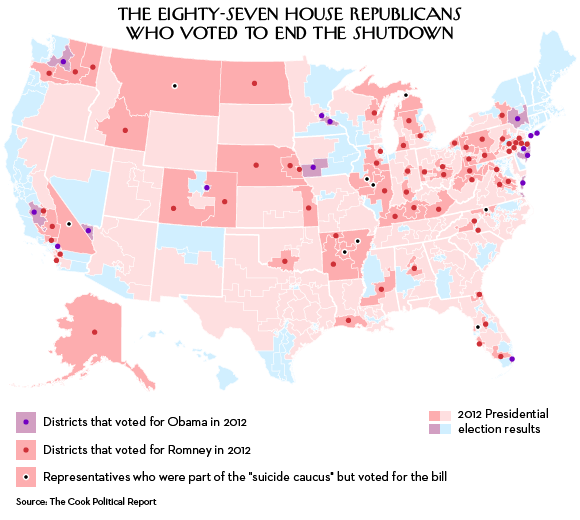
Lizza compares the GOP’s “suicide caucus,” which instigated the government shutdown, to the 87 House Republicans who voted to re-open the government, a group he dubs the “survival caucus”:
The biggest difference between the suicide caucus and the survival caucus is geography. While the suicide caucus is dominated by the South, and especially members from Appalachia and states like Tennessee, South Carolina, and Georgia, as well as Texas, the survival-caucus draws members more equally from the South (thirty per cent), the Midwest (twenty-seven per cent), the West (twenty-two per cent), and the Northeast (twenty-one per cent). There are no Texans, Tennesseans, South Carolinians, or Georgians in the survival caucus. In fact, the clearest divide between the two caucuses is also the oldest divide in American politics: North-South.
The survival caucus’s numbers are unlikely to grow significantly anytime soon. Weigel finds that an intra-GOP backlash against the Tea Party has yet to materialize:
There are only three or four “Tea Party conservatives” on the target list so far. Michigan Rep. Kerry Bentivolio and Tennessee Rep. Scott DesJarlais, repeatedly cited as the first backlash targets, had already guaranteed primary challenges by, respectively, winning an election after the incumbent had failed to make the ballot and covering up his mistress’s abortion. Anyway, they’re outnumbered on the other side: Republican senators or Senate candidates in Alaska, Colorado, Iowa, Kentucky, South Carolina, and South Dakota are all fending off Tea Partiers.
Unlike Dante and Milton, he eschewed a grand theology of the cosmos, focussing instead on quotidian temptations of the common man. An epistolary novel, “The Screwtape Letters” features a senior demon called Screwtape writing thirty-one letters of advice and encouragement to his inexperienced nephew, Wormwood, who is trying to win the soul of a nameless young man. …

 The Dish
