Talmudic Technicalities

Adam Kirsch puzzles over some of the stranger interpretations of Talmudic ritual – such as the warning that drinking only two cups of wine invites demons and witchcraft – and surveys attempts by rabbis to find loopholes:

Just as the rabbis codify in great detail exactly what can and can’t be moved on Shabbat, or how tall an eruv has to be, or what time in the evening you can say the Shema, so they lay out the rules and exceptions about urinating between a wall and a palm tree. This is dangerous, they explain, “only when there are not four cubits of space between the two objects. However, if there are four cubits, we have no problem. … And even when there are not four cubits, we said there is a problem only when the demons have no other route besides that one. However, if they have another route, we have no problem with it.”

The ease with which magic and witchcraft find a place in the Talmudic worldview is, to my mind, both illuminating and compromising. For it suggests that the Talmud’s general commitment to exact measurement and correct action—the need to find out exactly how to behave in order to please God, down to the order in which you put on your shoes in the morning—is itself a kind of magical thinking. For the rabbis, Jews are the protagonists of a cosmic drama in which their every slightest action will be either rewarded or punished. There is something ennobling about this, but when the same kind of scrutiny is attributed not just to God but to demons and witches, it begins to seem oppressive and even absurd.

The Crack Of Noon

Berfois recently republished G.K. Chesterton’s pitch-perfect rumination, “On Lying in Bed.” An excerpt:

Instead of being regarded, as it ought to be, as a matter of personal convenience and adjustment, it has come to be regarded by many as if it were a part of essential morals to get up early in the morning. It is upon the whole part of practical wisdom; but there is nothing good about it or bad about its opposite.

Misers get up early in the morning; and burglars, I am informed, get up the night before. It is the great peril of our society that all its mechanisms may grow more fixed while its spirit grows more fickle. A man’s minor actions and arrangements ought to be free, flexible, creative; the things that should be unchangeable are his principles, his ideals. But with us the reverse is true; our views change constantly; but our lunch does not change. Now, I should like men to have strong and rooted conceptions, but as for their lunch, let them have it sometimes in the garden, sometimes in bed, sometimes on the roof, sometimes in the top of a tree. Let them argue from the same first principles, but let them do it in a bed, or a boat, or a balloon. This alarming growth of good habits really means a too great emphasis on those virtues which mere custom can ensure, it means too little emphasis on those virtues which custom can never quite ensure, sudden and splendid virtues of inspired pity or of inspired candour. If ever that abrupt appeal is made to us we may fail. A man can get used to getting up at five o’clock in the morning. A man cannot very well get used to being burnt for his opinions; the first experiment is commonly fatal. Let us pay a little more attention to these possibilities of the heroic and unexpected. I dare say that when I get out of this bed I shall do some deed of an almost terrible virtue.

“Semitic Phantasms”

Anthony Grafton praises David Nirenberg’s Anti-Judaisman intellectual history of Western anti-Semitism. On the image of Jews espoused by the early Church fathers:

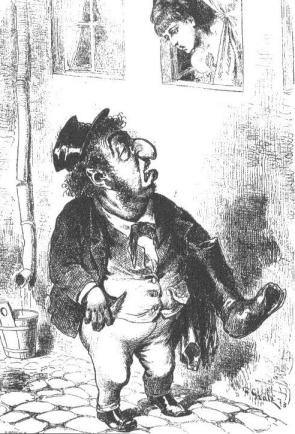
Again and again, Christian thinkers denounced their critics and enemies as “Jews”—that Antisemitic_caricature_1873 is, Christians who read too literally, or with no inspiration. And almost every one of them was denounced in his turn for the same crime of Jewish deviationism. In this world, in which imaginary Jews haunted real cities and their imaginary crimes became the object of real sermons, [St.] Jerome could find it reasonable to insist, almost in the same breath, that the Christian scholar must master Hebrew in order to understand the first half of his own sacred scripture and that Jewish liturgy and practice had lost their entire positive value with the coming of Christ, so that his own duty, as the pupil of a Hebrew teacher, was to hate the entire Hebrew race. …

The Fathers had far less to do with actual Jews than Paul or the evangelists—which is why Nirenberg’s enterprise really takes wing when he reaches them. In the fourth and fifth centuries, the Jews whom Jerome fiercely hated and Augustine drily pitied were largely abstract figures of thought rather than individuals of flesh and blood. Yet they were central to the two men’s visions of the past and the future—and their errors provided vital weapons with which Jerome could fight those who denied his readings of the Bible, and Augustine the Manicheans who did the same to his. Fictional Jews, as vivid as they were imaginary, began to fill the virtual world that the writers conjured into being. 

(Image: anti-Semitic caricature shortly after the big bang at the stock exchange in Vienna, 1873, via Wikimedia Commons)

“Blogging Isn’t Good For The Soul”

That’s what Richard Beck argues in a theologically-inflected rumination on how blogging feeds the competitive, narcissistic tendencies he finds at the heart of original sin:

One of the things I’ve learned from writers like James Alison, a theologian deeply informed by Rene Girard, is how rivalry is intimately associated with our self-concept. Specifically, most of us create, build up and maintain our self-esteem through rivalry with others. Our sense of self-worth is created and supported by some contrast and opposition to others. I am a self in that I am over and against others. Better. Smarter. More righteous. More successful. More authentic. More humane. Less hoodwinked. More tolerant. More insightful. More kind. More something.

In short, selfhood is inherently rivalrous. Rivalry creates the self. Rivalry is the fuel of self-esteem and self-worth.

… From sunrise to sunset every thought I have about myself is implicated in acts of comparison, judgement, and evaluation of others, allowing me to create a sense of self and then fill that self with feelings of significance and worthiness.

Things like blogging, given its nature, can bring these rivalrous feelings to the surface making them more transparent (if you are self-reflective). But it’s just a symptom of a deeper sickness, that the self in inherently rivalrous and that self-esteem is a feeling of significance achieved over against others.

A Poem For Sunday

absolute

“Hunger for the Absolute” by Frank Bidart:

Earth you know is round but seems flat.

You can’t trust
your senses.

You thought you had seen every variety of creature
but not

this creature.

When I met him, I knew I had
weaned myself from God, not

hunger for the absolute. O unquenched
mouth, tonguing what is and must

remain inapprehensible—
saying You are not finite. You are not finite.

(From Metaphysical Dog by Frank Bidart © 2013 by Frank Bidart. Used by permission of Farrar, Straus and Giroux, LLC. Photo by Tristan Bowersox)

Which Jesus Do You Believe In?

In an interview with Mockingbird marking the American release of his latest book, Unapologetic, Francis Spufford remarks on the different ways Jesus is portrayed:

M: So not the meek, not the cool, not the Ché, not the ironic, so then, what are we missing? Who is Jesus?

FS: We’re missing the open door to a generosity which thinks that law is the very beginning of what human beings need, where calling it radical is too small. You could call it conservative and it would make just as much sense, and you would still slough it off like a skin and leave it way behind. He is somebody. He is love without cost controls engaged. He is what it looks like to love deliberately without self-protection.

Reviewing the book, Wesley Hill appreciates that Spufford doesn’t offer “another defense of Christian ideas” but instead tries “to paint a picture of what it’s like to be a believer”:

Religious sensibilities, as Spufford writes in the preface, “are not made of glass, [and] do not need to hide themselves nervously from whole dimensions of human experience.” When we talk about sin and grace and faith, we’re not entering some rarefied realm of discourse removed from everyday life. We are, Spufford contends, trying to describe the sense of guilt that keeps us up at night worrying that our mean-spirited comment at a fancy dinner party puts us in the same predicament as the guy who tears into his former drinking buddy in a bar fight. We’re trying to describe the sense of mystery and elusive presence that frightens and comforts us—or comforts by frightening us—when we listen to the lilting melodies of Mozart’s “Clarinet Concerto.”

At the heart of Spufford’s book is a long retelling of the story of Jesus, or Yeshua, that is as evocative as any I’ve read. When I sent a copy of the book to a skeptical friend, I told him, “Finishing the Yeshua chapter made me want to become a Christian all over again.”

Previous Dish on Spufford here, here, and here.

Where Is God In After Tiller?

Casey N. Cep ponders religion’s complex role in the documentary:

“The debate is always framed in such stark, absolute terms, but when you hear from these women and what their lives are like, it’s harder to apply blanket, abstract rules,” [filmmaker Lana] Wilson said. The same is true for the four physicians, who themselves articulate doubts and uncertainties over the procedures they perform. When Dr. Sella reflects on her work, she confesses, “The reason that I’ve struggled is I think of them as babies. I don’t think of it as a fetus.” Later, Dr. Robinson decides to deny an abortion to a woman who is thirty-five weeks pregnant because she lacks a compelling reason, and then disagrees with her staff by approving an abortion for a Catholic teen-ager who considers herself pro-life.

That teen-ager is one of many patients who prays and worries over her relationship with God. Listening to her testimony, I thought back to my second year of seminary, when I lived down the street from a Planned Parenthood health center. Some mornings, on my way to lectures on the Hebrew Bible or the New Testament, I would stop to talk with the protestors who occupied the street corner. I remembered some of those conversations while watching “After Tiller.” When I asked Shane and Wilson why they did not interview those opposed to late-term abortions, they pointed to the presence of those views in the film. “Many of the patients, usually the ones struggling most with the decision, are wrestling with their religion,” Shane said. “Some of the patients are even anti-abortion,” Wilson explained. “These women struggle with these issues more than anyone.”

Check out the Dish’s “Ask Anything” series with the After Tiller filmmakers here.

Finding Sustenance For The Soul

In a wide-ranging interview, Ted Gioia, a Catholic writer perhaps best known for his books about jazz music, reflects on art and faith in an age of consumerism:

Those committed to a spiritual life understand what popular culture hasn’t yet learned (or is afraid to admit)—namely that the hunger of the soul cannot be satiated with sugary sweets and shallow entertainments.  Somewhere along the way, many people got the idea that the religious sphere and artistic sphere are at odds with each other.  I believe the opposite is true.  Both the arts and spiritual discernment broaden our perspectives and enrich our lives, and in very similar ways.

This was the single greatest lesson I learned from my years studying philosophy at Oxford—namely that the pervasive empiricism of modern life, which only accepts what it sees and quantifies, is ultimately a brutish philosophy.  The most important things in life cannot be seen with the eyes or measured with charts and numbers.  They are love, trust, faith, friendship, forgiveness, charity, hope, the soul, and the creative impulse.  You cannot live as a human without these, although you can’t even prove scientifically that any one of them actually exists.  They are metaphysical (a word used as an insult by my philosophy teachers, but their scorn was mistaken, in my opinion). To embrace these crucial aspects of our life, we must turn to art and religion. This hasn’t changed in the last two thousand years.  Nor will it change in the next two thousand years.

This Is Your Portrait On Drugs

In the 1950s, a researcher supplied an artist with two 50-microgram doses of LSD and asked him to sketch a series of portraits as the drug took effect:

Dan Colman provides more background:

We still don’t know the identity of the artist. But it’s surmised that the researcher was Oscar Janiger, a University of California-Irvine psychiatrist known for his work on LSD. The web site Live Science has Andrew Sewell, a Yale Psychiatry professor (until his recent death), on record saying: “I believe the pictures are from an experiment conducted by the psychiatrist Oscar Janiger starting in 1954 and continuing for seven years, during which time he gave LSD to over 100 professional artists and measured its effects on their artistic output and creative ability. Over 250 drawings and paintings were produced.” The goal, of course, was to investigate what happens to subjects under the influence of psychedelic drugs.

The mystery artist gave updates as the acid ran its course:

2 hours 45 minutes: Agitated patient says “I am… everything is… changed… they’re calling… your face… interwoven… who is…” He changes medium to Tempera. …

5 hours 45 minutes: “I think it’s starting to wear off. This pencil is mighty hard to hold.” (He is holding a crayon).

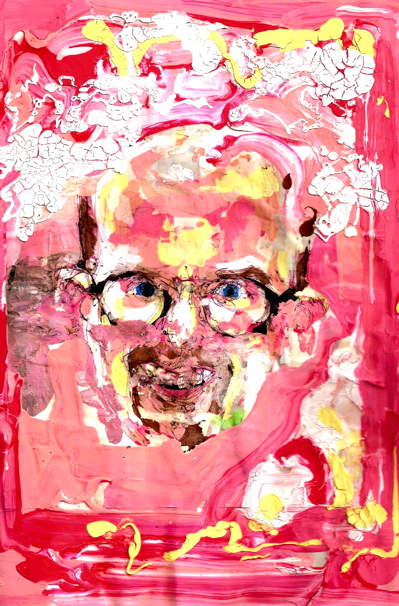
A few years ago we posted a similar series of self-portraits from Bryan Lewis Saunders, who experimented with dozens of different drugs, with fascinating results. Here is “1 ‘Bump’ of Crystalmeth”:

crystalmeth

Many more here.