The Utter Disaster Of Healthcare.gov, Ctd

Yuval Levin talked with sources in the Center for Medicare and Medicaid Services (CMS), the agency in charge of the federal health insurance exchanges. A key section of his post, which is worth reading in full:

If the problems now plaguing the system are not resolved by mid-November and the flow of enrollments at that point looks like it does now, the prospects for the first year of the exchanges will be in very grave jeopardy. Some large advertising and outreach campaigns are also geared to that crucial six-week period around Thanksgiving and Christmas, so if the sites are not functional, all of that might not happen—or else might be wasted. If that’s what the late fall looks like, the administration might need to consider what one of the people I spoke with described as “unthinkable options” regarding the first year of the exchanges.

All of the CMS people I spoke with thought the state-run exchanges are in far better shape than the federal system under their purview. But the insurers do not seem that much happier with many of those state exchanges.

Back-end data issues seem to be a problem everywhere, and some of the early enrollment figures being released by the states are not matching up with insurance company data about enrollments in those states, which suggests a breakdown in communication that is only beginning to be understood. The insurers believe that only Nevada, Colorado, Washington state, and Kentucky have what could reasonably be described as working systems at this point. Still, there is no question that on the whole the states with state-run exchanges are in better shape than those with federal ones.

Jonathan Cohn tries to look on the bright side:

[I]f these past two weeks appear to reflect poorly on the federal bureaucracy and the Administration managing it, they shouldn’t reflect poorly on health care reform itself—which, after all, has worked in Massachusetts and seems to be working in the states running their own operations. The success of states like Kentucky and New York and Connecticut and California are important for their own sake: By my count, they constitute about a fourth of the national population. But they are also important for what they show about how the law can work, once the technology piece is in place.

The Backlash Against Modern-Day America

Tea Party Views

Jelani Cobb outlines the GOP’s “Dixiecrat problem”:

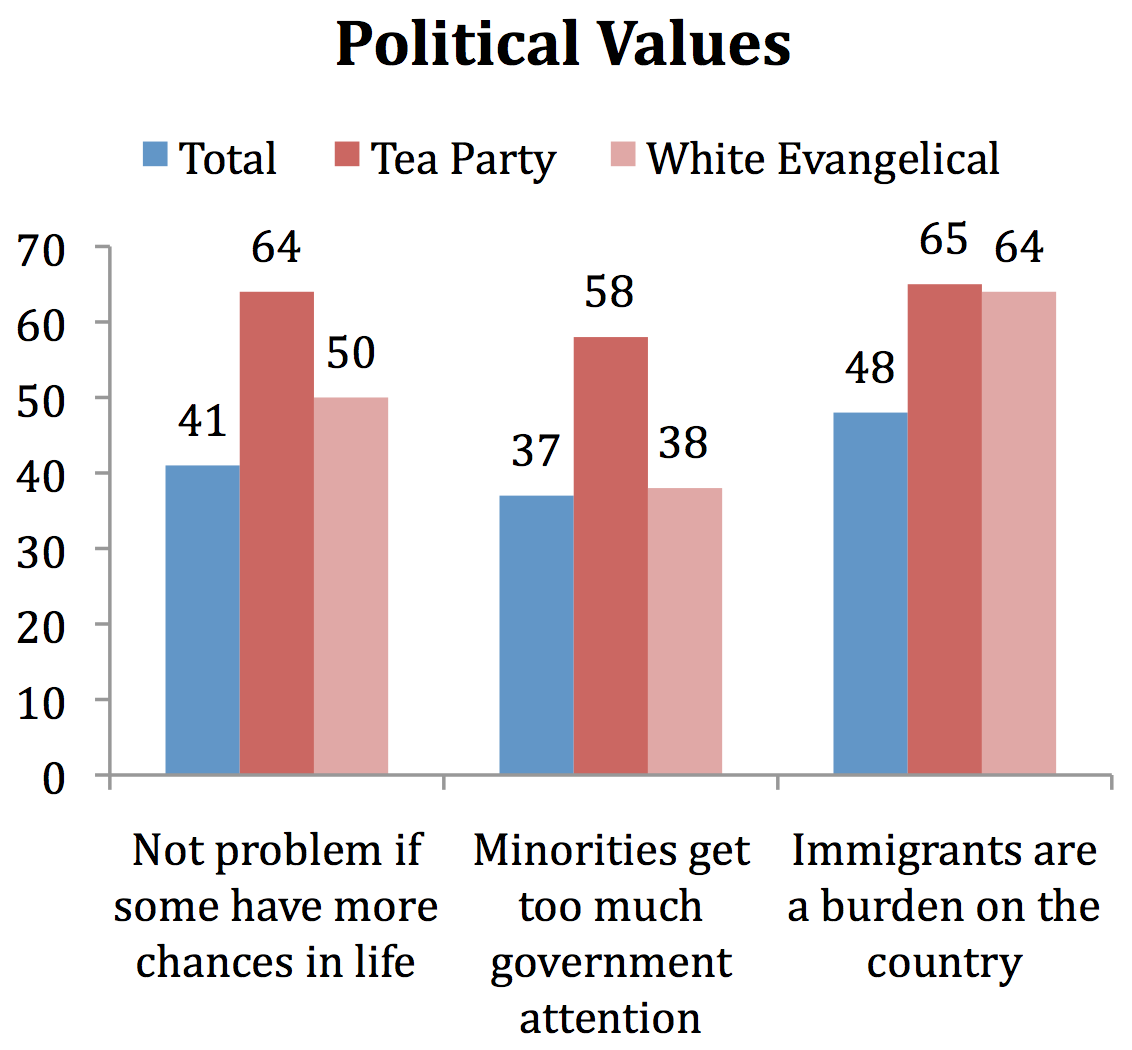
Today’s Republican Party, like the Democrats six decades ago, has had to come to terms with a demographic shift—one in which Hispanic voters are a crucial new element. We would be naïve to believe that the opposition to comprehensive immigration reform that features so prominently in current Tea Party politics is incidental to its appeal. (A 2010 survey of Tea Party supporters conducted by the Public Religion Research Institute found that fifty-eight per cent believed the government “paid too much attention to the problems of blacks and minorities”; sixty-four percent said immigrants were “a burden” on the country.) The Tea Party–inspired eruptions that have recurred throughout Obama’s Presidency represent something more complicated than a reactionary backlash to the sight of a black President; they are a product of the way he so tidily represents the disparate strands of social history that brought us to this impasse. The problem isn’t that there’s a black President; it’s that the country has changed in ways that made Obama’s election possible.

What If Obama Needs To Delay Obamacare?

Philip Klein wonders:

Obama, no doubt, wants to avoid the political embarrassment of a delay — or even the mere suggestion of one. But what happens if it’s the middle of December and enrollments are nowhere near where they need to be to make the system viable? What if, by necessity, he has to seek a delay?

The operating assumption would be that Republicans would jump at the chance to delay it. But after the past few weeks, can we really be sure that this would be the case?

It’s perfectly conceivable that if such a scenario played out, the position of the Tea Party activists and their allies in Congress would be that delaying the law for a year would be tantamount to a bailout of Obamacare.

Should Healthcare.gov fail to improve, Chait concedes that delaying the individual mandate may be necessary:

Here … is the kind of individual-mandate delay that would make sense. It would apply only to those states lacking a functioning website. (States that established their own exchanges are, in general, experiencing much better functionality than the states that boycotted their exchange and relied on the federal government to set up a site for them.) The delay would be tied to the workability of that state’s website — no reason to delay California’s individual mandate just because people in New Jersey can’t log on. And the process for making this determination would have to rest with the Department of Health and Human Services, or some other body that is trying to make the law succeed, not one that’s trying to destroy it.

Note that the individual mandate in 2014 is only a token $95 annual tax. Its main purpose is as a signaling device that everybody should get covered.

Chait is wrong about that last point:

The individual mandate’s penalty is not $95 in year one. It’s $95 or 1 percent of your taxable income, whichever is greater. So if you make $80,000 in taxable income, the penalty is $800.

Stephen Colbert Kills

Do yourself a favor and check out this clip of his remarks from last night’s Al Smith Dinner, a ghastly Catholic elite version of the White House Correspondents’ Dinner. But some choice gags:

I have great respect for Cardinal Dolan, though I do have to say, sir, it is not easy when you are wearing that outfit. In that cape and red sash, you look like a matador who’s really let himself go. Did you not see the invite? It said white-tie, not ‘Flamboyant Zorro.’

On Bloomberg:

Tiny, tiny man. The real reason he doesn’t want drink cups larger than 16 ounces is because he’s afraid he might drown in one.

On Christine Quinn:

New York City is the only place in the world where the lesbian candidate is too conservative.

Tip your waiter.

Sean Hannity Lies

A pretty definitive exposure of the mendacious agit-prop being deployed to undermine the Affordable Healthcare Act. At this point, Fox News doesn’t just have to invent their own reality, they really have to invent the people affected by it. One thing you can be sure of: there will be no response from Hannity. Because the only response would be to admit error, and, as we know, that’s a cardinal sin on the far right.

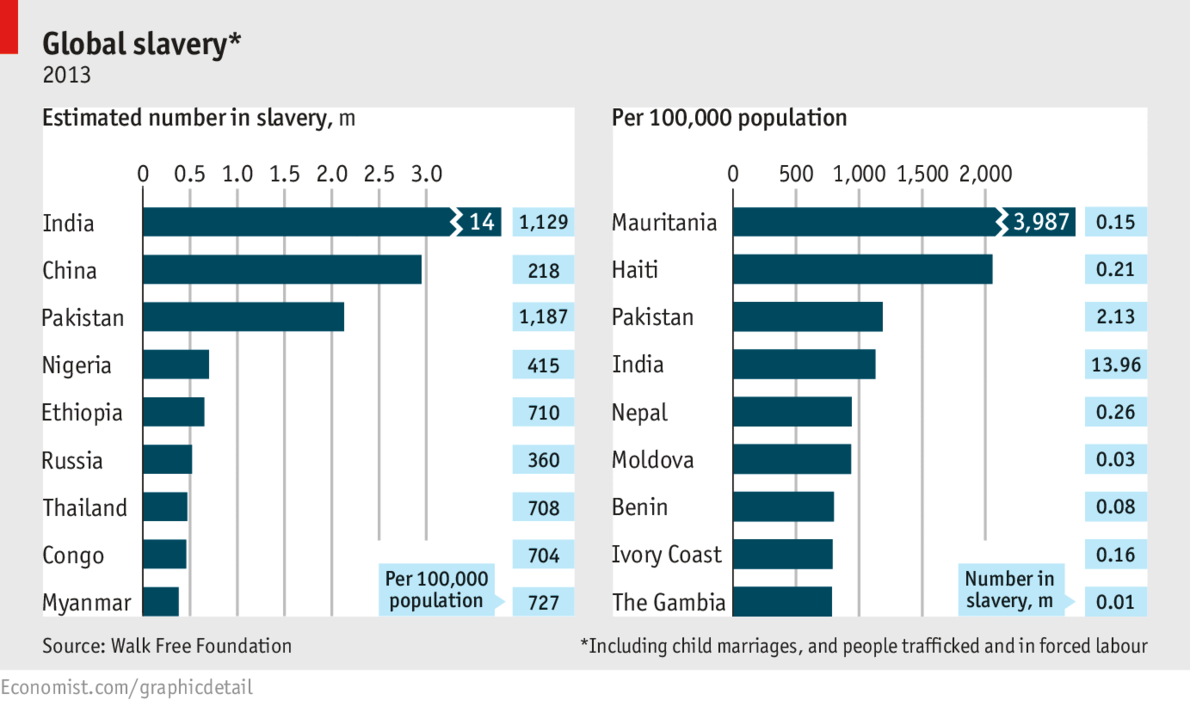
The World’s Biggest Democracy Has The Most Slaves

20131019_gdc589_1

New research indicates that 29 million people are enslaved worldwide:

The [Global Slavery Index], published by the Walk Free Foundation on Thursday, ranks 162 countries and identifies risk factors for enslavement and the government responses. The research found that around 10 countries hold about 70 percent of the world’s slaves. India has the highest number of people enslaved in absolute terms, approximately 14 million, almost half the total worldwide.

Amar Toor adds that “India’s problems [are based] on an inefficient legal system and a tradition of ‘servile marriage’.” Getting an accurate picture of the problem can be very difficult:

Dark figures are calculated on the basis of random sample surveys such as the British crime survey. By asking a sample of the population if they have experienced a list of crimes in the last year, the crimes the public reports can be compared to the official records of crimes known to the police. … The frightening fact is how many slavery crimes we are failing to detect: over 90 percent in most countries.

(Chart from The Economist)

The Abatement Of Cruelty, Ctd

Remaining thoughts on the popular thread:

In response to your Aussie reader suggesting kangaroo meat, there’s another very good option in Wild Pigs A Growing Problem In Berlinthe US, if a bit expensive and hard to find.  I’ve almost completely cut pork out of my diet for all of the reasons discussed, but being from North Carolina, giving up pulled pork permanently would be tantamount to treason.  It’s not common yet, but there is an alternative.

Wild boar have been exploding in numbers, particularly in Texas, for reasons that aren’t fully determined (more on that caveat to eating boar in a minute). They’re aggressive, dangerous, very damaging to local flora and wildlife, and incredibly delicious.  They’re also incredibly difficult to hunt, being fairly intelligent and swift of foot, which to me is a healthy challenge to our increasingly complacent collective backsides. Eating boar means you’re eating a gamier pork that needs to be reduced in numbers, and at the very least has lived its life in a natural environment. I’ve had wild boar sausage, and it was amazing.

The caveat, of course, is that there most certainly are boar that are intentionally released for hunts and which contribute to the problem.  We definitely need some way of distinguishing boar that’s killed in wildlife control and boar that’s killed after being intentionally released for sport, which turns the moral equation upside down.

Another zooms out:

I’ve been following your thread about how we can be more humane in killing the animals we eat.  It is fine for those of us who live in a place where we can actually get to a farmer’s market and find grass-fed beef that is killed humanely; however, I think there is a huge disconnect about how we feed the people who live in the United States who barely have access to a grocery store in their neighborhood much less barnyard raised chickens … and even if there were such a thing, they would never be able to afford to buy it.

In 1940, there were approximately 128 million people in the US and lots of family farms; now there are 308 million (probably more since that number is from the 2010 census) that we need to figure out a way to feed.  My dad had a grocery store in a small town and my aunt and uncle had a farm where they raised chickens, cattle and pigs.  In the fall, my dad and two uncles would slaughter a steer and a calf for meat for my dad to sell at his store.  And I am sorry, but when I saw my first calf with his neck cut, bleeding and stumbling around the barnyard until he fell over, I didn’t feel like that calf was treated humanely.  But I understood that that calf was going to feed a lot of people in my hometown (population 500) and at a not very expensive cost. The only expense my dad had was the slaughterhouse he took the animals to be cut up into smaller chunks so that he could store them more easily.  I can still remember the smell – a mix of blood and meat – that permeated the place.

So please tell me how, without factory farming, we are going to be able to feed 310 million people at an affordable price.  And please, if we all became vegetarians/vegans, don’t think that there wouldn’t be factory vegetable gardens (there already are in California and other farm states) and we would probably run out of arable land to feed everyone.  And if there weren’t factory cattle farms, we would quickly run out of space for meat too.

Now what we can do is regulate the hell out of them – which of course, our deregulating Congress wants nothing to do with.  Make sure that the conditions that the animals are kept in and the meat harvested are as safe as we can make it … chickens and pigs, too.  Of course that would mean adding inspectors and following up to make sure, etc. etc.  And how is that going to be accomplished?

I just think it’s really naïve to say that we can all just check out how our meat is harvested and not buy from certain suppliers and the market will force a change.  Until everyone makes enough money to put real pressure on the ranchers, meat producers, etc. it is not going to happen.

Another notes:

I wanted to comment on the research you cited on dog fMRI from the Berns lab that argues that “dogs are people” based on the fact that dogs show emotional processing that activates the caudate nucleus. In my own work I also use fMRI, and the caudate nucleus (part of the basal ganglia) is my primary research speciality.

I think that the methods for training and scanning dogs developed by Dr. Berns and his colleagues are very exciting and will lead to much greater understanding of the mind and brain of dogs. However, I think his emphasis on the caudate nucleus is very misleading. The basal ganglia in general, and the caudate in particular, are actually conserved across all vertebrate species, to a very remarkable degree; there is nothing special about dogs having a caudate nucleus, or using it to feel emotions. Stan Grillner at the Karolinska institute is a leader in the field and has found basal ganglia homologs in axolotl, lampreys, and pretty much every vertebrate ever tested. Even more impressive is recent research that found a basal ganglia like structure in the fly (drosophila)!

A goal of many scientists has historically been to try to find the special thing about our minds and brains that makes us human. Most of these (enlarged prefrontal cortex, ability to use tools) have ultimately been shown to not be unique to our species. So the lesson here might not be that dogs, specifically, are like humans – but that we humans are more closely related to other vertebrates, and even invertebrates, to a much greater degree than we appreciate. That lesson is certainly consistent with the moral argument made by Matthew Scully.

(Photo of a wild boar from Getty)
Rent Is Too Damn High? Don’t Blame The Artists

Ben Davis argues that artists aren’t responsible for gentrification, warning that “until there’s some understanding that gentrification isn’t just about people’s individual lifestyle choices – of artists, or preppies – but a symptom of dysfunctional urban policy, everyone is going to continue to get herded in front of rising rents every few years”:

6641537693_3af515d488_zIn the often-bitter narrative of neighborhood “revitalization,” much more depends on huge forces like average area incomes, social stratification, real-estate speculation, and rent policy than on the magic of art. (Even in artist-led gentrification’s relatively raw form in SoHo there were bigger city planning forces in play, including the Rockefellers’ concurrent push to renew Lower Manhattan.) …  The flip side is that in places like New York, with its turbo-charged real-estate market, artists aren’t really in the driver’s seat. Even in my neighborhood, Brooklyn’s increasingly uncool and preppy Williamsburg, the spectacular transformation of the last decade has not been just some natural process of rising cachet thanks to the art scene. It’s a function of very conscious and hotly contested zoning decisions.

(Photo by NOIR Visionary Studio)

Bright Young Thing

This week the 28-year-old New Zealand writer Eleanor Catton won the Man Booker Prize for her novel The Luminaries. A summary of the book:

“The Luminaries” is set in a town called Hokitika, a Maori word that means “around and then back again”, which offers a clue to the book’s real framework. Twenty characters, every one fully formed, fill the story in 20 chapters, each half the length of the one before and offering what Ms Catton calls “a prismatic view” of events. The plot is based on the signs of the zodiac, a post-modern circular mystery that is astrologically precise and encompasses whores and drunkards, hidden gold, ships and séances, a murder and a lot of mud and bad weather.

Charlotte Higgins spoke to one of the Man Booker judges, Stuart Kelly:

[H]e said that it was [Catton’s] ability to “make the novel think in a way that the novel doesn’t do normally” that set her apart; the way that, for example, she sets astrology and capitalism into play as competing systems of dealing with the world, but at the same time has produced “a rip-roaring read”. “The prize went to the true avant-gardist,” he said. “No novel has been like this before.”

Martha Anne Toll emphasizes the author’s 19th-century influences:

[Catton’s] literary ancestry derives less from her homeland and more from the British and American giants of the nineteenth century. Catton deserves their company. Nodding to Melville, she’s nailed the tormented sea captain and the revenge obsessed “Chinaman.” With so many characters taking on false identities and trying to out-cheat each other in New Zealand’s gold rush, Catton, too, has mined the seamy underside of greed and poverty so beloved by Dickens. Like George Eliot, Catton looks behind the stereotype of the whore and the opium dealer and forces us to question where the real morality lies. By the novel’s end, every character’s initial presentation has been destabilized.

Bill Roorbach appreciates that “Catton has built a lively parody of a 19th-century novel, and in so doing created a novel for the 21st, something utterly new”:

It’s a lot of fun, like doing a Charlotte Brontë-themed crossword puzzle while playing chess and Dance Dance Revolution on a Bongo Board. Some readers will delight in the challenge, others may despair. I went both ways: always lost in admiration for this young New Zealander’s vast knowledge and narrative skill, sometimes lost in her game, wishing at times for more warmth, delighted by her old-school chapter headings (“In which a stranger arrives . . . ”  “In which Quee Long brings a complaint before the law . . . ”), puzzled by her astrology, Googling everything twice and three times, scratching my head, laughing out loud, sighing with pleasure at sudden connections, flipping back pages and chapters and whole sections for rereadings, forging ahead with excitement renewed.

In an interview with Nick Clark, Catton describes what she learned from The Luminaries:

Writing the book, Catton says, became about the quest for self-knowledge. “It explored the degree to which the knowledge of your destiny corrupts a person. A lot of the characters in the book are engaged with their own pasts. What I’ve realised – partly from The Luminaries and partly just a life lesson – is the most revealing thing you can do is to surround yourself with people unlike you. And if you’re an artist the best thing is to read things that are most unlike what you are doing.”

Portraits Of Jewish Life

Chavie Lieber profiles a Brooklyn gallery featuring the work of young Hasidic Jewish artists:

The images displayed in this artistic genre herzog.hisbonenuscan often seem so synthetic: the modestly-clad woman, the Torah scrolls and their scholars—the messages of tradition almost hit you in the face. But every once in a while you’ll come across something that evokes the exact emotion you want to feel when looking at Jewish art, and you’re reminded why these same images and characters have been painted again and again by Jews for thousands of years. …

The variety of the art is expansive, from a brightly colored, four-foot splatter painting by Moully simply titled “Life,” to a cubism-depiction of the seven days of creation, to abstract ink splatters of Hasidic men dancing, to a moody charcoal sketching of children, presumably orphans, lighting Shabbat candles. Oh, and many, many drawings of the late Menachem Mendel Schneerson, the beloved Lubavitcher Rebbe, because an art exhibit blocks away from the Chabad headquarters at 770 Eastern Parkway will, most certainly, feature paintings of the Rebbe.

(Image: Hisbonenus (Meditation), by Musya Herzog)