The Utter Disaster Of Healthcare.gov, Ctd

Certain state health exchanges, such as New York’s, appear to be functional. But Healthcare.gov, the federal exchange that covers 34 states, continues to have problems. Suderman has no idea when it will be fixed:

It is clear now that, despite occasional suggestions of light at the end of the tunnel, the administration does not know how long the exchange problems will take to fix. At this point, then, it is necessary to at least consider the possibility that the federal exchanges, and perhaps a few of the state-run counterparts as well, are simply not going to work, at least not in the relatively short time the administration has to get the system on track.

Given how little information is available to outsiders, it’s hard to judge with great certainty. It is of course possible that the problems could be resolved in a few days or a few weeks. But the administration’s obfuscations, as well the repeated assurances both before and after the opening of the exchanges that they had everything under control, don’t inspire confidence that meaningful fixes are on the way. Already there are signals that the exchange problems could be deep and long-lasting.

Ezra explains the possible consequences of these glitches:

Short-term problems can become long-term problems. Take the difficulties accessing the federal exchanges. If those persist much longer, it could change the mix of people who ultimately sign up.

The people who really need insurance — so, sicker folks — will keep coming back until they get through. But younger, healthier people will give up after a try and decide to simply pay the fine, at least in year one. That would tilt the risk pool in states with federal exchanges towards older, sicker people, which would mean those states will see much higher premiums in year two, which will further dissuade healthier applicants from signing up, and so on. So that’s a case where a short-term problem could become a long-term one.

Additionally, this does not inspire confidence:

The deadline to apply to enroll in health coverage and not pay a penalty next year is not the same deadline as the end of the open enrollment period, March 31. It’s actually February 15. Which means that while you can still enroll after February 15, you’ll have to pay the penalty for going uninsured if you finish your application after that date. What’s terrifying isn’t the earlier date itself, but the facepalm-worthy fact that the administration, including the Internal Revenue Service, seems not have known about the earlier date until very recently when it was pointed out to them.
Be Of Good Cheer!

A reader writes:

People should be more positive. Something good has happened.

This is a gross oversimplification, but it will get the point across. We can think of three groups of people. The first group is the crazy people – the ones who want to default in order to kill off the government. The second group is the people who are appalled by the crazy people — you and me, and lots of other people. The third group are the people who aren’t crazy, but who have made alliances with the crazy people.

wile-e-coyoteIt’s that third group that’s changing. All sorts of people who have always backed the GOP are saying, “Wow, that sure was crazy!” Your readers who want the people who are in the first group, the actual crazy people, to change course, will certainly be disappointed. But from my perspective, having all sorts of conservative bloggers, the chamber of commerce, lots of CEOs, etc., and mainstream Republicans in general wake up and question their support of the nutters is good enough.

It’s a big leap forward. It’s an almost uniquely positive event in the post Gingrich history of the nutty right. We’ve seen lots of important wins – times when the crazies have been defeated politically. But this is the first time mainstream people are actually saying, “Those people were nuts!”

It’s not a final victory, or even anything close to that. A huge chunk of the country is really whacked out politically. It’s going to take years to push back against that, a lot of work and struggle. But what’s happened has really brought that fight into a new place. It’s an extremely positive development.

It’s interesting. Things were sort of malaise-y around the administration for awhile; there was a bleak vibe. But then out of the middle of that, we had a big win in Syria. Another one here. Iran could be enormous.

I know you want a two-state solution. I do too. But we have to chip away at the region incrementally – reduce the tension, consolidate smaller wins. Iran is extremely important in that regard. Kerry bloviates a lot on TV, but he seems to know his shit.

There’s an angle of this that I haven’t seen discussed. It might be just a mean-spirited fantasy on my part. But when we talk about racism in politics, we tend to talk about it in terms of “other”. As in, white guys don’t like Obama because he’s not like them, he’s “the other”. But white supremacy goes further than that. White supremacy says that the other is weak and inferior. They’ve always treated the President that way, and they’ve always described him in those terms.

So I am finding definite pleasure in the fact that the President, as an individual, beat them so decisively. That it was his personal strength that carried the battle.

I’ve come to know this reader by his emails and he’s often extremely perceptive. I agree about Iran and Syria. And about Obama’s new steel. Know hope!

Drudge And The Dish

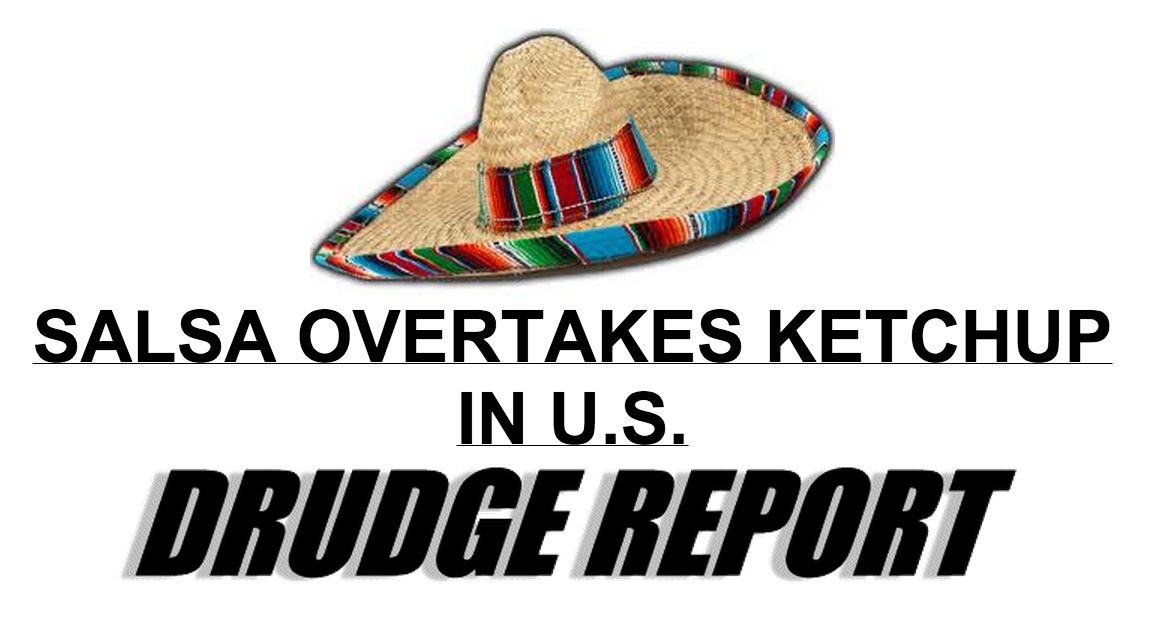
A salsa update. Meanwhile, a reader notes that “ketchup is originally Chinese”:

In the 1690s the Chinese mixed a concoction of pickled fish and spices and called it (in the Amoy dialect) kôe-chiap or kê-chiap (鮭汁, Mandarin Chinese guī zhī, Cantonese gwai) meaning the brine of pickled fish (鮭, salmon; 汁, juice) or shellfish. By the early 18th century, the table sauce had made it to the Malay states (present day Malaysia and Singapore), where it was discovered by English explorers. The Indonesian-Malay word for the sauce was kĕchap. That word evolved into the English word “ketchup”. English settlers took ketchup with them to the American colonies.

How To Weaken The Tea Party

Lizza suggests ways to fix Washington:

My list would start with the return of more money to politics. One of the reasons Boehner is such a weak Speaker is that he doesn’t have the carrots and sticks that his predecessors previously used. The House banned the use of earmarks, which were a traditional tool to keep recalcitrant members in line. In a four-trillion-dollar annual budget, a few million dollars here and there to lubricate the gears of Congress seems like a very small price to pay if it would create a more productive legislative body. Indeed, last night Mitch McConnell, or someone working on his behalf, won a couple billion dollars for a dam project in Kentucky, which seems like a decent outcome if it helped prevent a default.

The political system could also benefit if the national parties, which can act as moderating influences in elections, were allowed to spend more money on individual campaigns. The current system, under which party contributions are capped, has empowered special-interest groups and ideological factions like Heritage Action and Club for Growth, which constantly thwart the leadership of the G.O.P. If the parties were more powerful funding vehicles for members of Congress, a leader like Boehner could exercise more control over his conference, which would allow him far more room to negotiate with Obama: he’d be able to make concessions and know he could deliver the votes.

The Tea Party As A Religion, Ctd

Dreher makes the same analogy I did:

Can the Tea Partiers’ beliefs be falsified? I don’t think they can be. I mean, is there any evidence that could convince them that the fault here lies with themselves, in the way they conceive politics, and in the way they behaved? It sure doesn’t look like it. In that sense, they think of politics as a kind of religion. It’s not for nothing that the hardcore House members stood together and sang “Amazing Grace” as the impossibility of their position became ever clearer. They really do bring a religious zealotry to politics.

Let me hasten to say that I’m not endorsing the “Christianist” meme, which I find far too reductive, among other things. Besides, many of the Tea Partiers and fellow travelers are not motivated by religious faith, but by a religious-like zeal for their political ideology. It was like this on the Right before the advent of the Tea Party. There has long been a sense on the Right that the movement must be vigilant against the backsliders and compromisers, who will Betray True Conservatism if you give them the chance. Again, the religious mindset: politics as a purity test. In this worldview, a politician who compromises sells out the True Faith — and faith, by definition, does not depend on empirical observation to justify itself.

Millman points out that treating politics as religion makes getting a majority near impossible:

In order to persuade someone, you have to be willing to entertain the possibility that there are multiple ways of looking at something, that there are arguments on both sides (albeit presumably better ones on your own), and that it is right and proper for someone to expect to be persuaded of the rightness of your position rather than merely be told what it is. That the truth is not self-evident, but contested, continuously. If entertaining that possibility is threatening to your faith, you won’t do it. If you don’t do it, you won’t be very persuasive to people who don’t already believe. Of course, you make make some converts of people who are looking for a new faith. But those who don’t convert will remain unpersuaded.

A political party that tried to build itself like a church could only succeed if it had monopoly control of the state – if, in other words, it was the ruling party of a totalitarian system. Under a situation of free competition, those principles of organization will inevitably lead to perpetual minority status.

The confusion of politics with religion also explains why the GOP is obsessed with punishing political heresy. For example, Molly Ball gets an incredible quote from a Tea Partier who seems to no longer care about getting a majority:

“There are two views on the right. One says more Republicans is better; the other says better Republicans is better,” said Dean Clancy, vice president of public policy for the Tea Party group FreedomWorks. “One view focuses on the number of Republicans in the Senate, the other on the amount of fight in the senators.”

Finally, it’s telling that Eric Erickson uses religious language when attempting to enforce Tea Party dogma:

Men like Mitch McConnell, John Cornyn, Eric Cantor, Kevin McCarthy, and others have preached a great sermon against Obamacare, but now conservatives who supported them see that these men have refused to actually practice what they’ve been preaching. They’ve refused to stand and fight with the rest of us.

Go Big, Mr President

President Obama Delivers A Statement

Tomasky is highly skeptical that new negotations over the budget can result in any different outcome next time:

The position of the chaos caucus is going to be: Okay Obama, you give us entitlement cuts, and we’ll give you…uh, what? No revenues. They’re inflexible on that point. No programs (outside maybe of defense, and even that’s a maybe) funded at levels above sequestration. So actually, they’ll give nothing.

Beutler’s view:

[T]here’s a high likelihood that these negotiations will end the same way as all the others that preceded them did: no agreement. An agreement is only compatible with the GOP’s anti-tax absolutism if Democrats drop their demand for tax parity and agree to pay down sequestration with other spending cuts. Possible, but unlikely.

One way out of this would be for Obama to go big, to propose in these new talks a Bowles-Simpson-style deal in which major tax reform and entitlement cuts are exchanged for much higher revenues. If the GOP were a genuinely conservative party, actually interested in long-term government solvency and reform within our current system of government, they would jump at this. They could claim to have reduced tax rates, even if the net result were higher taxes. And the brutal fact is that, given simply our demographics, higher taxes are going to be necessary if we are to avoid gutting our commitments to the seniors of tomorrow. They could concede that and climb down from this impossibly long limb they have constructed for themselves.

I’ve long favored a Grand Bargain, but recognize its huge political liabilities without the leadership of both parties genuinely wanting to get there. But for Obama, it seems to me, re-stating such a possibility and embracing it more than he has ever done, is a win-win.

He may alienate Democrats – but after his cold-steel resistance to Tea Party blackmail, he has surely won some chips to his left. With independents and moderate Republicans, now reeling from the last month’s brinksmanship, it would signal centrist leadership that could bolster his political standing, even if the GOP turns him down. If his political standing improves, then the chances for a Democratic wave in 2014 increase.

But it means taking a real risk now. And this president has shown in his second term a much greater propensity to risk than in his first.

Think of the boldness of his response to Assad’s chemical weapons attack and agility in roping in Putin to deal with it (so far successfully). Think of his steadfast refusal to budge right up against the threat of default. He has earned new cred and could bolster it some more with a new, bold reach for the political center he can still represent. I believe it would be the most politically effective domestic policy agenda the president can plausibly move forward, if the GOP maintains its rigidity against immigration reform past the next Congressional elections. It would also help bring back the core coalition that gave him such a huge victory in 2008. It would mean the president has not given up on the long-term fiscal health of the country. And it is vital that no president gives up on that, especially one elected on the principle of hope as well as change.

Resignation to gridlock is perfectly rational. But changing that dynamic is never impossible. It’s what we elect presidents to do. And this one still could, if he swiftly exploits the opening this near-catastrophe has presented to him.

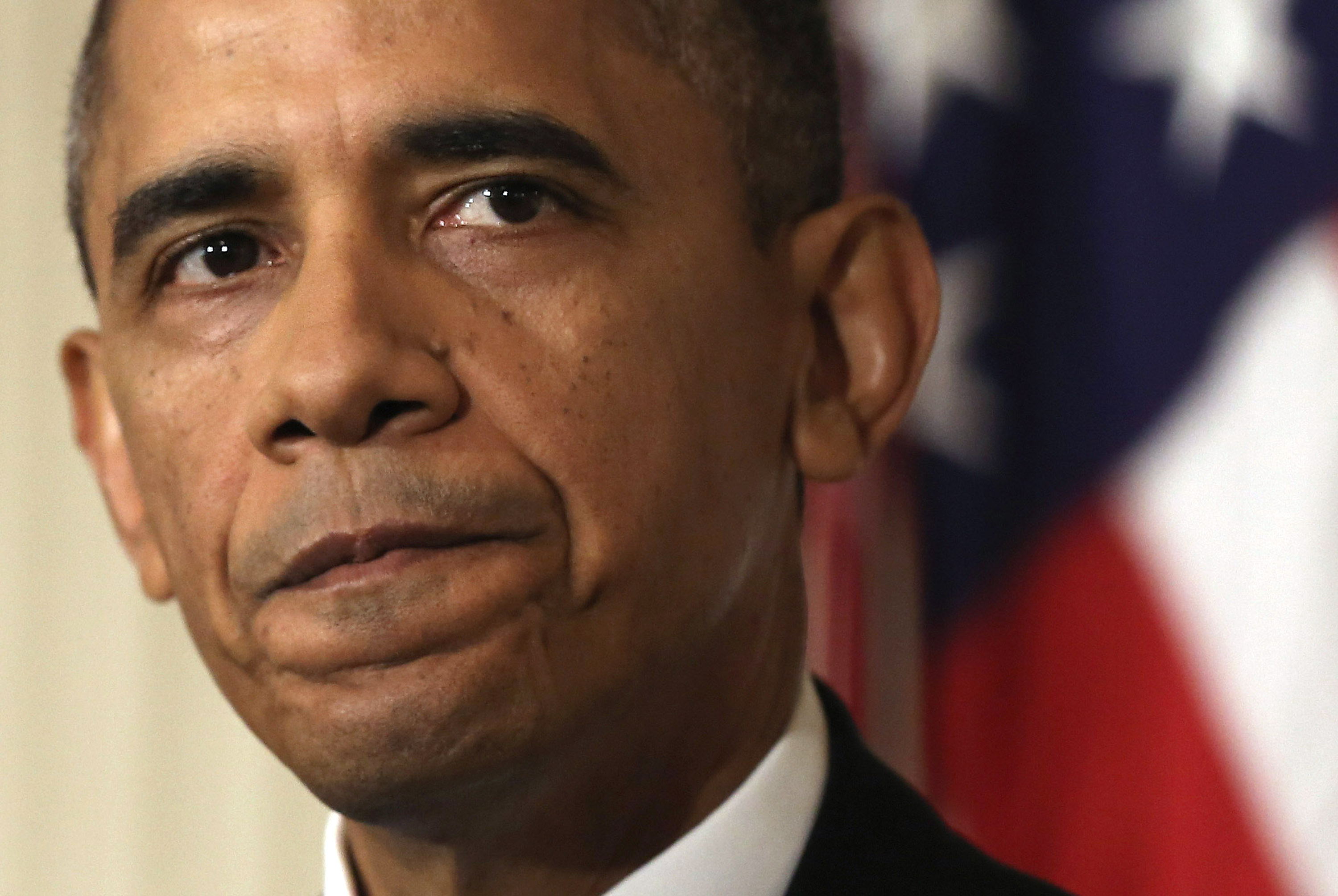
(Photo: U.S. President Barack Obama makes a statement at the State Dining Room of the White House October 17, 2013 in Washington, DC. Obama said the American people are completely fed up with Washington and called on cooperation to work things out. By Alex Wong/Getty Images.)

Headline Of The Day

Screen Shot 2013-10-17 at 2.33.55 PM

Update from a reader:

It’s good to know Drudge has caught up to 1992:

“New Mainstream: Hot Dogs, Apple Pie and Salsa”
March 11, 1992

KETCHUP, long the king of American condiments, has been dethroned. Last year, salsa — a retailing category that includes picante, enchilada, taco and similar chili-based sauces — took the condiment crown, outselling ketchup by $40 million in retail stores.”

Another goes Seinfeldian:

And an update from Drudge lui-meme:

Screen Shot 2013-10-17 at 4.46.41 PM

Amazing who reads the Dish, innit?

Whom The Shutdown Hurt Most

Americans like John Anderson:

He is a line cook at the American Indian Smithsonian Museum on the National Mall. Anderson is not a government employee. He’s a contract worker – the government hires his company to make the food for visitors to the museum. When the shutdown closed the museum, Anderson lost his job. He’ll now presumably be able to go back to work, but unlike federal workers, he won’t get back pay. And he could use that back pay: Anderson is a divorced father of two who usually brings home about $350 a week after taxes and child support. His 16-year-old son lives with him in Washington but commutes by bus and train to high school in Maryland every day.

Anderson has no savings – his wages don’t leave much cushion for savings – and struggled through the shutdown to pay his rent, put food on the table and pay for his son to travel back and forth to school.

When you think of the actual Americans that the Tea Party is playing with, like so many pawns on a chessboard, the repulsiveness of the ego of Ted Cruz and the fanaticism of Erick Erickson becomes even clearer. For them, for all their protestations to the contrary, this was a game. And nameless, struggling Americans were the losers.

Where’s Boehner’s Backbone? Ctd

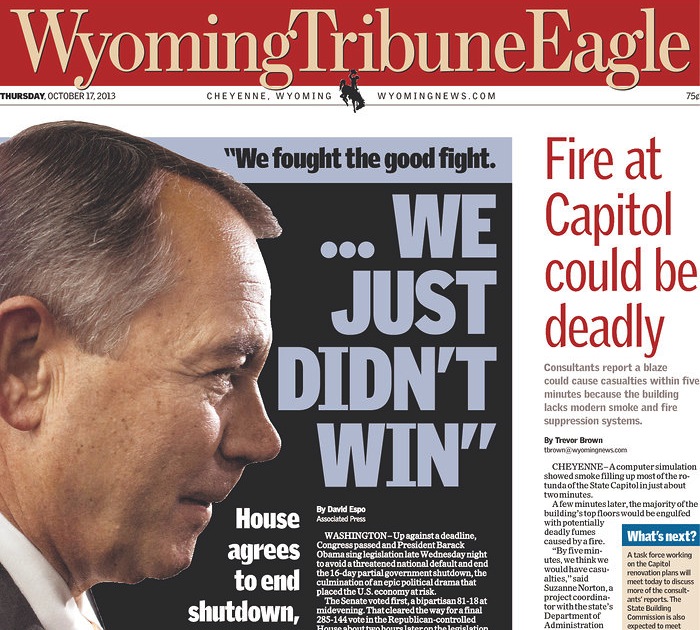
WY_WTE

A reader writes:

The fact is, John Boehner has made a deliberate choice all along in his speakership. You can moan all day about leadership and and herding cats, etc. But he has made the choice that his slavish devotion to the Hastert Rule is more important than anything else … more important than the financial health of the country, even the globe.

His choice of requiring a majority of the majority on every single vote continues to give unprecedented power to a relatively small minority in his party. He’s made a choice letting roughly 12% of the House drive the entire government. That’s all it is – a choice. There’s no law, rule or even recognized precedent for that. He’s taken the (occasional) practice of one of his predecessors and turned it into something more important than the law of the land. All he needs to do is stop, and everything immediately goes back to normal but for the screaming.

Another is far too generous to the Speaker:

I’ve never to be politically sophisticated but I did have a manipulative mother whose upbringing required me to develop survival skills in interpreting the underlying motivations of others.

Regarding John Boehner’s recent handling of the debt crisis, it seems to me by having the balls to let the extremist Republican element in the House play out their power play, while appearing to support them, has resulted in their demise.  This  greatly enhances his ability to control them in the future, which he managed without appearing to undermine their effort and, thus, gives him a much stronger hand in dealing with Democrats and puts the balance of power within their party back in the hands of their establishment.  The biggest winners in this show are Boehner and Mitch McConnell, who for his part and all at once, just neutralized his primary Tea Party opposition and his his eventual Democrat opponent, Allison Grimes, who has based her campaign on his perpetuation of gridlock.  These guys didn’t get to where they are by lacking in Machiavellian skills!

Another fumes:

I just can’t believe that this Speaker and his party will move on from this with no resignations, no apologies and no responsibility. This is an utterly disastrous event for the Republican party and the stories we read state that the Speaker’s position is not in question? WTF?

Previous Dish discussion here.