A Breakthrough With Iran?

This week’s talks in Geneva have been unusually productive:

In a rare joint statement, the nations called the discussions “substantive and forward-looking” and formalized the next round of negotiations in Geneva on November 7 and 8. The United States and the European Union depicted the talks as “substantive,”“very important,” and “positive.” One senior Obama administration official beamed with excitement. “I’ve been doing this now for about two years, and I have never had such intense, detailed, straightforward, candid conversations with the Iranian delegation before,” said the official. “I would say we really are beginning that type of negotiation where one could imagine that you could possible have an agreement.”

Kaplan is similarly hopeful:

First, the chances for a truly historic breakthrough are pretty good – which, at this stage in talks of such magnitude, is astonishing. Second, the Iranians’ main demands—at least what we know of them – are pretty reasonable. … Not only that, but after the first day of meetings, the U.S. and Iranian delegations broke away for an hourlong bilateral session, which American officials described as “useful” in clearing up ambiguities.

After the second day, another meeting was set for November 7 – 8. Some said it would be at the “ministerial” level, which, if true, would mean Secretary of State John Kerry would head the American delegation. A U.S. secretary of state doesn’t usually become so visibly involved until much closer to the end of a negotiation, suggesting that maybe we’re closer to the end than anyone could have imagined.

This is remarkably fast work for any set of nations negotiating any issue—much less for nations that haven’t had diplomatic relations in 34 years, and on an issue that ranks among the globe’s most perilous and contentious.

Cole is cautiously optimistic:

Can a breakthrough be had? I believe so. The sticking points will be the extremists on both sides. In Iran, the Revolutionary Guards and Leader Ali Khamenei think the negotiations are another imperialist US trick, and getting them to sign on the dotted line of an agreement won’t be easy. On the US side, the Israel lobbies and Israel itself will accept nothing less than the mothballing of the whole Iranian enrichment program, which is highly unlikely to happen. A settlement would therefore have to be one that could be accomplished by Presidents Rouhani and Obama despite the carping of the right wings of their countries.

Colin H. Kahl and Alireza Nader wants the US to be realistic:

Instead of pushing for an impossible goal, the United States and other world powers should push for a possible one: an agreement that caps Iranian enrichment at the 5 percent level (sufficient for civilian power plants but far away from bomb-grade) under stringent conditions designed to preclude Tehran’s ability to rapidly produce nuclear weapons, including restrictions on Iran’s stockpile of low enriched uranium, limitations on centrifuges, intrusive inspections, and halting the construction of a plutonium reactor that could open an alternative pathway to nuclear weapons. Such an accord would allow Khamenei and Rouhani to claim Iran’s “rights” had been respected, giving them a face-saving way out of the current nuclear crisis. Even this might be difficult for the Iranian regime to stomach. But if paired with meaningful sanctions relief, it has a much better chance of success than insisting on the complete dismantling of Iran’s program.

Walt agrees:

Iran had zero centrifuges in operation in 2000 and only a handful in 2005, the last time the Iranians offered to freeze their program. The United States rejected all these previous offers, and now Iran has some 19,000 centrifuges, a plutonium program, and a larger stockpile of uranium that could in theory be enriched to make a bomb if Iran ever decides it wants one. In short, the hard-line position of issuing threats, imposing sanctions, and insisting that Iran give in to all our demands has backfired and put us in a worse position today.

Which is why I support engagement of exactly the kind we’re now doing and believe it is the sanest way to achieve peace and stability in the Middle East – and, ultimately, democracy for the people of Iran. Getting Iran more fully into the international economy, rewarding the reformists, increasing bilateral contact and communication all reinforce each other. We have a chance for a virtuous cycle rather than a vicious one. As Reagan ended the first cold war by engaging moderates, so Obama can end the Iranian version by rewarding Rouhani. Because, like Gorbachev, he’s the best hope we’ve got now that sanctions have almost achieved their goal.
The Sabotage Of The American Economy

Fiscal Uncertainty

Derek Thompson puts the GOP’s economic damage in more perspective:

Counter-factual accounting is guess-work by definition, but a few research firms have tried to attach a number to the shutdown. Macroeconomic Advisers put the figure at $12 billion. S&P estimate the cost was twice as high, at $24 billion. Split the difference, and you’re talking about $18 billion in lost work.

What’s a good way to think about that kind of money—a sliver of the entire $15 trillion U.S. economy, but still, you know, $18 billion? In July this year, NASA funding was approved at around $17 billion for the fiscal year. So, there: The shutdown took a NASA-sized bite out of the U.S. economy.

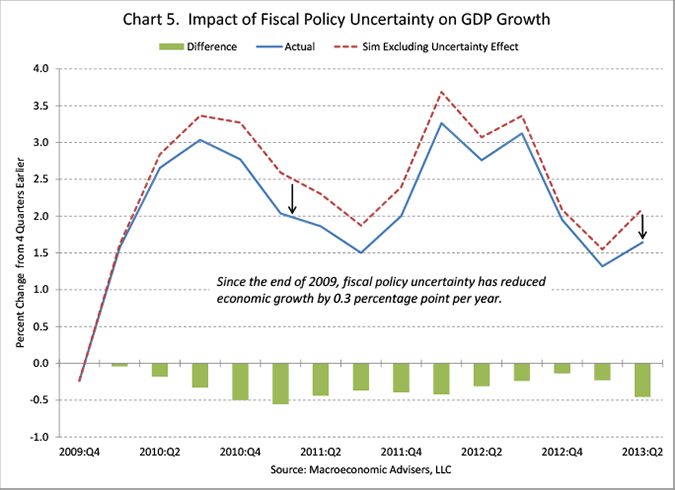
But that’s just a nibble compared to the total cost of the budget showdowns stretching back to 2010. According to Macroeconomic Advisers, the total cost of Congress’s assault on the economy going back to 2010—including the budget cuts, including sequestration, and fights around the budget cuts—was about 3 percent of our entire economy. That’s $700 billion. That’s not just NASA. It’s one year’s entire defense budget.

Krugman thinks the number-crunchers at Macroeconomic Advisors are underestimating the fiscal drag:

The combination of the payroll [tax] hike and the [unemployment] benefit cuts amounts to about $200 billion of fiscal contraction at an annual rate, or 1.25 percent of GDP, probably with a significant multiplier effect. Add this to the effects of sharp cuts in discretionary spending and the effects of economic uncertainty, however measured, and I don’t think it’s unreasonable to suggest that extortion tactics may have shaved as much as 4 percent off GDP and added 2 points to the unemployment rate.

In other words, we’d be looking at a vastly healthier economy if it weren’t for the GOP takeover of the House in 2010.

What The Shutdown Accomplished

The one concession Republicans got is meaningless:

There’s nothing about the income verification measures that passed Wednesday night that will change Obamacare, aside from a few staff members at Health and Human Services devoting some hours to gathering the data and writing up these reports. And that probably explains why Democrats were okay with passing this language in the first place.

Gleckman sighs:

Congress has just shuttered much of the federal government for more than two weeks and risked a market-shattering federal default in order to convene a meeting of budget negotiators.

And at the cost $24 billion in lost economic output. Sheer vandalism.

The Benefits Of Quiet Diplomacy

SWITZERLAND-IRAN-NUCLEAR-POLITICS-DIPLOMACY

Joshua Keating is, like me, grateful the shutdown has been drowning out coverage of our negotiations with Iran:

Thanks to the government shutdown and the looming default, the news cycle this week has skewed heavily domestic, and understandably so. Somewhat lost in all this has been what is actually a pretty big foreign-policy story, the restarted Iran nuclear talks in Geneva. It’s still early to say, but while nobody’s been paying attention, the talks have been going surprisingly well. Those two things may be connected.

[Neither lifting sanctions or allowing some uranium enrichment on Iranian soil is] popular on Capitol Hill. And as Yochi Dreazen and John Hudson of Foreign Policy report, some members of Congress – some Democrats, in particular – are already signaling opposition to a deal involving lifting sanctions. But Congress has also had its attention elsewhere this week. As Rep. David Price told FP, “We’re in such a weird situation on the Hill with the shutdown and all the oxygen is pretty much going to that fight.”

It’s easy to imagine an alternative-universe scenario in which the government is not shut down, the Iran talks are front-page news, and this is a major focus of attention from Capitol Hill. It still may be tough to the White House to sell Congress on lifting sanctions, but it has to have helped lead negotiator Wendy Sherman that Congress hasn’t been setting the terms of this debate before she even sat down with the Iranians.

And as I noted last night, the talks have been remarkably cordial so far. A distracted Congress and relative quiet about the Israel-Palestine peace process is also helpful, as the invaluable Roger Cohen notes today:

For almost three months now Israelis and Palestinians have been negotiating peace in U.S.-brokered talks. They have been doing so in such quiet that the previous sentence may seem startling. Nobody is leaking. Because expectations are low, spoilers are quiescent. There is a feeling nobody opposed to a resolution need lift a finger because the talks will fail all on their own. This is good. Absent discretion, diplomacy dies.

I think we’re going to get a deal that precludes a war against Iran and begins a period of constructive engagement and detente with the theocracy in Tehran. There’s still a lot to get nailed down and verified, and there are powerful forces in both countries determined to prevent a deal (the Revolutionary Guards, AIPAC and religious fanatics in Iran’s and America’s reddest states among them) but both recently elected governments in Washington and Tehran have a huge amount riding on success.

Avoiding another war in the Middle East – and the wave of murderous Jihadism and polarization that would provoke – is, to my mind, the most important foreign policy goal of the next three years. The second most important? A two-state solution in Israel/Palestine. Domestic drama – and a new constellation of forces in the Middle East, as Cohen explains – may help Obama secure both.

Am I delusional? Maybe. But the coalition of countries behind the negotiations with Iran, combined with the unexpectedly successful chemical weapons suppression and destruction in Syria, has isolated Netanyahu even more acutely in the world, as his political position at home remains tenuous.

You know who he reminds me of – threatening to upend global peace and break the US-Israel alliance by a unilateral attack? Ted Cruz.

(Photo: US Under Secretary for Political Affairs Wendy Sherman (right) smiles at the start of two days of closed-door nuclear talks in Geneva October 15. By Fabrice Coffrini/AFP/Getty Images)

The Wave On The Horizon?

3875705476_f5a3b5ef7e_b

Republican Congressman Charles Boustany worried recently that actions by House Republicans “could trigger a wave of discontent that could wash out our Republican majority in the House if we’re not careful.” Nate Cohn continues to insist that the Republican majority is safe:

[E]ven if public outrage with the GOP persists at today’s levels, there good reasons to question whether the wave will endure through November 2014. Unlike real waves, electoral waves shrink as they approach the shore. Political scientists have found that the generic ballot overestimates the president’s party this far from an election. That’s part of why Alan Abramowitz estimates that Democrats need a 13 point Democratic edge on September 1 to win the 17 seats necessary to retake the chamber in November.

Enten disagrees and argues that “Abramowitz’s forecast is a good starting-point for understanding how uphill is the Democrats’ task in taking back the House, but it is far from perfect.” Furthermore:

The thing is that expert ratings (like most polling) are not all that predictive a year out from an election. At this point in the 2006 cycle, there were 17 Republican seats in the lean or tossup categories (pdf). That’s well short of the 30 seats that Democrats would ultimately take from Republicans. At this point in the 2010 cycle, there were 28 Democratic seats in the lean or tossup category. Republicans, of course, went onto gain 63 seats in 2010.

It’s not until later in the cycle when individual seat rankings become quite useful. That’s when potential challengers and incumbents read the national environment and decide to run or not. Chances are that if the 4-5pt Democratic lead holds, the individual seat rankings will reflect that edge. For now, individual seat ratings probably aren’t all that helpful to understanding which way and how hard the wind is blowing.

My view, for what it’s worth, is that this event has the potential to deeply shape public attitudes about the GOP’s fitness for public office and change the shape of the next Congress decisively. I mean, here’s Ross today:

However you slice and dice the history, the strategery, and the underlying issues, the decision to live with a government shutdown for an extended period of time — inflicting modest-but-real harm on the economy, needlessly disrupting the lives and paychecks of many thousands of hardworking people, and further tarnishing the Republican Party’s already not-exactly-shiny image — in pursuit of obviously, obviously unattainable goals was not a normal political blunder by a normally-functioning political party. It was an irresponsible, dysfunctional and deeply pointless act, carried out by a party that on the evidence of the last few weeks shouldn’t be trusted with the management of a banana stand, let alone the House of Representatives.

And the key thing for responsible actors in the next year is to remind voters again and again about what this crew voted for: a second great depression to appease their ideological purity. They nearly got away with it. The lesson should not be relief and moving on; it should be continued outrage at this vandalism and brinksmanship and a demand for accountability. That means voting Democrat next year even if you disagree about many aspects of their policy proposals. Because this is not about mere policy. It’s about a party threatening to break apart the country if they do not get the rest of us to bend to their minority will and their apocalyptic vision.

If that message can sink in with independents and moderate Republicans, then of course the Democrats can regain the House – and finish the job of the Obama presidency.

I don’t like partisanship. But if it is an indispensable means to ending this level of blackmail of the entire system, then it is a necessary, short-term price to pay.

(Photo by Miguel Teixeira)

Quote For The Day

“Even at the bitter end, on the last possible day to defuse the crisis before the debt ceiling was breached, over 60% of House Republicans voted to push the US government into default, with incalculable but almost certainly catastrophic consequences. This is a very important point, with very ominous implications, that shouldn’t be forgotten or obscured.

Is it unfair, one-sided, or exaggerated to suggest that the national Republican Party has become a dangerous menace to the republic, with no clearly visible redeeming features? I don’t think so,” – Jeff Weintraub. Me neither.

The Sabotage Of American Democracy

Negotiations Continue On Capitol Hill One Day Before Debt Limit Deadline

I suppose I shouldn’t in any way be shocked by the extraordinarily vehement attitude of Tea Party Republicans after they nearly destroyed the US and global economy. And yet I am somewhat grateful I can still be shocked by a column on Fox News’ website. Here’s how it starts:

American taxpayers have once again been trampled by establishment Republicans – a thundering herd of chicken-hearted Republicans in Name Only (RINOs) galloping to the Left. The debt ceiling deal struck between Senate Majority Leader Harry Reid and Senate Minority Leader Mitch McConnell is a victory for President Obama and Democrats. ObamaCare is still the law of the land. The government is still spending money it does not have. And thousands of government workers just got a two-week vacation courtesy of the taxpayers.

Let’s take the last three disappointments/wishes from the non-chicken-hearted.

“ObamaCare is still the law of the land.”

Yes, it is. But that’s because the president who proposed it and the Senate that voted for it were re-elected in 2012. That’s how our system works. Is it possible Todd Starnes doesn’t know this? No, it isn’t. So it is fair, I think, to infer that he believes that because his party regards this centrist, private-sector-dependent reform as an “abomination”, the federal government should be shut down permanently and the country’s credit destroyed, prompting a global depression. And that’s why this episode has been so disturbing. It is not that the GOP doesn’t have a perfect right to vote against Obamacare a zillion times; it’s that they responded to their electoral loss in 2012 by threatening to destroy the entire polity and economy. That is not a tactic or a strategy; it’s a declaration of war against the system of American government.

“The government is still spending money it does not have.”

Yes, it is. But almost all the current debt is a function of massive tax cuts in 2001 that were never paid for (by the GOP), two bank-breaking wars that were never paid for (by the GOP), a big new entitlement for seniors, Medicare D, that was never paid for (by the GOP), and the usgs_line.phprevenue sinkhole provided by the worst recession since the 1930s (begun before Obama took office.). The scale of the debt thus acquired is vast. I think Starnes is absolutely right to make its reduction a priority. The question is a pragmatic one – how do we cut entitlement and defense spending along with raising revenues to get there?

One side is prepared to consider cuts in entitlement programs it cherishes; the other side is resolutely opposed to any net revenue increases at all. One side could begin to negotiate a debt deal that was 2-1 spending cuts to tax hikes; the other side refuses to negotiate even a 10-1 deal. What, for example, does the GOP offer the Democrats on fiscal matters right now? I see nothing. If one side is prepared to give nothing, no deal can be done. And if the Tea Party is right about the urgency of cutting the debt, no deal is very bad fiscal news.

And part of the pragmatic solution is recognizing that immediately ending the government’s current deficit by spending cuts alone would so vitiate economic growth that it would be counter-productive. Starnes is therefore not actually serious about the debt, and neither is the Tea Party.

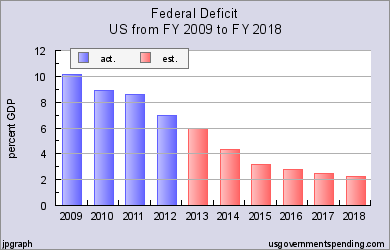
Their proposal for an immediate balancing of the budget would deepen the debt; and their absolute refusal to countenance any net new revenues to the federal government means they will never get an actual compromise that would actually cut the debt in a meaningful long-term way. In other words, their absolutism on taxes essentially destroys their debt-reduction position … as long as we remain in a constitutional democracy with two parties trying to represent all the people. If the president were saying that he does not care about the debt at all, it would be one thing. But, this president, on current trends, will have brought the deficit down from more than 10 percent of GDP when he took office to around 3 percent when he leaves, during a still tepid recovery (see graph above). What more can these people demand – except, of course, his resignation?

And again, that’s why this episode should not be regarded as anything but a deeply serious political and constitutional crisis. One party is refusing to accept that the other one exists, that not all of America agrees with them, and that democratic norms require compromise in that context.

“Thousands of government workers just got a two-week vacation courtesy of the taxpayers.”

This demonization of government itself, and generalized slur against all those who work for it (and who are also tax-payers) is not just an insult added to injury.

It is another attack on the entire system. As we found out in the fiasco, even Ted Cruz likes government sometimes. For him, it is about keeping monuments open. For other Republicans, it is about scientific research.  And the broader point is that government is the point of politics. There has to be a governing authority that commands universal assent in any functioning democracy. Yes, it should be solvent and run surpluses in peacetime. But it must exist. And conservatism in its proper sense is about governing firmly, securing the rule of law, and sustaining the legitimacy of the democratic system.

What the Tea Party represents, in stark contrast to conservatism, is a radical attack on the very framework of our governing system. It is not right or left within our democratic system. It is a form of secession from it and a de facto abandonment of the notion of one country under one rule of law. It is about sabotage rather than opposition. It is bad enough when one party will seek to sabotage the law of the land – by attempting to rally the public to spurn the new healthcare law, in the hopes of causing it to collapse. But when the dominant faction of one party is bent on sabotaging our democracy, it must not simply be tolerated or appeased the way John Boehner shamefully did. It must be defeated. Anything less is a form of appeasement of forces and ideas that are truly antithetical to the democratic way of life and to constitutional governance.

Yes, in my view, the situation is that grim. If the Republican right’s fanaticism still blinds them to the error of their ways after they nearly destroyed the global economy (and brutally damaged the American one), it becomes clear that only a total collapse of the American government and economy could truly teach them the futility of their deluded aspirations. The rest of us cannot and must not tolerate that. We must draw a line. That line, for those who still believe in the regular order of our democracy, is November 2014.

(Photo: U.S. Sen. Ted Cruz (R-TX) answers questions from the media after meeting with Republican senators regarding a bipartisan solution for the pending budget and debt limit impasse at the U.S. Capitol October 16, 2013 in Washington, DC. By Andrew Burton/Getty.)

Yglesias Award Nominee

“[The Obamacare defunders] hurt the conservative movement, they hurt people’s health care, they hurt the country’s economic situation and they hurt the Republican party … These are the people who said, ‘Plan: Step One, Invade Iraq. Step Two, It turns into Kansas,’ Could I ask if there’s anything in between Step One and Step Two? ‘Oh ye of little faith,’” – Grover Norquist.

Update from a reader:

Just wanted to point out that Norquist didn’t have much criticism for the Republicans during the shutdown.  Here are some of his tweets:

Which make his quote today all the more remarkable. (Award glossary here, for new readers.)

How The House GOP Vote Breaks Down

House Vote

Nate Cohn provides details:

[R]ed state and Southern representatives voted overwhelmingly against the Senate compromise: 27-91 in the redstates, 25-88 among Southern representatives. Republicans from the Northeast and Pacific voted “yes” by 30-16 margin; the blue states voted “yes,” 32-17. But compared to the fiscal cliff vote, the GOP might be even more cleanly divided along lines of vulnerability and ideology. Republicans from more competitive districts, with a Cook PVI of R+2 or more Democratic, voted almost unanimously for the Senate compromise.

Kilgore adds:

[A]ny way you slice it, the majority of the [Republican] Conference voted to continue a government shutdown and a debt limit threat that were not working very well for the GOP or for the country.

Yes, it gets worse. Surveying the far right this morning, much worse.