The Markets Bet On A Deal

Drum deems Wall Street a shutdown winner:

They didn’t panic because they figured Congress would do the right thing at the last second, just like always. They were right.

Sarah Binder has mixed feelings about this:

[M]arkets have wised up to Congress’s brinkmanship habits.  Anticipating that Congress would inevitably raise the debt ceiling, markets showed only a tepid reaction this week to the threat of default.  To be sure, we saw nervousness in bond markets as the Treasury came close to hitting its borrowing ceiling.  Still, we are a long way from TARP I: The defeat of the first TARP bill in September 2008 precipitated a market free-fall that forced the parties to the table.  With markets a bit more attuned to how polarized parties legislate, we can no longer count on adverse market reactions to discipline recalcitrant leaders into coming to the table.  This may prove a worrisome development in future episodes of brinkmanship when the blame game delivers a less decisive blow to one party or the other.

The Tragedy Of Ending The Shutdown

All those shutdown beards are getting shaved:

Booooo MauiHollyday. Boo. Liar.

But all is not lost:

The Democrats Have Finally Grown A Spine, Ctd

A reader is feeling good this morning:

After watching Democrats throughout my life continually bungle political opportunity, for once it’s really nice to bask in the utter incompetence of the Republicans for a change.  Had they just continued to be uniform in their resistance to the Affordable Care Act and then seized upon its horrendously planned, bureaucratically challenged, abysmally orchestrated roll-out, the Republicans would all be in tall cotton right now, with the mid-term elections just around the corner.

Instead, they decide to try to suicide-bomb Obamacare, knowing that Democrats have to blink for them to “win” (a strategy where they do not control their own destiny) and all the media can talk about is the idiocy of the Republican party.  The Obamacare rollout mess doesn’t even register within the noise of the shutdown and kamikaze debt-ceiling threats.  Heck, if they would have done nothing but complain loudly, Kathleen Sebelius would have resigned by now and the President’s signature legislation would look like a huge failure.

Instead, the administration gets to fix it under less media scrutiny, and Obama’s negotiating is getting compared to Michael Corleone: “My offer is nothing.”

The Utter Disaster Of Healthcare.gov, Ctd

A reader writes:

I’ve gotta push back a little against all the howling about how bad the online insurance exchanges are.  I just signed up yesterday in New York and had no prob whatsoever.  Took me about 20 minutes.  Smooth sailing, no hanging, no repeat entries, and pretty simple to use from a UI standpoint.  I even called customer service and was on hold for maybe a minute.  Ask me how long I’m on hold for Verizon, Dell, etc, whenever I call them.  My cousin also signed up yesterday – same experience, and I have two friends who enrolled last week, more or less same.

Furthermore, the fact that a lot of “lookers” aren’t “buyers” yet is fairly irrelevant, in my opinion.  Every time I’ve had to change my insurance I’m used to seeing a very small number of plans I can afford and must compare.  New York showed me 124 (?!).  For people who aren’t used to making financial comparisons, I’m sure there’s gonna be a lag time between info gathering and pulling the trigger.

On a more substantive note:

I’ve worked for myself for about 15 years and insurance shopping has always been a nightmare.  Last time I had to change my plan was a few years ago and I had about five options – all wildly expensive, most fairly sucky.  I ended up with an okay plan for my wife and me which, with double-digit annual increases, is now $1400/mo (not a typo).  That’s $16,800/year, or roughly 22% of my usual income, and I can’t write it off.  Yesterday, the exchange listed 124 plans, the great majority of which were less expensive than I have now.  I got literally exactly the same plan as I have now, from the same carrier, for ~ $1000/mo, and with the subsidy, I’ll be down to ~ $700/mo.  This is a life changer for us.

I know people’s mileage may vary, and I’m sure some of the exchanges have problems, but that’s my story.  I have direct firsthand knowledge of four people’s forays onto the exchange and all of them were good.

Update from a reader:

You posted a response from a reader noting that New York’s exchange is working well and gave them 124 options to choose from. New York is a state that created its own exchange, along with California, Kentucky, Connecticut, Rhode Island, and a few others. The states that created their own are performing fairly well, so your reader’s story is not surprising. What we haven’t heard yet are any success stories from the 36 states that relied on the federal government to build its website. The exchanges built by the Feds continue to appear to be an utter failure.

Another writes:

When judging Obamacare, you have to remember the following: 1. Each “application” can/probably does represent more than one person; 2. You have to count all of the “up to 26 year olds” that can stay on their parents insurance plan; 3. You have to count all of the people who got insurance through the expansion of Medicaid (e.g., California alone added 600,000+). In other words, you have to count ALL of the people who now have or soon will have healthcare because of Obamacare.

Another:

Please don’t forget the people who are getting their insurance greatly improved under the ACA. Not everyone needs subsidies. We have a small family business and purchase our own health insurance. Under the ACA, we will pay the same amount but get a much better policy with no underwriting and no chance of losing insurance if we actually use it. Unfortunately, there is no current benchmark to gauge how many people are getting this benefit, but it should also be included in the discussion.

One more:

Because so many Americans live paycheck to paycheck, most people aren’t going to want to part with hundreds of dollars until they need to, which in this case would be December. As for those who tried to get insurance and failed, it’s not like a news site being down where people can just get their news from somewhere else. In this case, they can’t get it anywhere else – that’s why the ACA exists! – so most people will return once the site is fully functional.

Face Of The Day

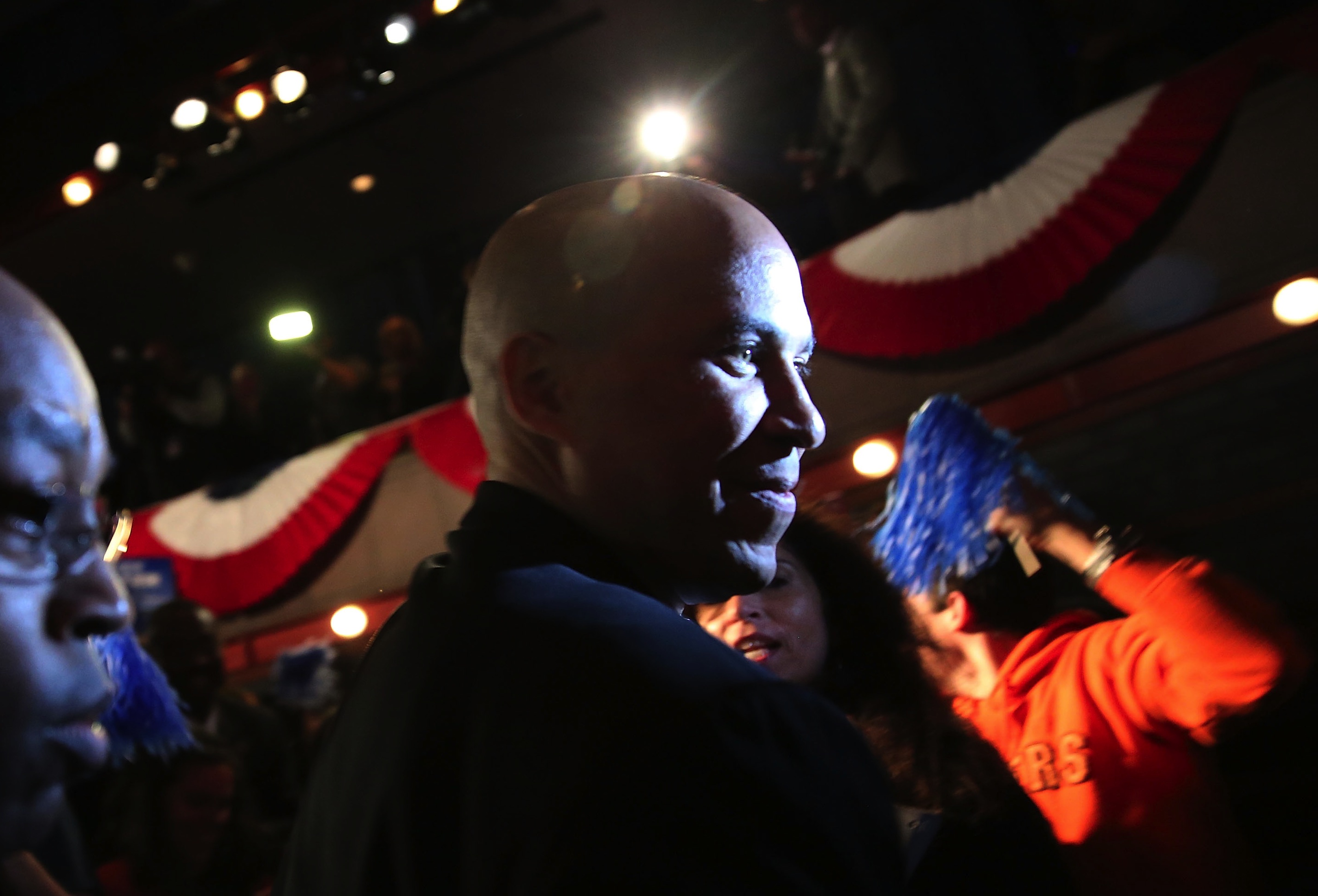
Newark Mayor And Senate Hopeful Cory Booker Attends Election Night Gathering

Newly elected U.S. Senator Cory Booker walks on stage to speak after winning a special election on October 16, 2013 in Newark, New Jersey. Booker, the current mayor of Newark, defeated Republican Steve Lonegan to replace Frank Lautenberg, who died in June. By Spencer Platt/Getty Images. Booker becomes the first African-American elected to the US Senate since Barack Obama and will join a very short list of black Senators in American history.

Dick Morris Award Nominee

“Oh, nobody believes [Obama’s vows to not negotiate on raising the debt ceiling]. Nobody believes that. He himself negotiated Bowles Simpson on the debt limit with Democrats. That was Kent Conrad’s requirement. He himself negotiated the Budget Control Act with the debt limit. Graham Rudman. Bush Andrews Airforce Base. Clinton Gore ‘97. All of those major budget agreements were debt limit agreements. I see this time as no different and I believe he does too. I think most people believe he’s just posturing for now,” – Paul Ryan, on September 28.

The Best Of The Dish Today

wile-e-coyote

We were, of course, consumed by the politics at the edge of the fiscal and economic precipice. My attempt at a zoom-out on the broader cultural and social forces behind this impasse – The Tea Party As A Religion – is here. A former friend of Ted Cruz told us of his past character and actions. I noted the consequences of epistemic closure on the far right, which is now basically synonymous with the right. The anti-incumbent mood reached historic highs, as Brit Hume rationalized the irrational and Ann Coulter betrayed a gob-smacking lack of self-awareness.

Meanwhile, talks with Iran got off to a positive start:

“I have been doing this now for two years and I have never had such intense, detailed, straight-forward, candid conversations with the Iran delegation before,” the American official said. “The discussions took place in English…the pace of discussions was much better. It creates the ability to have a back and forth.”

“There are [still] serious differences.” the U.S. official said, adding if there weren’t, “it would have been resolved” long ago. We “got more today than we have ever gotten before, but there’s still a whole lot more we have to get.”

The news on Obamacare, alas, remained unforgivably grim. The faith Americans have in their own government must be hitting all-time lows. Certainly the rest of the world sees us as a banana republic. And they’re thisclose to being right.

The most popular post of the day was The Tea Party As A Religion. The runner-up? What Moderate Republicans?, Ctd.

Sorry for being late with this post tonight. We had a Dish meeting that took three hours. And it’s been a marathon day of blogging. If you’ve appreciated it, and want to support the nine of us putting this out every day, please [tinypass_offer text=”subscribe”]. It takes two minutes and costs as little as $2 a month. And you are the only source of income we have.

See you in the morning. And, er, meep meep.

The Republican Radicals Won’t Be Driven Out

That’s the thesis of Frank Rich’s latest:

Some Democrats … cling to the hope that electoral Armageddon will purge the GOP of its radicals, a wish that is far less likely to be fulfilled now than it was after Goldwater’s landslide defeat, when liberalism was still enjoying the last sunny days of its postwar idyll. This was also the liberal hope after Gingrich’s political demise of 1998. But his revolution, whatever its embarrassments, hypocrisies, and failures, did nudge the country toward the right: It’s what pushed Clinton to announce in his 1996 State of the Union address that “the era of big government is over” and to adopt policy modulations that tamped down New Deal–Great Society liberalism. The right has only gained strength within the GOP ever since. Roughly half of the party’s current House population was first elected in 2010 or 2012, in the crucible of the tea-party revolt. While it’s Beltway conventional wisdom that these Republicans don’t know how to govern, the real issue is that they don’t want to govern. That’s their whole point, and they are sticking to it.

He dumps on the idea that “Chris Christie will parlay his popularity in the blue state of New Jersey into leading the national party back to sanity and perhaps even into the White House”:

To believe this you not only have to believe in miracles, but you also have to talk yourself into buying the prevailing bipartisan canard, endorsed by King and Obama alike, that the radicals are just a rump within the GOP (“one faction of one party in one house of Congress,” in the president’s reckoning). In reality, the one third of the Republican House caucus in rebel hands and the electorate it represents are no more likely to surrender at this point than the third of the states that seceded from the Union for much the same ideological reasons in 1860–61. Unless and until the other two thirds of the GOP summons the guts to actually fight and win the civil war that is raging in its own camp, the rest of us, and the health of our democracy, will continue to be held hostage.