Portland, Maine votes next month on a marijuana legalization ballot measure. Mike Riggs posits that “turning cities into building blocks for statewide changes is sometimes the best legalization advocates can hope for”:
Despite its seemingly limited impact, measures like Portland’s can still be vital to changing marijuana laws. For starters, they’re far cheaper to field than statewide ballot initiatives. “We got to 3,000 signatures through volunteers mostly,” Boyer says. To get an initiative on Maine’s state ballot, legalization advocates would need closer to 60,000 signatures, and that would cost money. Fighting for policy changes in just one city also means spending less on ad buys.
Cities are also part of the legalization movement’s long game. Before Colorado voted as a state to legalize pot, Denver, Breckenridge, and Nederland passed legalization initiatives in 2005, 2009, and 2010, respectively, giving the 2012 push that much more momentum. The flip side of such victories is that if you can’t get big, dense, liberal cities to support marijuana legalization, the state’s probably not ready.
Robert Laszewski explains what the insurers are experiencing:
The insurance industry is literally receiving a handful of new enrollments from the 36 Obama administration-run exchanges. It’s really 20 or 30 or 40 each day through last week. And a good share of those enrollments are problematic. One insurance company told me, “we got an enrollment from John Doe. Then five minutes later we got a message from CMS disenrolling him. Then we got another message re-enrolling him.” On and on, up to 10 times. So insurers aren’t really sure if the enrollments they’ve got are enrollments they should have.
The administration had planned on 500,000 sign-ups in October. But Garance digs into the dismal rate of enrollment:
[It] so far is low enough that if you extrapolate it out it, the health-insurance exchanges would see only 2.76 million people enrolled at the end of the six month open-enrollment period. That number falls well short of the 7 million the administration has announced as its first-year enrollment goal and reflects the lack of enrollment reported through the federally-run exchanges, which cover 34 states, as well as troubles at the state exchanges.
That’s right: Even as the disaster of Healthcare.gov has gotten a fair bit of attention, it turns out that a substantial fraction of the state-run exchanges also have been plagued by moderate to severe technical issues that have hampered enrollment. The verdict from trade publication MedCity News after the first day of state exchange enrollment was that six of the 16 state exchanges were failing. Two weeks after launch, several of the exchanges—including the ones serving Oregon, Vermont and Hawaii—remain hamstrung by technical problems, according to news coverage in the states.
Of course it didn’t have to be this way:
[I]n the small alternate universe of states where enrollment has not been thwarted by technical issues at the state or federal level, the data suggests what must be a welcome proof of concept for the exchanges. The demand is there and people are completing applications through the marketplaces at a solid clip where it’s possible for them to do so.
Straining to see a silver lining, Sarah Kliff finds some evidence of progress on the site.
Beinart is worried that the GOP is winning policy battles over government funding. Douthat pushes back:
[T]he Bush era is a perfect example of why liberals shouldn’t be freaked out by the Tea Party’s modest gains right now, because it shows how quickly and easily temporary limits on domestic spending can disappear, and why the creation of a new entitlement often looms larger than the outcome of short term budget battles. When was the last time you heard Ted Cruz calling for the repeal of Medicare Part D? I thought so.
That’s why, instead of angsting about how the Tea Party has cost them the chance to pass a cap and trade bill or to fund some kind of universal preschool, liberals should be focused like a laser beam on the Obamacare rollout. That’s the whole ballgame for liberalism right now: If the health care law works, thiswill be remembered as an era of progressive public policy, and the prospects for extending that era into another presidency — and getting immigration reform and climate legislation and the rest of their policy wish list — will get a lot, lot brighter. If, on the other hand, the train derails in some truly disastrous fashion, then nothing the House Intransigents have done or will do is likely to matter much in the long run: The hoped-for of liberalism will have been foreclosed, not by Tea Party extremism, but by a liberal administration’s own unforced errors.
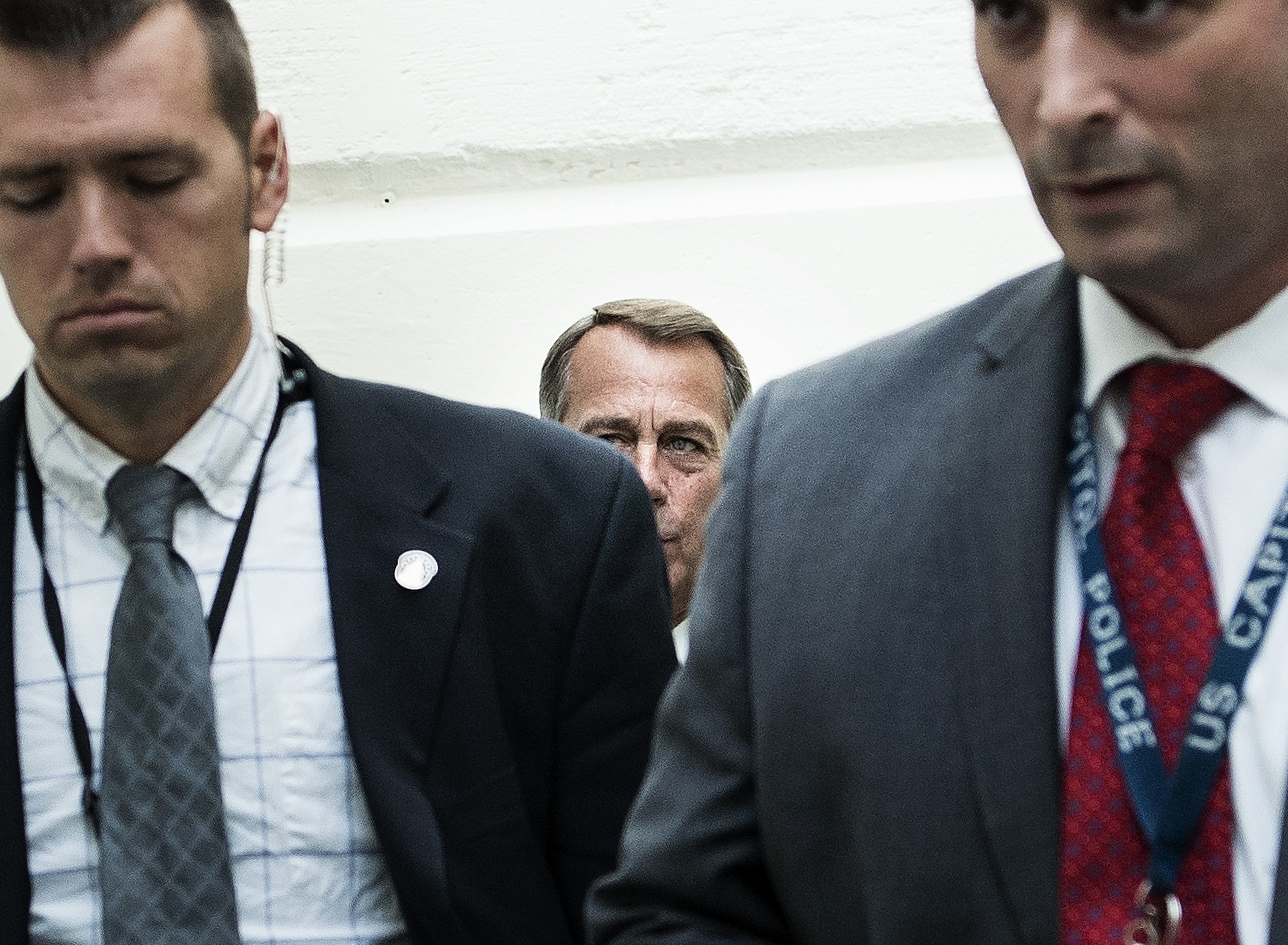
Speaker of the House John Boehner walks with Capitol Police to a meeting with House Republicans on Capitol Hill on October 16, 2013. House Republicans are meeting after Senate Democrat and Republican leadership agreed on a compromise to reopen the US federal government funding it to mid January address the debt limit till early February. By Brendan Smialowski/AFP/Getty Images.
Republican recklessness has hurt the party’s chances in the Senate:
New PPP polls of 6 key Senate races that will determine control of the body after next year’s election finds voters extremely unhappy about the government shutdown. As a result Republicans trail in 5 of the 6 key races and are tied in the 6th. Republicans need to win 6 seats to take control of the Senate.
As the crosstabs show, the shutdown is usually driving more independents away from Republican candidates than it is attracting. Republican control of the House likely isn’t in jeopardy next year, but these results reveal that the shutdown has done substantial damage to the GOP’s Senate hopes. The party has demonstrated that it can’t be trusted with more power, and it seems that voters in many parts of the country are not inclined to give them more.
Berating the director of the National Park Services, Jonathan Jarvis:
Nora Caplan-Bricker puts this piece of political theater in perspective:
Whether or not the parks service did a flawless job implementing the shutdown (after furloughing over 20,000 of its roughly 23,000 employees), only in a funhouse-mirror version of reality should members of Congress be debating the functions of an agency that accounts for .0006 percent of the federal budget on the day before we may default on our national debt.
Republican congressmen had a handy point of comparison for the closures on the National Mall: Occupy DC set up camp on the NPS-maintained McPherson Square for 100 days in 2011 without harassment from park police. “Do you consider it an exercise of your First Amendment right to walk to a monument that you helped build,” Rep. Trey Gowdy (R-S.C.) asked Jarvis, “or is it only just smoking pot at McPherson Square?”
Rep. John Mica (R-Fla.) seized on a quote, provided anonymously from a NPS ranger to aWashington Times columnist, that “we’ve been told to make life as difficult for the people as we can.” Over the last two weeks, conservatives have cited this as evidence the White House may have orchestrated the monument closures. Jarvis insisted that it was strictly an NPS decision. He denied any such order to make life difficult and said the quote—which after all appeared in a newspaper that regularly publishes Ted Nugent—was “hearsay.” “It may be hearsay,” Mica said, but he was sticking to it.
Almost a year removed from the Obama-Romney presidential election, 2013 has been a lost year for the Republican Party. Has it improved upon its image problem? Nope. Has it fixed its shortcomings with women and minority voters? Nope. Is it in a stronger place than it was in Oct. 2012? No way. Perhaps more than anything else, the GOP remains blinded by the health-care law — and by President Obama himself (who will never run for office again). Indeed, in some ways, you could see this entire shutdown/debt ceiling debate over the president’s health-care law as a replay of the House GOP’s impeachment of Bill Clinton in 1998 — a last-ditch fight against the term-limited incumbent. The good news for the Republican Party is that the Clinton impeachment is a reminder that its problems can be fixed. After all, the GOP won the White House just after Clinton’s impeachment.
Felix, on the other hand, compares the Tea Party to a pack of zombies:
Yes, the President has won an important battle against the zombies. But while it’s possible to win a zombie battle, it’s never possible to win a zombie war. No matter how many individual zombies you dispatch, there will always be ten more where they came from. The Tea Party doesn’t take legislative defeat as a signal that it’s doing something wrong: it takes it as a signal that nothing has really changed in Washington and that they therefore need to redouble their nihilistic efforts. Take it from me: come February, or March, or whenever we end up having to have this idiotic debt-ceiling fight all over again, the Tea Party will still be there, and will still be as crazy as ever. A bruised zombie, ultimately, is just a scarier zombie.
[W]ill Republicans continue to hold the debt ceiling hostage indefinitely (or, at least, until a Republican occupies the White House)? I doubt it. The debt-ceiling fight was not brought on by Ted Cruz and his baying hordes. It was actually the preferred strategy of mainstream Republicans, especially Paul Ryan. The Ryanites opposed shutting the government down because they wanted to extort Obama with default. The crazies who favored the shutdown were actually willing to lift the debt ceiling so they could keep the shutdown going.
Democrats managed to get the budget conference they’ve been pursuing for six months. They got a CR of the length they wanted and ending before the next sequestration cuts rather than six-month CR that Sen. Susan Collins proposed. They got a debt-ceiling increase all the way into February. This is far beyond what Democrats thought possible on Sept. 30.
But the strategy Ted Cruz managed to force on the GOP was so suicidal that Democrats felt comfortable forcing Republicans to cave completely. They were so confident that they managed to reject a deal proposed by Sen. Susan Collins and supported by many Senate Democrats because it funded the government for longer than the Democratic leadership preferred. That’s a level of control over the outcome that Democrats never expected to have.
Going forward, not only will Republicans be afraid to shut down the government or threaten the debt ceiling again during this Congress, but if Republicans somehow end up doing it anyway, Democrats will be unafraid of the fight.
Josh Marshall gives Obama credit for standing strong:
Many Republicans knew this was going to be a disaster going in. But just as many totally misread Obama. Just days before the shutdown numerous high profile Republicans insisted there was no way Obama wouldn’t negotiate. But probably the key driver of this drama has been President Obama’s refusal to negotiate over raising the debt ceiling. Yes, there’s been some back and forth here at the end, but as begging like this suggests, it’s mainly been to sort of out terms of surrender. But that refusal has defined the entire standoff.
I cannot believe I’m saying this, but I hope the House flips to the Democrats in 2014, so we can be rid of these nuts. Let Ted Cruz sit in the Senate stewing in his precious bodily fluids, and let Washington get back to the business of governing.
After watching the display of the last few weeks, it is hard to argue that Republicans should have control over any part of the government. It is even harder to believe that they should increase what control they have.
Millman isn’t particularly “pessimistic about the GOP’s chances in the next couple of elections as a consequence of their manifest insanity”:
The electorate is fickle, after all. For that very reason, though, I’m quite pessimistic about the quality of governance in this country going forward.
 The Dish